What just happened? The market for single-board computers continues to expand, creating new opportunities for both Arm- and x86-based products. MSI is launching a new single-board computer aimed at industrial and embedded applications, meaning these boards are unlikely to appear at traditional retailers anytime soon.
MSI is introducing a new SBC built for demanding computing scenarios. The MS-CF16 V3.0 uses the standard Pico-ITX form factor, offers multiple connectivity options, and can even run a standard edition of Windows, potentially turning the compact board into a PC-like system – though MSI is primarily targeting businesses with embedded systems for now.
The company is producing the new board under its MSI IPC division, which strictly handles industrial and embedded solutions. The design supports a fanless setup, keeping power consumption low while delivering solid performance via an embedded BGA x86 CPU from Intel.
MSI will offer the new Pico-ITX board in three CPU variants: Alder Lake N97, Amston Lake Atom X7433RE, and Twin Lake N150. These quad-core processors feature clock speeds from 3.4 GHz to 3.6 GHz and TDPs ranging from 6W (N150) to 12W (N97).
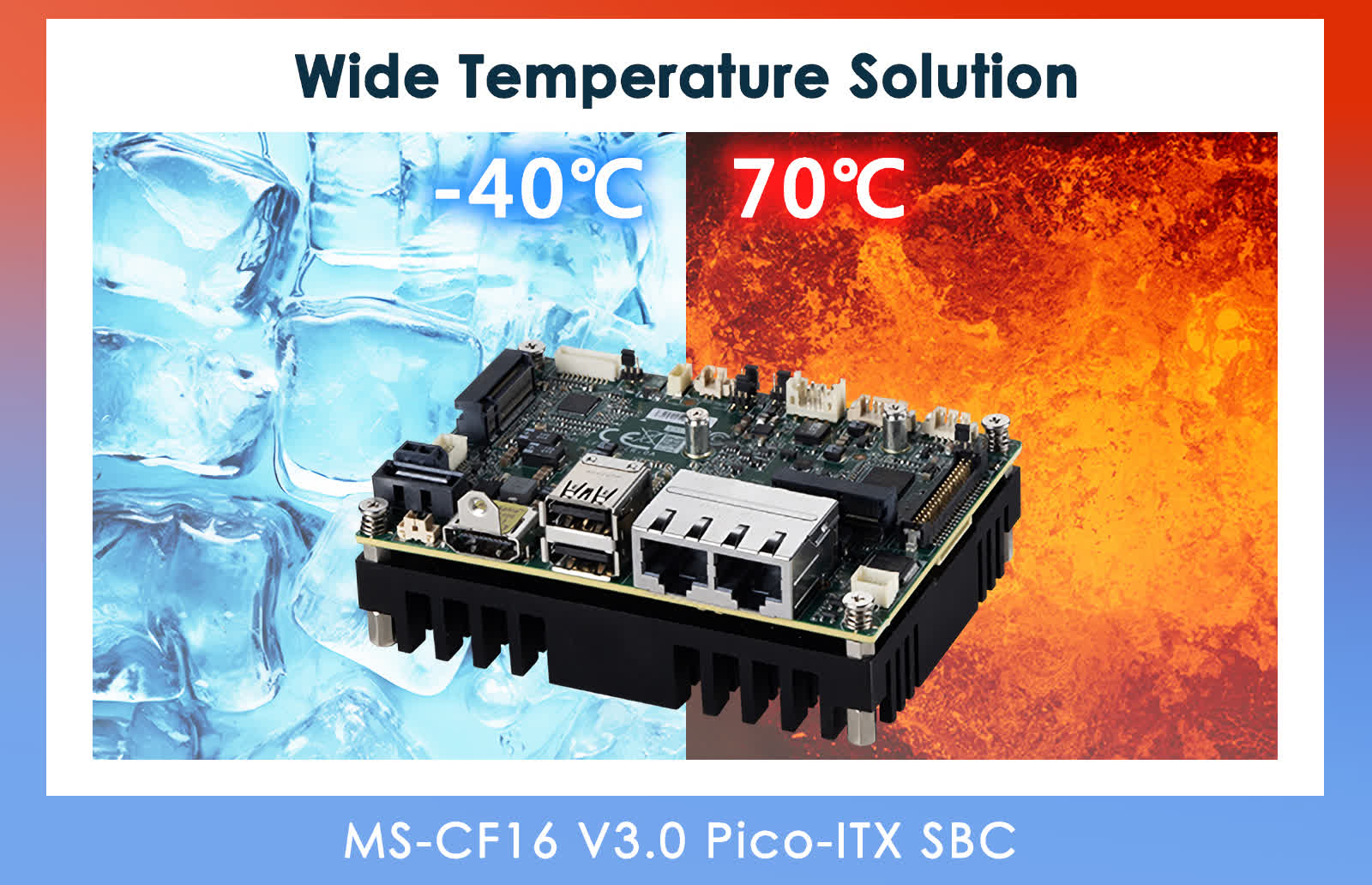
The MS-CF16 offers up to 16GB of LPDDR5 memory and supports both internal (LVDS, eDP) and external (HDMI) displays. Connectivity options include Gigabit LAN (RJ-45), multiple USB ports (2.0, 3.2), COM ports, GPIO, and more. The board also accommodates a Realtek ALC897 audio processor, SATA 3.0 storage, and two M.2 slots (B and E) for wireless networking or high-speed storage expansion.
MSI said the board works reliably in harsh environments, with an operating temperature range of -40°C to 70°C. Its direct 12V power connector ensures compatibility with standard industrial power sources, simplifying integration into custom projects.
The manufacturer is promoting the new SBC for specialized industrial applications. The MS-CF16 V3.0 offers ample computing power and connectivity for developers, industrial OEMs, and system integrators. Its compact form factor also suits other niche uses, including smart manufacturing, healthcare equipment, transportation infrastructure, and more.
The MS-CF16 V3.0 highlights MSI's focus on industrial and embedded solutions rather than consumer or hobbyist markets. The company did not have pricing or a release date in its announcement. For developers seeking a robust x86 SBC for personal projects or general-purpose applications, other options – such as LattePanda boards – remain more practical.
This tiny MSI x86 SBC board runs Windows, survives -40°C, and is aimed at factories


