Valve confirms FSR 4 for Steam Machine, AMD releases FSR 4.1 for RDNA 3 GPUs

DragonSlayer101

Posts: 984   +14
Staff
Looking ahead: Valve has confirmed that its Steam Machine will support AMD's FSR 4 upscaling technology. In an interview with Digital Foundry, SteamOS developer Pierre-Loup Griffais said there is no official release timeline yet, but hinted that it could roll out "on the same schedule (as the Windows release)."

Screenshots posted on X by YouTuber and XR analyst Brad Lynch appear to show that Valve is already testing support for FSR 4.1 upscaling in the Proton Experimental build for SteamOS. According to a SteamDB entry dated June 22, AMD has added FSR 4.1.1 INT8 DLL files to Steam, suggesting the company is working with Valve to bring its latest upscaling technology to SteamOS devices.

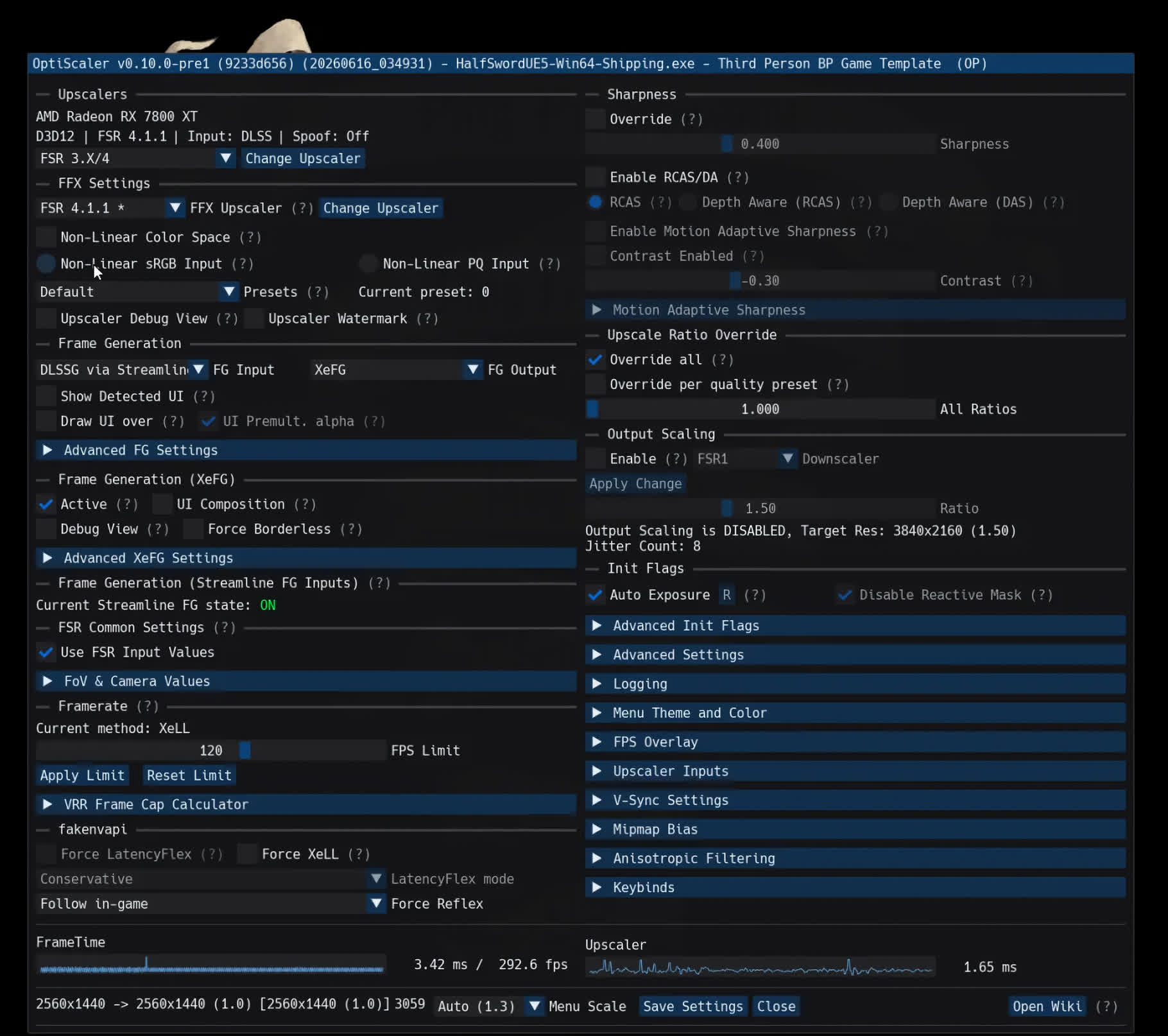
Valve has since deleted the manifest from the Proton Experimental depot, suggesting the update was pushed out earlier than intended. However, a Redditor who managed to download the DLL before it was removed claims this version of FSR works even on RDNA 3.5 hardware. They added that the DLL includes a new INT8 version of FSR 4.1.1 and can be used with OptiScaler to upgrade games from FSR 3.

Screenshots shared by Redditor AthleteDependent926 appear to show FSR 4.1 working on at least three Radeon GPUs across multiple RDNA generations. The new DLL reportedly delivers smooth gameplay on the RDNA 3-based Radeon RX 7800 XT and RDNA 3.5-based Radeon 890M, but on the RDNA 2-based 6900 XT, it still exhibits the same shimmering and ghosting issues seen in the older DLL.

Valve may have confirmed FSR 4 for Steam Machine, but AMD has not yet officially confirmed FSR 4.1 support for Proton. However, earlier today, the company released the Adrenalin 26.6.2 WHQL driver, adding support for FSR 4.1 on all RDNA 3-based GPUs, including the Radeon RX 7000 series. The move expands support for AMD's latest upscaling technology to more than 300 games.

According to AMD's Jack Huynh, the company is also developing "lightweight machine learning models" to bring FSR 4.1 to RDNA 3 APUs. The announcement will be welcome news for RDNA 3 APU users, who were previously unsure whether FSR 4.1 would work on integrated graphics solutions in budget systems.

AMD also plans to extend FSR 4.1 support to RDNA 2 GPUs next year, as it continues optimizing its AI models to run on older graphics hardware without dedicated AI accelerators. There is no exact rollout timeline yet, but RDNA 2 users are likely to appreciate AMD's decision to bring its latest upscaling technology to hardware that is several years old.

Permalink to story:

 
Will try it on my expensive AMD APUs and... Wait, it won't work... Because AMD chose not to, artificially setting its obsolescence
 
Last edited:
I bought a laptop from walmart 3 years ago for hundreds less that could trounce this thing. Good luck Valve, you're one of my less disliked corporate entities.
 
I bought a laptop from walmart 3 years ago for hundreds less that could trounce this thing. Good luck Valve, you're one of my less disliked corporate entities.
How much would that same laptop cost now? Last year I bought 64GB of 6000 RAM for a fifth, and 32GB 4800 for a third of the price it is now.

You must be one of the few remaining enthusiasts who cannot understanding the NAND apocalypse we're in.
 
How much would that same laptop cost now? Last year I bought 64GB of 6000 RAM for a fifth, and 32GB 4800 for a third of the price it is now.

You must be one of the few remaining enthusiasts who cannot understanding the NAND apocalypse we're in.
No that he doesn't understand, it's all about "I'm not stressed, I don't need to buy it and I'll wait until prices go down again"
 
Will try it on my expensive AMD APUs and... Wait, it won't work... Because AMD chose not to, artificially setting its obsolescence

Expensive...?

AMD never denied FSR 4 for RDNA 3.5 iGPUs, should work later but an extremely slow iGPU with no native FP8 and using slow system memory likely won't gain much anyway

The perf hit on 7000 series is kinda high, example: FSR 4 Quality running on 7900 XTX is almost as taxing as FSR Native, so why would you run FSR 4 Quality over FSR 3 Native if perf is the same? FSR Native likely looks better, as no upscaling is involved anyway.

The perf hit on 6000 is going to be bonkers and probably the reason why AMD delayed it to "sometime in 2027" - These people needs upscaling the most but won't get it untill their cards is either too slow, dead or they upgraded anyway. I could see AMD not holding this promise. Seems like waste of time. Support comes way too late.

Literally pointless to bring FSR 4 to Radeon 6000 series if you ask me, waste of time and money as 6000 series is obsolete in too many ways. Focus should be on RDNA 3, 4 and 5 next year (aka UDNA)

RTX 3000 aged like wine compared to Radeon 6000 series, with access to DLSS 4 on day one - Good upscaling with broad game support is the single most important metric for longevity. People ramble about VRAM all the time, look at Radeon 6800/6900 with 16GB today, literally so sluggish and GPU arch is dated and lacks features to a massive degree. Hooray for VRAM! LMAO! There is literally many games where 3070 8GB beats 6800 16GB today, even at native 1440p, now enable DLSS 4 and the axe is planted right in RDNA 2's face. Game over.

A good GPU, that don't buckle under forced RT elements with access to top tier upscaling = GOLD FOR LONGEVITY - Hence why RTX 3000 demolished Radeon 6000 when it comes to longevity while having alot less VRAM (You are not going to max out games anyway on these slow 6+ year old GPUs, hence why you don't need much VRAM - LOGIC 101)

Radeon 5000/6000 is trash bin worthy tech. AMD should look forward now.
 
Last edited:
Expensive...?

AMD never denied FSR 4 for RDNA 3.5 iGPUs, should work later but an extremely slow iGPU with no native FP8 and using slow system memory likely won't gain much anyway

The perf hit on 7000 series is kinda high, example: FSR 4 Quality running on 7900 XTX is almost as taxing as FSR Native, so why would you run FSR 4 Quality over FSR 3 Native if perf is the same? FSR Native likely looks better, as no upscaling is involved anyway.

The perf hit on 6000 is going to be bonkers and probably the reason why AMD delayed it to "sometime in 2027" - These people needs upscaling the most but won't get it untill their cards is either too slow, dead or they upgraded anyway. I could see AMD not holding this promise. Seems like waste of time. Support comes way too late.

Literally pointless to bring FSR 4 to Radeon 6000 series if you ask me, waste of time and money as 6000 series is obsolete in too many ways. Focus should be on RDNA 3, 4 and 5 next year (aka UDNA)

RTX 3000 aged like wine compared to Radeon 6000 series, with access to DLSS 4 on day one - Good upscaling with broad game support is the single most important metric for longevity. People ramble about VRAM all the time, look at Radeon 6800/6900 with 16GB today, literally so sluggish and GPU arch is dated and lacks features to a massive degree. Hooray for VRAM! LMAO! There is literally many games where 3070 8GB beats 6800 16GB today, even at native 1440p, now enable DLSS 4 and the axe is planted right in RDNA 2's face. Game over.

A good GPU, that don't buckle under forced RT elements with access to top tier upscaling = GOLD FOR LONGEVITY - Hence why RTX 3000 demolished Radeon 6000 when it comes to longevity while having alot less VRAM (You are not going to max out games anyway on these slow 6+ year old GPUs, hence why you don't need much VRAM - LOGIC 101)

Radeon 5000/6000 is trash bin worthy tech. AMD should look forward now.
It's true but notice Nvidia didn't make dlss 4.5 fp8 exclusive to Blackwell and allowed rtx hardware to run all models. Yes the newer Transformer models like m and l run more efficiently on newer hardware but I believe this is more of marketing the newer hardware for those on older hardware. When AMD brings fsr 4.1 or newer to older hardware, gamers will be on a cross road upgrade my hardware to run fsr 4.1 more efficiently or take the hit especially if they running the higher end 6800 to 6950XT gpus as well higher end 5000 series gpus. AMD gets street credit while making their newer Gen flagships more attractive to previous Gen owners. It's a win/ win situation imo.
 
It's true but notice Nvidia didn't make dlss 4.5 fp8 exclusive to Blackwell and allowed rtx hardware to run all models. Yes the newer Transformer models like m and l run more efficiently on newer hardware but I believe this is more of marketing the newer hardware for those on older hardware. When AMD brings fsr 4.1 or newer to older hardware, gamers will be on a cross road upgrade my hardware to run fsr 4.1 more efficiently or take the hit especially if they running the higher end 6800 to 6950XT gpus as well higher end 5000 series gpus. AMD gets street credit while making their newer Gen flagships more attractive to previous Gen owners. It's a win/ win situation imo.

DLSS 4 using preset K is still the best choice on the Nvidia side overall. RTX 2000/3000 has full support and very limited perf hit here. Preset M is mostly for 4K/UHD+ and optimized for performance preset, no 1080p/1440p gamers should be using preset M, unless they are clueless. RTX 4000/5000 is better at handling preset M.

However, 95% of PC gamers, uses 1440p or lower. Therefore they should be running preset K, which is optimized for DLSS Quality/Balanced mode. M is optimized for DLSS Performance mode. No-one should be using Performance mode at 1440p or lower, unless they seriously lack performance.

Transformer model is K too. Limited performance penalty on RTX 2000/3000 due to these have Tensor cores that do the calculations, not the GPU, like on the AMD side for Radeon 6000 (sometimes in 2027 you will see, FSR 4 on Radeon 6000 will likely make the GPUs buckle due to FP8 emulation work, using INT8 - Extremely taxing for the GPU).

Radeon 5000 and 6000 don't have any dedicated AI cores of any sort. They will be dirt slow with FSR 4. These GPUs only have regular GPU cores, with full rasterization focus.

7000 had matrix cores (WMMA instructions) and 9000 series had AI cores - These 2 generations has dedicated hardware to handle FSR 4 "well" - Nvidia had this since RTX 2000 series from 2018, almost 10 years ago. Tensor cores. That is why DLSS 4 works on any RTX card, since day one, while AMD is struggling and working hard to bring FSR 4 to older GPUs. However, AMD probably held FSR 4 exclusive to Radeon 9000 till now, to sell cards. With no FSR 4 exclusity, Radeon 9000 lineup would have looked miserable at the reveal.

Radeon 6000 owners don't need proper upscaling sometime in 2027, they needed it years ago. RDNA 2 GPUs are dirt slow at native today. Meanwhile RTX 2000/3000 owners are smooth sailing still, due to DLSS 4. DLSS has been worth using since 2020, when DLSS 2 released (DLSS 1 was pure garbage, just like FSR 1, 2 and 3). DLSS 2 came out almost 7 years ago now. FSR first became relevant with FSR 4, released in Q2 2025. Facts. 6 years too late really.

Good upscaling + RT capable (many games have forced RT elements and had for years), even with less overall VRAM, aged far better than: Bad upscaling (FSR 1 (completely useless) + FSR 2 and 3) and more VRAM.

Meaning RTX 3000 aged massively better than Radeon 6000 series, both are 6+ years old now. Upscaling secured good longevity on the Nvidia side. DLSS 2 was great on launch and only improved since then, DLSS 4 is pretty much upscaling-perfection with massive game support + mods)

16GB on Radeon 6800/6900 sounded nice, sadly the GPU arch itself was miserable and could not handle RT elements or deliver good upscaling. Aged like milk due to this. Game development changed approach. The arch was not ready for the future. AMD only focussed on raster perf with Radeon 5000/6000, therefore aged badly. Regardless of having "plenty of VRAM"

VRAM alone never saved a weak GPU. VRAM is not as important as people think, and memory compression improves gen to gen anyway. You just need "enough" and then you will be fine.

A good GPU these days, ticks all these boxes:

- Good rasterization perf.
- Enough VRAM with good memory compression and cache system.
- Good upscaling and frame gen, with actual support in games.
- Can handle RT without buckling, due to many newer games having forced RT elements.

VRAM is important, but not that important, you can always lower settings to get around this. A fast GPU with a solid feature set, and it will age like wine.

And don't forget about memory compression and bandwidth improvements. An 8GB GPU from 10 years ago, is not the same as an 8GB GPU today. Memory compression improved bigtime. Nvidias cache hit/cache miss system works very good. Hence why Nvidia overall needs less VRAM than AMD. In tons of games, AMD GPUs uses more VRAM for the exact same settings - This is due to Nvidia having better memory compression and cache system.

Nvidia increased cache bigtime on RTX 4000/5000 series due to this. 10 times more cache or so, overall SKU vs SKU.

People generelly needs to wake up from their slumber - This is 2026 not 2016 - SO many people here still think RASTER PERF and VRAM AMOUNT is the only important metric. ITS NOT. Your GPU will age like MILK without good features like upscaling and frame gen + decent RT perf for the games that force RT elements (pretty much every Unreal Engine 5 game but many more engines has RT elements these days, had for years)

People needs to wake up and accept that game developers changed approach. AMD knows this, and the prime focus with RDNA 4 was improved upscaling and RT performance. AMDs own words. Search and you shall find, they officially said this. And delivered on this promise.
 
Last edited:
No that he doesn't understand, it's all about "I'm not stressed, I don't need to buy it and I'll wait until prices go down again"
I'm in the same situation, however I still don't like the current prices and hope that all of these AAAAAAAAAAAAIIIIIIIIIIIIIIIIIIII scammers die a fiery death and drag all of these corrupt NAND manufacturers down with them.
 
Expensive...?

AMD never denied FSR 4 for RDNA 3.5 iGPUs, should work later but an extremely slow iGPU with no native FP8 and using slow system memory likely won't gain much anyway

The perf hit on 7000 series is kinda high, example: FSR 4 Quality running on 7900 XTX is almost as taxing as FSR Native, so why would you run FSR 4 Quality over FSR 3 Native if perf is the same? FSR Native likely looks better, as no upscaling is involved anyway.

The perf hit on 6000 is going to be bonkers and probably the reason why AMD delayed it to "sometime in 2027" - These people needs upscaling the most but won't get it untill their cards is either too slow, dead or they upgraded anyway. I could see AMD not holding this promise. Seems like waste of time. Support comes way too late.

Literally pointless to bring FSR 4 to Radeon 6000 series if you ask me, waste of time and money as 6000 series is obsolete in too many ways. Focus should be on RDNA 3, 4 and 5 next year (aka UDNA)

RTX 3000 aged like wine compared to Radeon 6000 series, with access to DLSS 4 on day one - Good upscaling with broad game support is the single most important metric for longevity. People ramble about VRAM all the time, look at Radeon 6800/6900 with 16GB today, literally so sluggish and GPU arch is dated and lacks features to a massive degree. Hooray for VRAM! LMAO! There is literally many games where 3070 8GB beats 6800 16GB today, even at native 1440p, now enable DLSS 4 and the axe is planted right in RDNA 2's face. Game over.

A good GPU, that don't buckle under forced RT elements with access to top tier upscaling = GOLD FOR LONGEVITY - Hence why RTX 3000 demolished Radeon 6000 when it comes to longevity while having alot less VRAM (You are not going to max out games anyway on these slow 6+ year old GPUs, hence why you don't need much VRAM - LOGIC 101)

Radeon 5000/6000 is trash bin worthy tech. AMD should look forward now.


You are so deluded in your own mindtricks that you fool yourself LMAO.

Let me tell you something that is called FSR 4.0.2c (made by the awesome folks at optiscaler FSR discord)the performance hit on RDNA2 is 8 - 15 % depending on the preset so FSR4.x already looks 10 times better than FSR 3.1.x available to RDNA2/3 !

https://cdn.discordapp.com/attachme...284fe958a3e1653537a802f1190fd7dd5f2eca25cee05


Also, since FSR 4.1 that comes in JANUARY next year should be even better since FSR 4.x right now is based on an older INT8 model (which AMD will definitely refine over the next months).
 
You are so deluded in your own mindtricks that you fool yourself LMAO.

Let me tell you something that is called FSR 4.0.2c (made by the awesome folks at optiscaler FSR discord)the performance hit on RDNA2 is 8 - 15 % depending on the preset so FSR4.x already looks 10 times better than FSR 3.1.x available to RDNA2/3 !

https://cdn.discordapp.com/attachme...284fe958a3e1653537a802f1190fd7dd5f2eca25cee05


Also, since FSR 4.1 that comes in JANUARY next year should be even better since FSR 4.x right now is based on an older INT8 model (which AMD will definitely refine over the next months).

Mindtricks? Try experience. Tried it all first hand.

Your proof is pointless really, both looks blurry, does not show the fps counter and RDNA 3 is used. Meh.

I am talking about RDNA 2, which don't have any dedicated hardware or FP8 support.

AMD never stated january 2027, they said early 2027 for RDNA 2 FSR 4 support and the GPU perf hit will be vastly higher than RDNA 3 due to RDNA 3 actually having WMMA instructions that can handle the FP8 emulation. AMD will probably delay FSR 4 support for RDNA 2, because it is mostly waste of time. They should focus on RDNA 5 now, launching in 2027.

RDNA 2 is old garbage really. Some watered down FSR 4 support is not going to save this dated arch. RDNA 1 and 2 was made with 100% focus on rasterization perf. Simple GPU cores, no AI or WMMA instructions present.

RDNA 3 and 4 are much better suited for FSR 4 due to AI cores and WMMA instructions.
RDNA 4 is clearly better than 3 tho. Arch was made for FSR 4+ (meaning hopefully FSR 5 will be supported) - Lets see if AMD releases FSR 5 with RDNA 5 next year, and if any older RDNA cards will get it.

DLSS 4 / Transformer model worked day 1 on RTX 2000 series from 2018, released 10 years ago. Today there is 1000+ DLSS games and DLSS 4 works in pretty much all of them. Plus DLSS mods, meaning pretty much all games can use DLSS/DLAA today.

For older games and games with no DLSS suppport, RTX users can use DLDSR to vastly improve visuals, with low perf hit. It is generally much better than AMD VSR. Less issues in games too.

Just like RTX users can enable RTX HDR to make SDR games look insanely good on a HDR capable monitor.

Features matter. This is why people choose to pay more for Nvidia GPUs. Lower power usage overall as well and with higher resell value, means you don't really pay more in the end.

You can ramble all you want, dGPU marketshare speaks the truth, Nvidia sits at like 85%
 
Last edited:
DLSS 4 using preset K is still the best choice on the Nvidia side overall. RTX 2000/3000 has full support and very limited perf hit here. Preset M is mostly for 4K/UHD+ and optimized for performance preset, no 1080p/1440p gamers should be using preset M, unless they are clueless. RTX 4000/5000 is better at handling preset M.

However, 95% of PC gamers, uses 1440p or lower. Therefore they should be running preset K, which is optimized for DLSS Quality/Balanced mode. M is optimized for DLSS Performance mode. No-one should be using Performance mode at 1440p or lower, unless they seriously lack performance.

Transformer model is K too. Limited performance penalty on RTX 2000/3000 due to these have Tensor cores that do the calculations, not the GPU, like on the AMD side for Radeon 6000 (sometimes in 2027 you will see, FSR 4 on Radeon 6000 will likely make the GPUs buckle due to FP8 emulation work, using INT8 - Extremely taxing for the GPU).

Radeon 5000 and 6000 don't have any dedicated AI cores of any sort. They will be dirt slow with FSR 4. These GPUs only have regular GPU cores, with full rasterization focus.

7000 had matrix cores (WMMA instructions) and 9000 series had AI cores - These 2 generations has dedicated hardware to handle FSR 4 "well" - Nvidia had this since RTX 2000 series from 2018, almost 10 years ago. Tensor cores. That is why DLSS 4 works on any RTX card, since day one, while AMD is struggling and working hard to bring FSR 4 to older GPUs. However, AMD probably held FSR 4 exclusive to Radeon 9000 till now, to sell cards. With no FSR 4 exclusity, Radeon 9000 lineup would have looked miserable at the reveal.

Radeon 6000 owners don't need proper upscaling sometime in 2027, they needed it years ago. RDNA 2 GPUs are dirt slow at native today. Meanwhile RTX 2000/3000 owners are smooth sailing still, due to DLSS 4. DLSS has been worth using since 2020, when DLSS 2 released (DLSS 1 was pure garbage, just like FSR 1, 2 and 3). DLSS 2 came out almost 7 years ago now. FSR first became relevant with FSR 4, released in Q2 2025. Facts. 6 years too late really.

Good upscaling + RT capable (many games have forced RT elements and had for years), even with less overall VRAM, aged far better than: Bad upscaling (FSR 1 (completely useless) + FSR 2 and 3) and more VRAM.

Meaning RTX 3000 aged massively better than Radeon 6000 series, both are 6+ years old now. Upscaling secured good longevity on the Nvidia side. DLSS 2 was great on launch and only improved since then, DLSS 4 is pretty much upscaling-perfection with massive game support + mods)

16GB on Radeon 6800/6900 sounded nice, sadly the GPU arch itself was miserable and could not handle RT elements or deliver good upscaling. Aged like milk due to this. Game development changed approach. The arch was not ready for the future. AMD only focussed on raster perf with Radeon 5000/6000, therefore aged badly. Regardless of having "plenty of VRAM"

VRAM alone never saved a weak GPU. VRAM is not as important as people think, and memory compression improves gen to gen anyway. You just need "enough" and then you will be fine.

A good GPU these days, ticks all these boxes:

- Good rasterization perf.
- Enough VRAM with good memory compression and cache system.
- Good upscaling and frame gen, with actual support in games.
- Can handle RT without buckling, due to many newer games having forced RT elements.

VRAM is important, but not that important, you can always lower settings to get around this. A fast GPU with a solid feature set, and it will age like wine.

And don't forget about memory compression and bandwidth improvements. An 8GB GPU from 10 years ago, is not the same as an 8GB GPU today. Memory compression improved bigtime. Nvidias cache hit/cache miss system works very good. Hence why Nvidia overall needs less VRAM than AMD. In tons of games, AMD GPUs uses more VRAM for the exact same settings - This is due to Nvidia having better memory compression and cache system.

Nvidia increased cache bigtime on RTX 4000/5000 series due to this. 10 times more cache or so, overall SKU vs SKU.

People generelly needs to wake up from their slumber - This is 2026 not 2016 - SO many people here still think RASTER PERF and VRAM AMOUNT is the only important metric. ITS NOT. Your GPU will age like MILK without good features like upscaling and frame gen + decent RT perf for the games that force RT elements (pretty much every Unreal Engine 5 game but many more engines has RT elements these days, had for years)

People needs to wake up and accept that game developers changed approach. AMD knows this, and the prime focus with RDNA 4 was improved upscaling and RT performance. AMDs own words. Search and you shall find, they officially said this. And delivered on this promise.
All true but why just trust the pros, paid influencers when you can swap out the dll and see the difference yourself. I personally like model m. Also at this rate fsr will eventually improve their upscaler beyond 4.1. Let the end user decide if they want to upgrade to latest hardware or use fsr 4.1 on older hardware. It marketing opportunity which some might say is much needed for AMD. Nothing like enjoying that fine wine to the last drop and mitigating e-waste.
 
All true but why just trust the pros, paid influencers when you can swap out the dll and see the difference yourself. I personally like model m. Also at this rate fsr will eventually improve their upscaler beyond 4.1. Let the end user decide if they want to upgrade to latest hardware or use fsr 4.1 on older hardware. It marketing opportunity which some might say is much needed for AMD. Nothing like enjoying that fine wine to the last drop and mitigating e-waste.

I tried preset M, looked bad at 1440p. Clearly worse than K. Both is Transformer model. M is just optimized for lower quality preset (meant for high res)

Nvidia officially says M is for 4K+ (5K, 6K included)
DLSS Ultra Performance is for 8K.

I sometimes use M when I output to my 4K OLED TV. Most often, I use my 3440x1440, 360 Hz QD-OLED Ultrawide and K is clearly superior. Just looks better.

M is optimized for Performance preset. You don't use DLSS Performance unless you run 4K+ or you don't mind blurry visuals. At 1440p, which 95% of PC gamers run, you stay at K with DLSS Ultra Quality, Quality or Balanced. Preset K is also less taxing on RTX 2000 and 3000 SKUs.

I have massive experience with this. Have been tinkering with DLSS for years, dlls, worked with DLSS Swapper team on/off on GH, DLSS HUD testing, 3rd party and game optimization testing, also have fairly good experience with AMDs FSR 2-4, been using 7900 XT for Linux FSR 4 testing months ago. Tried 9070 XT and seen FSR 4 vs DLSS 4 side by side in my own office. DLSS 4 is clearly much better still. Which TechSpot and Techpowerup also agree with.

FSR 4 was a huge step forward, from the garbage FSR 2/3 is. AMD is on the right track. The lack of FSR 4 support on RDNA 1, 2 and 3 was/is the biggest problem still.

I don't even mention FSR 1 because it is absolute garbage. Just like DLSS 1 is utterly useless and blurry. DLSS became good, when version 2 launched, almost 7 years ago.

By the time DLAA was released, I was sold and today I solely use DLSS Quality (or Ultra Quality) if not DLAA gives me the framerates I want (200 fps minimum)

Most people that hate upscaling, never tried actually good upscaling. They base their opinion on FSR 1-2-3 testing. Every single version is bad upscaling. FSR 4 is AMDs first good upscaler. Worse than DLSS 4 but still a decent alternative, for the few AMD GPU owners, that actually can use it.

DLSS pretty much always look better than "native" these days. Built in top-tier AA with sharpening applied means cleaner and crisper visuals. DLAA is possible, if you want best in class visuals (FSR Native is decent too, but DLAA seems sharper for me, tried them both 100s of times and since I use RTX 4090, I can switch back and forth with ease, pixel peeping and watch the fluidity. DLSS/DLAA is smoother, crisper, clear winner.

And when it comes to game support, DLSS/DLAA is a home run. Nvidia have years and years of advantage here tho. So it makes sense that AMD is way behind. Nvidia have the time and the money to be in the lead.

I cringe when I see people praise "native" gaming, while slamming TAA on top. TAA is horrible. With DLSS/FSR4 you don't have to use garbage AA like TAA. Top notch AA is included right in the upscaler, with sharpening applied too. This is why DLSS can easily look better than regular "native" in so many scenarios, while giving higher framerates on top. It is literally a nobrainer for people with access to DLSS 4 and FSR 4.

AMD have tons of work to do still, before they catch up. In both visuals and gamesupport. It will slowly improve and 3rd party apps allow for tinkering too (not for casuals tho). You can force FSR 4 in many DLSS games, if you tinker.

On the Nvidia side, it is just alot more easy, as DLSS is most often supported by default.

I have forced DLSS/DLAA in FSR games too. Both is possible.
Does not change the fact, that DLSS is far more supported overall. There is vastly more 3rd party tools for RTX/DLSS too.

DLSS Swapper, DLSSTweaks, Nvidia Profile Inspecter, Gold.
You can use the Nvidia App in most cases tho.
 
Last edited:
Jesus, what is happening in this thread lol.

FSR3 is pretty much only useful in quality mode, anything lower looks bad.

FSR4 is the opposite, quality mode isn't very useful but you can go all the way to performance or even ultra performance mode and it still looks good.

It's just that simple.
 
Jesus, what is happening in this thread lol.

FSR3 is pretty much only useful in quality mode, anything lower looks bad.

FSR4 is the opposite, quality mode isn't very useful but you can go all the way to performance or even ultra performance mode and it still looks good.

It's just that simple.

You clearly have little experience with this. Did it become too technical?

FSR 2/3 never looks >>good<<
It is mostly useless at 1440p and lower due to bad visuals.

People mostly use FSR 2/3 at 4K/UHD because their GPUs are too weak to run 4K, and thats about it. Pretty much useless for 1440p and lower, which 95% of PC gamers use.

FSR 2/3 have tons of smearing, jitter and shimmering. If you care for visual quality, you generally hate FSR 2-3, just like FSR 1 and DLSS 1 is blurry garbage.


FSR 4 works great at 1440p and even 1080p. Just like DLSS 2 have for 6½ years.
DLSS 4 is the clear king of upscalers today. In both quality and game support.

FSR 2/3, garbage upscaling. Sometimes worse than Intel XeSS that is not good either. If you think FSR 3 look good, you have never seen/tried good upscaling.

This is nothing new:


The funny thing is, some people gladly use FSR 2/3 even tho its pretty bad. Because what is the alternative? Bad performance.

Just like people use Loseless Scaling and is very happy with the result. This is bottom tier Frame Generation, and some people like it.

DLSS = Best Upscaler
DLSS FG = Best Frame Gen Tech

Now you know, why most RTX users enable features like this.

Tons of AMD and Intel GPU users, uses much worse upscaling, might even slam Loseless Scaling on top of that, while happily gaming.
 
Last edited:
You clearly have little experience with this. Did it become too technical?

FSR 2/3 never looks >>good<<
It is mostly useless at 1440p and lower due to bad visuals.

People mostly use FSR 2/3 at 4K/UHD because their GPUs are too weak to run 4K, and thats about it. Pretty much useless for 1440p and lower, which 95% of PC gamers use.

FSR 2/3 have tons of smearing, jitter and shimmering. If you care for visual quality, you generally hate FSR 2-3, just like FSR 1 and DLSS 1 is blurry garbage.


FSR 4 works great at 1440p and even 1080p. Just like DLSS 2 have for 6½ years.
DLSS 4 is the clear king of upscalers today. In both quality and game support.

FSR 2/3, garbage upscaling. Sometimes worse than Intel XeSS that is not good either. If you think FSR 3 look good, you have never seen/tried good upscaling.

This is nothing new:


The funny thing is, some people gladly use FSR 2/3 even tho its pretty bad. Because what is the alternative? Bad performance.

Just like people use Loseless Scaling and is very happy with the result. This is bottom tier Frame Generation, and some people like it.

DLSS = Best Upscaler
DLSS FG = Best Frame Gen Tech

Now you know, why most RTX users enable features like this.

Tons of AMD and Intel GPU users, uses much worse upscaling, might even slam Loseless Scaling on top of that, while happily gaming.
I have literally used FSR3 and FSR4 a lot, on a 4K screen. That's the only experience that matters.

The longer your reply, the more it's clear you don't get it.
 
Last edited:
How much would that same laptop cost now? Last year I bought 64GB of 6000 RAM for a fifth, and 32GB 4800 for a third of the price it is now.

You must be one of the few remaining enthusiasts who cannot understanding the NAND apocalypse we're in.

On the contrary, I bought it because laptops were a good value at the time and with GPUs ballooning, RAM and storage were sure to follow. Anyone actively involved in local inferrence saw this coming a year or more in advance. Right now you should be buying displays and networking gear, but don't take my word for it.
 
On the contrary, I bought it because laptops were a good value at the time and with GPUs ballooning, RAM and storage were sure to follow. Anyone actively involved in local inferrence saw this coming a year or more in advance. Right now you should be buying displays and networking gear, but don't take my word for it.
I already have several WiFi routers as gateways and an OpenWRT router (N3150, 8GB RAM, 128 SSD). I can't imagine what networking gear I should buy as I've recently bought two 2.5Gb switches to make use of the chip on my gaming PC, media server and Mini PC.
 
I look forward to giving this a go - only used FSR previously when using my 1080Ti before I upgraded to a Radeon 7800XT. At 1440p 75Hz I don't need anything more powerful - but FSR 4 should let me turn on the high ray tracing settings on the few games that I own that have it (about 2 out of my 2,500 games have worthwhile ray tracing according to Hardware unboxed).
 
I have literally used FSR3 and FSR4 a lot, on a 4K screen. That's the only experience that matters.

The longer your reply, the more it's clear you don't get it.
Stay out of this discussion, you don't know what you are talking about

FSR 3.x and older looks like crap compared to FSR 4 and even DLSS 2+

DLSS 4 is the best upscaler today, and everyone with actual experience knows this
FSR 4 is decent too but FSR 3.1 and older, pure garbage with shimmering and jittering all over, even XeSS is better in most scenarios.
 
I look forward to giving this a go - only used FSR previously when using my 1080Ti before I upgraded to a Radeon 7800XT. At 1440p 75Hz I don't need anything more powerful - but FSR 4 should let me turn on the high ray tracing settings on the few games that I own that have it (about 2 out of my 2,500 games have worthwhile ray tracing according to Hardware unboxed).
Don't bother with Ray Tracing unless you own RDNA 4 or Nvidia RTX

Radeon 5000/6000 and 7000 can't do RT well, massive performance hit and even stuttering at times if slammed too hard, GPU buckles

Hence why improved RT perf and upscaling was a crucial part of RDNA 4 design, AMD officially said this, watch the launch event if in doubt

7900 XTX is beat relatively easy by 9070 XT in RT games/benches and the 9070 XT is a much weaker SKU overall (chip size, bus, VRAM)

Going down to Radeon 7700/7800 series, RT won't make any sense
Also, once you have seen Path Tracing, you won't care about RT anymore

RT is nothing special really. Path Tracing can look insane but is much more demanding and Nvidia has the crown here too

People that care about RT and especially Path Tracing, should simply not buy an AMD GPU
 
Don't bother with Ray Tracing unless you own RDNA 4 or Nvidia RTX

Radeon 5000/6000 and 7000 can't do RT well, massive performance hit and even stuttering at times if slammed too hard, GPU buckles

Hence why improved RT perf and upscaling was a crucial part of RDNA 4 design, AMD officially said this, watch the launch event if in doubt

7900 XTX is beat relatively easy by 9070 XT in RT games/benches and the 9070 XT is a much weaker SKU overall (chip size, bus, VRAM)

Going down to Radeon 7700/7800 series, RT won't make any sense
Also, once you have seen Path Tracing, you won't care about RT anymore

RT is nothing special really. Path Tracing can look insane but is much more demanding and Nvidia has the crown here too

People that care about RT and especially Path Tracing, should simply not buy an AMD GPU
Tried RT last night on cyberpunk, 1440p FSR 4.0 quality on my 7800XT and was getting around 60 FPS with everything on except path tracing. No stuttering at all. Could lower a few settings to get my target 75 fps.
 
Back