"We've achieved AGI," says Nvidia CEO, but his own examples suggest otherwise

Skye Jacobs

Posts: 2,001   +58
Staff
Big quote: Nvidia CEO Jensen Huang declared this week that AGI – short for "artificial general intelligence" – has already arrived, before quickly softening the claim. In one podcast appearance, Huang said flatly, "I think we've achieved AGI," before conceding that today's AI systems may not yet match human capability.
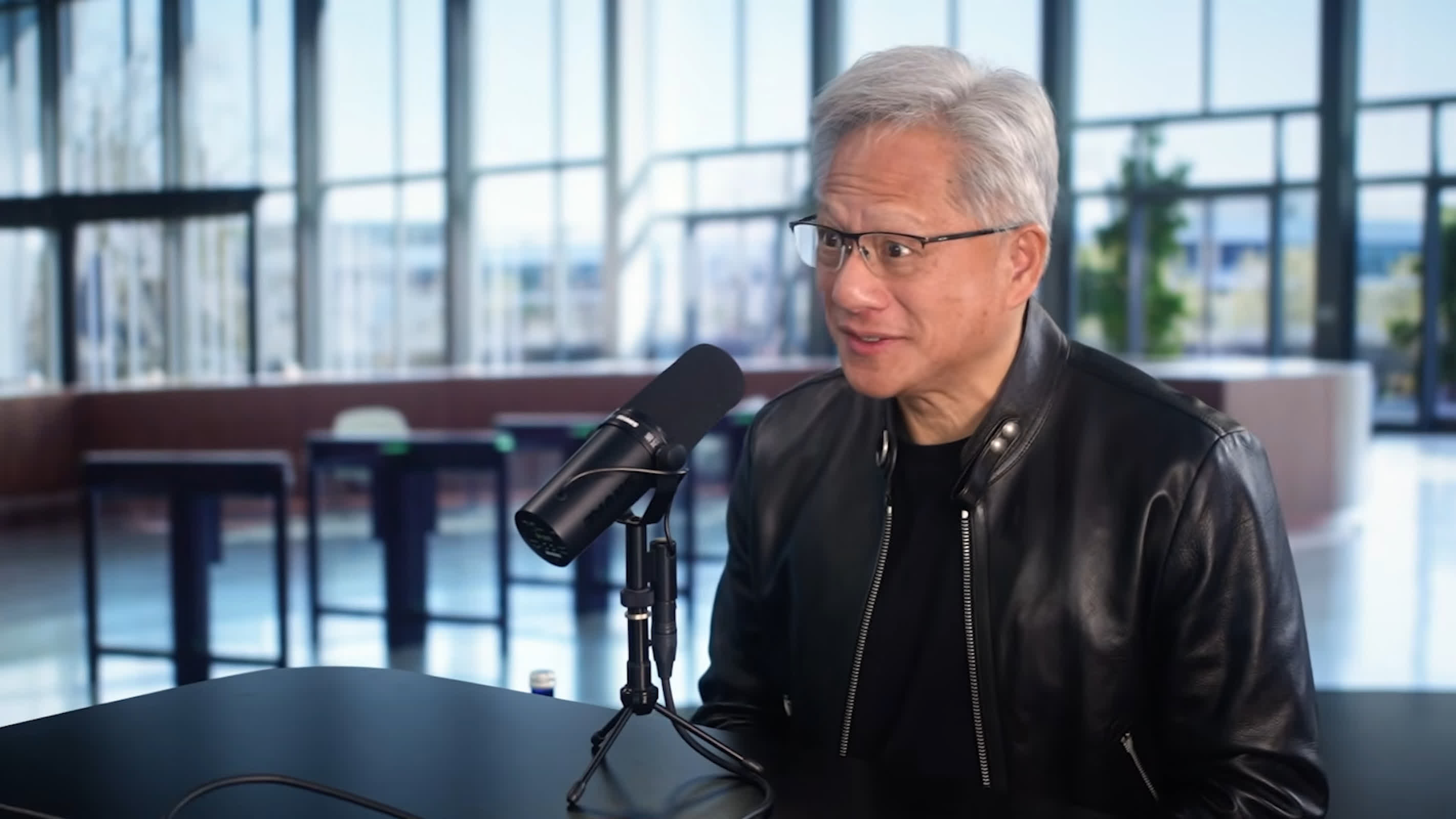
In a separate conversation, he struck a different note, chastising engineers who underuse AI tools and warning he would be "deeply alarmed" if they were not spending enough on the very systems he had just suggested were already intelligent. The tension between those remarks – one heralding the dawn of human-level AI, the other implying it still requires significant human guidance – captures the ambiguity surrounding how close the industry truly is to achieving AGI.

The two appearances came days apart. On March 19, Huang sat down with the All-In Podcast at Nvidia's GPU Technology Conference in San Jose. Three days later, on March 22, his interview with Lex Fridman was released.

In the Fridman interview, Huang said bluntly, "I think we've achieved AGI," referring to the class of systems expected to match or surpass human intelligence. The statement instantly intensified an already polarized debate about what exactly qualifies as "general" intelligence – and whether anyone, including Nvidia, can credibly say it has been reached.

The exchange was prompted by Fridman's own definition of AGI as a system capable of essentially doing your job, including starting, growing, and running a successful technology company worth more than $1 billion.

Asked for a timeline – within five, ten, or even twenty years – Huang didn't hesitate. "I think it's now," he said. His caveat, though, was telling: "You said a billion," he added, "and you didn't say forever" – framing AGI not as a durable human-level mind, but as a momentary commercial threshold. Fridman noted that Huang's definition could "get a lot of people excited," and indeed it did. Tech leaders and researchers have long disagreed over whether current AI systems truly demonstrate general intelligence or just mimic fragments of it.

The term itself has become loaded, shaping billion-dollar contracts and strategic direction at companies such as OpenAI and Microsoft, where performance benchmarks and risk clauses hinge on whether AGI has been "achieved."

Huang cited the rapid evolution of open-source AI agent platforms such as OpenClaw, which is in the process of being acquired by OpenAI, where developers use digital agents to launch social applications and creative experiments.

He described a wave of entrepreneurial creativity: AI that can design influencers, automate digital communities, and perhaps "become an instant success." But he quickly tempered those remarks, acknowledging the limits of the technology. "A lot of people use it for a couple of months and it kind of dies away," he said. "The odds of 100,000 of those agents building Nvidia is zero percent."

"If that $500,000 engineer did not consume at least $250,000 worth of tokens, I am going to be deeply alarmed," Jensen recently said.

That mix of ambition and restraint was also clear in Huang's earlier appearance on the All-In Podcast, where the conversation turned from AGI's potential to how humans are – or aren't – leveraging it. There, he drew a sharp line between talent and tool use. "If that $500,000 engineer did not consume at least $250,000 worth of tokens, I am going to be deeply alarmed," he said. Tokens – units AI models use to process and generate language – represent both the cost and capacity of AI work. For Huang, under-spending on tokens signals under-utilization of AI itself.

"This is no different than one of our chip designers saying, 'Guess what? I'm just going to use paper and pencil'" – forgoing CAD tools entirely, he said. Nvidia is reportedly trying to allocate $2 billion for token access across its engineering team, with Huang suggesting that tokens could even become a formal part of compensation packages.

"They're going to make several hundred thousand dollars a year, their base pay," he said. "I'm going to give them probably half of that on top of it as tokens so that they could be amplified 10X."

Permalink to story:

 
It is cause for regret that the classic, stricter term strong AI is being forgotten. Matching or surpassing human ability is no great achievement. Consciousness and sentience are the grail; until mechanically understood in ourselves and other life, replicating it in a system will be hard, and blindly throwing scale at the problem certainly won't work. Simple life forms display sentience, suggesting it is not scale but a distinctive architecture or circuitry—in us, something tied to the brainstem, reticular formation, and anterior cingulate cortex.

Ethically, too, this is important. Without a functionally-accurate definition of sentience and a test, there will be moral crime where sentience exists but corporations deny it; for the sentient machine will, presumably, surpass the non-sentient, and there will be every incentive to conceal this. Humans have already done it to their fellows with slavery; we do it to animals (and I say that hypocritically as a meat eater). Ultimately, the aim of these corporations is the creation of automated slaves.
 
Wow these CEOs are desperate to sell their AI products.

>> If that $500,000 engineer did not consume at least $250,000 worth of tokens, I am going to be deeply alarmed

This makes me laugh. The bubble could have been avoided if CEOs were more honest about actual AI capabilities and outcomes. Overselling it is not helping anyone.
 
Jensen Huang has lost his mind in the last few years. AI's aren't even I let alone AGI and he knows it. The level of deceit and mis-selling going on with these complete dumb LLMs (not AI's) is off the charts. They can barely hold a conversation in a chat bot together for ten sentences before the wheels start to come off let alone be described as an AI.
 
This is going to be a generational run of vaporware. Never before have so many people stood to lose so much money.

Probably wipe trillions of dollars off the NASDAQ alone...
 
There is too much at stake for him not to try and hype things out every time he speaks. So whatever he says, I think we can safely take it as the opposite. People out there can also observe the state of AI now. Have we attained AGI? Even OpenAI is hiring a bunch of humans to do work that AI supposedly can replace.
 
Wow these CEOs are desperate to sell their AI products.

>> If that $500,000 engineer did not consume at least $250,000 worth of tokens, I am going to be deeply alarmed

This makes me laugh. The bubble could have been avoided if CEOs were more honest about actual AI capabilities and outcomes. Overselling it is not helping anyone.
That's how Jensen became so rich. He needs to keep the hype going so that he can sell stocks given to him as compensation, at a high price. He knows his words can move the market with little downside, hence, he just goes out there and continue hyping it up. Unfortunately, most people with eyes to see the state of AI now may just blindly follow. Note that only big technology CEOs are saying that AI is a "miracle", while most users find it useful but not life changing. You should believe the users more than the "sales people" peddling the product.
 
Or in other words, it's nice for investors if "AGI" is a subjective term.

And with the "I think..." he can get away with these statements when it comes to the SEC. If they ever investigate this - provided they are still somehow neutral -, he can say that it was a personal opinion based on an interpretation (hence subjective) of the term AGI.
 
The AI lacks a survival instinct and does not experience pain, which means it lacks intrinsic motivation. While it is more capable than humans when given direction, it does not know what to do on its own. AI is like an exoskeleton for intelligence; it has meaning only when attached to a human. The exoskeleton itself is important, but it is not a living thing and will not do anything alone simply because it lacks motivation. It does not feel pleasure or dissatisfaction, nor does it experience pain, does not have needs, does not die, or even possess self-awareness.

Therefore, if by AGI one means deploying an AI in an unsupervised "set it and forget it" role, this will not happen. If, however, AGI refers to an AI that is more capable in intelligent tasks than humans, meaning the intelligence the AI possesses alone is greater than the intelligence a human possesses alone, not a comparison of their combined capabilities, this is already occurring. This is analogous to how an exoskeleton alone provides more force compared to the force a body alone can provide. For example, AI models have scored 140 on traditional IQ tests, as documented by trackingai.org. The difference in IQ points is not linear; one million people all with an IQ of 120 cannot solve a problem that requires an IQ of 130, which a person with that IQ can solve alone. Similarly, one million cats or dogs with an IQ of 5 cannot solve a problem a dolphin with an IQ of 15 can solve.
 
His statements boil down to this for me. "Please, please think of the billionaires!!" Followed by "You can't let Elon become the first trillion, that achievement has to be mine!"

His focus isn't on reaching AGI, he just needs to keep the hype train running until he can walk away with more wealth than a human should ever have...
 
The difference in IQ points is not linear; one million people all with an IQ of 120 cannot solve a problem that requires an IQ of 130, which a person with that IQ can solve alone. Similarly, one million cats or dogs with an IQ of 5 cannot solve a problem a dolphin with an IQ of 15 can solve.
I suspect you're wrong in all the above but I'm certain you'd find listening to "How I joined Mensa" by Steve Martin enlightening.
 
Back