Wikipedia is now getting paid by Meta, Microsoft, Perplexity, and other AI companies

Skye Jacobs

Posts: 2,029   +59
Staff

As generative AI companies search for cleaner training data, one of the internet's oldest institutions is quietly changing its economic model. The Wikimedia Foundation, which operates Wikipedia, has confirmed new agreements with major AI players, including Amazon, Meta, Microsoft, Mistral AI, and Perplexity. The deals formalize paid access to the encyclopedia's vast information trove – content that has long functioned as both an open resource and a magnet for automated web scrapers.

The foundation said the contracts give participating companies access to structured Wikipedia data at scales and speeds tailored to their requirements. The organization did not disclose financial terms. Even so, the move marks a turning point for one of the world's most visited websites, shifting from a model mainly built on small donations toward commercial partnerships with companies developing the next generation of large language models.

Foundation executives say this strategy is a response to soaring technical demands on the network. Automated scraping – often disguised as regular traffic – has intensified as AI developers harvest online text for model training. As a result, the load on Wikipedia's servers has grown significantly, even as human readership has fallen by roughly eight percent over the past year.

Wikimedia operates one of the internet's most complex server ecosystems, hosting more than 65 million articles across roughly 300 languages, edited by about 250,000 volunteers. Wikimedia Foundation Chief Executive Officer Maryana Iskander told The Associated Press that maintaining the data infrastructure supporting both human readers and machine access comes at a significant cost.

"Our infrastructure is not free," Iskander said. "It costs money to maintain servers and other infrastructure that allows both individuals and tech companies to draw data from Wikipedia."

Wikipedia founder Jimmy Wales has welcomed the partnerships as a practical solution. He argued that models trained on Wikipedia benefit from its human editing process, which filters out misinformation and enforces verification standards.

"I'm happy that AI models are training on Wikipedia because it's human-curated," he said, adding that "[AI firms] should chip in and pay for their share of the cost that [they're] putting on us."

The debate over data reuse has been contentious across the tech industry. While image libraries and publishers have pursued legal action against unauthorized use of data for training, Wikimedia has taken a different path. Rather than restrict access, the foundation is steering toward collaboration and compensation, acknowledging how Wikipedia's open structure has made it central to the AI ecosystem – and how sustaining that openness requires funding.

At the same time, Wikimedia is exploring its own uses for artificial intelligence. Wales described plans to develop tools to automate routine editorial maintenance, such as identifying broken links and recommending source replacements based on contextual analysis. These systems wouldn't replace human editors, he said, but could reduce repetitive work. He also envisioned a future in which Wikipedia's search evolves into a conversational engine that can quote directly from verified text in response to user queries.

Wikipedia's journey spans 25 years of collaborative publishing, controversy, and adaptation. The platform remains one of the internet's top ten destinations and a frequent flashpoint in cultural and political debates.

Critics, including some US lawmakers and tech figures such as Elon Musk, have accused Wikipedia of ideological bias – a charge Wales dismisses as inevitable in polarized online discourse. Musk's own AI-driven rival, Grokipedia, mirrors Wikipedia's format but relies on large language models that, according to Wales, cannot yet match the encyclopedia's accuracy or editorial depth.

Despite the turbulence, Wikimedia's leadership frames the latest deals as a pragmatic recalibration rather than a retreat from its founding ideals. The nonprofit still draws most of its revenue from roughly eight million individual donors. However, enterprise customers now provide a new source of capital in an era where the largest consumers of its data are machines, not people.

Permalink to story:

 
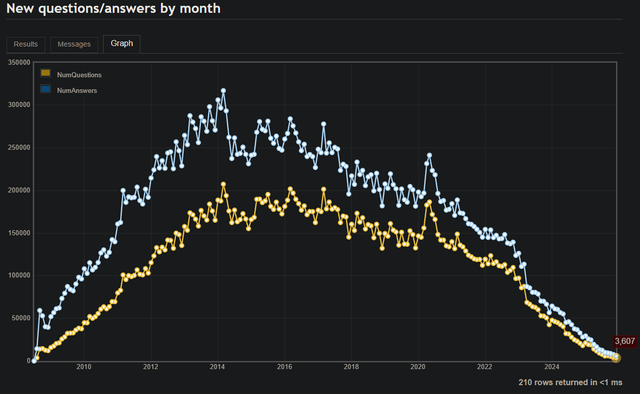
The same thing happened with Stack Overflow. It was paid by AI companies to learn from the information shared there. It used to be the #1 source for finding programming knowledge as the top Q&A site on the web. Now its usage has been entirely replaced by AI, which is better for consumers than the source knowledge ever was. So in December 2025, new questions and answers have dropped to its lowest of any month of operation:


Wikipedia founder Jimmy Wales has welcomed the partnerships as a practical solution. He argued that models trained on Wikipedia benefit from its human editing process, which filters out misinformation and enforces verification standards.

"I'm happy that AI models are training on Wikipedia because it's human-curated," he said, adding that "[AI firms] should chip in and pay for their share of the cost that [they're] putting on us."
If things continue to go in the same direction as Stack Overflow, then Wikipedia will be doomed, and the "practical" solution will only be a temporary one. The idea that humans will always be better at editing than AI is based on a weak premise considering AI practically writes better than humans already.
 
Last edited:
The idea that humans will always be better at editing than AI is based on a weak premise considering AI practically writes better than humans already.

Artificial neural networks continue to improve apace, but the human brain hasn't changed since the Stone Age.
 
The same thing happened with Stack Overflow. It was paid by AI companies to learn from the information shared there. It used to be the #1 source for finding programming knowledge as the top Q&A site on the web. Now its usage has been entirely replaced by AI, which is better for consumers than the source knowledge ever was. So in December 2025, new questions and answers have dropped to its lowest of any month of operation:


If things continue to go in the same direction as Stack Overflow, then Wikipedia will be doomed, and the "practical" solution will only be a temporary one. The idea that humans will always be better at editing than AI is based on a weak premise considering AI practically writes better than humans already.
Wikipedia does not need to be profitable. It only needs to exist.
As a repository of knowledge, which is its goal, it should persist as a standard.
 
The irony is that humans are reading Wikipedia less while bots are reading it more than ever. The site built for people is now mostly being consumed by machines trained to sound like people.
 
Would be amazing if AI somehow cause internet to crash and slow down everything.

Don't trust these AI summary anyway it's wrong so many times and causes me to double check everything now. Sometimes you can search the same thing but just change the wording and it spits out two different facts. Useless if you need to do research to make sure you have the correct information.
 
Artificial neural networks continue to improve apace, but the human brain hasn't changed since the Stone Age.
There's no real sign of improvement at all. Instead they're just being applied to more fields is all. As it stands, LLMs, on their own, can't create new material that isn't just regurgitation.
 
There's no real sign of improvement at all. Instead they're just being applied to more fields is all. As it stands, LLMs, on their own, can't create new material that isn't just regurgitation.
If you look back over the past two years, there has been vast improvement. In another 50 years, where will it be? Today's LLMs are analogous to the language faculty of the brain. Other parts need to be added for it to be "mind."
 
Looking back I see zero change. LLMs are still as they were when first introduced. The much hyped "AGI" just isn't happening.
The architecture may not have changed much since Google's Transformer, but scale has. For comparison, the mouse and human brain share similarities, but our scale and complexity make a difference. As for "AGI," the new cliché for the older term of "strong AI," developments in the architecture, along with a better understanding of the human brain, will move progress towards that in the future. Perhaps in the next few decades.
 
Artificial neural networks continue to improve apace, but the human brain hasn't changed since the Stone Age.
Wow such profound take, MUCH WOW.

In other news water is wet. how the brain looks has nothing to do with anything. it's all about accumulated knowledge and human ingenuity and discern, something that AI can only emulate. Never innovate.
 
Wow such profound take, MUCH WOW.

In other news water is wet. how the brain looks has nothing to do with anything. it's all about accumulated knowledge and human ingenuity and discern, something that AI can only emulate. Never innovate.
The software is being updated, so to speak, but the hardware hasn't changed. Our brain is a system, and that system, in principle, can be emulated or surpassed.
 
The same thing happened with Stack Overflow. It was paid by AI companies to learn from the information shared there. It used to be the #1 source for finding programming knowledge as the top Q&A site on the web. Now its usage has been entirely replaced by AI, which is better for consumers than the source knowledge ever was. So in December 2025, new questions and answers have dropped to its lowest of any month of operation:


If things continue to go in the same direction as Stack Overflow, then Wikipedia will be doomed, and the "practical" solution will only be a temporary one. The idea that humans will always be better at editing than AI is based on a weak premise considering AI practically writes better than humans already.
I think Wales was going on the premise that humans were less corruptible (more inclined to tell the truth) than AI. When it started that was generally true since the effort required to create the articles was large. Now it is changes to the articles (to control the narrative to authors agenda) that are easy. An AI to can be programmed to control a narrative to an specified conclusion - so we will have articles changing as we read them since my AI is faster than your AI and I disagree with your narrative - e.g. my ancestror invented the wheel not yours. You can tell I,am a human since I included a spelling mistake.
 
Since they are getting paid by these large corporations, does that mean Wikipedia will be removing their donation NAG screen that pops up from time to time? ;)

No. Wikipedia only spend $3.4 million on hosting costs last year. They gave away $28.7 million to various random orgs they want to financially support. So basically they take your money and turn around and give it away to someone else you probably didn't necessarily want to support.

There is zero reason to ever give wikipedia a dime because they are likely just going to give it away to someone else or pocket it to their now $115M payroll.
 
Wow such profound take, MUCH WOW.

In other news water is wet. how the brain looks has nothing to do with anything. it's all about accumulated knowledge and human ingenuity and discern, something that AI can only emulate. Never innovate.
And are you AI?? he said nothing about 'how the brain looks'
 
The architecture may not have changed much since Google's Transformer, but scale has. For comparison, the mouse and human brain share similarities, but our scale and complexity make a difference.
And it has no impact on abilities at all. LLMs are just as stupid now as they always have been.

As for "AGI," the new cliché for the older term of "strong AI," developments in the architecture, along with a better understanding of the human brain, will move progress towards that in the future. Perhaps in the next few decades.
Yeah, right. The same old worn out line. Fusion power generation will be here long before that day. Until that day happens, the current waste of money and electricity is just as stupid as the LLMs are.
 
And it has no impact on abilities at all. LLMs are just as stupid now as they always have been.


Yeah, right. The same old worn out line. Fusion power generation will be here long before that day. Until that day happens, the current waste of money and electricity is just as stupid as the LLMs are.
As models scale up, emergent behaviour occurs:


Yeah, right. The same old worn out line. Fusion power generation will be here long before that day. Until that day happens, the current waste of money and electricity is just as stupid as the LLMs are.
The waste of money and energy on LLMs is stupid, but we are talking about the theory and the science of what can be done. LLMs are only one part of the puzzle.
 
They don't really have options I've seen numbers ranging from 30 to even 50% of wikipedias traffic/costs being due to AI scraping.
So all their data is copied regardless, to feed the thing that reduces their own income. At least now they're getting compensated for it.
 
As models scale up, emergent behaviour occurs:
Keep dreaming. When LLMs are dead and buried maybe.

The waste of money and energy on LLMs is stupid, but we are talking about the theory and the science of what can be done. LLMs are only one part of the puzzle.
Problem is the money. Problem is the electricity. Problem is the water. Problem is the IC supply chains. Problem is the LLMs.
 
Keep dreaming. When LLMs are dead and buried maybe.


Problem is the money. Problem is the electricity. Problem is the water. Problem is the IC supply chains. Problem is the LLMs.
 
*****ic. Wikimedia already has cash reserves measured in the hundreds of millions, from constantly begging for donations on Wikipedia. I stopped donating years ago, they take the money you think is going to help keep Wikipedia's infrastructure going and spend it on a thousand things completely unrelated in any way to wikipedia itself.
 
Back