World's tallest bridge debuts in China, soaring 2,000 feet above a canyon

Skye Jacobs

Posts: 1,913   +58
Staff
The big picture: China has opened what is now the tallest bridge on Earth, a feat of engineering that rises more than 2,000 feet above a gorge in the country's southwest and marks the latest chapter in Beijing's push to transform one of its most mountainous and remote provinces.
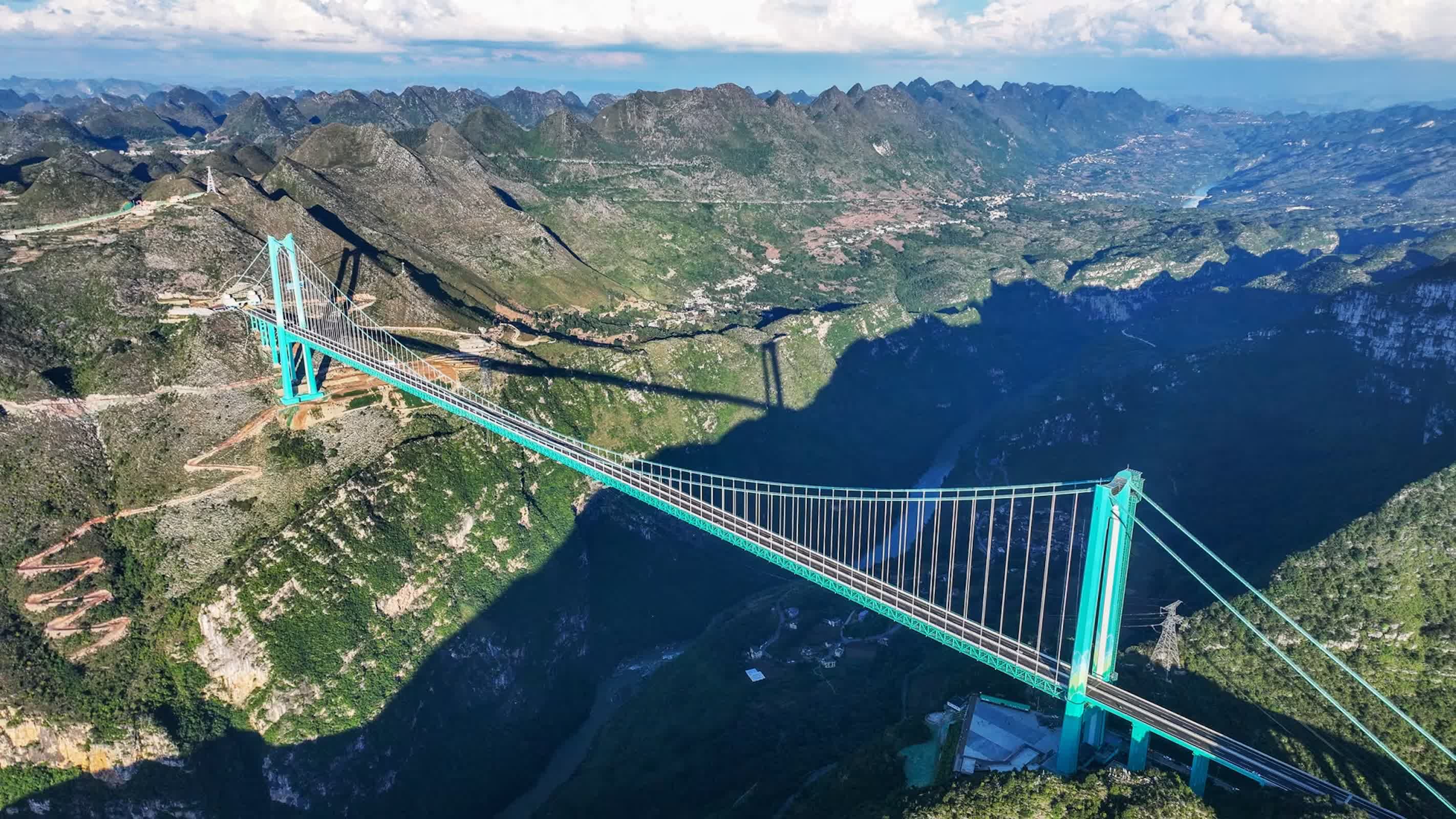
The new bridge eclipses another structure in Guizhou, the Duge Bridge, which opened in 2016 and is now the second-highest bridge in the world. That competition for superlatives reflects a broader pattern in China, where engineering mega-projects have become symbols of modernization and national achievement.

The Huajiang Grand Canyon Bridge in Guizhou, a province known for its rugged karst terrain, began operation on Sunday. The suspension bridge stands approximately 2,050 feet above the Beipan River, more than doubling the height of the Royal Gorge Bridge in Colorado, which holds the distinction of being the tallest span in the United States at 956 feet above the Arkansas River.

The project is not only the world's highest by clearance from the ground but also, according to Chinese reports, the longest bridge ever built in a mountainous region. Its main span stretches 4,600 feet across the Huajiang Grand Canyon, linking two cliffs that previously required a two-hour drive to travel between. With the new bridge, that journey is expected to take minutes.

Officials in China have framed the bridge as both a practical improvement and a symbolic achievement. State media called it an "infrastructure miracle," emphasizing its role in opening new routes for economic development and tourism in Guizhou. The province has a population of roughly 40 million and, while historically one of China's poorest, has seen massive state-led investment in roads, rail, and bridges over the past three decades.

Construction of the Huajiang Grand Canyon Bridge took nearly four years, a timeline that included challenges posed by the sheer height of the gorge and the need to stabilize its foundations in difficult terrain.

The span is also designed as a tourist attraction, adding amenities that highlight the depth of the gorge itself. A high-speed glass elevator transports visitors to a coffee shop perched 2,600 feet above the river, while bungee jumping and a glass walkway, suspended at about 1,900 feet, are among the experiences offered.

Image credit: NBC News

Permalink to story:

 
Very few countries use the imperial system, and it might be shocking to some but the US is not the world. Use the metric system and add the imperial system in brackets if you want.

Quite a few machines were invented and created especially for the construction of this beautiful bridge. Well done to the engineers and all who worked on this monumental project.
 
Very few countries use the imperial system, and it might be shocking to some but the US is not the world. Use the metric system and add the imperial system in brackets if you want.
Techspot is a US based website, and it might be shocking to some in the world but not the US. Use the imperial system and convert the numbers to metric if you want.
 
And if you hadn't noticed our favourite Aussies post their reviews here (thanks other Steve) and, thus, this is a global website.

I also prefer a modern and universal measurement system, but 60-70% of the revenue of these so-called global tech sites comes from US traffic. I know this because I have experience working in this field.
 
Very few countries use the imperial system, and it might be shocking to some but the US is not the world. Use the metric system and add the imperial system in brackets if you want.

Quite a few machines were invented and created especially for the construction of this beautiful bridge. Well done to the engineers and all who worked on this monumental project.
At least they don't throw at you (this time) football field units, '20 cars', average rock throwing distance (Its main span stretches 67 rock throwing distance across the Huajiang Grand Canyon...)...

What is most irritating, is the lack of consistency...
https://www.techspot.com/news/99496-nasa-dart-mission-left-trail-small-boulders-wake.html "The largest boulder measures around 7 meters in diameter"

"A few days later, a 3-foot-wide magnetic sled was dropped to a depth of 1.2 miles onto the ocean floor and pulled along by the ship around a six-mile-wide area. After a week of frustration, a filter with a mesh size of a third of a millimeter " (foots, miles, and millimeters in the same paragraph)

"The object, around half the size of a football field", " It means the likelihood of the 180-foot-wide asteroid", "it would leave a crater measuring anywhere from 500 to 2,000 meters (1,640 to 6,561 feet) across" https://www.techspot.com/news/106816-asteroid-2024-yr4-may-miss-earth-2032-hit.html

This is not because they are US based. This is just a jumbo mambo and a pseudo tech site where caring about the unit consistency is simply too much for some of the audience to stomach. Lets say they are equally hard to US citizens which are stroke quite often by metric units, as the end of the world which rarely uses football fields to measure anything.

Anyway, it is an amazing engineering and maybe it is time to actually think about some holidays there. Would love to see it myself at some point, probably would consider a couple of weeks there for some holidays.
 
Wow, The US is literally the only country keeping the damn imperial system alive.
That may be but the imperial system is still alive in some other countries. Take the UK for example. Check car tire (tyre) sizes and see if the diameter of the wheel is measured in inches. Also, in the area of hand tools see if ratchet drives are measured in 1/4, 3/8 or 1/2 inch square drives. Some countries, I understand, will express those drives in metric but they are the equivalent of the imperial system. Maybe one day that will change but not yet.
 
At least they don't throw at you (this time) football field units, '20 cars', average rock throwing distance (Its main span stretches 67 rock throwing distance across the Huajiang Grand Canyon...)...

What is most irritating, is the lack of consistency...
https://www.techspot.com/news/99496-nasa-dart-mission-left-trail-small-boulders-wake.html "The largest boulder measures around 7 meters in diameter"

"A few days later, a 3-foot-wide magnetic sled was dropped to a depth of 1.2 miles onto the ocean floor and pulled along by the ship around a six-mile-wide area. After a week of frustration, a filter with a mesh size of a third of a millimeter " (foots, miles, and millimeters in the same paragraph)

"The object, around half the size of a football field", " It means the likelihood of the 180-foot-wide asteroid", "it would leave a crater measuring anywhere from 500 to 2,000 meters (1,640 to 6,561 feet) across" https://www.techspot.com/news/106816-asteroid-2024-yr4-may-miss-earth-2032-hit.html

This is not because they are US based. This is just a jumbo mambo and a pseudo tech site where caring about the unit consistency is simply too much for some of the audience to stomach. Lets say they are equally hard to US citizens which are stroke quite often by metric units, as the end of the world which rarely uses football fields to measure anything.

Anyway, it is an amazing engineering and maybe it is time to actually think about some holidays there. Would love to see it myself at some point, probably would consider a couple of weeks there for some holidays.
Maybe spat out by GPT or Grock, hence the inconsistencies.
 
That may be but the imperial system is still alive in some other countries. Take the UK for example. Check car tire (tyre) sizes and see if the diameter of the wheel is measured in inches. Also, in the area of hand tools see if ratchet drives are measured in 1/4, 3/8 or 1/2 inch square drives. Some countries, I understand, will express those drives in metric but they are the equivalent of the imperial system. Maybe one day that will change but not yet.
Oh I'm fully aware, the UK is particularly annoying as we use the metric system for nearly everything else, measurements of boxes, weight of cars, amount of liquid in a bottle etc...

But then when we get on the road, it's in Miles... When I was younger, if someone asked for my weight, I'd give it in stones, that has sort of changed though and more often than not, kilograms is more widely accepted now.
I don't understand why people get so worked up over units of measure, the size is the size.
I think it's more, the rest of the world has moved on, or really want to move on from the imperial system, but the USA is basically keeping it alive for some reason.
 
I don't understand why people get so worked up over units of measure, the size is the size.
Absolutely. If you need a conversion, all you need do is search for conversion sites. There's plenty of them out there for those looking to de-confuse themselves.
 
I think it's more, the rest of the world has moved on, or really want to move on from the imperial system, but the USA is basically keeping it alive for some reason.
Living in the US, many products have both units on their labels.

Also, in the area of hand tools see if ratchet drives are measured in 1/4, 3/8 or 1/2 inch square drives. Some countries, I understand, will express those drives in metric but they are the equivalent of the imperial system. Maybe one day that will change but not yet.
A couple years ago, I bought a ratchet/socket set. It came with both metric and imperial sockets. Interestingly, the drives were all imperial whether the socket was metric or not.
 
Maybe spat out by GPT or Grock, hence the inconsistencies.
The world also doesn't understand why one country insists on using a metric that is imprecise and outdated.

That may be but the imperial system is still alive in some other countries. Take the UK for example. Check car tire (tyre) sizes and see if the diameter of the wheel is measured in inches. Also, in the area of hand tools see if ratchet drives are measured in 1/4, 3/8 or 1/2 inch square drives. Some countries, I understand, will express those drives in metric but they are the equivalent of the imperial system. Maybe one day that will change but not yet.
Tools does not mean universal use. You don't see plane manufacturers measuring in the imperial system as the metric system is far more precise.
 
Tools does not mean universal use. You don't see plane manufacturers measuring in the imperial system as the metric system is far more precise.
I'm not sure you understood what I said. If you are familiar with tools, I was speaking of the square drive of ratchets which are tools not airplanes. Yes, the sockets that attach can be metric, imperial, torx, hex bits, etc. Speaking of planes, imperial (aka customary) fasteners (I.e. nuts and bolts) are common (though not necessarily exclusive) on U.S. military aircraft and I believe Boeing still uses imperial fasteners on their planes.

Please note that I'm not judging whether one is better than the other or what manufacturers should or shouldn't use, I'm just saying. One of my hobbies is repairing cars and trucks and I work with metric fasteners found on modern vehicles all the time although I occasionally still work on older imperial measurement cars. Interestingly, not counting the older vehicles I mentioned, I can't quite get away from imperial (aka standard, SAE, customary) sockets and wrenches. I find that some, not all, tools that require sockets or wrenches to operate, such as pullers and ball joint presses, have imperial size hexes. That said, many use sizes that are more or less interchangeable, such as 3/4" and 19mm or 5/8" and 16mm. Common sized dies, metric or imperial, often have 1" outside hexes, at least the ones I have. I think most manual slide hammers available in the U.S. use a 5/8 - 18 thread. Sorry, getting carried away.
 
Any China hawk claiming China stole the design of this Bridge from USA...?!
Its a suspension bridge and that basic design is fairly common in the world of bridge designs. There are many examples in the world, but I can see why you might think it was stolen from the USA since it looks something like San Francisco's Golden Gate Bridge.
 
It's not enough that China has a surplus of housing despite 4x the population of the US, now they have the most impressive bridges also.
 
Techspot is a US based website, and it might be shocking to some in the world but not the US. Use the imperial system and convert the numbers to metric if you want.
NASA is a US based institution, and it might be shocking to some in the US but not the rest of the world. Use the metric system and convert the numbers to imperial if you want.

Just an example. Many professions inside US science/academic/military actually use metric despite the fact that officially US uses imperial. Turns out metric is just superior for anything that requires precision.
 
Oh I'm fully aware, the UK is particularly annoying as we use the metric system for nearly everything else, measurements of boxes, weight of cars, amount of liquid in a bottle etc...

But then when we get on the road, it's in Miles... When I was younger, if someone asked for my weight, I'd give it in stones, that has sort of changed though and more often than not, kilograms is more widely accepted now.

I think it's more, the rest of the world has moved on, or really want to move on from the imperial system, but the USA is basically keeping it alive for some reason.

It's the old people, like me. We are used to the Imperial system. I'm fine with using both at the same time though. Most of the time I don't really think about physical measurements unless I am making something. If the U.S. ever switched to metric, I could use the opportunity to buy any necessary measuring tools in advance with both metric and imperial measurements as the metric side would be sited perfectly for me as a lefthander. Everything else is mostly optimized for right-handed people.
 
Back