
Forward-looking: Silicon Motion has revealed early details about its next-generation SSD controller for client PCs, aiming to significantly boost storage performance using the latest PCIe technology. Announced at the Future Memory & Storage Conference, the development signals major advancements on the horizon for consumer solid-state drives.
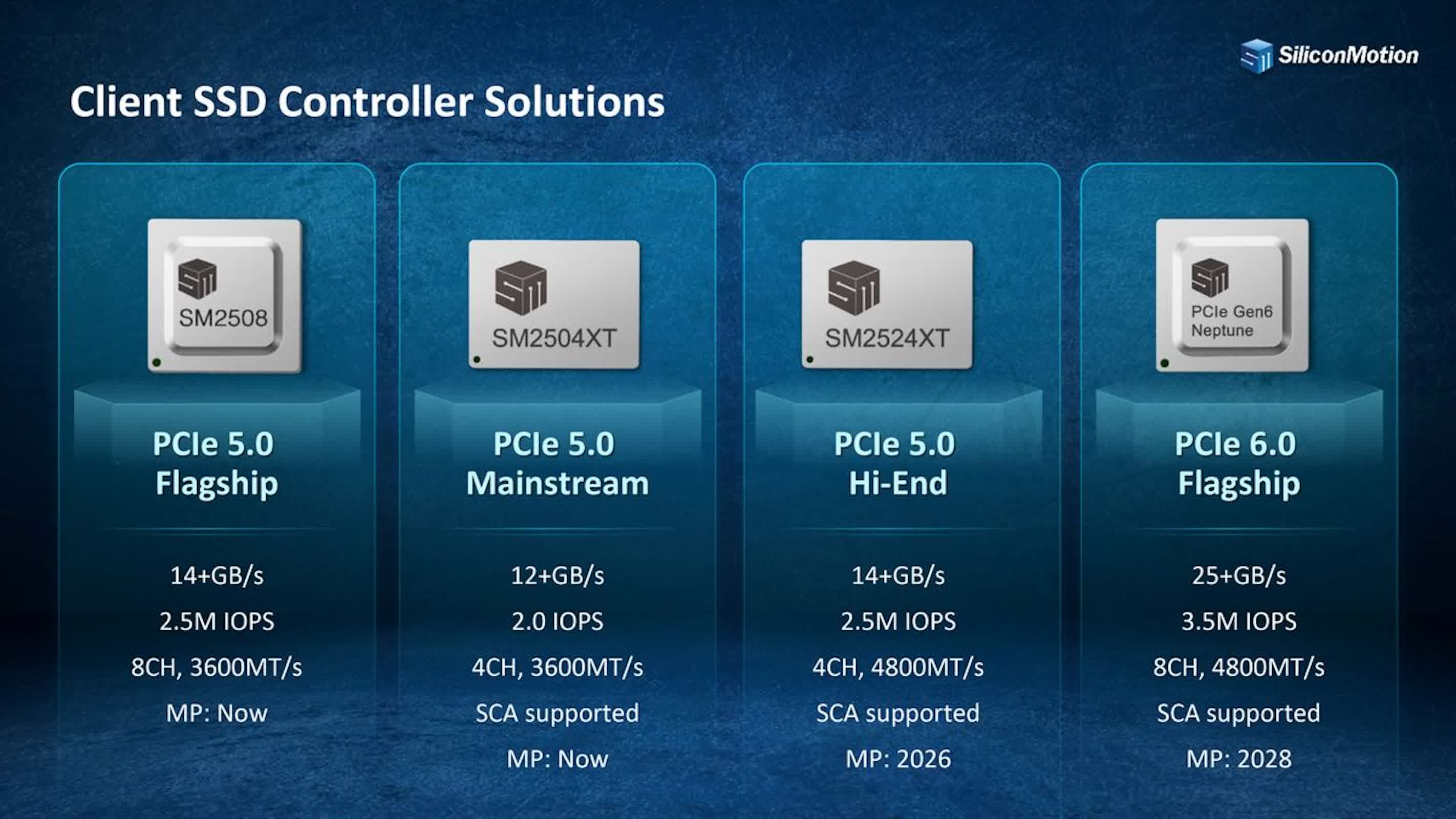
The new controller, called Neptune, is designed for the PCIe 6.0 x4 interface. Upon release, it's expected to deliver sequential read speeds exceeding 25 GB/s and support up to 3.5 million IOPS for random read operations. Compared to current SSDs using PCIe 5.0, this marks a substantial leap forward in consumer storage performance.
Neptune features eight flash memory channels and supports data rates of up to 4,800 MT/s. It's compatible with advanced 3D NAND memory expected to feature more than 400 active layers, enabling higher capacities and improved performance in future SSDs.
One key innovation is Neptune's Separate Command Architecture, which allows commands and addresses to be processed in parallel rather than sequentially. This design reduces latency and increases effective bandwidth under real-world workloads.
Despite its technical improvements, Neptune still falls short of Silicon Motion's enterprise-grade controllers. For instance, the SM8466 platform – designed for data centers – features 16 NAND channels and is expected to deliver sequential read speeds of up to 28 GB/s and random reads as high as 7 million IOPS. These enterprise-class drives are built to handle sustained, high-intensity workloads far beyond typical consumer demands.
Silicon Motion plans to begin production of Neptune in 2028, with retail drives likely not arriving until 2029 or later. Wallace Kou, the company's CEO, told Tom's Hardware that interest in PCIe 6.0 for PCs remains low and urged patience. "You will not see any PCIe Gen6 [solutions] until 2030. PC OEMs have very little interest in PCIe 6.0 right now – they do not even want to talk about it. AMD and Intel do not want to talk about it," he said.
Building faster SSDs also comes with increased cost and complexity. The latest controllers require more sophisticated hardware and faster interfaces, which raises development and manufacturing expenses.
During the conference, Silicon Motion also introduced an update to its MonTitan SM8366 Gen5 controller, widely used in data centers. The upgraded controller now supports SSD capacities of up to 256 TB with the latest 3D NAND technology, doubling the storage limit of previous versions.