
The big picture: With Intel facing existential challenges due to multiple strategic missteps over the past decade, AMD's CPU market share has reached record highs across both client and server segments. While Intel still holds a lead in both sectors, AMD has been rapidly narrowing the gap in recent years.
The latest data from Mercury Research shows AMD's desktop CPU market share in Q2 2025 reached an all-time high of 32.2 percent, up 4.2 percent from the previous quarter and 9.2 percent from the same period last year. Conversely, Intel's share in the category fell to 67.8 percent, sharply cutting its lead over its long-time rival.
Tom's Hardware notes that while Intel still outsells AMD 2:1 in this segment, it is no longer as dominant as it once was. In 2016, the company outperformed Team Red 9:1, when it was the undisputed leader in x86 CPUs across all market segments. Even as recently as 2023, Intel was selling four times as many desktop CPUs as AMD, but the gap has narrowed significantly over the past two years.
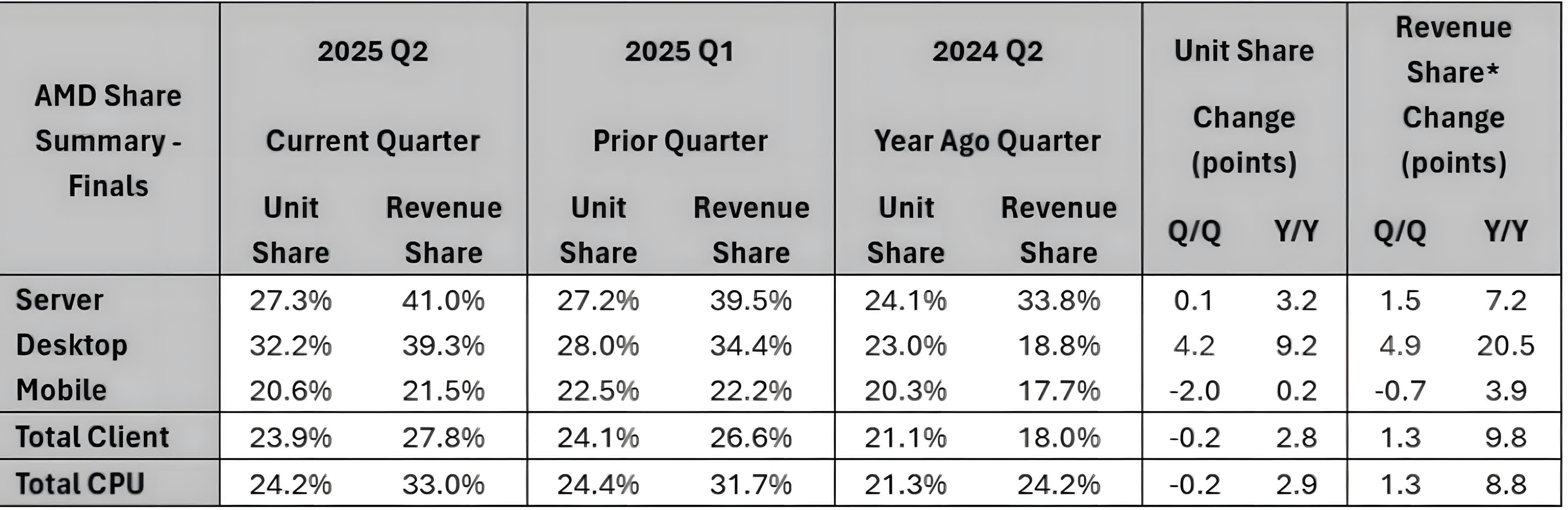
Despite its well-documented troubles, Team Blue maintained dominance in laptop CPUs, even increasing its market share both sequentially and year-over-year. AMD's unit share in the segment fell to 20.6 percent during the quarter, down 2 percent from the previous quarter and 0.2 percent from the same period last year.
Thanks to growth in the mobile segment, Intel slightly boosted its overall share in client CPUs compared with the previous quarter, though sales fell substantially year-over-year. AMD's total client CPU share stood at 23.9 percent during the quarter, down from 24.1 percent in Q1 2025 but up from 21.1 percent in Q2 2024.
AMD's consumer CPU revenue share reached 27.8 percent, up 1.3 percent from Q1 2025 and 9.8 percent year-over-year. The data suggests Team Red is not only shipping more units but also selling more high-end CPUs, likely aided by its X3D processors, which are especially popular among gamers.
Following the launch of its 5th-generation Epyc 'Turin' processors, AMD is selling more server chips than ever, with its market share in the segment reaching 27.3 percent in Q2 2025. That figure represents a 0.1 percent increase from Q1 2025 and a 3.2 percent gain over Q2 2024. Revenue share rose to 41 percent, up 1.5 percent from Q1 2025 and 7.2 percent year-over-year.