
TL;DR: While OpenAI continues to draw enormous attention for its technological pace and sweeping ambitions, Anthropic's disciplined enterprise strategy is earning increasing recognition from investors. In a market dominated by expensive infrastructure and public hype, its ability to translate AI performance into steady business demand may ultimately prove the more enduring success story.
OpenAI has entered agreements worth hundreds of billions of dollars to build vast data centers packed with high-performance chips, designed to strengthen its grip on generative AI. Yet as it expands through costly construction and mass-market products, a quieter rival, Anthropic, is emerging as a more structurally sustainable business in the same field.
Founded in 2021 by former OpenAI researchers, Anthropic develops large language models similar to OpenAI's GPT systems. Both companies sell access to these models, but their approaches to revenue diverge sharply.
OpenAI earns most of its income through consumer subscriptions and partnerships tied to Microsoft's productivity software. Meanwhile, Anthropic has concentrated on enterprise applications, positioning itself as a technical supplier rather than a consumer brand.
OpenAI's main consumer product, ChatGPT, remains the most widely used AI tool worldwide. The company reports that more than 800 million people use the chatbot weekly, replacing many traditional search queries with conversational exchanges.
That broad adoption has pushed OpenAI's annual revenue run rate to about $13 billion, according to the company's data, with roughly 30% of that coming from corporate customers. Subscribers pay $20 per month for a "Plus" tier or $200 per month for a "Pro" package, which offers faster performance and greater reliability. However, much of the system's computing costs still exceed the revenue generated by these subscriptions.
Anthropic has aimed instead at large corporate clients seeking measurable productivity gains from AI tools. The company says that about 80% of its revenue comes from enterprise accounts, with around 300,000 business customers as of late 2025.

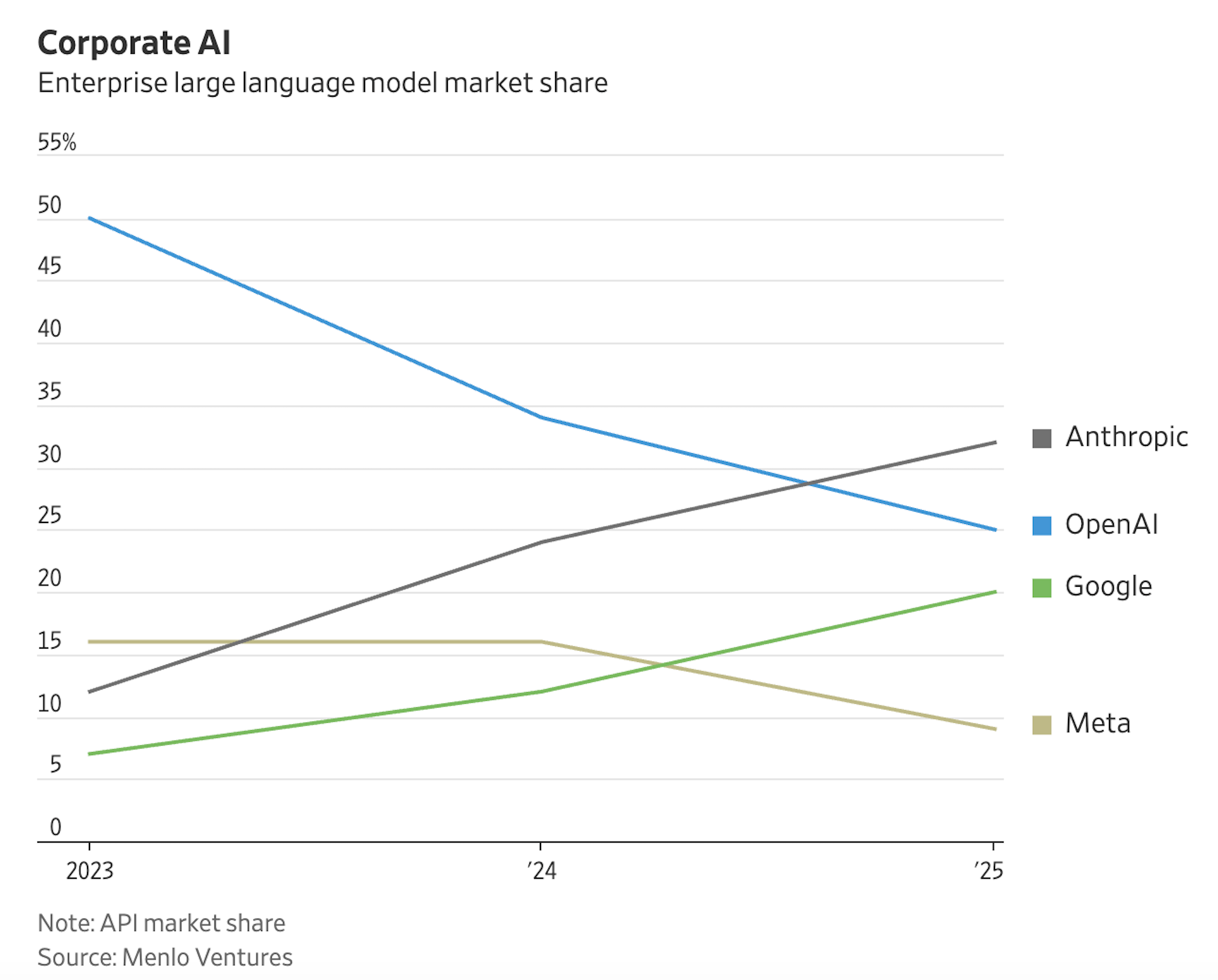
That focus appears to be paying off. A July study by the venture firm Menlo Ventures found that Anthropic's Claude models now lead the field in corporate AI adoption, claiming 32% market share compared with OpenAI's 25%.
In specialized domains such as computer programming, the survey estimated Claude's share at roughly double that of GPT. The report credited Claude's accuracy in structured tasks such as coding and legal drafting, where precision in language and predictable behavior are prioritized over creativity.
Those enterprise results have translated into solid financial performance. Anthropic is operating at a $7 billion annual revenue run rate and expects to reach $9 billion by year's end, far closer to OpenAI's figure than its smaller public profile might suggest.
Analysts note that its per-customer income is markedly higher than OpenAI's, a sign that businesses are using Claude in mission-critical processes rather than as a supplemental research tool.
The two developers also rely on distinct industrial alliances. OpenAI's infrastructure and distribution stem from its deep partnership with Microsoft, which provides Azure cloud computing and integrates OpenAI models into Word, Outlook, and other Office applications.
Anthropic's computing resources, by contrast, come through investments from both Amazon and Google, giving it access to advanced cloud infrastructure and a broad cross-section of potential business clients. In September, Microsoft – despite its alignment with OpenAI – announced it would also include Anthropic's Claude model in its Copilot software suite, underscoring enterprise demand for Anthropic's systems.
Those enterprise uses are expanding across industries. Businesses are adopting Claude to write and test software, process legal materials, analyze financial data, and accelerate back-office documentation, such as billing and compliance. Many of those applications offer direct cost savings, making the return on investment easy to quantify – something investors see as an advantage over OpenAI's consumer-driven revenue model.
OpenAI's efforts to monetize mass adoption are less straightforward. Besides subscriptions, the company is exploring potential advertising strategies, though integrating ads into conversational products presents consumer and ethical challenges. Traditional search advertising – the primary driver of Google's profits – cannot be easily replicated in natural-language chat. Users may resist explicit brand placements or commercial suggestions within their AI interactions, leaving the company to experiment with indirect revenue models.
At the same time, OpenAI's reputation as a freewheeling consumer platform could complicate its work with corporate clients that demand tighter governance. The company has permitted adult content functionality within ChatGPT and taken a lighter regulatory stance, which may limit its appeal among enterprises cautious about reputational risk.
Anthropic, by contrast, promotes a safer and more structured approach focused on "constitutional AI," a technique that ensures predictable model behavior through predefined ethical guidelines.
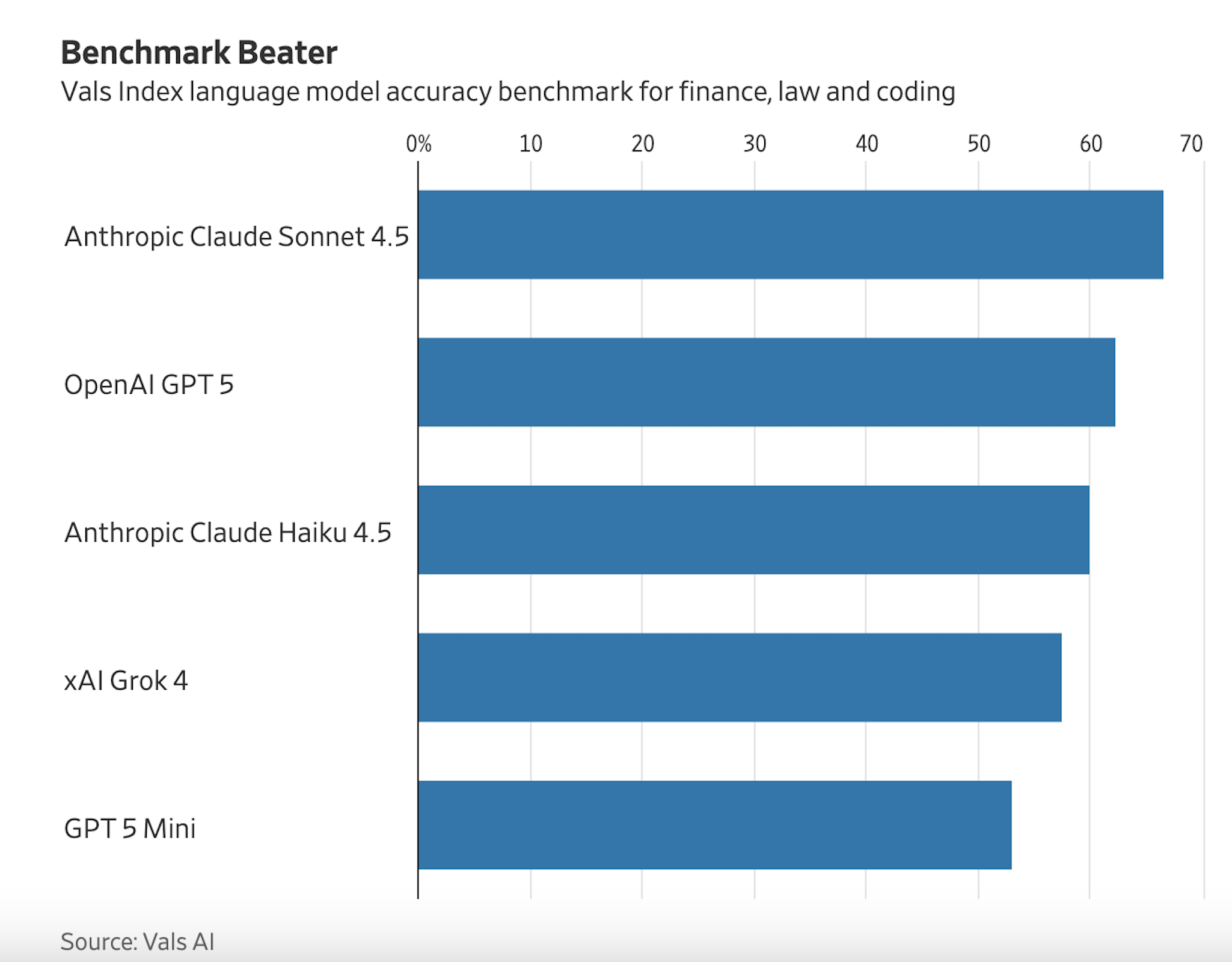
Independent model evaluations reinforce that contrast. Vals AI – a benchmarking startup ranking large language models on business-oriented tasks – currently lists Claude as the top-performing enterprise-grade model. "Anthropic is laser-focused on agentic enterprise use cases and they're playing a very competitive game with OpenAI right now," Vals co-founder Rayan Krishnan told The Wall Street Journal.
Image credit: The Wall Street Journal