The big picture:
According to TrendForce, DRAM contract prices in the third quarter of 2025 rose by 171.8% compared to the same quarter last year. The substantial leap, driven by growing demand for AI servers, exceeded the rise in gold prices.
Supplies of DDR5 RAM chips are so depleted that some South Korean manufacturers have halted new orders until later this month. Enterprise SSD prices have risen by between 15% and 35%, while server-grade RDIMM memory increased by 40% to 50%.
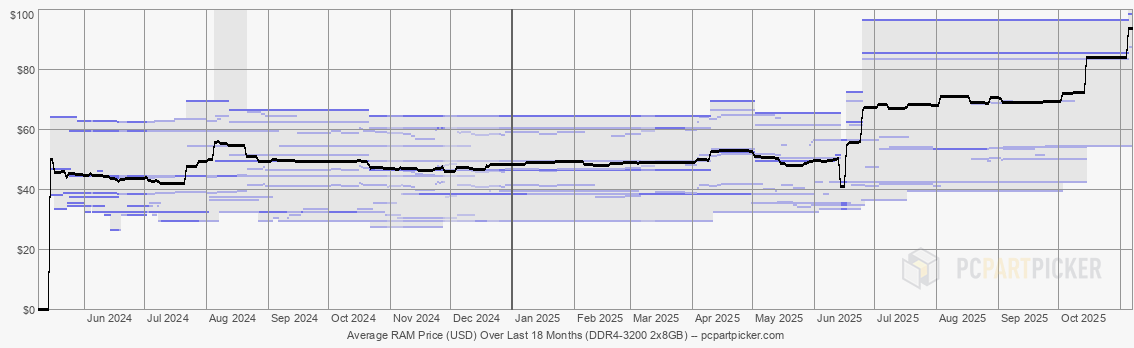
The effects have also trickled down to consumers. A little over a week ago, DRAM Exchange's daily high spot prices for DDR4 16Gb (2Gx8) and DDR5 16Gb (2Gx8) were $28.00 and $20.00, respectively. Since then, they have jumped to $37.00 and $33.00.
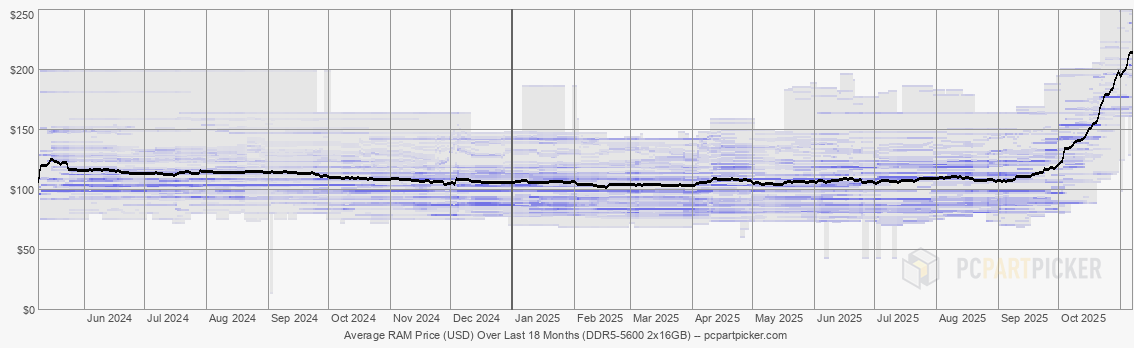
Meanwhile, pricing trends on Amazon and PCPartPicker for DDR4 and DDR5 RAM sticks from manufacturers such as Corsair and Crucial have risen sharply in recent weeks. DDR4 prices began rising between July and September, with DDR5 following in October.
Despite DDR5 being newer and faster, prices for the more mature technology increased faster because manufacturers are currently transitioning from DDR4 to DDR5. The timing of the changeover, coupled with the AI boom, has created a perfect storm of shortages.
SK Hynix recently confirmed that it has sold through all of its DRAM, NAND, and HBM stock into next year. Supplies have become so tight that cloud service providers have begun paying inflated prices for shipments that are only 70% fulfilled. Meanwhile, OEMs are seeing fulfillment rates of between 30% and 40%.
Since the AI boom, cloud service providers such as OpenAI, Amazon Web Services, and Microsoft have become the primary customers for memory and storage because of the large amounts required by data centers. Manufacturer Adata does not expect conditions to improve soon, warning that shortages will continue well into 2026. The companies struggling to match demand are describing the oncoming conditions as a bull market.