
The big picture: Qualcomm's latest internal benchmarks claim that its new Adreno X2 GPU significantly outperforms its predecessor and the latest integrated graphics chips from Intel and AMD. However, that means little unless the company can increase the number of games that support Windows on Arm. Qualcomm is working to improve driver support, expand anti-cheat support, and encourage developers to release Arm-native PC games.
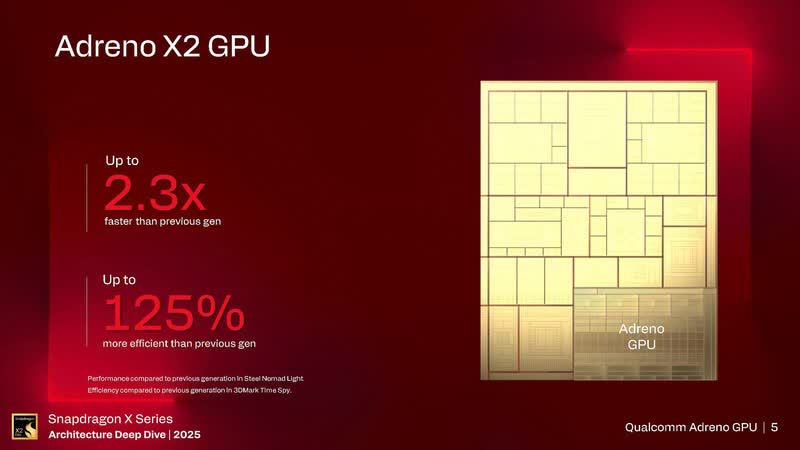
At the 2025 Snapdragon Architecture Deep Dive event in San Diego, Qualcomm claimed that the Snapdragon X2 Elite SoC's Adreno X2 GPU runs games at an average of 2.3 times faster than Adreno X1. It also increases performance per watt by 125%, offering 70% more performance than X1 at the same wattage.
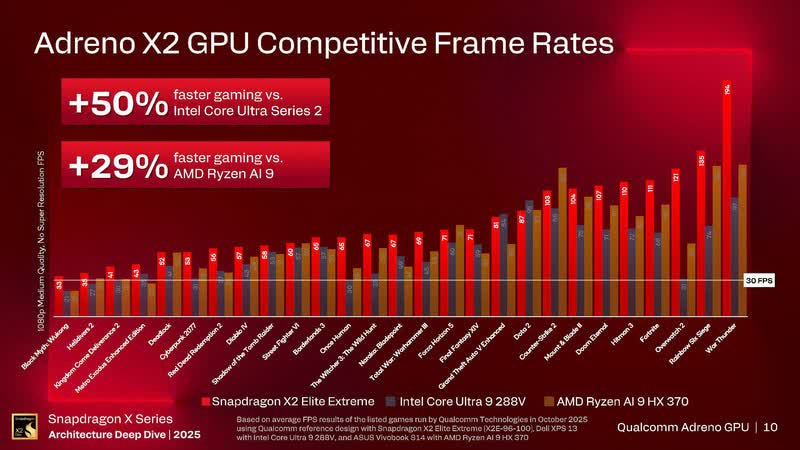
According to PC Watch, internal benchmarks show that the Snapdragon X2 Elite Extreme's GPU tile reaches 29% higher average framerates than AMD's Ryzen AI 9 HX 370 and over 50% higher framerates than the Intel Core Ultra 8 288V. The Qualcomm chip's biggest performance win is in War Thunder, where it doubles the 288V's framerate. It also enjoys a significant advantage in Rainbow Six Siege and Overwatch 2, but falls slightly behind the competition in Counter-Strike 2 and Dota 2.
When the Adreno X1 launched with the original Snapdragon X Elite last year, Qualcomm estimated that it achieved approximately 70% compatibility with Windows games, running thousands of titles at "playable" framerates. With Adreno X2, the company claims to have reached 90%, promising major improvements next year.
Qualcomm's GPU driver updates have arrived every few weeks so far, but the company wants to achieve a roughly monthly cadence similar to AMD and Nvidia's driver update cycles. Additionally, anti-cheat services such as Epic Games Online Services, Tencent ACE, Roblox, Denuvo, and BattlEye now natively support Arm, making Fortnite and other online games compatible with Snapdragon chips. EA's anti-cheat system remains the primary holdout.
Most Windows games currently run on Arm through compatibility layers, but Qualcomm is laying the groundwork for Arm-native titles. Since Unity and Unreal have started implementing Arm support, and Microsoft's Windows Arm compiler is now available, the first games are expected to appear next year.
It remains unclear if or when the selection of native Arm Windows games will catch up to Apple Silicon. While most titles still utilize compatibility layers on M-series processors, notable exceptions include Baldur's Gate 3, Assassin's Creed Shadows, Balatro, Hollow Knight: Silksong, and Hades II.