
What we know so far: Scientists believe that dark matter comprises most of the material in the observable universe, but the mysterious substance has not been identified or directly detected after nearly a century of investigation. But a recent study claims to provide direct evidence supporting one of the leading dark matter theories.
In a recently published study, Tomonori Totani of the University of Tokyo's astronomy department claims to have observed evidence of dark matter annihilation. If the findings survive scrutiny, they could provide the strongest evidence yet not only of the existence of dark matter, but also of the theory that it is composed of particles called WIMPs.
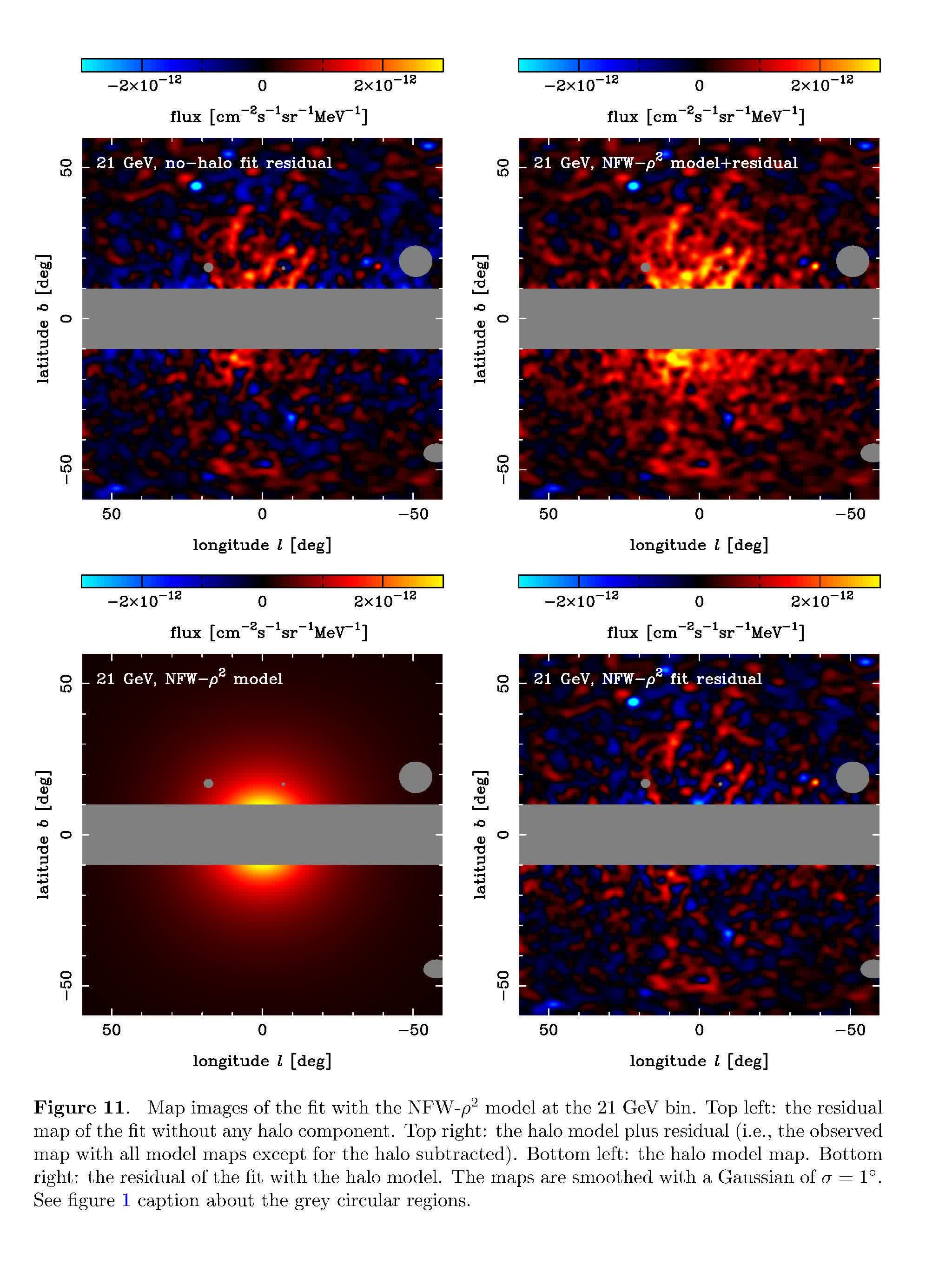
While searching through 15 years of data from the Fermi Large Area Telescope, Totani detected and isolated signs of noticeably strong gamma-ray emissions from a halo surrounding the center of the Milky Way galaxy. The emissions might originate from Weakly Interacting Massive Particles (WIMPs), one of the primary suspects for dark matter.
Serious study of dark matter began in the 1930s when Swiss astronomer Fritz Zwicky noticed that the movements of some galaxies contradicted traditional understanding of physics. He theorized that gravity from a mysterious "dark" material must have been holding them together.
Subsequent observations of researchers such as Vera Rubin have led the scientific community to agree that dark matter exists, even though it does not interact with light or any other electromagnetic radiation. Dark matter accounts for 85 percent of all matter in the observable universe, but it has not been directly observed.
Researchers suspect several types of objects to be responsible for the gravity exerted by dark matter, including WIMPs. The hypothetical heavy, slow-moving particles interact with gravity but not light, and would annihilate each other upon making contact, emitting gamma rays.
However, scientists have not successfully detected such emissions until now. Some considered giving up on WIMPs to devise methods of observing other candidates, such as dark electromagnetism.
Tomonori told 404 Media that his discovery, which he initially met with skepticism, felt like winning the lottery. Although it could reinvigorate the WIMPs theory, other researchers worry that the findings might be premature.
Other suspects include neutrinos, subatomic particles that scientists detected last year. Some theories point toward axions, another hypothetical subatomic particle, and primordial black holes dating back to the universe's birth.