Samsung is locking in five-year chip deals as AI demand shows no signs of slowing

Skye Jacobs

Posts: 2,182   +62
Staff
Forward-looking: Samsung Electronics is locking in long-term chip orders as AI-driven demand continues to exceed available production, and the company expects those constraints to persist for years. Shortages are likely to deepen in 2027 and carry into 2028, Jaejune Kim, executive vice president of Samsung's memory business, told analysts. To manage that imbalance, Samsung has signed long-term supply agreements with the five largest global data center operators and is close to finalizing deals with five more.
Kim said those contracts will run for at least five years and account for 60% to 70% of the company's future capacity. The agreements include upfront payments and floor pricing, giving Samsung more predictability as it invests heavily in advanced chip production.

The approach reflects how AI infrastructure is changing the memory market. Large cloud and data center companies are no longer relying on short-term purchasing cycles. Instead, they are securing guaranteed access to key components, particularly high-bandwidth memory, or HBM.

Samsung's comments come after a period of volatility for chip stocks, driven by concerns about whether AI spending can hold up and how competition from China could affect pricing. Even so, analysts viewed the company's outlook as a positive signal. "Management's commentary on the conference call was better than expected, and it was one of the more reassuring calls we've heard in quite some time," Ryu Young-ho, a senior analyst at NH Investment & Securities, told Reuters.

The company's latest earnings show how strong that demand has been. Samsung's semiconductor division posted an operating profit of 89.2 trillion won ($61.7 billion) in the second quarter, up more than 250 times from a year earlier. Overall operating profit for the quarter reached 89.5 trillion won, while revenue rose 130% to 171.5 trillion won.
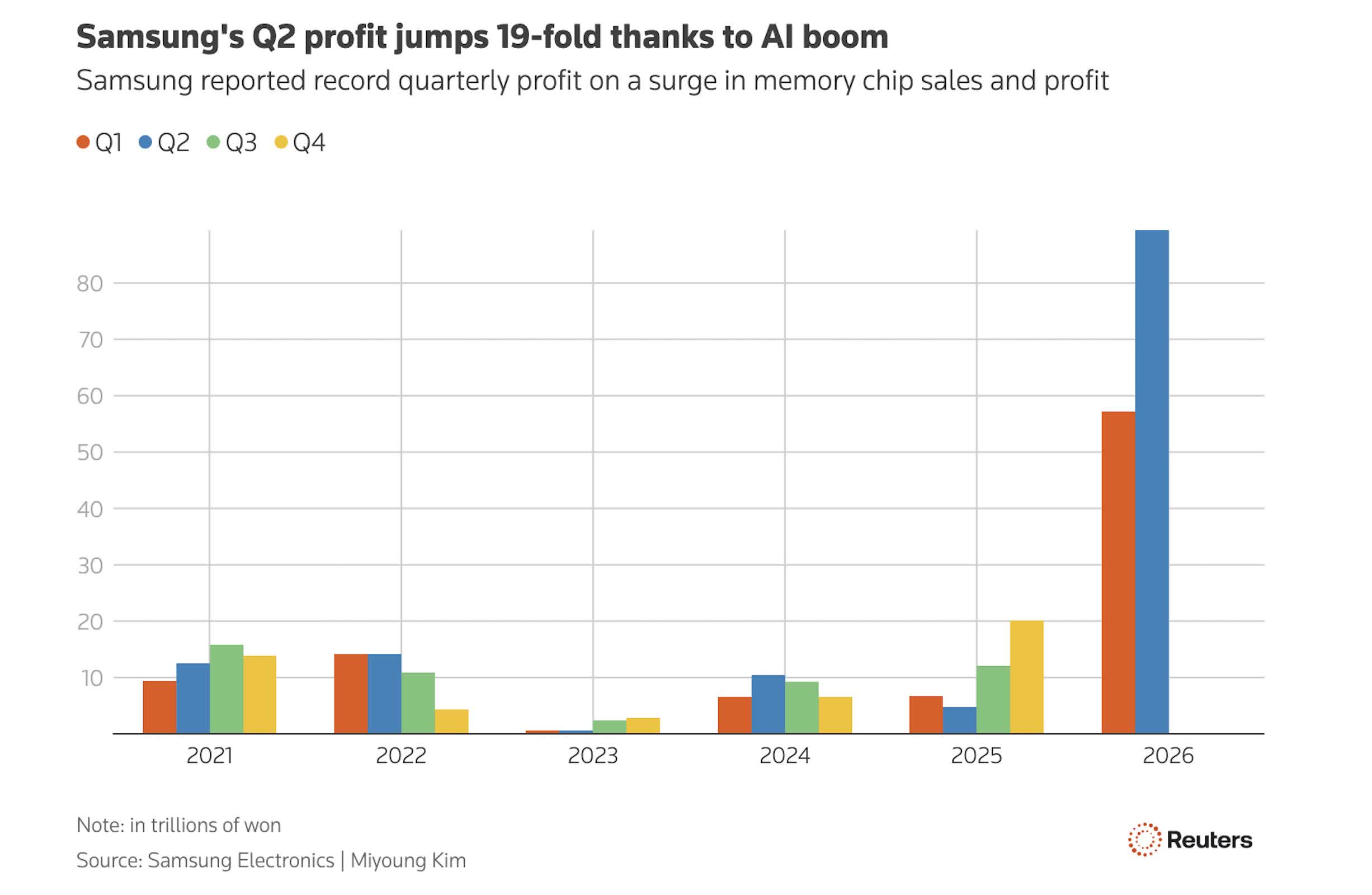
Image credit: Reuters

Those gains are being driven by higher memory prices tied to AI demand, but they are also creating pressure inside the company. Samsung's mobile division reported a 700 billion won loss, its first quarterly loss. "The chips enriching one side of Samsung are now hurting the other, leaving the group more exposed than ever to memory pricing and the durability of hyperscaler demand," said Josh Gilbert, an analyst at eToro.

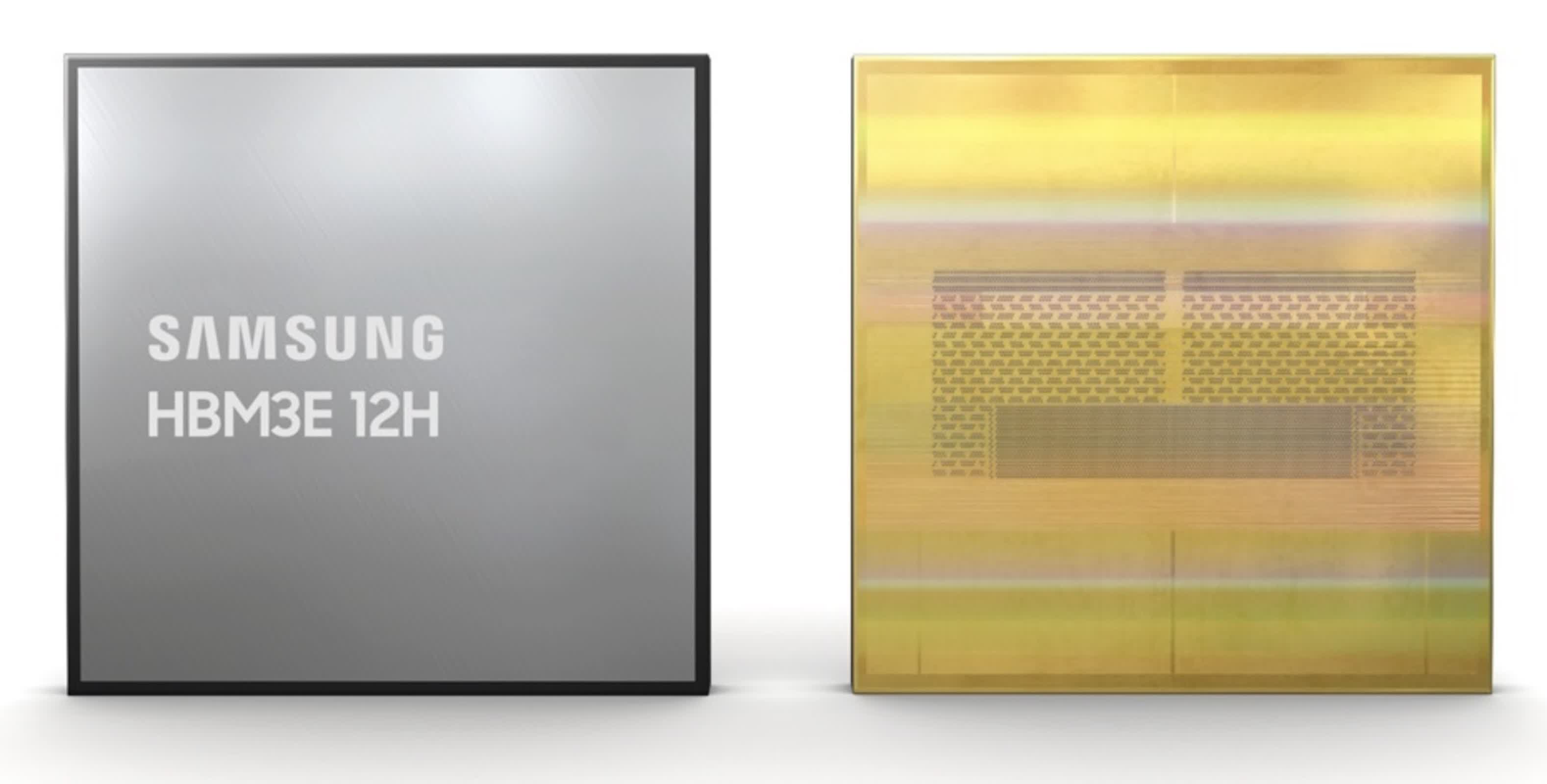
A big part of Samsung's push is centered on HBM, which is used alongside AI processors from companies such as Nvidia and AMD. The company said it expects HBM4 revenue to more than triple in the third quarter. That growth could help Samsung close the gap with SK Hynix and bring its share of the HBM market closer to its overall DRAM share later this year.
Samsung is also working to expand its manufacturing capacity. Its foundry business, which competes with TSMC and Intel, is expected to improve as utilization rates rise and pricing remains strong. The company said its Taylor, Texas fab is on track to begin operations this year, with plans for a second facility that could start mass production in 2030.

Rival SK Hynix also reported strong results this week and said it plans to increase capital spending by about 50% to meet AI demand. Despite that competition, Samsung signaled it is comfortable with its financial position. CFO Park Soon-cheol said the company does not plan to issue American depositary receipts following SK Hynix's recent US listing, citing steady cash generation from its existing businesses.

Permalink to story:

 
South Korean Stock Market Crash July 2026
"Everything is fine, nothing to see here"
KOSPI is 70% up compared to 1 year ago.
The "crash" was a normal correction after it more than doubled since the beginning of 2026.

Even though all the decels are praying for a crash for years (together with China and all the NGOs financed by it), that's apparently not enough to wish a crash into existence.
 
KOSPI is 70% up compared to 1 year ago.
The "crash" was a normal correction after it more than doubled since the beginning of 2026.

Even though all the decels are praying for a crash for years (together with China and all the NGOs financed by it), that's apparently not enough to wish a crash into existence.
If you invest $5000 or more in the Korean stock market banks will lend you money equal to your investment to put into their stock market. It's standard practice in SK to do this and is even encouraged. Many people in SK lost all their money in this crash and it's also larger than the DotCom crash and the 2008 crash. Their stock market is on fire right now and not in the good way.
 
Chips are Samsung #1 $ maker, always has been. They just do phones and TVs. They could lose those n it wouldn't change anything. Phones tend to keep them relevant since they are literally everywhere like Apple. People also like there TVs. But there's a lot comp in the TV market these days. Sony isnt a major player anymore. LG, Vizio and TCL are the big boys these days.
 
Chips are Samsung #1 $ maker, always has been. They just do phones and TVs. They could lose those n it wouldn't change anything. Phones tend to keep them relevant since they are literally everywhere like Apple. People also like there TVs. But there's a lot comp in the TV market these days. Sony isnt a major player anymore. LG, Vizio and TCL are the big boys these days.
Ask the American auto companies (and VW) how giving up their bottom line to chase margin is going for them.

Low margin items keep the assembly lines running when sales are bad. If you only chase high margin items then the lines get shut down.

This is likely why they're locking in 5 year contracts right now. The Datacenters companies are going to be stuck buying from Samsung at high prices and they'll sail through a recession as the only way they don't get paid is if the companies go bankrupt. It's a brilliant plan but it's really a sign of the desperation of things to come. People are buying less GPUs, nVidia is down, most tech stocks are taking a hit and SKs economy is on fire. Meanwhile, trillions of dollars are getting wiped off the economy weekly, it's only a matter of time before we see a cascading world wide failure.
.
I don't hate AI because I think it's useless, I hate the AI tech companies because the circular investing risks causing a global recession.
 
I think a huge price hike for all phones is on the horizon.
If a computer price has gone up at least x2, why should the phones
be exempt from the same fate?
Low end phones costing like low end video cards today
can quickly become reality
 
If you invest $5000 or more in the Korean stock market banks will lend you money equal to your investment to put into their stock market. It's standard practice in SK to do this and is even encourage
Wrong on pretty much all counts. South Korean brokerages -- not banks -- will lend you money on your existing stocks to purchase additional. It's called a margin account, and pretty much all exchanges and brokers worldwide have always allowed this -- even and especially here in the US. The margin rules in SK are just more lax than elsewhere (the US allows a 200% multiplier, SK 500%).

Banks in SK rarely directly lend money using stocks as collateral, and when they do, it is never an amount "equal to your investment", nor is the loan ever required to be used for additional stock purchases.

I also have no idea where you got that "$5000" minimum figure. SK mandates holding a 30M won (>$20K) minimum cash deposit if you're buying high-risk single-stock ETFs, but not stocks in general.

Meanwhile, trillions of dollars are getting wiped off the economy weekly
Why do you persist in making these ridiculous claims?
 
Last edited:
Wrong on pretty much all counts. South Korean brokerages -- not banks -- will lend you money on your existing stocks to purchase additional. It's called a margin account, and pretty much all exchanges and brokers worldwide have always allowed this -- even and especially here in the US. The margin rules in SK are just more lax than elsewhere (the US allows a 200% multiplier, SK 500%).

Banks in SK rarely directly lend money using stocks as collateral, and when they do, it is never an amount "equal to your investment", nor is the loan ever required to be used for additional stock purchases.

I also have no idea where you got that "$5000" minimum figure. SK mandates holding a 30M won (>$20K) minimum cash deposit if you're buying high-risk single-stock ETFs, but not stocks in general.


Why do you persist in making these ridiculous claims?
1000000707.png
 

Attachments

  • 1785439933508.png
    1785439933508.png
    919.8 KB · Views: 1
When you see a 250x increase in profit, it reeks of price fixing and collusion. Of course the authorities are closing their eyes to it, until something hits the fan and they want to "show" that they care about their people. It's always been the case.
It is a demand and supply thing that pushed the prices up. However, what is Samsung, Micron and SK Hynix doing with all these profits? Should they use it to try and increase supply? I don't see them actively try and meet that demand. The execs are paying themselves sky high bonus while doing nothing more than before.
 
When you see a 250x increase in profit, it reeks of price fixing and collusion. Of course the authorities are closing their eyes to it, until something hits the fan and they want to "show" that they care about their people. It's always been the case.
It is a demand and supply thing that pushed the prices up. However, what is Samsung, Micron and SK Hynix doing with all these profits? Should they use it to try and increase supply? I don't see them actively try and meet that demand. The execs are paying themselves sky high bonus while doing nothing more than before.
I hear that AI suppositories are becoming a very lucrative market
 
When you see a 250x increase in profit, it reeks of price fixing and collusion
Only for those wholly ignorant of accounting, business management, and basic economics.

. Of course the authorities are closing their eyes to it
The world's just one big conspiracy theory to you, eh?

What is [sic] Samsung, Micron and SK Hynix doing with all these profits? Should they use it to try and increase supply? I don't see them actively try and meet that demand.
Then you're blind, deaf, and wholly isolated from news of the outside world. All three are spending hundreds of billion of dollars on both new fabs and expansion of existing ones.
 
Chips are Samsung #1 $ maker, always has been. They just do phones and TVs. They could lose those n it wouldn't change anything. Phones tend to keep them relevant since they are literally everywhere like Apple. People also like there TVs. But there's a lot comp in the TV market these days. Sony isnt a major player anymore. LG, Vizio and TCL are the big boys these days.
I wouldn't really say that there is much "competition" in the (smart) TV market. They all just offer the same deal - invasive technology , ads accompanied by the occasional program. Watch the real competition if ever someone decides to make a quality "dumb" TV. ( I wish)...
 
Locking in their present customers, because they are scared shitless of the up-and-coming CXMT.
Out of sheer spite, I hope that CXMT takes a massive bite out of the SK memory-makers market. (Not forgetting Micron also).
 
The action to lock companies into fixed pricing is contrary to the claim that AI demand is not slowing. If you are a company selling a product and expecting demand to remain high, there is absolutely no reason to want to go into a long term contract with a fixed price. And honestly, I am wondering how many of these hyper scalers and big tech companies will survive if the AI bubble blows. They are in a bad financial state with substantial assets in data centers that depreciates quickly and mostly negative cash.
 
I wouldn't really say that there is much "competition" in the (smart) TV market. They all just offer the same deal - invasive technology , ads accompanied by the occasional program. Watch the real competition if ever someone decides to make a quality "dumb" TV. ( I wish)...
Comp as in other manufacturers not the features inside the TV. Some offer Google, roku or built in others. Some people make their decisions based on what interface is being used.
 
Back