
The takeaway: Almost a year ago, Dell replaced its three-decade-old PC naming scheme with one intended to better signify product segments. However, a new leak suggests that the company's product stack is becoming increasingly complicated. It also provides more information about Intel's upcoming CPU lineup.
An unannounced Dell laptop that recently appeared on Geekbench indicates the company is preparing to adjust its product naming scheme only a year after its last shakeup. The benchmark also includes a new data point for Intel's upcoming Xe3 integrated graphics chips.
The entry, titled "Dell Pro Precision 7 16 PW716260," diverges from the naming conventions the company established in January. After over 30 years, Dell replaced its XPS, Inspiron, and Latitude lineups with the more straightforward Dell, Dell Pro, and Dell Pro Max. The "Precision" name suggests more changes are coming to Dell's product stack, possibly as soon as next month.
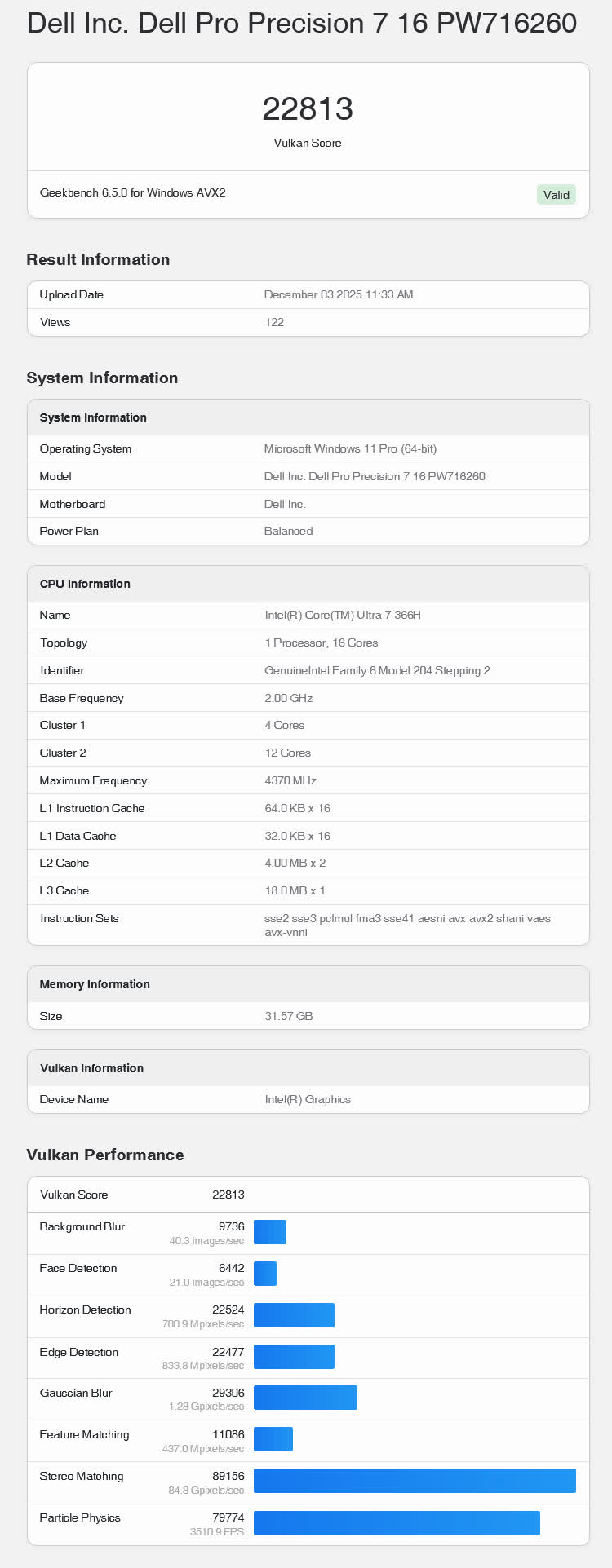
Intel is scheduled to introduce Panther Lake, the successor to its Lunar Lake laptop CPUs, at CES 2026 in January. The PW716260 includes one of these upcoming CPUs, the Intel Core Ultra 7 366H, indicating that it might emerge early next year.
Likely an engineering sample, the laptop's four Xe3 integrated graphics cores and four ray tracing units resulted in a Vulkan score of 22,813. The benchmark lands significantly above the AMD Ryzen AI 5 340's Radeon 840M iGPU and Nvidia's GTX 1050 Ti, but below the Radeon 860M. With four Cougar Cove performance cores, eight Darkmont efficiency cores, four LP efficiency cores, and a maximum clock frequency of 4.37GHz, the 366H appears to be intended for affordable mid-range gaming laptops.
"Dell Pro Precision 7"
– Hardware (@realVictor_M) December 3, 2025
Dell just dropped "Precision" from its new naming scheme this year. https://t.co/6sYqG6o7gU
Panther Lake will also include a lineup of 16-core high-performance processors, called Core Ultra X300H, and a series of low-power eight-core chips for small netbooks, called Core Ultra 300U. The CPUs are expected to deliver a 50 percent performance boost over Lunar Lake. Intel claims that Panther Lake will combine the power of its desktop Alder Lake chips with the efficiency of Lunar Lake.
The upcoming launches of Panther Lake and the Clearwater Forest server CPUs represent a crucial moment for Intel. The architectures are partially built on the company's new 18A semiconductor process node, the success of which will determine Chipzilla's viability in the foundry market against stiff competition from TSMC and Samsung.