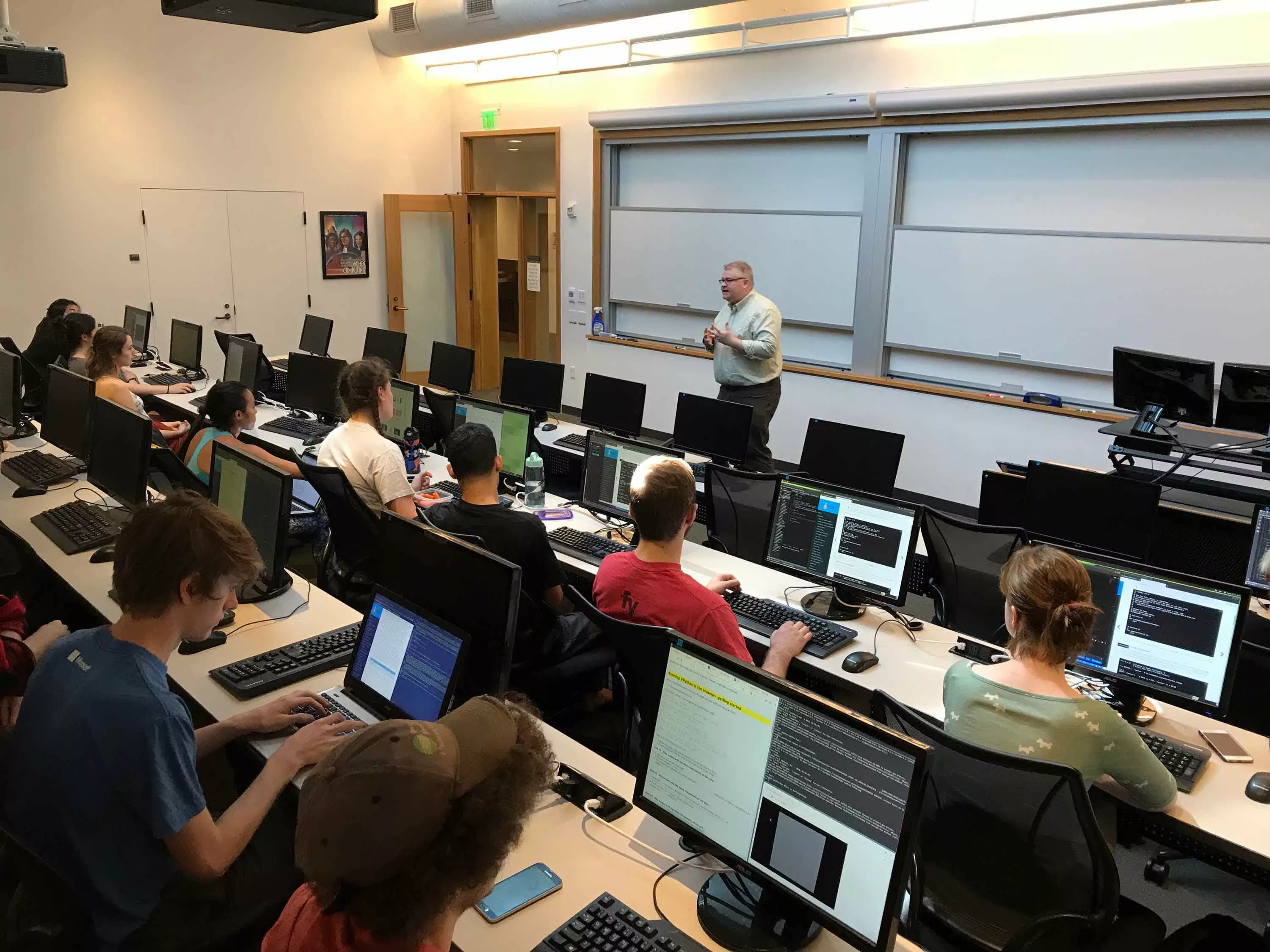
Ripple effect: Whether AI turns out to be a bubble remains to be seen, but it appears young people remain confident that the technology is the future. Just look at universities, which are seeing more students sign up for AI majors at the expense of traditional computer science programs.
Across the US, the rise of dedicated AI-undergraduate degrees – something almost unheard of a decade ago – marks one of the most significant changes in higher education.
Schools that once treated AI as a niche elective within a computer-science department are now spinning up full-blown majors, dedicated AI colleges, and cross-disciplinary programs built around the subject.
The New York Times reports that at the University of South Florida in Tampa, more than 3,000 students enrolled in a new college of artificial intelligence and cybersecurity. 150 first-year students signed up for a new AI major at the University of California, San Diego. And at the State University of New York at Buffalo has created the Department of A.I. and Society.
At places like MIT, AI-branded programs now rival computer science in enrollment numbers, while other universities report their AI signups growing even as their CS-student numbers shrink.

The appeal for students is obvious: despite the financial concerns, AI is taking over the world right now. Many incoming freshmen say they would have picked computer science in previous years, but they now view "AI" on a diploma as more enticing for prospective employers.
Universities, sensing this demand, have jumped on board. New AI programs promise a broader blend of technical and societal training, coving not just algorithms and programming, but also ethics, policy, human-machine interaction, and interdisciplinary problem-solving.
Some campuses have even lowered barriers to entry for non-STEM students, pitching AI as a skill set relevant to fields as varied as healthcare, law, and business.
But some warn that an AI degree doesn't automatically guarantee a great job. Many graduates understand the advanced elements of AI architecture but struggle with the foundational skills needed to deploy real-world systems, including networking basics, security hygiene, systems integration, or even writing production-grade code.
Small and mid-size companies in particular still need engineers who understand the boring but essential bits that keep modern IT functioning. There's concern that some AI programs lean too heavily on theory and hype without giving students the technical depth that CS traditionally offered.
There's also the broader fear of institutions stretching themselves too thin. With enrollment booming, some academics worry that programs are being built faster than they can ensure quality, rigor, or experienced faculty. The pressure to appear cutting-edge can lead to shallow curricula or a focus on flashy research rather than fundamentals.
Despite the concerns, AI majors seem poised to redefine what a tech degree means. Whether this ultimately strengthens the next generation of talent or simply rebrands computer science for the AI era, one thing is clear: students aren't waiting for the bubble question to resolve itself. They're betting their futures on AI, and universities are racing to keep up.