Big quote: According to Intel's benchmarks, the new Core Ultra X9 388H equipped with the Arc B390 iGPU is ~73% faster than the Ryzen AI HX 370 on average. AMD's Strix Point SoC is powered by Radeon 890M integrated graphics. Intel also claims its new chips surpass AMD in ray tracing, frame generation, and other graphics workloads.
While unveiling the Core Ultra 3 Series processors at CES 2026, Intel spent several minutes outlining its latest work in integrated graphics. The company claims its new flagship iGPU, the Arc B390, significantly outperforms AMD's best low-wattage competitor and confirmed plans to build a new handheld platform alongside several manufacturers.
Intel's benchmark results represent an average across 45 games at 1080p, upscaled from 540p, with the AMD chip drawing 53W and Intel's processor capped at 45W.
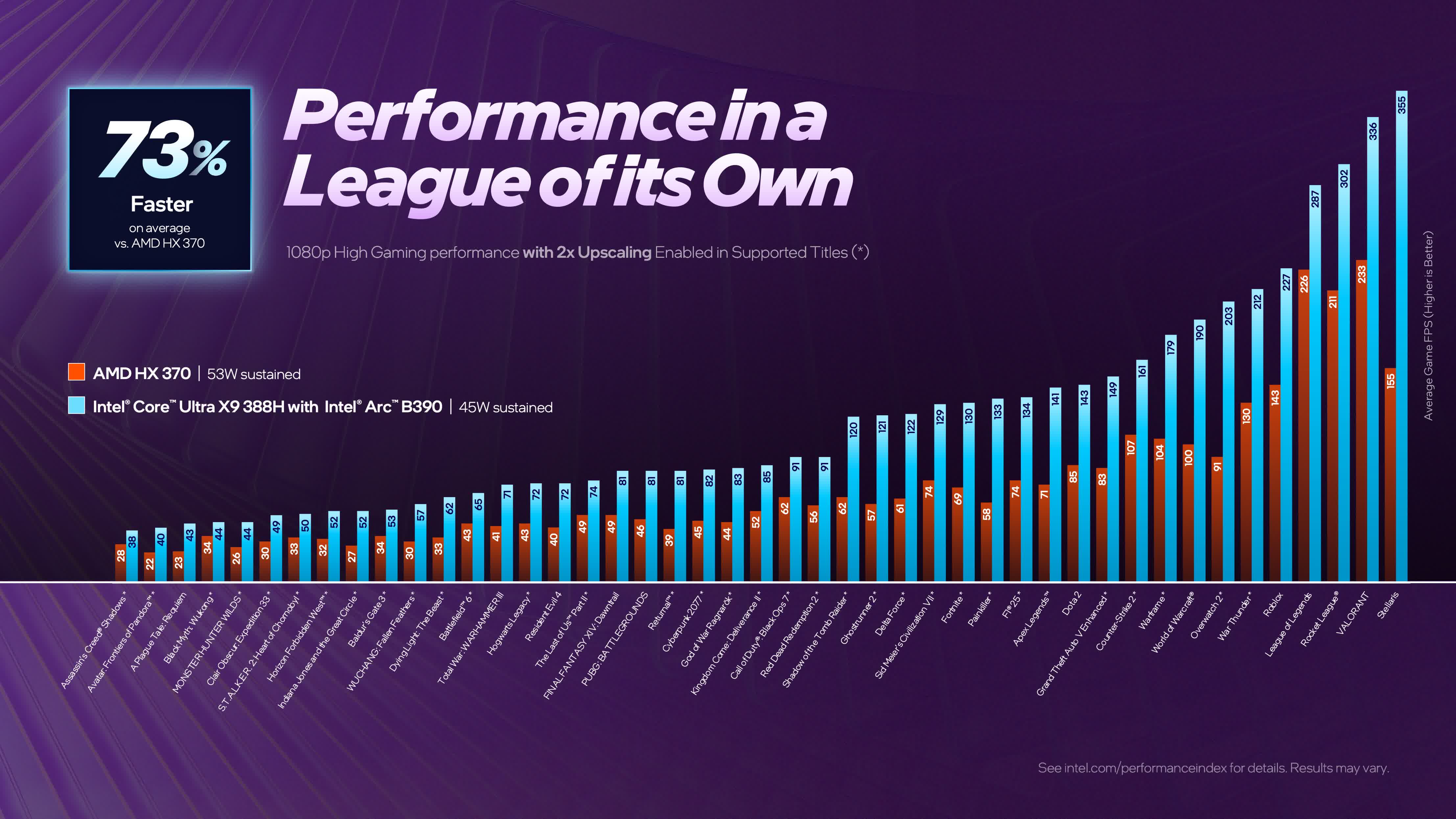
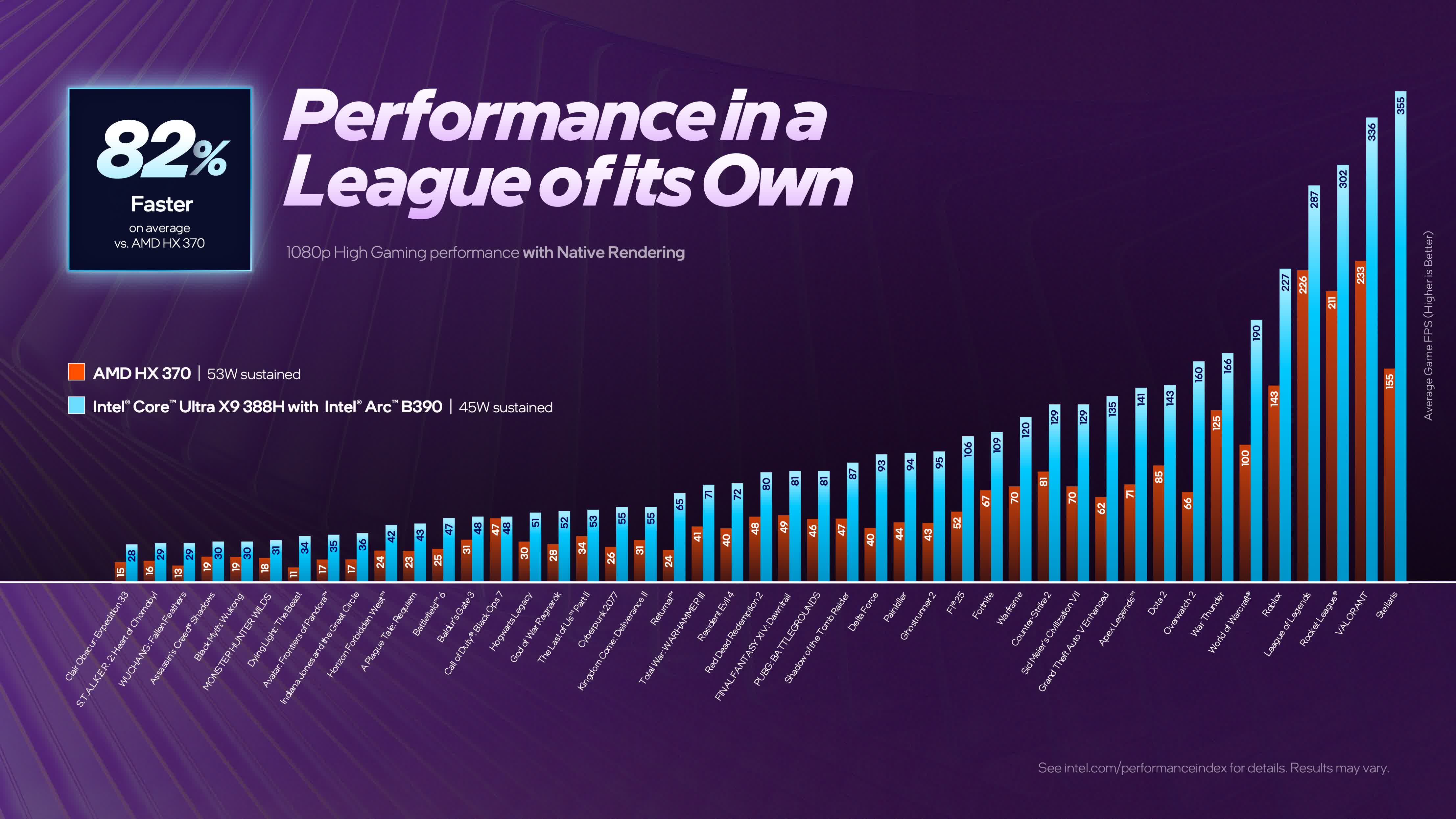
Demanding titles such as Assassin's Creed Shadows and Black Myth: Wukong achieve playable frame rates in the 30s and 40s, while League of Legends and Rocket League approach the 300 fps mark without relying on frame generation. At native 1080p, the average performance gap reportedly increases to 82%.
Intel also highlighted its XeSS upscaling technology, which is already available in current laptops and select MSI Claw models, claiming it outperforms the 890M's FSR3 implementation. While AMD has no plans to bring the more advanced FSR4 to mobile chips, Intel says its upcoming XeSS 3 will further improve AI-based upscaling on laptops and handhelds, while introducing multi-frame generation to mobile hardware for the first time.
Much like DLSS 4 on Nvidia's RTX 50 desktop GPUs, XeSS 3 aims to boost perceived frame rates by using AI to insert up to three generated frames between traditionally rendered ones.
Intel shared additional benchmarks comparing the technology favorably to FSR and DLSS, though the company stopped short of detailing its impact on input latency – an ongoing concern with frame generation.
Previous independent testing also suggests that multi-frame generation offers meaningful benefits primarily on displays with refresh rates of 240Hz or higher.
The Arc B390 features 12 Xe cores based on Intel's Xe3 Arc Battlemage architecture. Not to be one-upped, AMD unveiled the Ryzen AI 400 series at CES this week, but its new mobile chips utilize the same iGPUs as Ryzen AI 300.
The company also previewed the next generation of Strix Halo, its large-scale APUs that push mobile CPUs and GPUs into a new weight class. While Strix Halo can reportedly approach PlayStation 5-class performance, the only handheld device currently using it, the GPD Win 5, can cost as much as $2,000.
Although Intel's gaming-focused presentation largely centered on laptops, the company also signaled broader ambitions for the handheld PC market. A presentation slide confirmed partnerships with Microsoft, MSI, Acer, GPD, OneXPlayer, and other companies. Asus's logo was conspicuously absent.
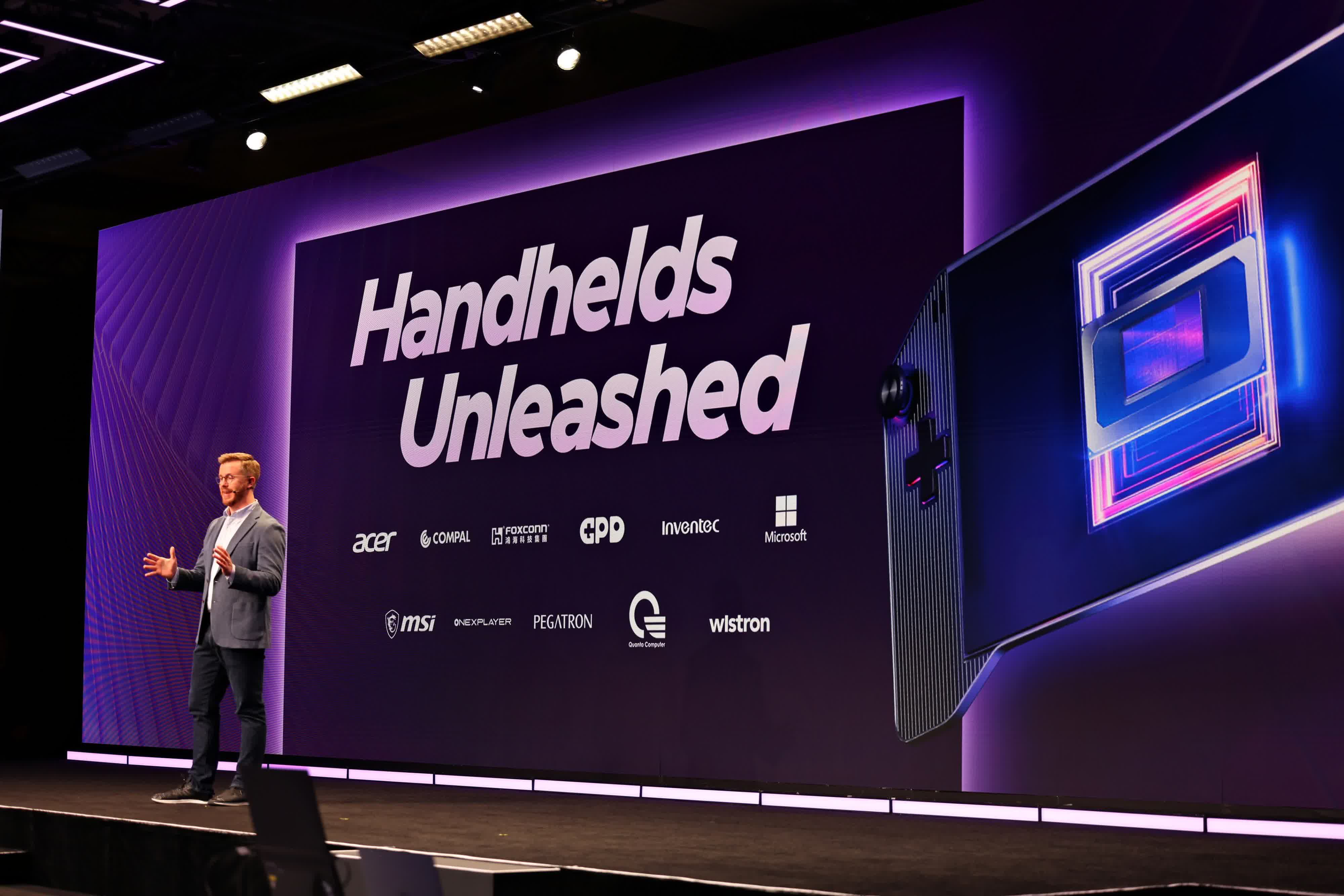
Intel's benchmarks appear to have been aimed squarely at the Radeon 890M, which powers recent handheld gaming PCs such as the Asus ROG Xbox Ally X, MSI's Claw A8, and the 2025 revision of the GPD Win 4. But it still remains unclear how the Arc B390 or a similar Xe3-based iGPU will perform in handheld form factors, which typically operate within a 15-30W power envelope.