
Editor's take: Companies with advanced chipmaking capabilities are currently raking in enormous profits. Unsurprisingly, two of the world's largest memory manufacturers are focused on sustaining and even inflating this unprecedented demand for as long as possible.
According to Korean sources, Samsung and SK Hynix are more than willing to raise memory chip prices while the AI-driven financial bubble continues. Both companies are reportedly notifying their high-profile customers that server DRAM prices could increase by as much as 60 – 70 percent compared to the fourth quarter of last year.
The price hike is hitting Big Tech particularly hard, with Microsoft and Google reportedly purchasing as many DRAM chips as possible. Outside the data center market, consumer products such as PCs and smartphones are expected to see similar manufacturing cost increases. Eventually, Asus and other consumer brands are likely to pass these higher costs on to end customers.
Additionally, the two Korean foundries are asking customers to agree to new quarterly contracts. Long-term agreements are now the exception rather than the rule, as chip manufacturers anticipate further price increases over the coming months and into 2027. In December, Micron announced it had already secured agreements for memory supply covering all of 2026, and the company has discontinued its consumer-oriented Crucial brand to better focus on enterprise customers.
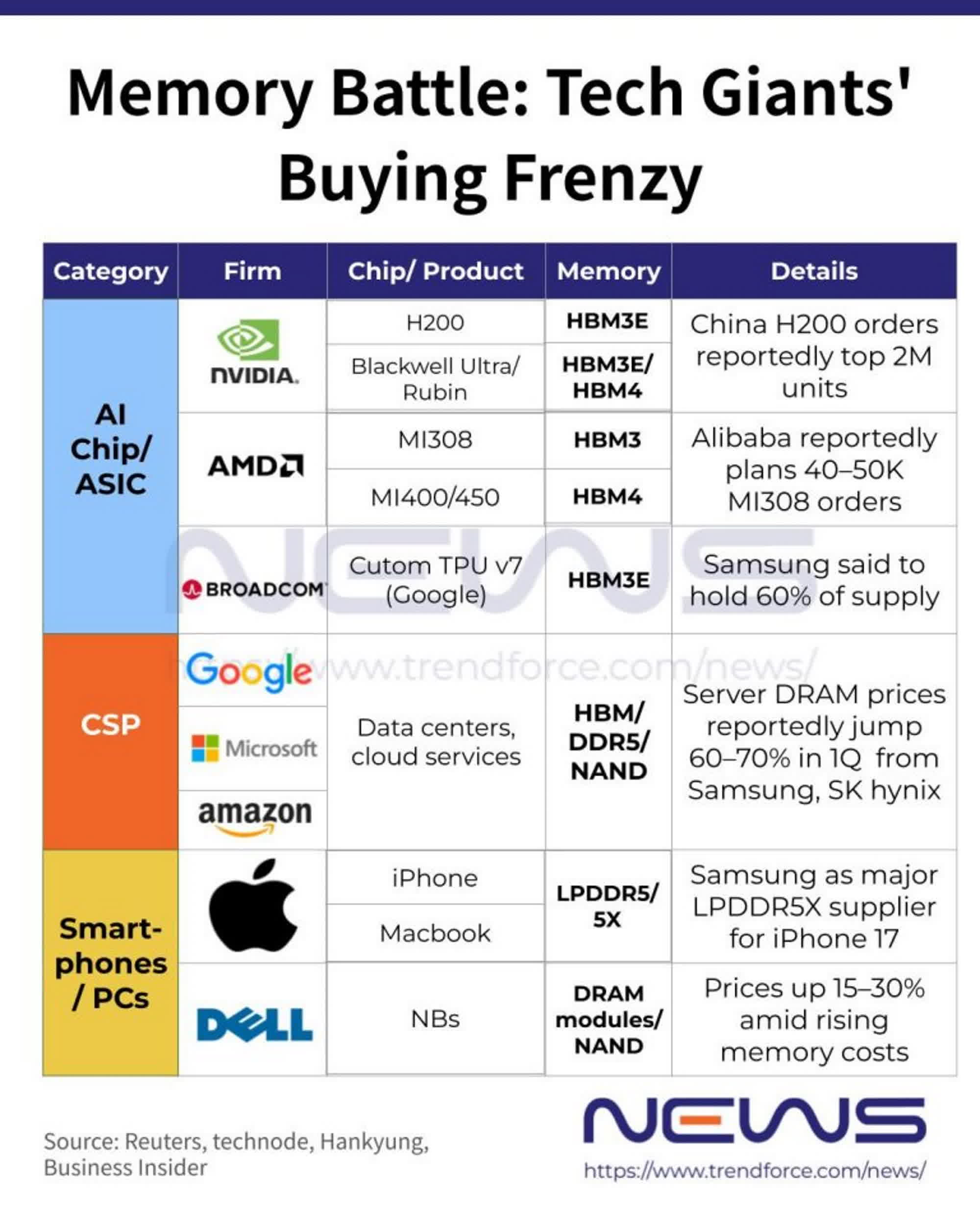
Sources said the recent cost increases are largely driven by a surge in orders for HBM3E memory products. Companies building new AI data center capabilities require powerful AI accelerators with large amounts of high-performance memory. HBM3E is used by Nvidia's H200 chips, which were recently cleared by the US government for export to China.
Broadcom is also ramping up HBM3E orders for Google's TPUs and other custom AI accelerators, adding further pressure on the DRAM supply chain. Microsoft, Amazon, and other IT giants are reportedly sending procurement teams to Korea to secure a stable memory supply. As a result, business hotels around Seoul have been booked for extended stays by US corporations.
TrendForce predicts that the DRAM boom will continue for some time, with prices for conventional contracts expected to rise up to 60 percent in the first quarter of 2026. NAND Flash prices are also projected to increase, though more modestly, with a maximum rise of around 38 percent. Demand is expected to far exceed the availability of new chips, and customers will likely accept the higher costs if they want to remain competitive.