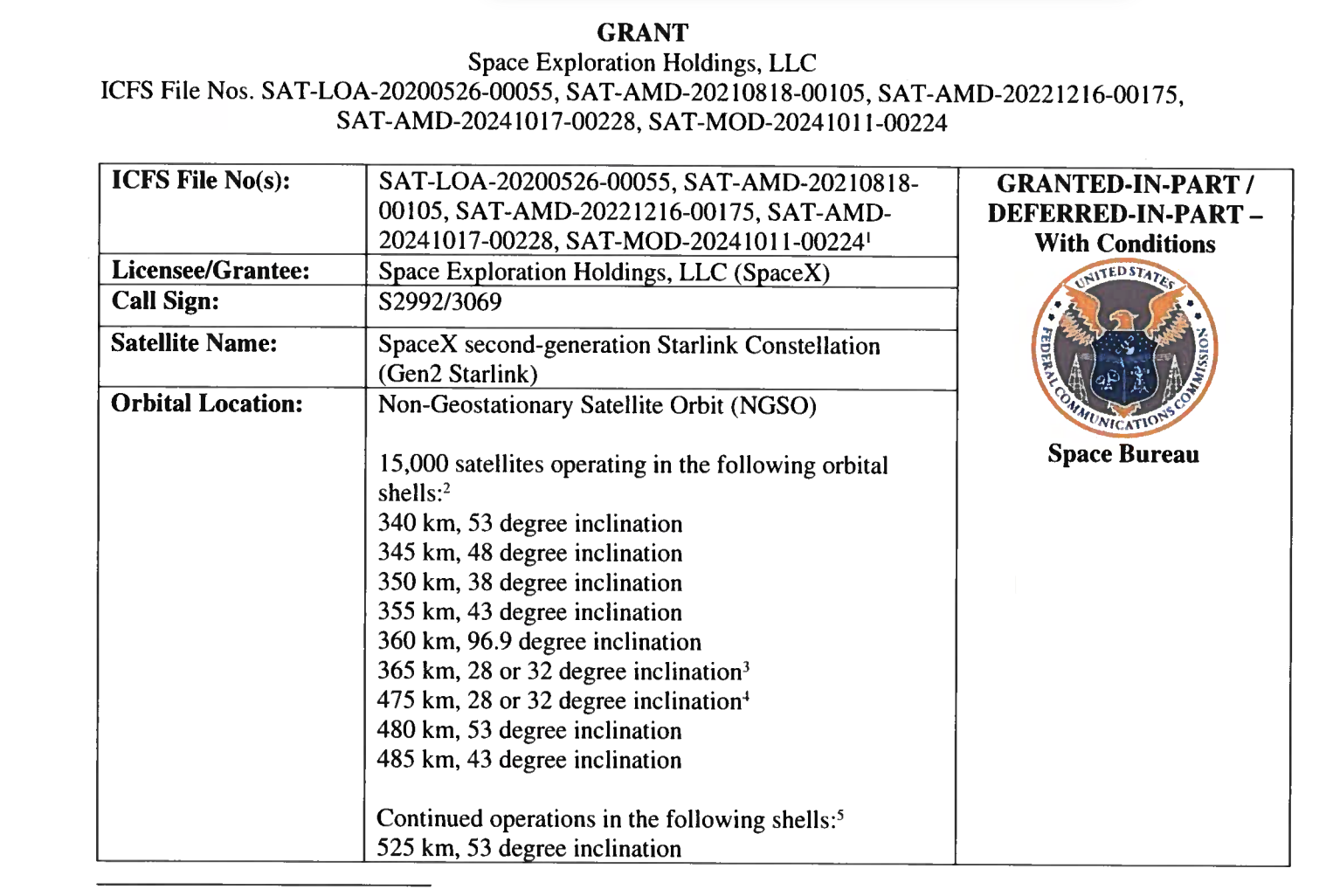
What just happened? The FCC has approved SpaceX's proposal to launch another 7,500 Gen2 Starlink satellites in low Earth orbit. Once those are up, the total constellation will swell to around 15,000 spacecraft, doubling the number of Gen2 units SpaceX can operate and marking a major regulatory victory for Elon Musk's satellite internet ambitions.
The approval is a major win for SpaceX, even though it falls short of the company's original request to deploy nearly 30,000 satellites. The green light allows Starlink to significantly expand its next-gen network, which is designed to deliver faster speeds, lower latency, and greater overall capacity compared to the first-generation constellation currently providing service worldwide.
According to the FCC's order, the newly approved satellites will operate at lower orbital altitudes than some of Starlink's existing spacecraft, helping to reduce latency while also allowing the network to support a higher density of users.
The Gen2 satellites are expected to play a key role in SpaceX's push toward symmetrical gigabit speeds, particularly in congested regions where demand for Starlink has surged faster than capacity.
The approval also gives SpaceX more flexibility in how it uses radio spectrum, including permission to operate across additional frequency bands. That expanded spectrum access should help Starlink improve performance and reliability, especially during peak usage periods.
SpaceX has argued that these upgrades are necessary to keep satellite broadband competitive with terrestrial fiber and cable, as well as with emerging rivals like Amazon's Project Kuiper.
However, the FCC attached conditions to the authorization. SpaceX must deploy and operate at least half of the newly approved satellites by the end of 2028, with the remainder launched by the end of 2031. The company is also still required to complete deployment of its earlier batch of Gen2 satellites by late 2027.
As with previous Starlink expansions, the decision has reignited concerns about orbital congestion and the growing number of satellites crowding low Earth orbit. Astronomers and competitors have repeatedly warned about increased collision risks, interference with ground-based observations, and the long-term sustainability of mega-constellations. The FCC says it weighed those concerns but concluded that SpaceX's mitigation measures and operational track record were sufficient to justify approval.
SpaceX announced earlier this year that it was lowering the orbit of its satellite constellation by around 44 miles to hopefully reduce the number of near-misses.
The congestion issue was highlighted last month when one of the nine satellites deployed from a Chinese rocket missed a SpaceX satellite by just 656 feet. The incident led to Michael Nicolls, a vice president of Starlink engineering at SpaceX, calling for increased coordination between satellite operators.
Starlink is beginning a significant reconfiguration of its satellite constellation focused on increasing space safety. We are lowering all @Starlink satellites orbiting at ~550 km to ~480 km (~4400 satellites) over the course of 2026. The shell lowering is being tightly…
– Michael Nicolls (@michaelnicollsx) January 1, 2026
Beyond consumer internet access, the expanded constellation supports enterprise customers, maritime and aviation connectivity, and future direct-to-device services.