
Ripple effect: Panic over ongoing PC hardware shortages has largely centered on the historic price hikes affecting RAM, but the same underlying pressures are also driving up the cost of solid-state storage. Recent price comparisons suggest that, in extreme cases, SSDs might as well be made of gold. Even traditional hard drives have not been completely spared from the crunch.
Redditor Dark_Marmot recently claimed that Western Digital's most expensive WD Black solid-state drive is worth 70 percent more than 24-karat gold by weight. While average SSD prices remain far below gold territory, quick calculations by TechSpot and Tom's Hardware suggest that some 8TB models have already crossed that threshold, with 4TB drives rapidly approaching it.
Comex Live currently prices gold at approximately $4,601 per ounce. The 8TB WD Black SN8100 weighs 8.6 grams without its heatsink, translating to roughly $1,396 worth of gold. Priced at $1,000 in October, the SSD was already nearing parity with its weight in gold, but its price surged to $2,169.99 earlier this month (currently discounted from $2,308.99). While that figure still falls short of being 70 percent more valuable than gold, the sudden doubling in price underscores just how strained the supply has become.
Some M.2 storage is now 70% more valuable than 24k gold by weight.
byu/Dark_Marmot inpcmasterrace
While the 4TB model costs $1,144.99, it weighs just 7.5 grams, which translates to "only" $1,217 worth of gold by comparison. Tom's Hardware reached similar figures after surveying multiple retailers.
That said, the SN8100 is a premium SSD. It currently tops our list of recommended PC storage drives under its new SanDisk branding. While average prices for 2TB and 4TB SSDs have risen sharply since last fall, PCPartPicker data shows they are now approaching roughly $300 and $600, respectively.
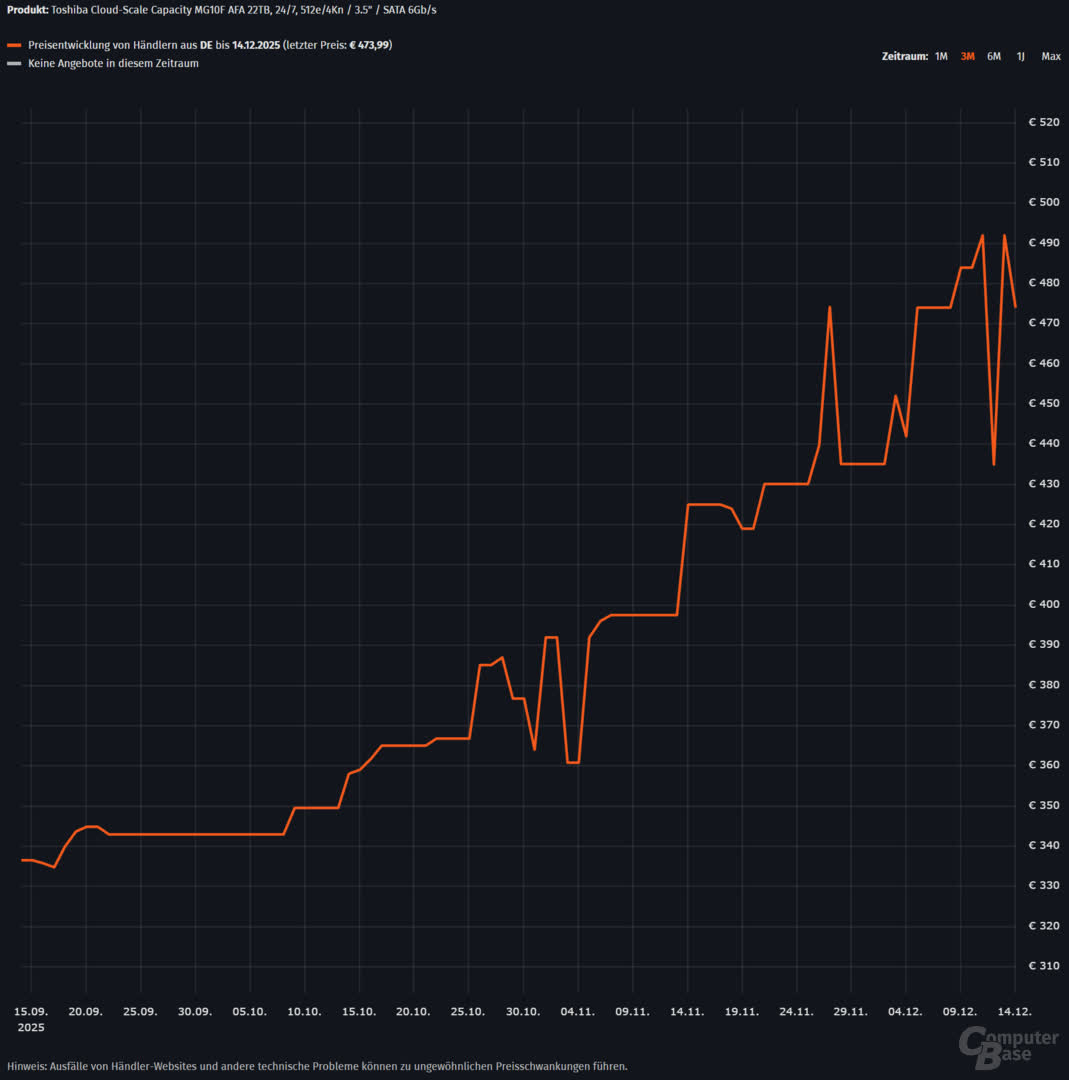
Meanwhile, although the AI industry's appetite for storage has not yet significantly affected hard drive prices in the United States, ComputerBase reports that HDDs have become an average of 46 percent more expensive in Europe since September.
That headline figure masks wide variation across a sample of roughly a dozen models with capacities ranging from 4TB to 30TB. While some drives have seen price increases of 20 to 30 percent, others now cost 50 to 60 percent more than they did just four months ago.
AI companies are aggressively hoarding DRAM and NAND production capacity for planned data center expansions as the industry's boom continues. Manufacturers such as Samsung and SK Hynix have responded by raising DRAM prices by as much as 70 percent. Since early November, DDR4 16Gb (2Gx8) spot prices have more than tripled, climbing from $28 to $90, a shift that has even prompted a limited resurgence of older DDR3 memory.
Industry leaders now predict the supply crunch will persist through at least 2026.