
Bottom line: The blockchain's promise of limitless financial experimentation has curdled into something more sobering, revealing an ecosystem straining under its own excesses. By late 2025, what once looked like a frontier instead resembled an overburdened network littered with abandoned code. A CoinGecko analysis shows that more than half of all cryptocurrencies ever created have already failed. Of the 20+ million tokens launched between mid-2021 and the end of 2025, 53% are no longer traded, their contracts still float in block explorers but are effectively lifeless.
That collapse didn't unfold gradually, it accelerated.
In 2025 alone, roughly 11.6 million tokens went inactive, accounting for 86.3% of all crypto project failures recorded over the five-year period. The forces behind the downturn weren't rooted in broken technology so much as in broken incentives. Automation made it trivially easy to mint new tokens at scale.
Platforms like pump.fun, a launchpad built to streamline token deployment, let creators spin up digital assets in minutes, often without a product, purpose, or development roadmap. CoinGecko analyst Shaun Paul Lee said these tools lowered barriers to entry, but at a cost: markets flooded with low-effort memecoins, many of which barely survived beyond their first few trades.
The consequences became impossible to ignore in the final quarter of the year. Between October and December 2025, an estimated 7.7 million tokens failed, the sharpest three-month collapse since 2021. That period overlapped with a major liquidity shock on October 10, dubbed the "liquidation cascade," when $19 billion in leveraged crypto positions were forcibly unwound. The event wiped out paper value and siphoned liquidity from decentralized exchanges, pushing already fragile or purely speculative tokens into permanent dormancy. Lee described it as the largest deleveraging event in crypto's history, one that exposed how fragile the post-bull-cycle environment had become.
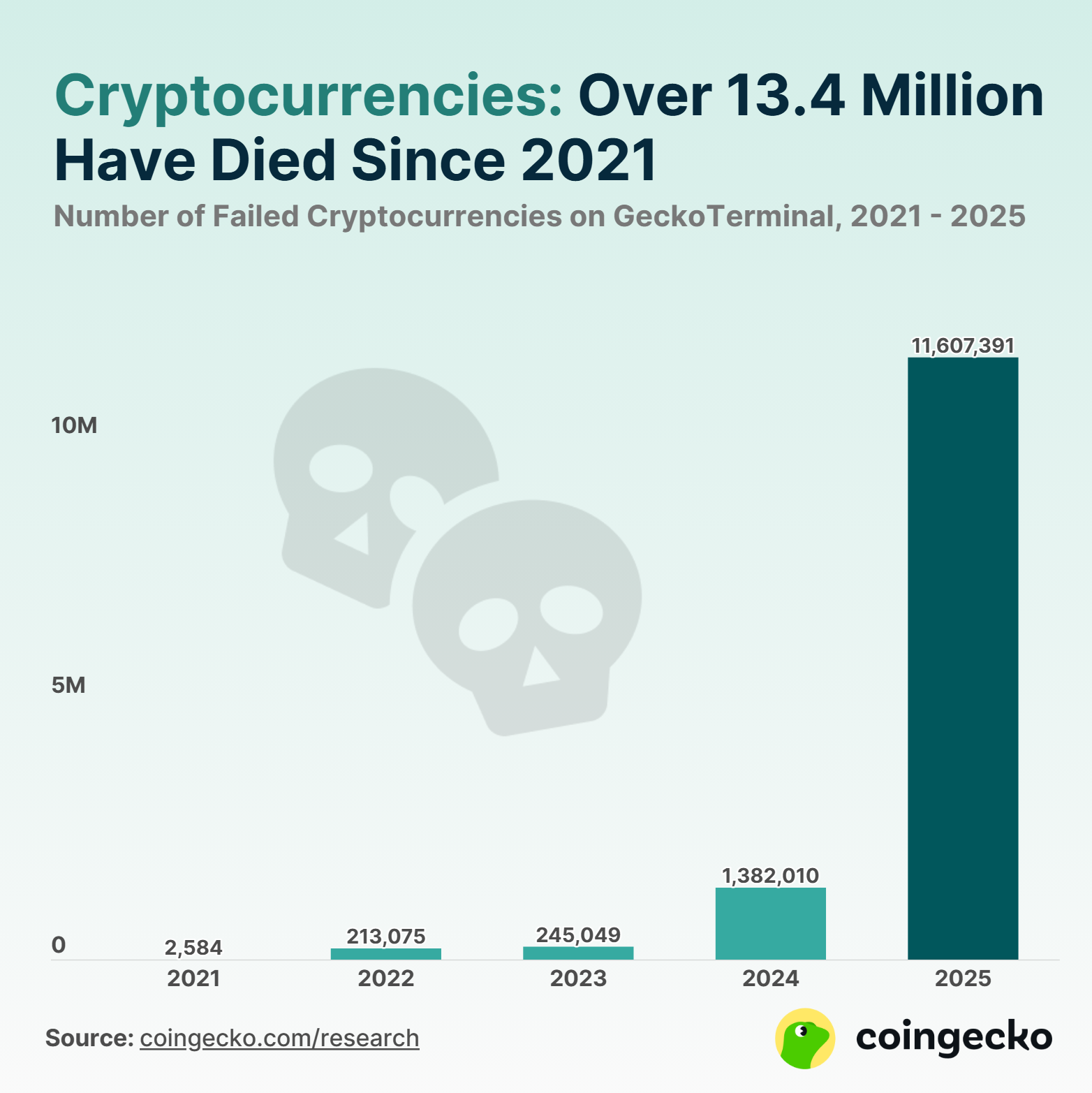
Zooming out, the broader timeline tells a story of explosive but increasingly hollow growth. Just 2,584 projects went dark in 2021. By 2024, that figure had swelled to more than 1.3 million, before erupting in 2025. The data tracks projects that recorded at least one trade before going silent, a definition that shows just how many digital tokens die immediately after launch.
Behind the numbers lies an important characteristic of the blockchain economy: its open-access design. The same permissionless architecture that enables innovation also allows near-infinite replication, turning token creation into something more akin to digital spam.
What emerges from CoinGecko's dataset is a picture of an industry overwhelmed by its own accessibility. Token generation has become so frictionless that network capacity, market liquidity, and user attention simply can't keep up.
The speculative momentum that once drove crypto adoption has turned recursive, a system endlessly minting its way toward irrelevance. The blockchain, it turns out, didn't just decentralize finance, it democratized failure at scale, too.