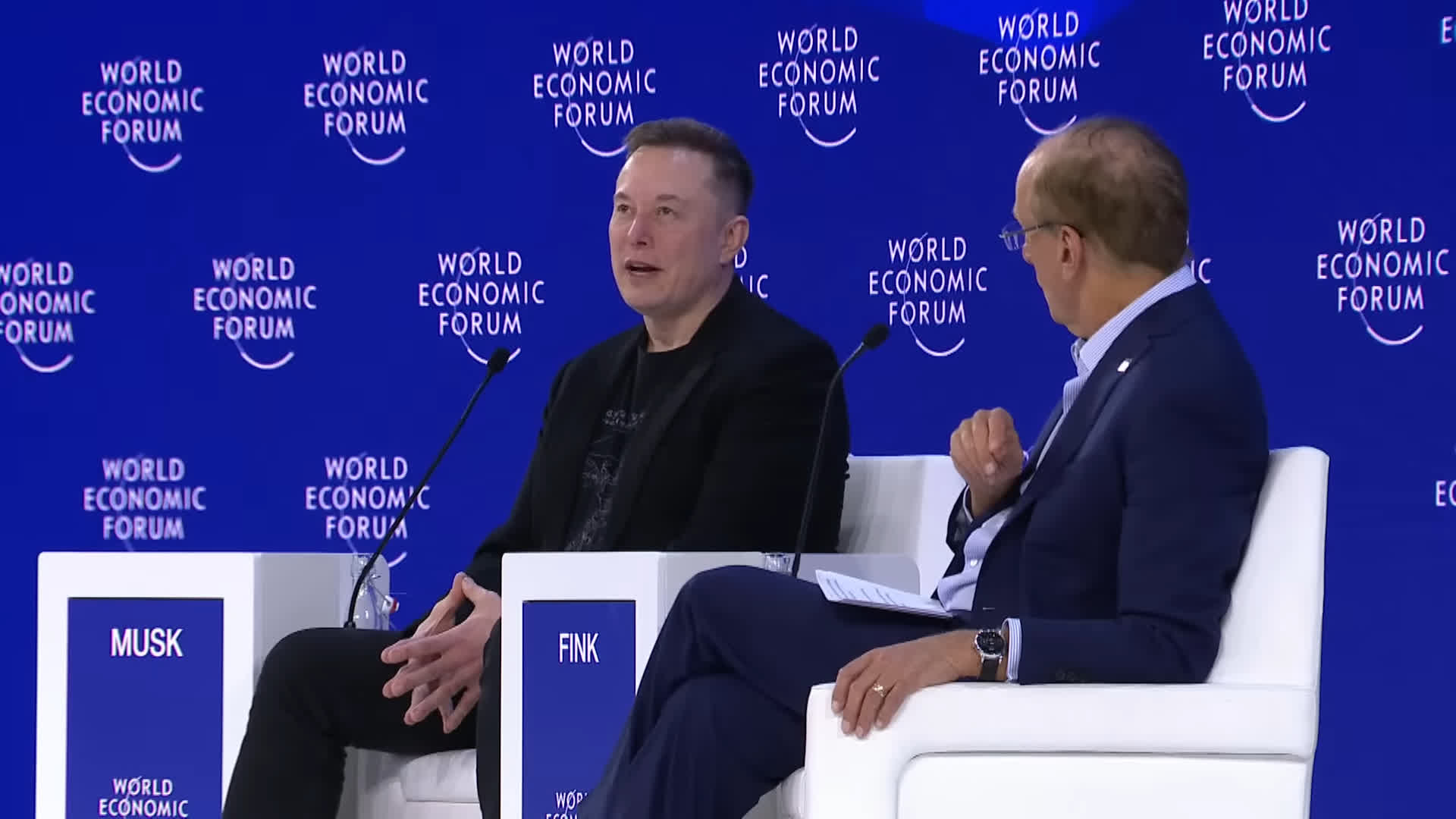
What just happened? Elon Musk has never been a fan of the World Economic Forum, having once declined an invitation to Davos because it sounded "boring af lol." As such, his first appearance at the Swiss event came as a surprise, as did his claim that aging is "a very solvable problem."
Musk made his WEF debut yesterday for an interview with BlackRock CEO and interim WEF cochair Larry Fink. The world's richest man has long criticized the organization for "increasingly becoming an unelected world government."
Musk started with a joke, of sorts, about President Trump's recent actions and his Board of Peace. "I was like, is that piece? A little piece of Greenland. A little piece of Venezuela," he said. It got the kind of muted response you'd expect. It's likely that Mel Brooks – who did the same joke (in song) so brilliantly as Hitler in 1983's To Be or Not To Be – would have been embarrassed for him.
The conversation covered a lot of what Musk has talked about in the past: AI and robotics becoming "ubiquitous" and making human work obsolete, AGI arriving by 2030 or 2031. Back in 2023, Musk told then-UK Prime Minister Rishi Sunak that artificial intelligence will eventually replace all human jobs as it would be able to "do everything."
Musk also talked about Tesla's Optimus robots, which he said will go on sale to the public next year. He said that when robots do outnumber humans there will be a huge economic boom, but urged caution as "we don't want to find ourselves in a James Cameron movie."
Musk also said that SpaceX would launch its solar-powered AI data centers into space within a few years, adding that he expects them to solve the problem of data centers consuming vast amounts of power on Earth.
"The net effect is that the lowest cost place to put AI will be in space, and that'll be true within two years, maybe three at the latest," said Musk.
There was also a swipe against tariffs in the US. Musk said the United States could produce enough solar power to meet all of its electricity needs, including data centers, by covering a small corner of Utah or Nevada with solar panels – something he previously said in 2015.
"Unfortunately, the tariff barriers for solar are extremely high and that makes the economics of deploying solar artificially high," Musk said.
Musk also gave his views on aging and death. "When we figure out what causes aging, I think we'll find it's incredibly obvious. It's not a subtle thing," he said.
"The reason I say it's not a subtle thing is because all the cells in your body, you know, pretty much age at the same rate. I've never seen someone with an old left arm and a young right arm ever in my life, so why is that? There must be a clock that is synchronizing across 35 trillion cells in your body."
The billionaire did admit that there are some benefits to death. "If people do live for a very long time, I think there's some risk of an ossification of society. Of things getting locked in place," he said. "It may become stultifying. A lack of vibrancy, but that said, do I think we'll figure out ways to extend life and maybe even reverse aging? I think that's highly likely."
Elsewhere in the conversation, Musk joked that he would like to die on Mars, "but not on impact."