Back to the x86 Past: As PC hardware becomes prohibitively expensive for many users, modders are increasingly turning to retro computing and related projects. One developer recently set out to build a fully functional 486 motherboard using modern components, and ultimately achieved far better results than initially expected.
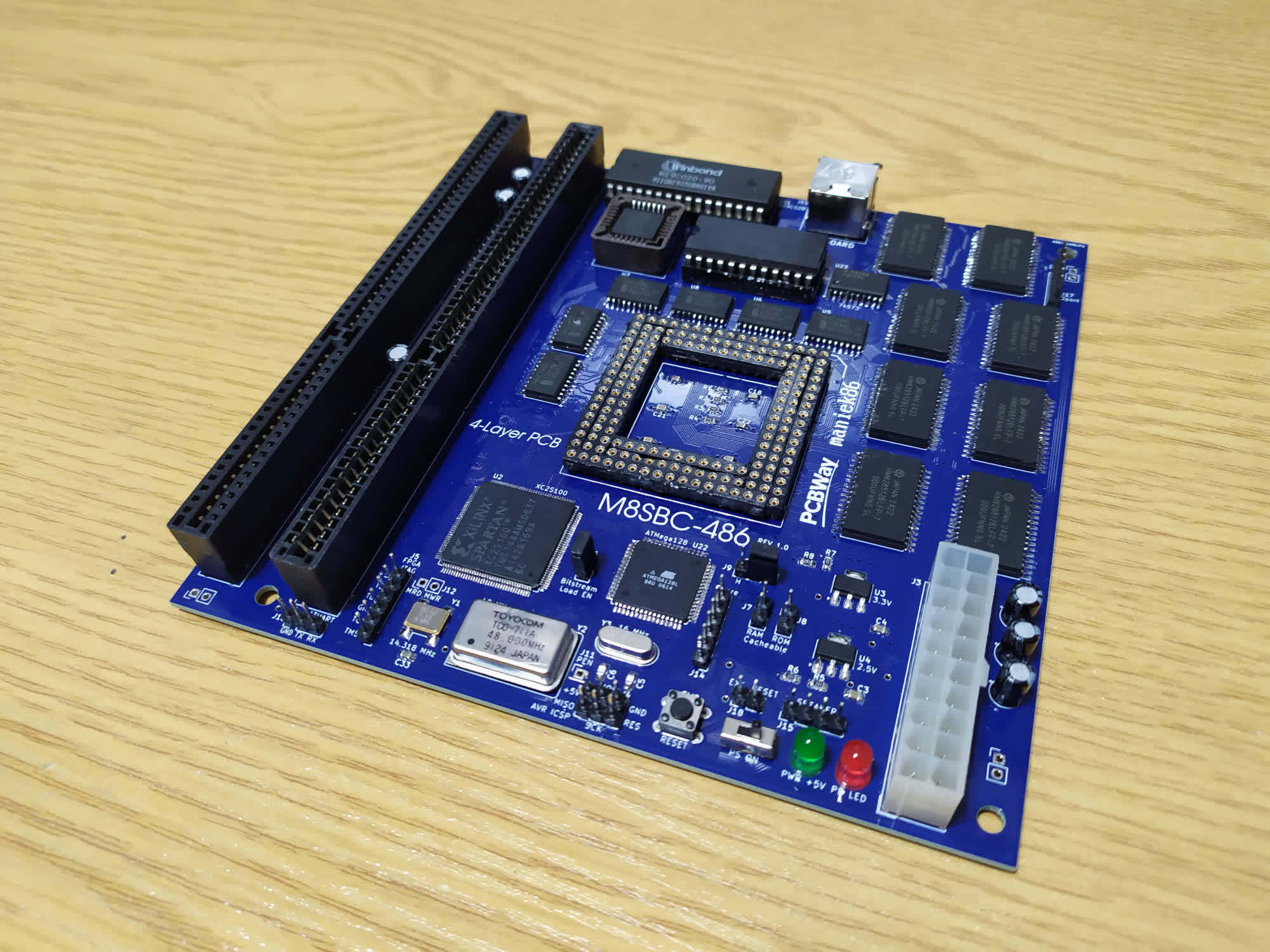
A hobbyist programmer named Piotr "maniek86" Grzesik recently unveiled his latest project. The M8SBC-486 motherboard is designed to power a homebrew 486-style computer, though it does not include a genuine Intel 486 processor and offers only limited compatibility with DOS- and Windows-era software.
Maniek86 began the project with a relatively modest goal: to build a homebrew 486 system capable of running Linux and Doom. After several months of schematic design and PCB prototyping supported by PCBWay, he achieved a significantly higher, though still constrained, level of PC compatibility.
The final "kind-of PC-compatible" motherboard is built around a custom chipset, codenamed Hamster 1, implemented on a Xilinx Spartan-II XC2S100 FPGA. It features 4MB of SRAM, two 16-bit ISA slots, and a handful of essential PC components. However, the design omits a secondary programmable interrupt controller (PIC) and DMA support, which means it cannot operate ISA sound cards.
Grzesik notes that the bare-bones specifications of the M8SBC-486 are still sufficient to support a limited range of ISA VGA cards and DOS-based operating systems, including MS-DOS 6.22 and FreeDOS 1.4, as well as a custom Linux kernel based on Linux 2.2.26. Windows 3.1 in enhanced mode can "kind of" run under FreeDOS, while Windows 95 fails to progress beyond the setup stage.
Compatible DOS software includes FastDoom, a retro port designed to run id Software's iconic shooter as efficiently as possible on 386 and 486 systems. The M8SBC-486 effectively emulates a 486-class processor with a 24 MHz front-side bus, meaning a 486 DX2 configuration tops out at 48 MHz. Other working software includes several FreeDOS memory extenders, a handful of demoscene productions such as Second Reality, and classic games like Prince of Persia and Wolfenstein 3D.
Grzesik emphasizes that the M8SBC-486 is strictly an experimental platform, created to explore the inner workings of legacy x86 architectures – a subject of growing interest among retro-computing enthusiasts. He adds that other modders could potentially build on his design to create a more robust and stable system, or even develop a fully custom set of boards targeting different x86 processors.
"There are still many issues, but it's heartwarming that I can get so much existing software to work," the code and electronics enthusiast stated.