
Winners & losers: Nvidia CEO Jensen Huang has announced that the company's Vera CPU will debut as a standalone infrastructure product, not merely as a supporting element for its GPUs. For the first time, Nvidia will sell a processor capable of powering full computing stacks on its own, signaling an intentional move into the heart of the data center market long dominated by AMD and Intel. Huang described Vera as "revolutionary," hinting that early partners such as CoreWeave are already preparing deployments, even before official design wins have been announced.
This decision represents far more than a new product launch; it is the culmination of Nvidia's push to become a one-stop silicon provider for AI and high-performance computing. The company's strategy is clear: rather than relying on GPUs to accelerate other firms' CPUs, Nvidia now wants its own architecture to run every stage of computation, from number-crunching cores to AI inference pipelines.
The shift is expanding its influence across cloud and enterprise infrastructure, aiming to position Nvidia as a full-system supplier rather than a single-component vendor.
Technically, Vera arrives well-equipped for that ambition. The processor is built around 88 custom Armv9.2 Olympus cores, each capable of running two threads through Spatial Multithreading. This design gives Vera an effective footprint of 88 cores and 176 threads, unlocking parallel performance traditionally reserved for x86-based rivals.
Bloomberg interview with Nvidia CEO Jensen Huang, on the Vera CPU Plan:
– Ed Ludlow (@EdLudlow) January 26, 2026
"For the very first time, we're going to be offering Vera CPUs. Vera is such an incredible CPU. We're going to offer Vera CPUs as a standalone part of the infrastructure. And so not only, not only can you... https://t.co/Qwd5bL91Wf
Nvidia's choice to base the CPU on Arm architecture allows more flexibility in performance scaling and power optimization – critical advantages in data center efficiency.
The chip integrates 1.5 terabytes of LPDDR5X memory and delivers 1.2 terabytes per second of bandwidth, an unusually high ratio for a general-purpose CPU. That balance makes Vera especially suited for memory-intensive workloads such as AI model preprocessing, data analytics, and simulation.
Still, it remains unclear whether Nvidia will support conventional DDR5 RDIMM modules or rely solely on the LPDDR5X configuration typical of its system-on-module designs.
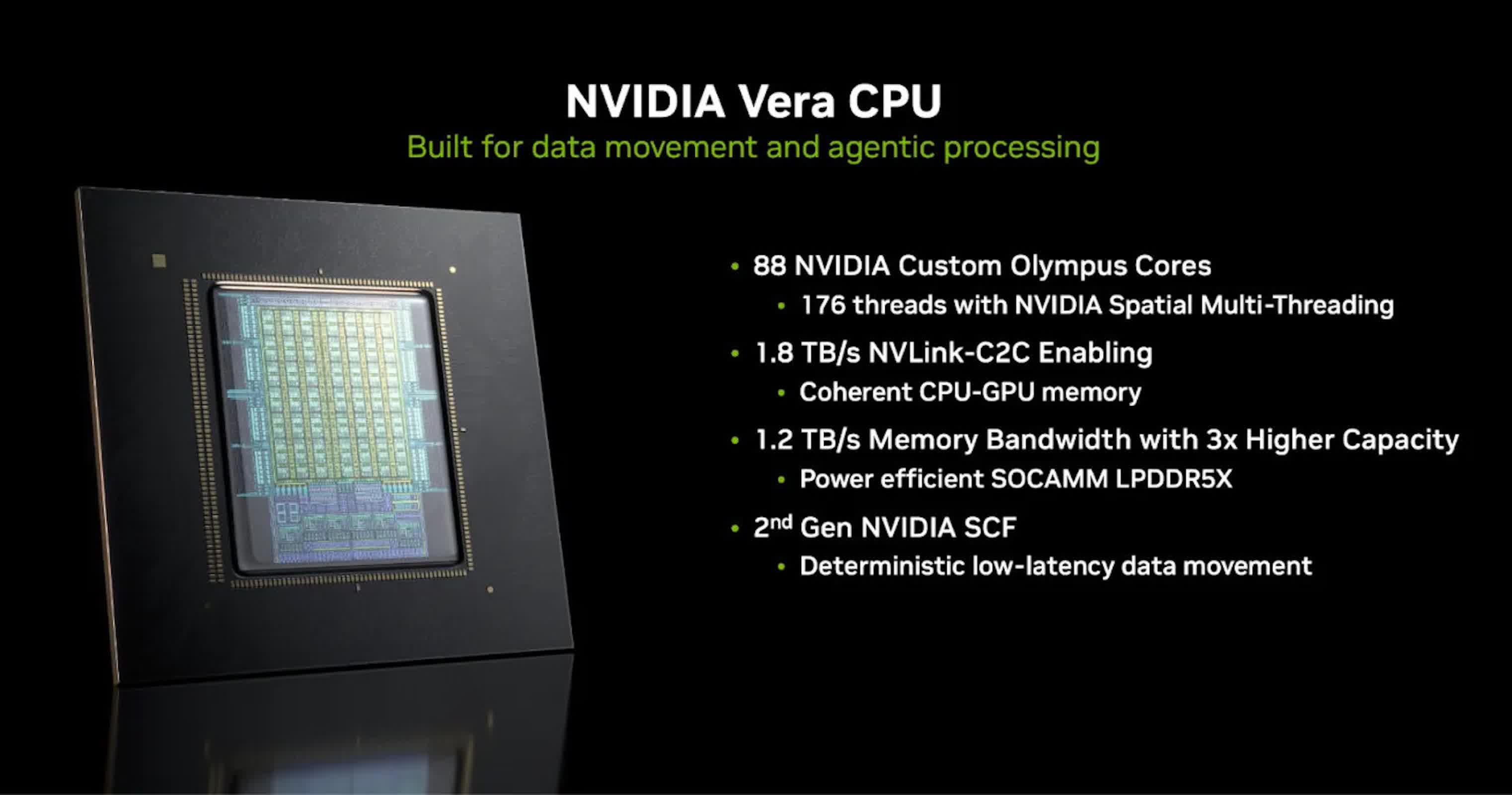
A defining component of Vera's architecture is its second-generation Scalable Coherency Fabric, a high-speed interconnect that links all 88 cores across a single monolithic die. The fabric enables 3.4 terabytes per second of bisection bandwidth, allowing efficient data exchange between cores with minimal latency – an engineering choice that sidesteps the synchronization delays often encountered in chiplet-based CPUs such as AMD's EPYC.
Vera's fabric doesn't act alone. It interfaces directly with Nvidia's NVLink Chip-to-Chip technology, now in its second generation, providing up to 1.8 terabytes per second of coherent bandwidth to external components such as the upcoming Rubin GPU.
The symmetry between Vera and Rubin enables them to share memory models and data, creating a unified CPU-GPU environment within the same compute framework.
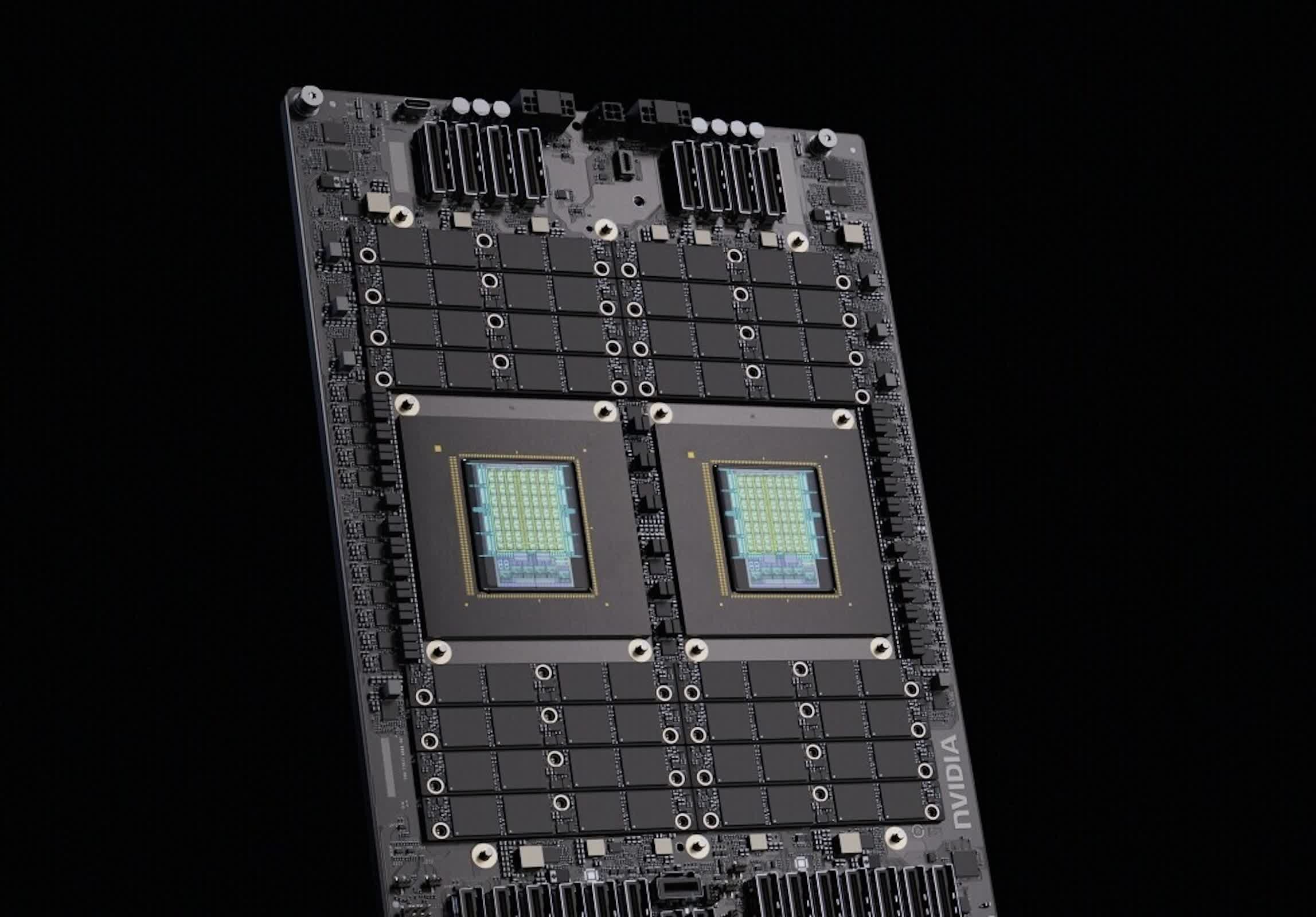
Vera's cores use FP8 arithmetic and six 128-bit SVE2 vector units for faster data and AI processing. These capabilities allow Vera to handle certain AI and floating-point operations directly on its CPU cores, reducing the need to offload everything to a GPU. In doing so, Nvidia shifts AI-inference efficiency closer to the CPU – an advantage that could reduce energy overhead and latency in diverse enterprise applications.
For Nvidia, the Vera CPU marks both a technological milestone and a strategic turning point. It transforms the company from the world's leading GPU supplier into a direct competitor in the general-purpose computing market. AMD's EPYC and Intel's Xeon families will soon face a new kind of challenger – one leveraging the same GPU-CPU integration that has fueled Nvidia's rise in AI acceleration.