
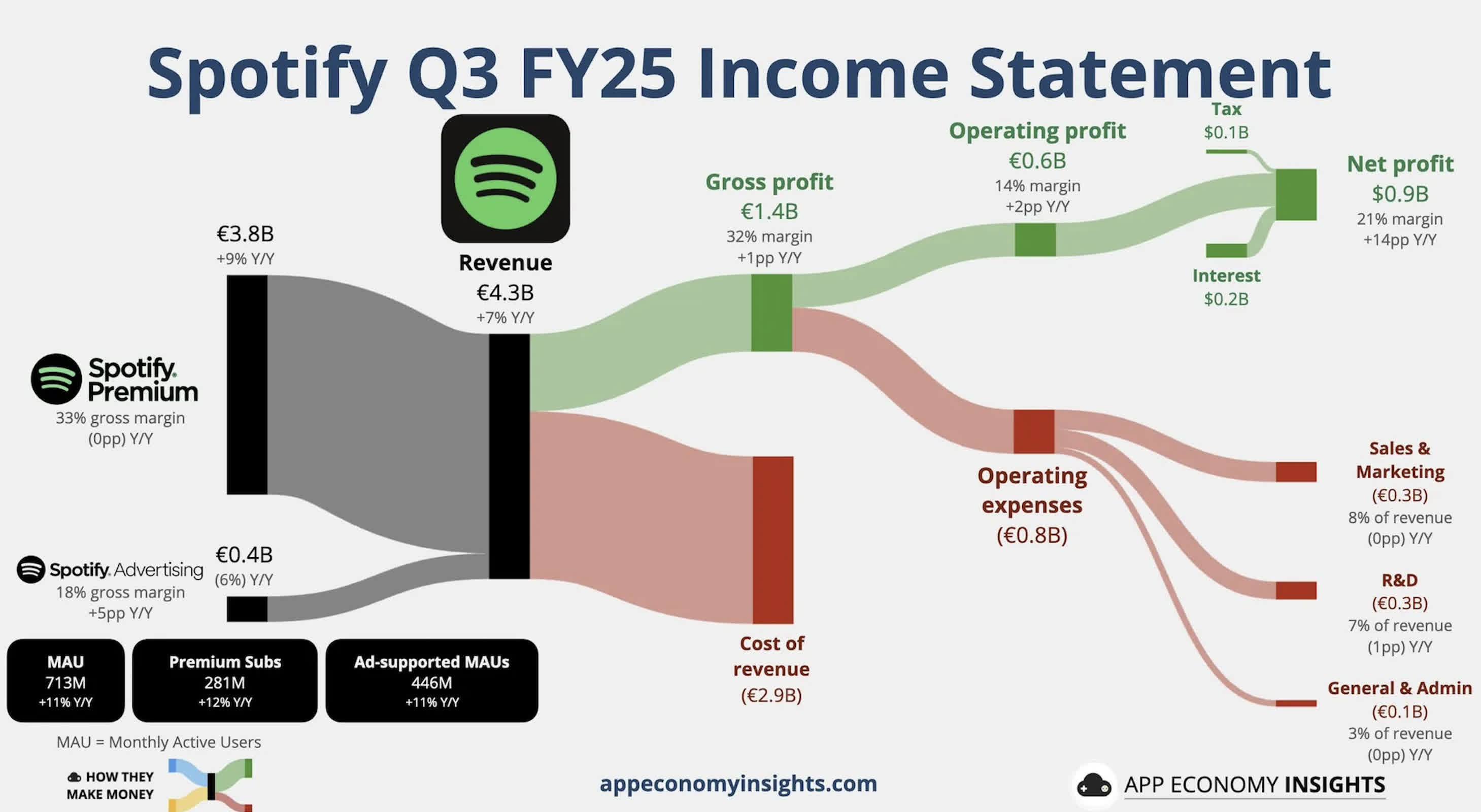
Bottom line: Spotify's influence over the global music economy reached a new peak in 2025, as the company disclosed it now accounts for roughly one-third of all recorded music revenue. The milestone places the streaming platform at the center of the industry's financial ecosystem – and the data behind that dominance is significant.
The company reported that it distributed more than $11 billion to rights holders last year, the largest annual payout in music history. Since 2017, Spotify's total payouts have doubled, bringing cumulative payments to nearly $70 billion. Head of Music Charlie Hellman described the figure not just as a measure of scale but as evidence that the platform is now the primary engine of industry growth.
Spotify said its payouts to artists and labels grew by more than ten percent in 2025, while other revenue channels, such as digital downloads and physical media, expanded by roughly four percent. That widening gap highlights how streaming has become the dominant source of global music income – and how dependent artists and labels have become on its algorithms and revenue systems.
Credit: App Economy Insights
Independent artists and smaller labels saw a notable boost, collectively earning about half of all royalties distributed through Spotify. The company said more musicians than ever are now earning six-figure incomes annually through the platform alone – a signal that its reach is translating into measurable gains for creators outside the traditional major-label system.
But Spotify's statement wasn't only about revenue. With over 100,000 new tracks uploaded each day, Hellman acknowledged that helping new artists "cut through the noise" has become one of the company's toughest challenges. Competing against what amounts to the entire digital history of recorded music, newcomers face an algorithmic battlefield where visibility can determine a career's trajectory.
In response, Spotify announced several product initiatives aimed at discovery and authenticity. Among them is SongDNA, a forthcoming feature that will let listeners view detailed credits for each track, including songwriters, producers, and contributors.
The company is also developing new tools to convert casual listeners into ticket buyers, bridging streaming with live performance revenue, and reintroducing human editors to complement automated playlisting.
A major component of the company's roadmap addresses what Hellman called the "exploitation" of artificial intelligence in music distribution. He said Spotify will overhaul its systems for artist verification and song credits to counter the influx of AI-generated material that's designed to "game the system" and redirect royalties from legitimate creators.
"AI is being exploited by bad actors to flood streaming services with low-quality slop," Hellman said, describing the company's effort to prevent synthetic tracks from eroding trust in the streaming ecosystem.
The combination of record-breaking payouts and an escalating campaign against AI misuse signals a new phase for Spotify – one in which the infrastructure of the world's largest streaming platform becomes as much about authenticity and transparency as about volume or reach. For an industry long defined by disruption, Spotify's message is clear: its next disruption may be in defense of music itself.