Through the looking glass: In the faint distortions of distant galaxies, astronomers have glimpsed the scaffolding of the universe. A new high-resolution dark matter map, created using data from the James Webb Space Telescope, has given physicists their clearest view yet of the invisible material thought to compose most of the cosmos.
Published in Nature Astronomy, the study details how Webb's infrared instruments charted nearly 800,000 galaxies in the COSMOS field. The data reveal how dark matter – undetectable by light but dominant in mass – has shaped the universe's structure from its earliest epochs.
"It's the gravitational scaffolding into which everything else falls," Richard Massey, a physicist at Durham University and co-author of the study, told The National Geographic. "We can actually see that process happening in this map."
Dark matter is believed to be roughly five times more abundant than ordinary matter, yet it emits no light. Scientists infer its presence from gravitational effects – how it bends and tugs at visible matter. By tracing such distortions, researchers can outline where dark matter clusters and how it guides galaxy formation.
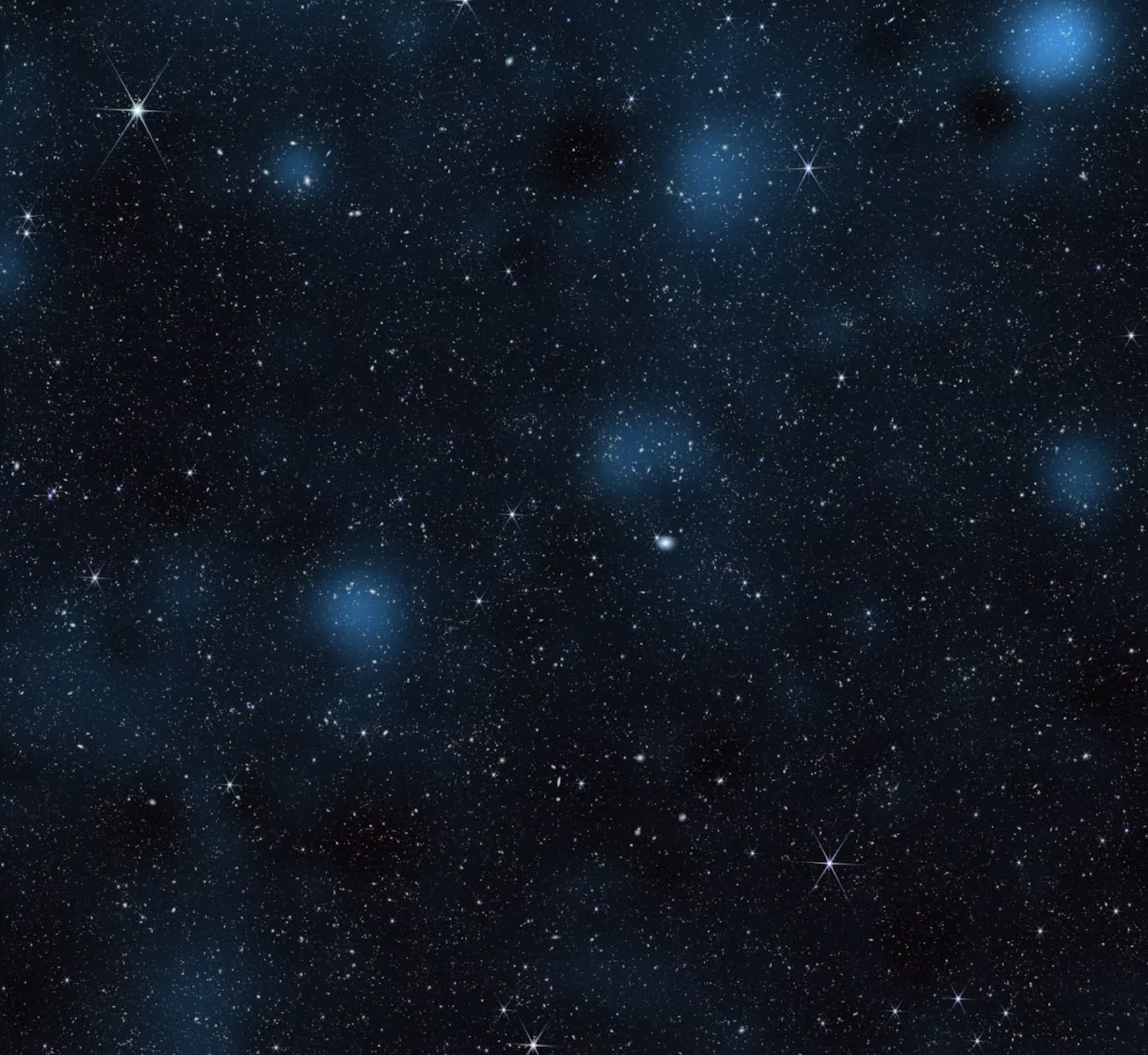
The Webb team used a phenomenon called weak gravitational lensing, a subtle warping of light caused by massive invisible structures. When dark matter gathers in filamentary webs, its gravity bends the paths of photons from background galaxies. Those galaxies appear stretched or slightly skewed, like reflections seen through rippled glass.
"The galaxies get bent into these characteristic shapes, like a funhouse mirror," Massey explained. "We work out how much dark matter there is by figuring out how it distorted the shapes of these background galaxies."
The method depends on quantity and precision. Webb observed the same patch of sky for 255 hours – the telescope's largest survey in its first year of operation. The resulting data enable researchers to calculate these minute deflections across hundreds of thousands of galaxies, transforming faint patterns into a map of dark matter's gravitational fingerprints.
The COSMOS field, long studied by the Hubble Space Telescope, has been central to observing how galaxies form and cluster. Two decades ago, Hubble offered groundbreaking images of this region. Webb's infrared detectors now extend that perspective, piercing deeper into time and exposing galaxies that formed billions of years earlier.
"We can see that the structures match each other, but now we can see with much better details and finer details," said lead author Diana Scognamiglio of NASA's Jet Propulsion Laboratory. "So this is stunning."
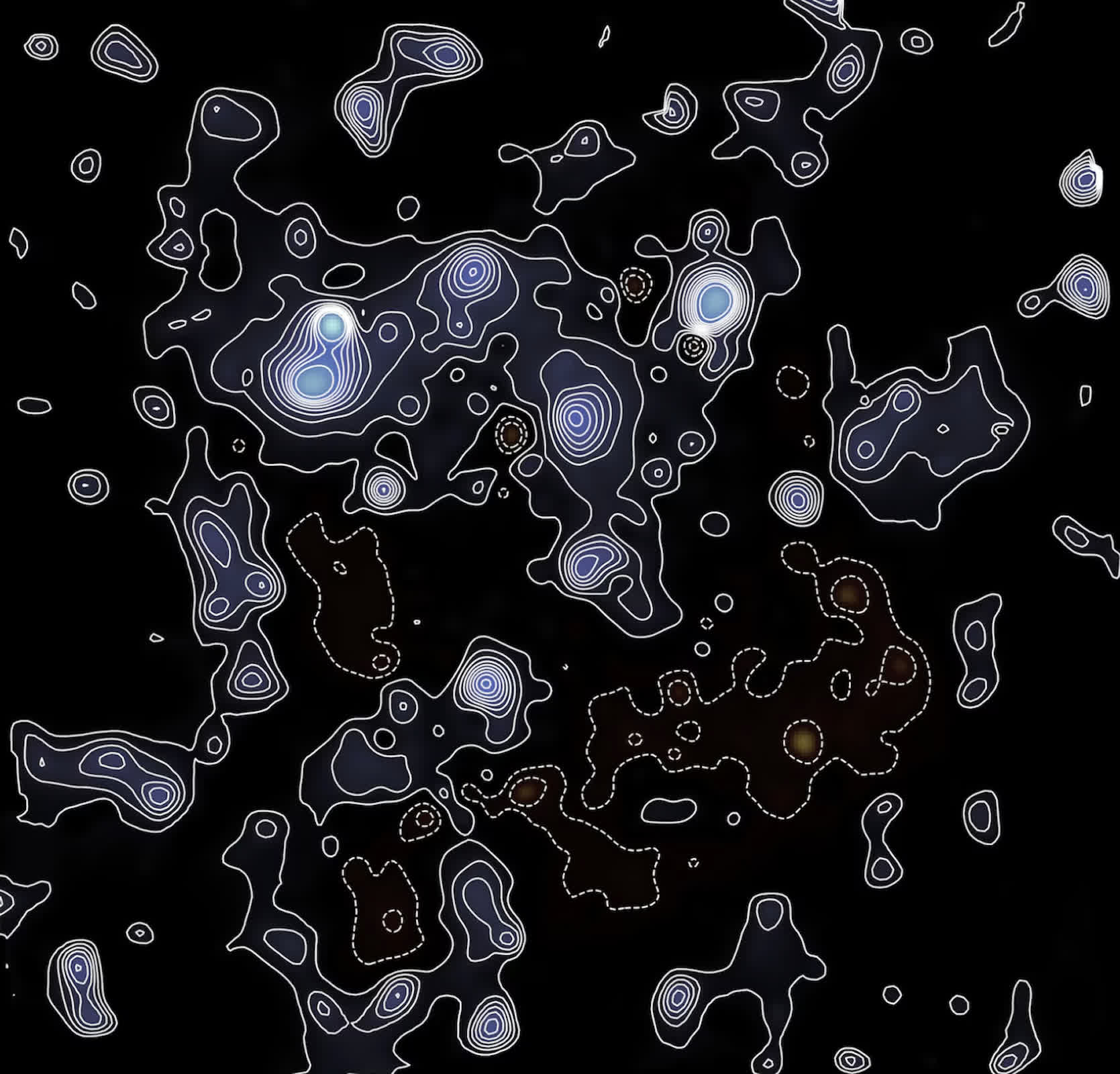
Infrared light also allows astronomers to identify the cosmic web – interconnected filaments of dark matter along which galaxies align like beads on a string. These filaments show where the first cosmic clumps arose after the Big Bang, offering direct evidence of how gravity drew in ordinary matter to form stars, planets, and entire galaxies.
Where dark matter concentrated, visible matter followed. "Wherever there's dark matter, it pulls in the ordinary material and starts to accumulate enough ordinary material in any one place to form stars and planets," Massey said. Without it, galaxies like the Milky Way could never have held together.
The new study offers more than a snapshot – it provides a dataset that other researchers will mine for years to come. "This will help us answer our basic questions about the universe and how matter is distributed and how galaxies have evolved," said Rachel Mandelbaum, a physicist at Carnegie Mellon University who was not involved in the work.
Future missions will build on Webb's template. The European Space Agency's Euclid telescope, launched in 2023, and NASA's upcoming Nancy Grace Roman telescope are designed for wide-field surveys that can complement Webb's high-detail focus. On the ground, Chile's Vera C. Rubin Observatory, whose first images were released in 2025, will collect data across the southern sky to further refine dark matter mapping.
Each observatory adds scale, precision, or spectral depth, bringing physicists closer to identifying dark matter's true nature – whether its particles are massive and slow-moving or light and fast. Webb's new map may serve as the foundation for a three-dimensional cosmic model that integrates all these upcoming data streams.
Image credit: National Geographic