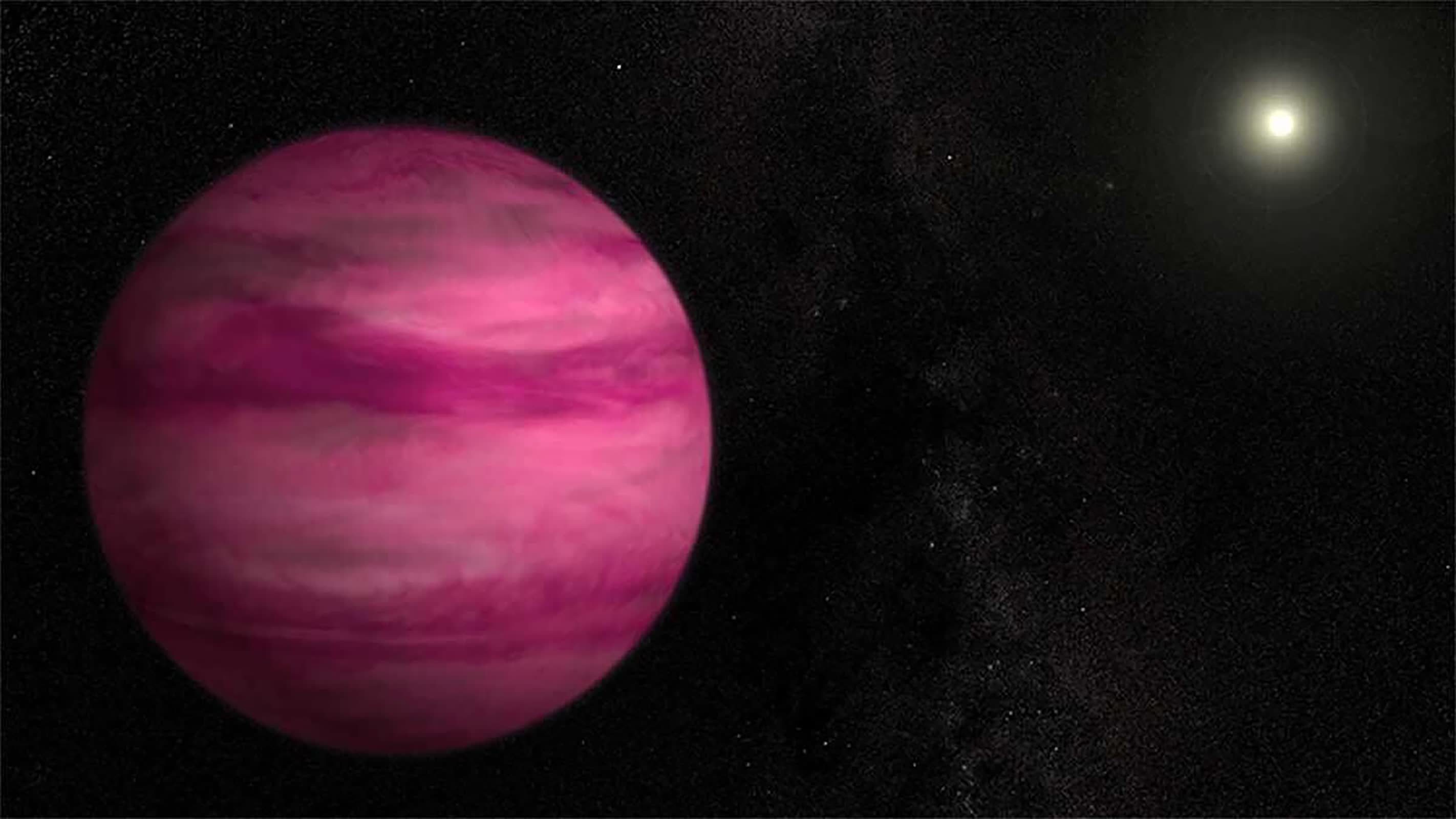
First look: For more than a decade, GJ504b has been something of an oddity – easy to spot, hard to understand. The planet orbits a sun-like star about 57 light-years from Earth and has stood out since its 2013 discovery because of its distinct pink hue. But its appearance didn't reveal much about what was happening there. Despite repeated attempts, ground-based telescopes couldn't extract enough usable data to explain conditions in its atmosphere. That just changed thanks to the James Webb Space Telescope.
Using Webb's ability to isolate faint planetary light from the glare of a nearby star, a team led by Northwestern University captured direct spectroscopic data from GJ504b for the first time. What had taken countless observation attempts from Earth was accomplished in roughly two hours. More importantly, the data was detailed enough to move beyond simple imaging.
When researchers broke the light into its component wavelengths, they found familiar ingredients: water vapor, methane, carbon dioxide, and ammonia. At first glance, that mix did not seem unusual. But when those elements were plugged into atmospheric models, the results didn't hold up. The simulations produced conditions that didn't make physical sense.
That disconnect forced the team to rethink the problem. Instead of focusing strictly on chemical composition, they looked at how light might be altered as it passed through the planet's atmosphere. The missing piece turned out to be clouds.
After running multiple scenarios, they found one configuration that aligned with the data: cloud layers made of vaporized salt particles. Those clouds appear to scatter and attenuate light from deeper in the atmosphere, effectively reshaping the spectral signals detected by Webb. Once that factor was included, the earlier inconsistencies were resolved.

The finding adds a layer of complexity to how astronomers interpret exoplanet atmospheres. It's not just about what gases are present, but how atmospheric structure – especially clouds – can distort or mask those signatures.
GJ504b itself doesn't fit neatly into existing categories. At about 25 times the mass of Jupiter, it sits somewhere between a large gas giant and a brown dwarf. Astronomers typically refer to it as a planetary-mass companion. It's also relatively cool compared to other directly imaged exoplanets, with a temperature around 550 degrees Fahrenheit. Most similar objects run much hotter, often exceeding 1,000 degrees.
That lower temperature likely reflects age. Estimates put the planet at between 2.5 and 4 billion years old, suggesting it has had time to cool. But that lower temperature also made it harder to study. A cooler planet emits less detectable radiation, which helps explain why it remained so difficult to analyze from Earth-based observatories.
Webb's advantage comes down to sensitivity and precision. Its instruments can filter out stellar interference and isolate specific wavelengths, making it possible to pull usable signals from objects that would otherwise be lost in the noise.
Even with the new data, there are still open questions – particularly around how GJ504b formed. Researchers are trying to determine whether it developed like a typical planet, from a disk of material around a young star, or more like a star, through the collapse of a gas cloud.
For now, what's clearer is the mechanism behind its unusual appearance. The planet's pink tone is tied not just to its chemistry, but to how light is filtered through a layer of high-altitude salt clouds.