
TL;DR: The PCI-SIG consortium introduced the PCI Express standard in 2004, the same year the original PCI bus received its final spec revision. The two technologies are based on completely different principles, but they can be forced to cooperate with the right PCIe-to-PCI adapter. Here's the proof.
A Redditor who enjoys experimenting with old hardware and ancient operating systems recently tried a small but clever experiment: installing an NVMe drive in a PCI-based machine. The idea was to force a modern(ish) SSD to operate under the constraints storage devices faced in the 1990s, requiring it to interact with a "foreign" bus interface – the now-ancient Peripheral Component Interconnect (PCI).
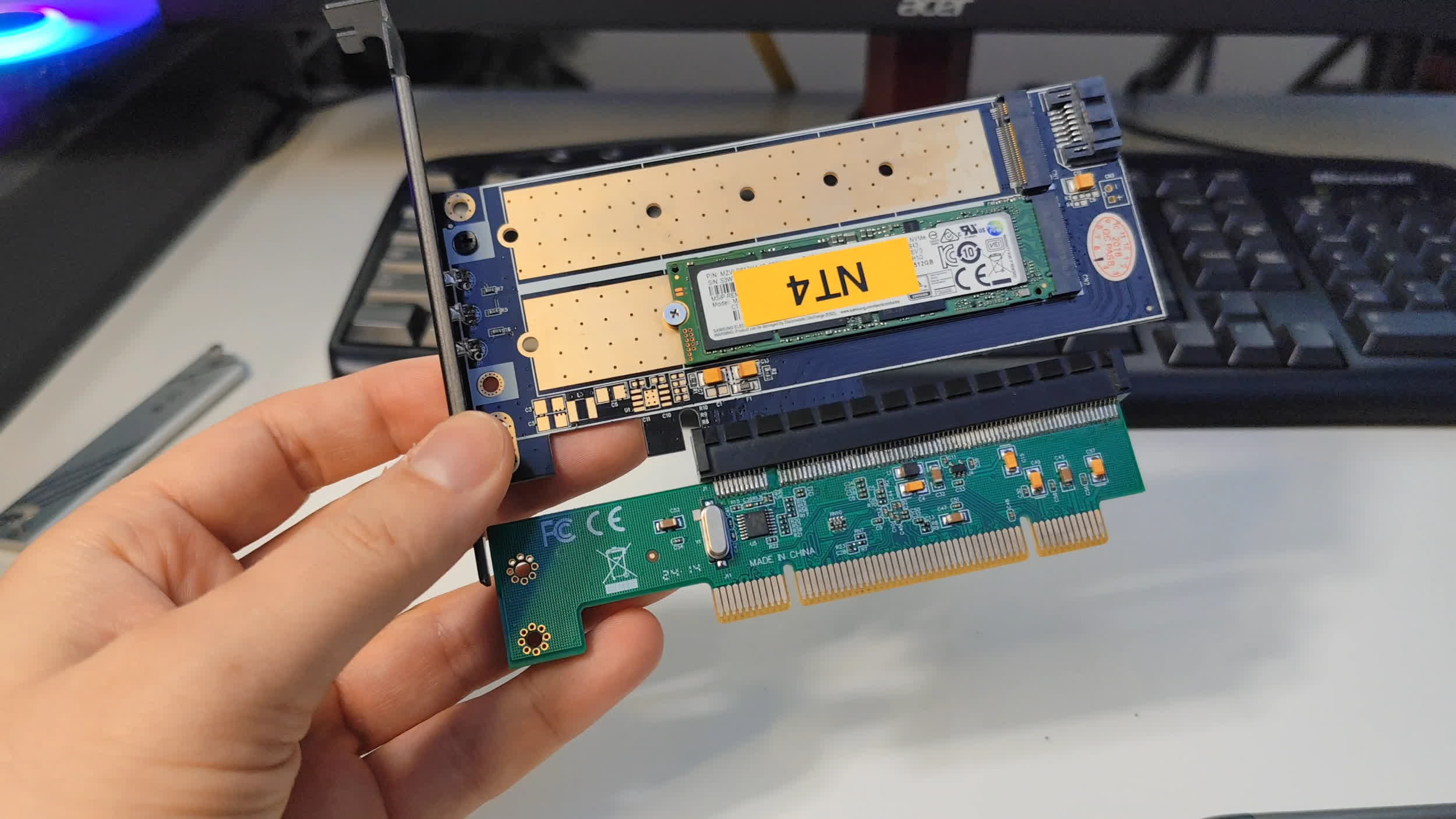
As explained in his post, the retro enthusiast installed an M.2 PCIe 3.0 SSD into an M.2-to-PCIe add-in card (AIC). He then inserted that AIC into a PCIe-to-PCI adapter purchased on AliExpress. Finally, the fully assembled adapter was plugged into a 66 MHz PCI slot on a Pentium III – based motherboard.
The convoluted setup worked, and the SSD behaved as expected. The Redditor shared a screenshot showing CrystalDiskMark benchmarks taken on Windows 10, which suggests he used a more modern system to capture the image. Windows 10 should not be able to install and load on a Pentium III system, at all.
In any case, the benchmarks show that an NVMe SSD forced to operate through a PCI slot can reach sequential read and write speeds of 208.45 MBps and 58.24 MBps, respectively. That's still only a fraction of the throughput PCIe 3.0 SSDs can theoretically achieve in a modern system.
The Redditor also notes that as far back as 2006, 15,000 RPM hard disk drives were already capable of reaching data transfer rates around 110 MBps. However, SSD access times are roughly 1,000 times faster than those of HDDs, making the difference immediately noticeable in everyday use.
Also read: The Inner Workings of PCI Express - How Hardware Works
The magic "trick" that makes the setup behave mostly resides in the adapter, he said. The PCIe-to-PCI card converts the x1 PCIe signal into a PCI signal, while the host operating system recognizes the SSD as a standard PCI device with a specific hardware ID. No dedicated software driver is required for the setup to function properly.
The original PCI local bus specification (version 1.0) was introduced in 1992, while PCI 3.0 arrived in 2004. After the introduction of PCI Express that same year, motherboard manufacturers quickly phased out the parallel PCI bus in favor of the newer, lane-based serial architecture.