
Through the looking glass: A century after Thomas Edison's early experiments with nickel-iron batteries, researchers at UCLA and their international collaborators have revived the concept using modern nanotechnology. The result is a durable, fast-charging battery that could one day store energy generated at solar farms and other renewable energy sites. Their nickel-iron battery prototype – inspired by natural structures found in shells and bones – has demonstrated ultra-fast recharging and decades-long durability, qualities Edison once claimed his own design would achieve but never did.
The new design retains Edison's choice of metals while incorporating 21st-century nanotechnology and bioengineering. The UCLA-led study, published in Small, describes a battery capable of recharging in seconds rather than hours and withstanding more than 12,000 full charge-discharge cycles – equivalent to over 30 years of daily use.
The breakthrough centers on a deceptively simple fabrication process. Researchers did not rely on expensive nanofabrication tools or exotic catalysts. Instead, they used proteins – byproducts of beef production – as molecular scaffolds to form nickel and iron clusters smaller than five nanometers in diameter. At that scale, tens of thousands of these clusters could fit across the width of a human hair.
Co-author Maher El-Kady, a researcher in UCLA's Department of Chemistry and Biochemistry, noted that the process relies on common ingredients and accessible thermal steps – a reminder that high-tech results do not always require high-tech manufacturing.
These protein-guided clusters were bonded to graphene oxide, a two-dimensional material made of single-atom-thick carbon sheets decorated with oxygen. Heating the mixture in water and then baking it at high temperature triggered a remarkable transformation.
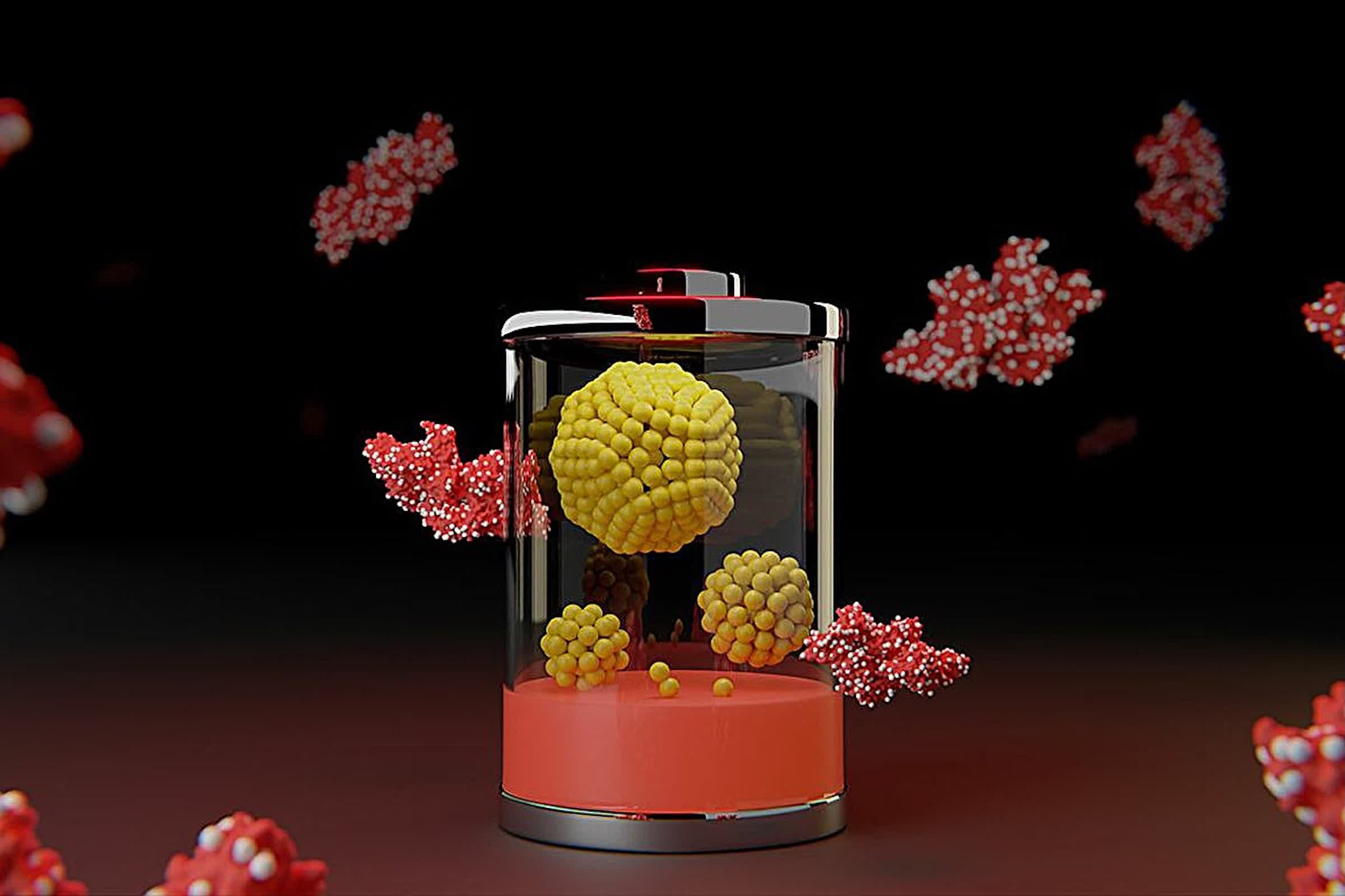
The proteins carbonized as they heated, simultaneously removing oxygen from the graphene oxide and forming a highly porous aerogel that is 99 percent air by volume. This ultralight scaffold became the structural framework for the nickel-iron electrodes.
According to Ric Kaner, co-corresponding author and professor of materials science and engineering at UCLA, the team drew inspiration from biological mineralization. Just as proteins guide the precise deposition of calcium in bones and shells, the researchers used proteins to direct the placement of nickel and iron atoms. The result is a material that combines strength and flexibility at the atomic scale.
The importance of this structure comes down to surface area. In electrochemistry, the more exposed atoms an electrode has, the more efficiently ions can move in and out.
By shrinking the metal particles to just a few nanometers, the researchers increased surface exposure dramatically. In practical terms, that translates into much faster charge and discharge rates because nearly every atom can participate in storing or releasing energy.

Although the capacity of this new design still lags behind the lithium-ion batteries that power modern electric vehicles, its combination of exceptional cycle life, rapid charging, and low-cost fabrication makes it a compelling candidate for grid-scale applications.
The researchers envision it as a storage solution for solar and wind farms, where fast recharge times and long service life matter more than compact size. It could also serve as a safety buffer for data centers and other critical infrastructure that require instant backup power.
Future work will focus on refining the chemistry, potentially by incorporating alternative metals or replacing bovine proteins with more abundant natural polymers better suited to large-scale manufacturing.
This latest incarnation of the nickel-iron battery may not replace lithium-ion technology in cars anytime soon, but it offers something equally valuable: a pathway to sustainable, durable, and affordable energy storage.