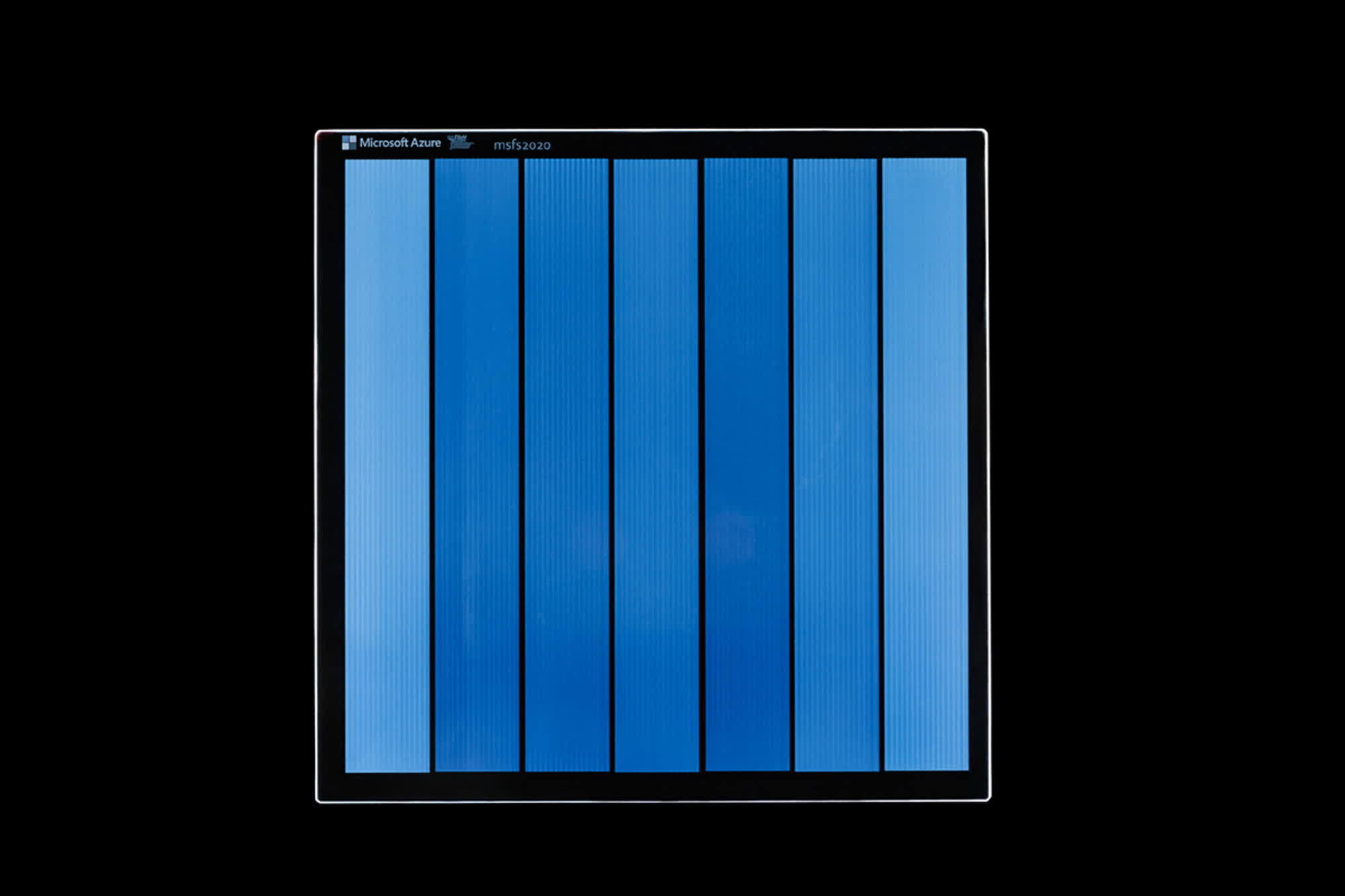
The takeaway: Microsoft and other data center operators are racing to develop new methods for storing massive amounts of data on permanent media. Redmond is pursuing a technology based on glass and three-dimensional pixels, which has recently advanced significantly thanks to the latest research breakthroughs.
Microsoft has been developing Project Silica for years, transforming glass into permanent storage media capable of retaining digital data for up to 10,000 years. The company recently highlighted its latest advancements, including significant improvements in cost, performance, and storage complexity.
Project Silica now stores data using femtosecond lasers on ordinary borosilicate glass, which is cheaper and more abundant than the previously used fused silica. Redmond describes borosilicate as a low-cost, readily available material already used in cookware and oven glass doors.
According to the company, this new material addresses one of the main obstacles to Project Silica's commercialization by improving both the cost and availability of the storage medium. The updated technique allows data to be stored in hundreds of layers on the glass, with each layer just 2 mm deep.
Compared with earlier versions, the system now requires only one camera instead of three or four, reducing assembly costs and complexity. The I/O system is smaller, cheaper to produce, and involves fewer parts, minimizing manufacturing and calibration challenges.
Microsoft has also refined its voxel-based writing method. Data structures can now be recorded with fewer laser pulses, while a machine learning model effectively separates actual data from interference. By combining a mathematical model with heat-assisted recording, the system has achieved significant gains in data density.
The company has rigorously tested Project Silica to assess its long-term data retention capabilities. According to the latest aging experiments, which use a non-destructive optical method, the technology can reliably preserve information for 10,000 years – and potentially even longer.
Redmond highlights several demonstrations over the years showcasing Project Silica's abilities, including the archiving of images, audio, music, and spoken languages – essentially preserving elements of human culture for millennia. While Microsoft says the research phase is now "complete," there are no indications that the technology will enter commercialization in the near future.
Microsoft emphasized that the scientific advancements are clear, but it is now encouraging other organizations to explore turning the research into a practical product. Permanent storage solutions are becoming an increasing priority in the digital age, though alternative approaches – such as Cerabyte's ceramic-based media – also aim to preserve data for the long term.