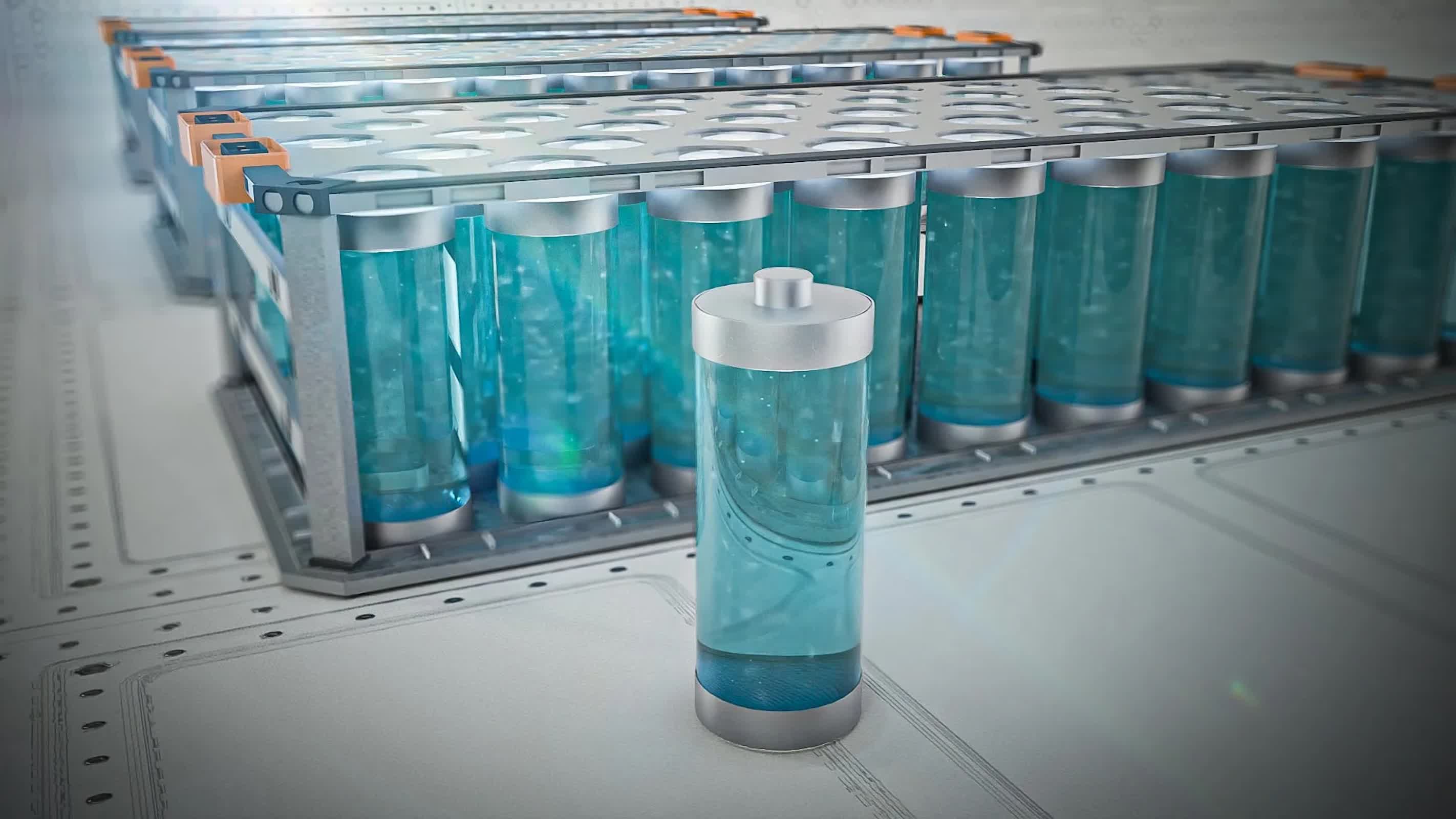
The takeaway: For decades, battery engineers have gone to great lengths to remove water from their materials. However, new research shows that keeping water inside a key cathode material can sharply boost sodium-ion battery performance and narrow the gap with lithium-ion cells.
University of Surrey researchers discovered a compound known as nanostructured sodium vanadate hydrate (NVOH) – a layered sodium-based material that naturally contains water within its crystalline structure. Traditionally, researchers treat such compounds with heat to evaporate that water, assuming it weakens the material's stability. The Surrey team tested that assumption and found the opposite: the hydrated material dramatically improved energy storage and charge performance.
The study, published in Journal of Materials Chemistry A, shows that NVOH can store nearly twice as much charge as conventional sodium-ion cathodes. In laboratory testing, it delivered robust energy retention for more than 400 charge cycles while maintaining excellent structural stability. Most notably, it charged faster and achieved higher capacity than its dehydrated counterpart, placing it among the top-performing sodium-ion cathode materials reported to date.
"Our results were completely unexpected," Dr. Daniel Commandeur, the study's lead author and a research fellow in the University of Surrey's School of Chemistry and Chemical Engineering, told Science Daily. "The material showed much stronger performance and stability than expected and could even create exciting new possibilities for how these batteries are used in the future."
The hydration appears to support better ion diffusion – allowing sodium ions to move more freely through the material's layers during charge and discharge. That mobility leads to faster reaction kinetics and improved energy density. The discovery flips a long-held rule in battery design: instead of engineering materials to be perfectly dry, it may sometimes be better to embrace their natural chemistry.
The study also uncovered another surprising capability: when operated in salt water, the sodium vanadate hydrate not only continued to function effectively but also helped remove sodium ions from the solution. At the same time, a graphite electrode extracted chloride ions, creating an electrochemical desalination effect that powers the battery while purifying water simultaneously.
This discovery shows that sodium-ion batteries might do more than just store energy – they could also help remove salt from water.
"In the long term, that means we might be able to design systems that use seawater as a completely safe, free and abundant electrolyte, while also producing fresh water as part of the process," Dr. Commandeur said.
If scaled, this breakthrough could mark a pivotal moment for sodium-ion technology. Unlike lithium, sodium is abundant, inexpensive, and accessible worldwide, making it a strong candidate for large-scale applications such as grid storage and renewable integration. The simplicity of Surrey's approach – using water instead of complex heat treatments – may also reduce production costs and environmental impact.