Crystal ball: Sony is exploring a method that allows games to continue running when players briefly look away by introducing a "soft pause" system that modifies gameplay rather than stopping it entirely. A recent US patent filing outlines a flexible framework that leverages artificial intelligence, machine learning, and dynamic difficulty adjustment to reduce the impact of short interruptions. Sony specifically highlights virtual reality as a primary application for the technology.
Rather than halting the simulation, Sony's design keeps the game active while shifting it into a lower-intensity state. The patent describes scenarios in which time may slow down, enemy pressure may decrease, and assistance systems may quietly become more active, allowing players to glance at messages or notifications without losing control of gameplay.
In some configurations, the system could also mute or reduce in-game audio so that external sounds and alerts are easier to hear, turning a pause into a brief, managed interruption rather than a hard transition to a menu screen.
The patent outlines a set of engine-level adjustments that developers can combine to create different versions of a soft pause experience, depending on the game genre and design objectives.
One dimension is temporal control: the game can slow global time progression, stretch animation or projectile travel duration, or widen timing windows for key interactions such as parries or quick-time-style prompts.
Another dimension is difficulty adjustment. Enemy accuracy, aggression, or spawn rates can be reduced, resource drops can be increased, or damage calculations can be softened while the mode is active.
In addition, the system can rely on player-assistance mechanics. The filing references features such as stronger aim assistance, more permissive auto-targeting, and extended input windows, allowing the game to compensate for reduced player attention. For example, a platformer might subtly adjust jump timing and collision forgiveness, while an action RPG could bias lock-on targeting and defensive triggers during the soft pause window.
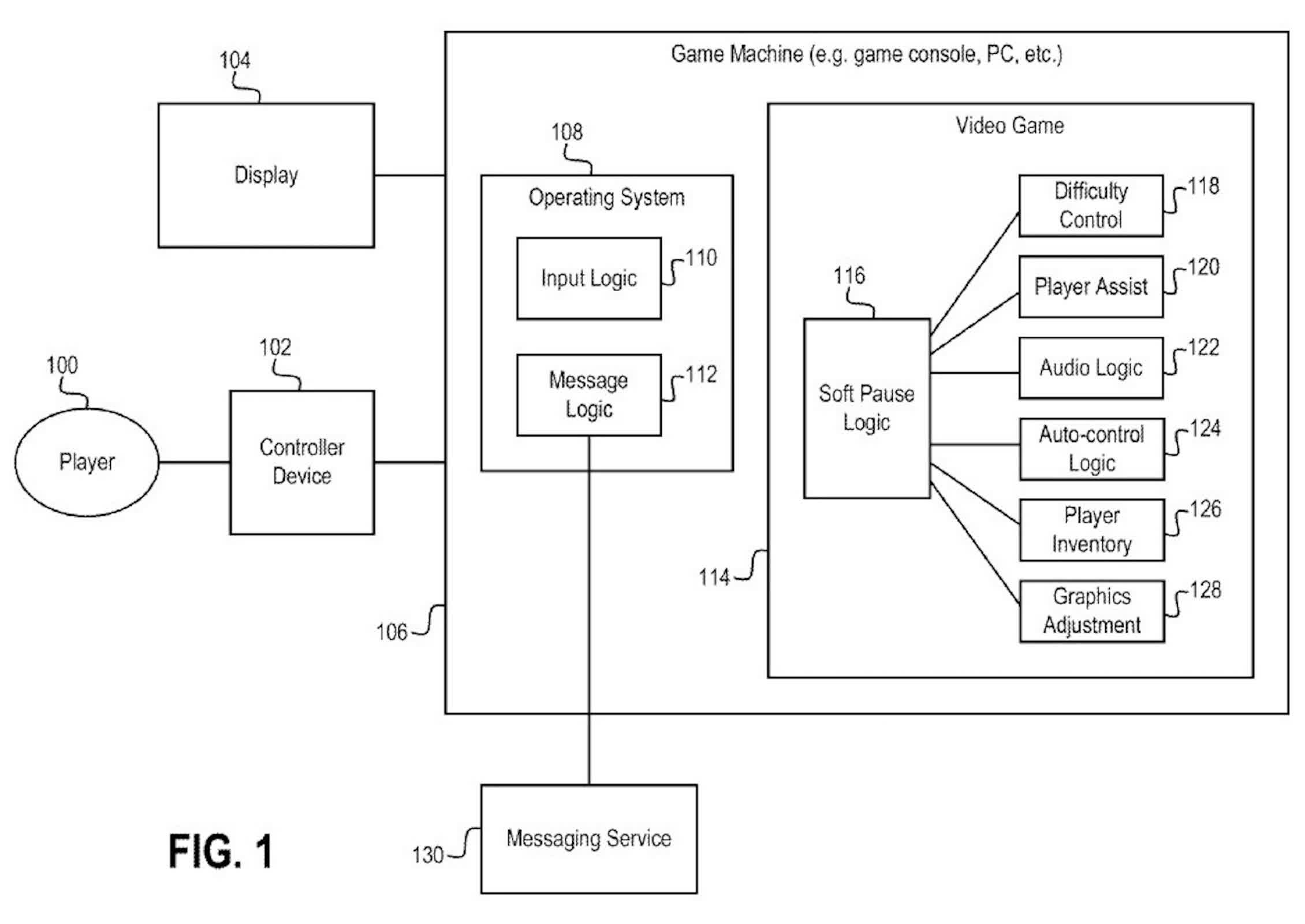
One of the more advanced concepts described in the filing is a machine-learning-based agent capable of temporarily taking over gameplay while soft pause mode is active. In this state, the system does not simply make the game easier; it can actively play on the user's behalf, maintaining basic survivability or performing simple objective actions while the player responds to a distraction.
The patent does not specify whether such a model would be personalized to individual players or rely on a more generalized behavioral profile, leaving open questions about training data, inference constraints, and the extent to which the system's decisions would mirror human gameplay behavior.
The idea approaches what might be described as a "ghost gamer" framework, in which the platform maintains enough contextual understanding of gameplay to preserve progress without requiring continuous player input. Applications could include holding a defensive position in a shooter or maintaining vehicle control in a racing game, with the machine learning system functioning as a temporary proxy rather than a persistent autonomous agent.
Sony also outlines an AI-assisted workflow in which incoming notifications act as triggers for the soft pause system. Instead of requiring players to manually pause the game, the platform could detect the arrival of messages or alerts and automatically transition gameplay into a lower-intensity state, potentially after evaluating the notification's priority level.
In high-priority scenarios, the system might apply stronger slowdown effects or greater difficulty reduction so that players can read and respond to notifications without being overwhelmed by on-screen activity.
The patent also preserves support for traditional activation methods, such as a dedicated button or control combination, to initiate soft pause mode.
Soft pause is presented as a possible solution to a long-standing challenge in online multiplayer games: there is no practical way to suspend a shared simulation without affecting other participants.
In battle royale or team-based shooter games, a traditional pause would halt gameplay for multiple players simultaneously, so such systems are generally not permitted. As a result, players who briefly step away risk being eliminated during their absence. Sony's design instead envisions individual players entering a modified low-intensity state while the match continues, with artificial intelligence or assistive systems attempting to compensate for short interruptions.
This approach introduces obvious balance considerations. A less skilled player who activates soft pause and transfers control to a capable AI mid-match could gain an unintended advantage, while a more conservative implementation might limit AI assistance to the point that the player remains vulnerable to elimination.
Some existing games, such as Paladins, already transfer control to bots when players disconnect. However, Sony's proposal differs in that the transition would be deliberate, time-bounded, and potentially used repeatedly, which would require designers to carefully define how far automated assistance can extend in competitive gameplay.
For now, US20260021411 remains a patent application rather than a product roadmap. No public implementation timeline has been announced, and the filing itself is sufficiently broad that any future deployment could differ significantly from the diagrams and examples presented.