
TL;DR: Jolla is attempting something few smartphone makers pursue anymore: launching a new handset built around a non-Android, non-iOS operating system and tying it to a broader push for sovereign European technology, modular hardware, and privacy-centric AI. The new Jolla Phone and the still-in-development Mind2 AI computer form the core of that strategy. The initiative is squarely aimed at users who want modern performance without relying on US-based cloud platforms.
Jolla's return to the smartphone market follows a turbulent decade during which the company nearly collapsed, pivoted to licensing its Sailfish OS platform, severed business ties with Russia after the invasion of Ukraine, and later reorganized under the new corporate structure Jollyboys. The reset produced a device assembled in Salo, Finland that combines mid-range mobile silicon, a Linux-based operating system with optional Android app compatibility, and a modular back cover system designed to encourage hardware customization.
Priced at €649, the Jolla Phone is not intended for the mass market, and company leadership has acknowledged that it will remain a niche product. Instead, it is marketed as a "European phone" for users seeking alternatives to ecosystems dominated by Google and Apple. More than 10,000 pre-orders were placed following a December 2025 preview, with commercial shipments scheduled to begin at the end of June across the EU, the UK, Norway, and Switzerland.
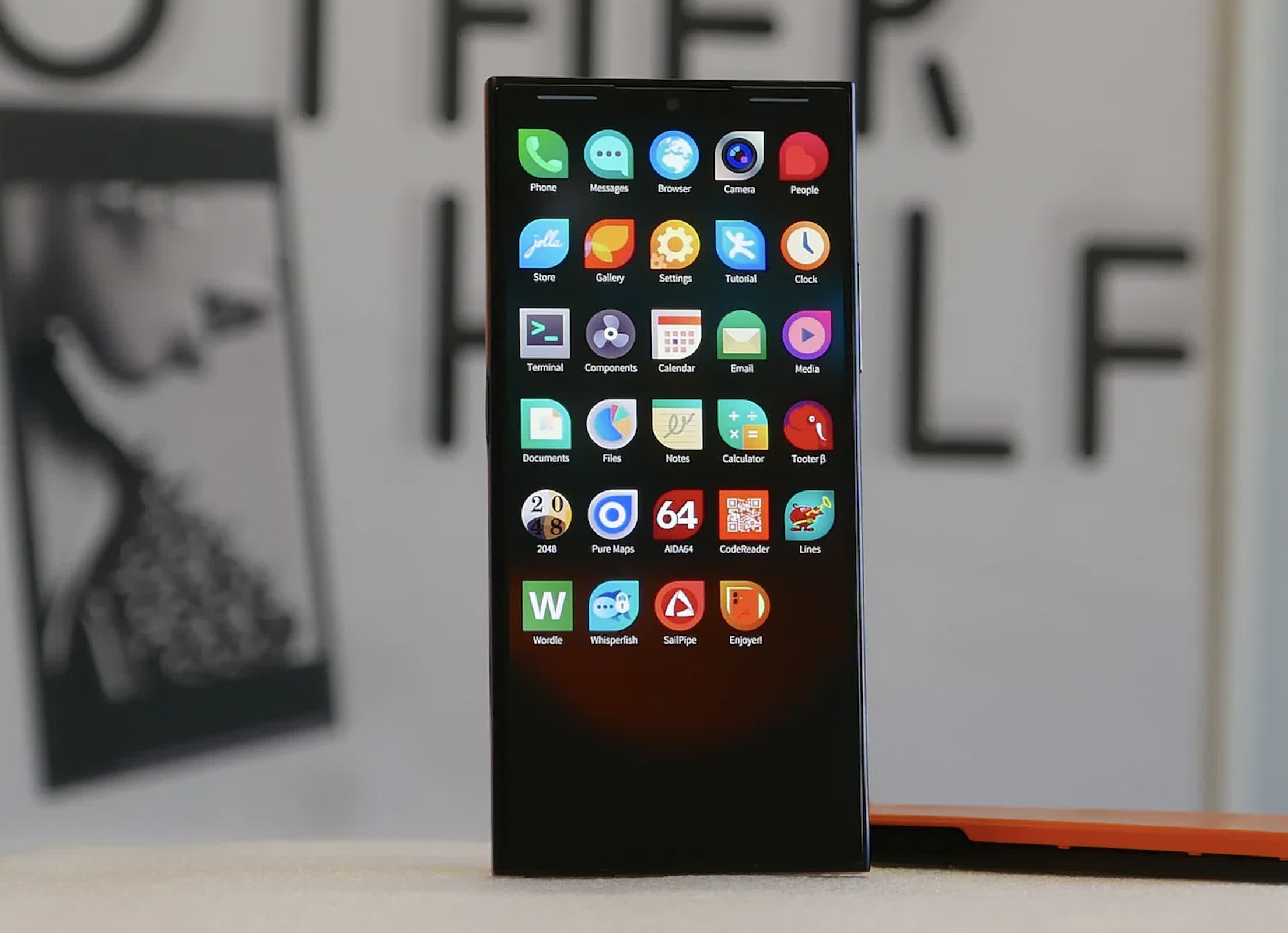
Unlike most so-called "de-Googled" smartphones, the Jolla Phone does not run a hardened or forked version of Android. While Sailfish OS can execute Android applications through a compatibility layer, performance and stability are not guaranteed, and some apps may behave unpredictably. The system also aims to reduce onboarding friction by avoiding mandatory cloud accounts. Users are not required to register a Sailfish account simply to operate the device, a design choice that contrasts with the cloud-first identity models used by many modern smartphones.
On the hardware side, the phone is powered by a MediaTek Dimensity 7100 5G processor sourced from Taiwan, paired with 8 GB or 12 GB of RAM manufactured by SK Hynix and 256 GB of internal storage with microSD expansion support. The display is a 6.36-inch Full HD+ AMOLED panel protected by Gorilla Glass, offering 1080p-class resolution and a modern screen-to-body ratio.
The camera system uses sensors from Sony, including a 50-megapixel primary camera, a 13-megapixel ultrawide sensor on the rear, and a 32-megapixel front-facing camera. Power is supplied by a 5,500 mAh user-replaceable battery housed behind the modular back cover, giving the device higher capacity than many similarly sized smartphones. Connectivity options include 5G cellular support, Wi-Fi 6 (rather than Wi-Fi 7), and Bluetooth wireless technology.
The most distinctive hardware feature is located on the rear. The device revives the "Other Half" concept, a modular back cover system that allows third parties and hobbyists to design functional add-ons such as secondary displays, hardware keyboards, or other electrically and mechanically integrated accessories. Jolla also operates a community Innovation Program encouraging users and developers to co-design and 3D-print custom modular backs.
The company is not alone in targeting users skeptical of mainstream US-based platforms. Murena, in France, ships devices running /e/OS, a privacy-focused Android fork that removes Google services. Meanwhile, GrapheneOS, developed in Canada, focuses on hardened security atop Android and recently announced hardware compatibility partnerships with Motorola for selected devices. In Switzerland, Punkt has collaborated with ApostrophyOS to deliver another privacy-centric mobile stack on its MC03 handset.
Many of these products operate under similar economic constraints. Without the manufacturing scale enjoyed by platform leaders such as Samsung or others in the global smartphone market, niche privacy-focused devices often ship with modest hardware specifications at comparatively high prices. The minimalist Light Phone III illustrates this trade-off: limited functionality combined with small production volumes can still result in costs reaching several hundred dollars. Against this backdrop, the Jolla Phone's combination of a mid-range 5G system-on-chip, higher-end display technology, and large battery capacity at €649 appears comparatively balanced, though it remains positioned well outside the budget segment.
Jolla is also developing Mind2, a compact AI computing device intended to function as a privacy-preserving personal assistant that operates primarily on local hardware. Rather than transmitting email, calendar, or document data to remote servers, the system is designed to ingest personal information locally and answer queries directly on the device.
The platform hosts multiple specialized AI agents tuned for workflow-specific tasks, including email triage and composition, contact and relationship management, document summarization and preview, and digital signature workflows, with additional agents planned for calendar scheduling, storage management, task automation, and messaging.
When local inference models are insufficient, Mind2 can optionally route queries to third-party large language models. The interface visually flags such operations to ensure users are aware when data leaves the local environment.
Although still under active development, Mind2 is conceptually linked to the smartphone roadmap. The new handset will ship without built-in AI functionality at launch, but users will have the option to enable partial Mind2 integration later in the year.

In the longer term, the company envisions mobile devices gradually evolving into AI-driven computing companions rather than direct replacements for today's dominant smartphone platforms.
One of Jolla's central arguments is that it offers longer software support lifecycles than most competitors. The original Jolla smartphone, released more than a decade ago, continued receiving software updates until 2020. The company now promises similarly extended support windows for the new model.
Ultimately, the project serves as a real-world experiment testing whether a Linux-based mobile operating system with partial Android compatibility, modular industrial design, and a privacy-first AI companion can achieve meaningful market penetration in a sector dominated by two major ecosystems. For now, even company executives acknowledge that the phone targets a niche audience, though they hope it will help expand space for more diverse, sovereignty-oriented computing models in Europe and beyond.