
Connecting the dots: In its latest overhaul of the MacBook Pro lineup, Apple has done more than roll out faster hardware. The launch of the M5 Pro and M5 Max chips introduced a subtle but significant reframing of Apple's CPU design – and the language used to describe it. What was once a familiar hierarchy of "performance" and "efficiency" cores has been reframed. The M5 generation introduces a new top tier of "super" cores.
On the surface, the change might look like semantics. But it reflects a broader evolution inside Apple Silicon that moves beyond the traditional mobile-processor model where "big" cores handle demanding work and "little" cores handle background tasks for efficiency's sake. By renaming its cores (in pure Apple's marketing style), the company is signaling that the roles of these components have changed.
The M5 series' most powerful cores are now called "super" cores, while the secondary cores – depending on the chip – are either the traditional efficiency cores (in the base M5) or performance cores in the Pro and Max variants.
Performance cores sit between the super and efficiency cores in size and speed. Apple describes these cores as still highly power-conscious but substantially more capable in multithreaded workloads. Their new designation suggests a rebalancing of priorities between strict power savings and sustained computational throughput.
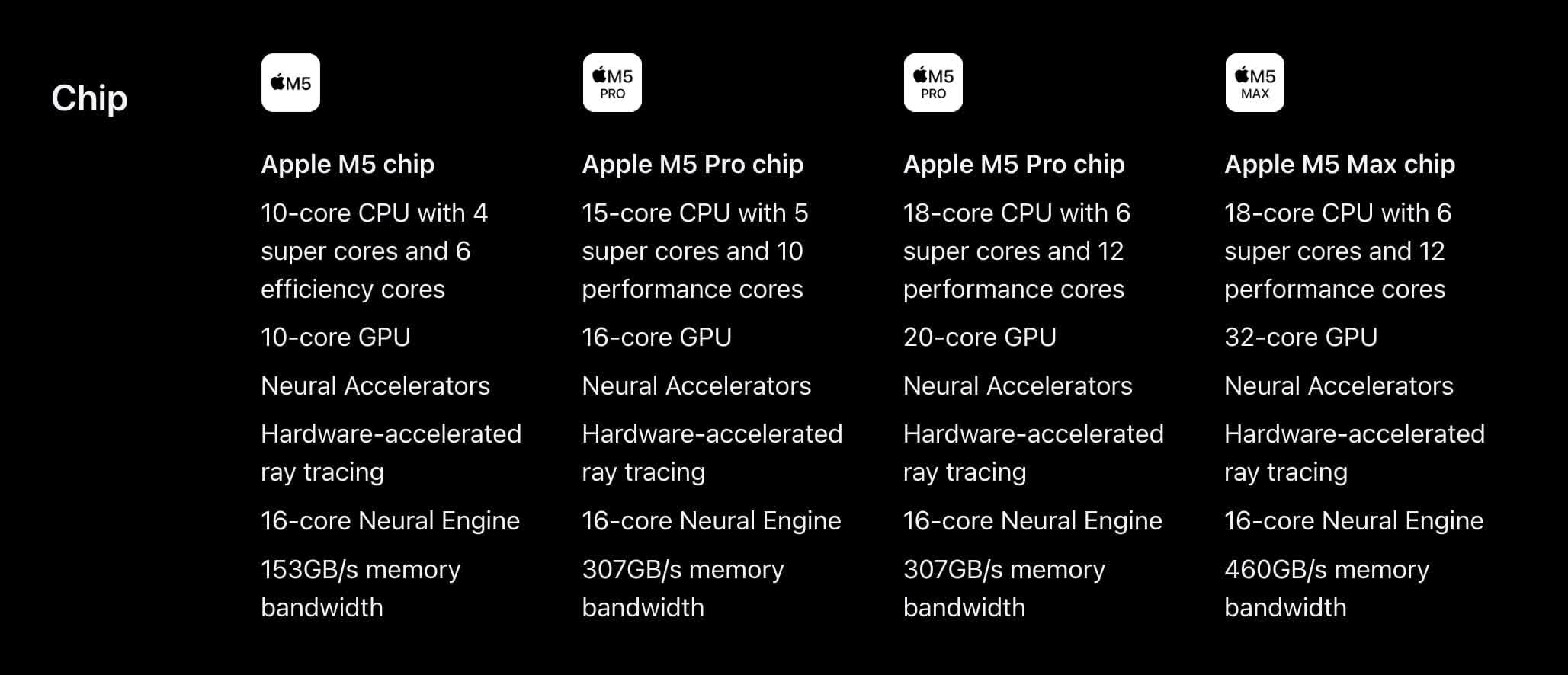
Rather than a pure marketing tweak, the M5 generation introduces three CPU core classes across the lineup: the former "performance cores" have been rebranded as super cores, the base M5 retains efficiency cores, and the M5 Pro and Max introduce a separate performance-core design optimized for multithreaded throughput and die density.
Like most other modern CPUs, previous M-series chips tended to draw a clearer line: the performance cores did the heavy lifting, and the efficiency cores handled background tasks or light workloads. The M5's new approach narrows that distinction, creating a middle layer that can drive heavier processes without scaling all the way to the power-hungry super cores.
Behind the branding lies a technical motivation. Apple engineers have long been aware that efficiency cores were sometimes perceived as weaker links. In practice, they've always delivered strong performance-per-watt numbers, but their role was overshadowed by the more glamorous primary cores.
With the new design, Apple appears eager to rewrite that narrative. The reclassification emphasizes parity more than hierarchy, a recognition that the secondary cores in the Pro and Max chips are no longer meant solely for lightweight tasks.
But the upgrade goes beyond terminology. The M5 architecture introduces Apple's Fusion Architecture, a multi-die packaging approach that links multiple silicon tiles within a single processor package.
In practice, that means Apple can scale chip designs across different product tiers without dramatically increasing the size of a single monolithic die. The M5 Pro and Max models illustrate this: they share a common CPU structure but differ in their GPU configurations: 20 cores for the Pro and 40 for the Max.
Fusion Architecture reflects a deeper engineering goal to scale across product lines and workloads. Instead of relying on a single massive chip for every configuration, Apple can build processors from interconnected silicon tiles that expand compute and graphics resources as needed. The approach echoes strategies used by AMD and other chip designers, though Apple's integration remains vertically controlled across hardware and software.
For Mac users, the benefits are mostly indirect. Modular packaging can enable faster iteration cycles, better manufacturing yields, and potentially smoother transitions to future lineup tiers, such as a forthcoming M5 Ultra or next-generation base chips that inherit the same architectural foundation.
Looking ahead, the architectural template unveiled in these chips likely previews how Apple will build its silicon roadmap. As the company leans further into modular designs and multi-die packaging, future Mac and iPad processors will likely share the same scalable architecture, with differentiation coming primarily through GPU scale, memory bandwidth, and packaging rather than entirely new CPU layouts.