
A hot potato: A year after announcing the most significant change to Android in a long time, Google is now introducing a new process aimed at making the mobile platform "open" again. Mountain View says the move is intended to balance openness with safety, but some users are expressing strong frustration nonetheless.
Google has confirmed that Android will not retire app sideloading, but the company is implementing measures that make the process cumbersome – something only "power users" are likely to attempt. According to Matthew Forsythe, the newly introduced advanced flow is designed to protect users from potential coercion, scams, or malicious software.
In 2025, Mountain View announced that app developers would be required to register with Google using a standard, government-issued ID. Some third-party developers and alternative app stores, such as F-Droid, opposed the change, prompting Google to retract its original plan. The advanced flow was ultimately introduced to address concerns from the open-source community.
"Android is built on choice. That is why we've developed the advanced flow - an approach that allows power users to maintain the ability to sideload apps from unverified developers," Forsythe said in a post on the Android Developers Blog.
The one-time process is based on the assumption that only power users will permanently re-enable sideloading on their devices. The advanced flow has been carefully designed to prevent successful scams or coercion, requiring both an explicit user choice and a one-day enforced delay before sideloading can be completed.
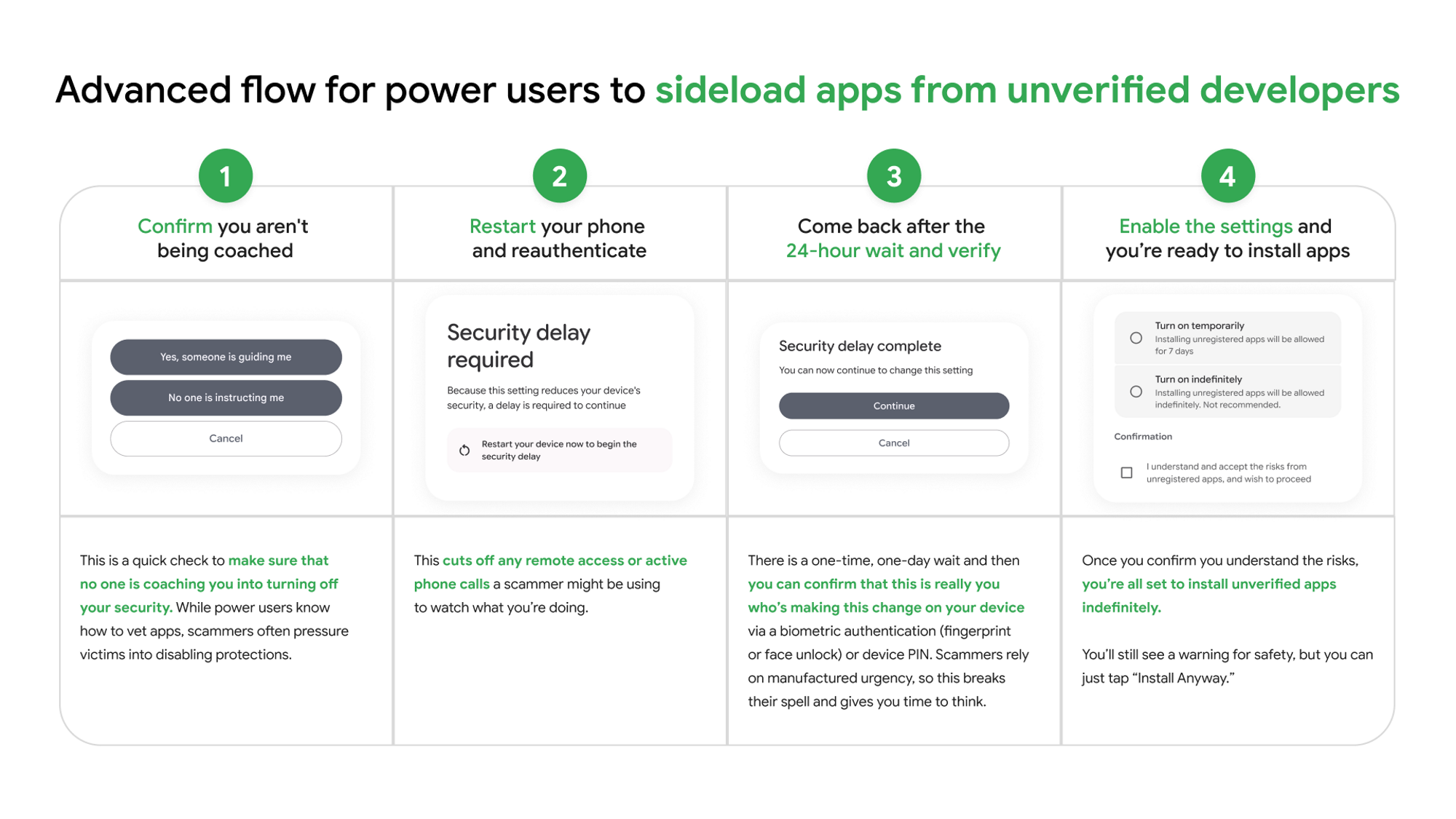
The process is straightforward but involves four distinct phases, beginning with the activation of developer mode in Android's system settings. Users must also confirm that no external party is "coaching" them to bypass security measures. Next, the phone must be restarted, followed by a 24-hour "protective waiting" period.
Finally, users must provide another confirmation that they genuinely wish to enable full app sideloading – either for seven days or indefinitely. The system continues to warn against sideloading but will ultimately allow the installation to proceed. Advanced flow activation is only required for apps from unverified developers, while apps from newly registered developers follow a separate installation process.
Forsythe acknowledged that developer identification could pose a significant barrier for new Android apps but said the advanced flow technology should give users sufficient freedom to join the ecosystem. The new process is expected to roll out in August, while the ID-based developer regime is slated for a global launch in 2027.