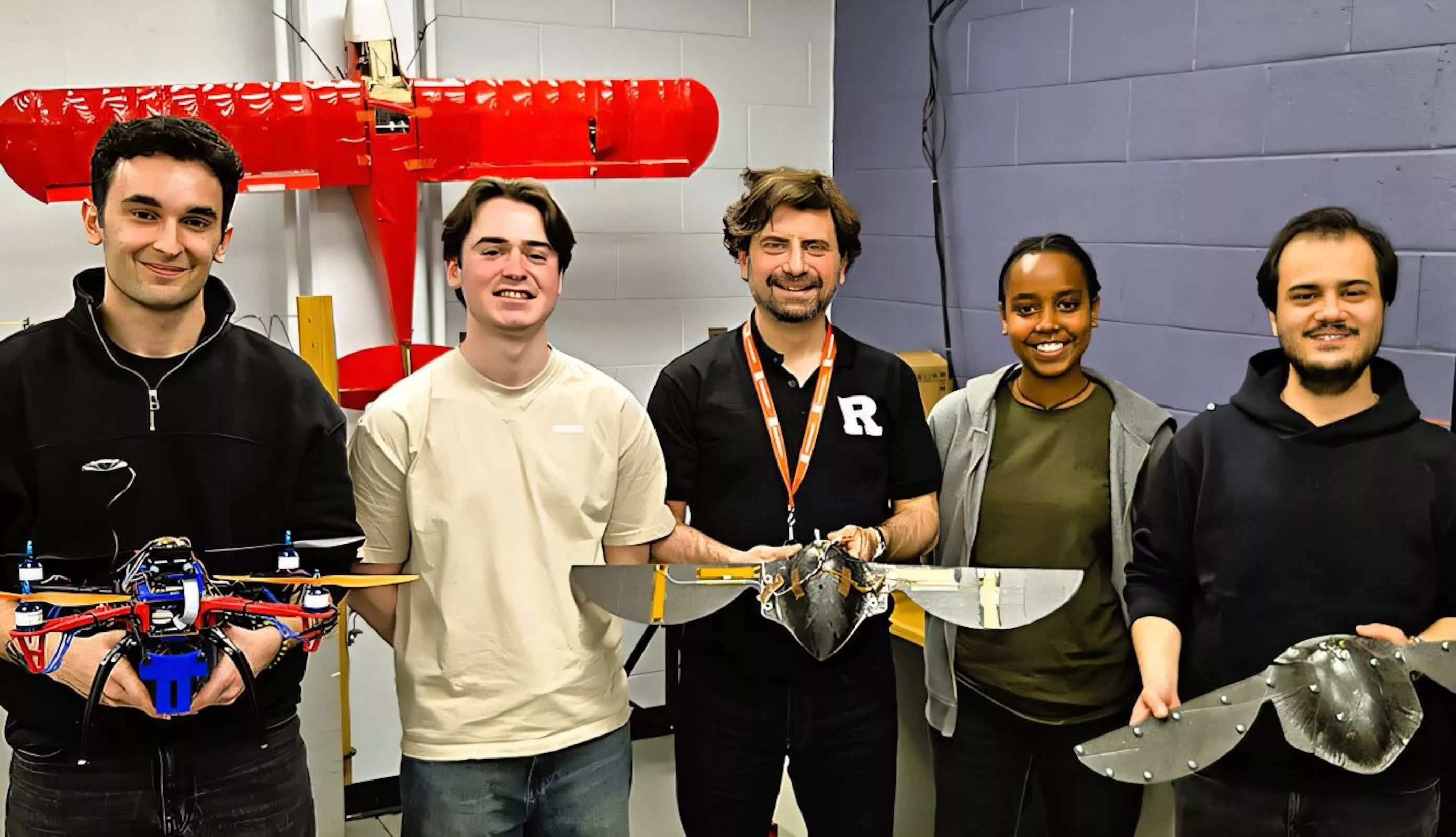
First look: In a lab at Rutgers University, engineers are challenging conventional assumptions about flight. Rather than relying on motors and gears, their latest research envisions a future where drones move more like living organisms – flapping and twisting their wings through material flexibility alone.
The concept, known as a solid-state ornithopter, replaces the typical network of actuators with electricity-driven materials that deform when voltage is applied. This approach could represent a turning point for next-generation aerial vehicles, combining principles of aerodynamics, materials science, and biomechanics into a single design model.
The research, detailed in Aerospace Science and Technology, was conducted by aerospace engineers Xin Shan and Onur Bilgen at Rutgers. Their experimental drone operates without motors, linkages, or gears. Instead, it uses layers of smart materials that move when an electric current passes through them, mimicking the muscular action of a bird in flight.
"We apply electricity to the piezoelectric materials, and they move the surface directly, without extra joints, extra linkages, or motors," said Bilgen, an associate professor in Rutgers' Department of Mechanical and Aerospace Engineering. "The wing is a composite including a piezoelectric material layer and a carbon-fiber layer. Apply voltage to the piezoelectric layer, and the whole composite flexes."
Because these wings can twist and flex, they are well-suited for operation in complex, cluttered environments where maneuverability is critical. Bilgen said this adaptability makes them promising for missions where agility and delicacy matter, ranging from environmental monitoring and search-and-rescue operations to urban package delivery.
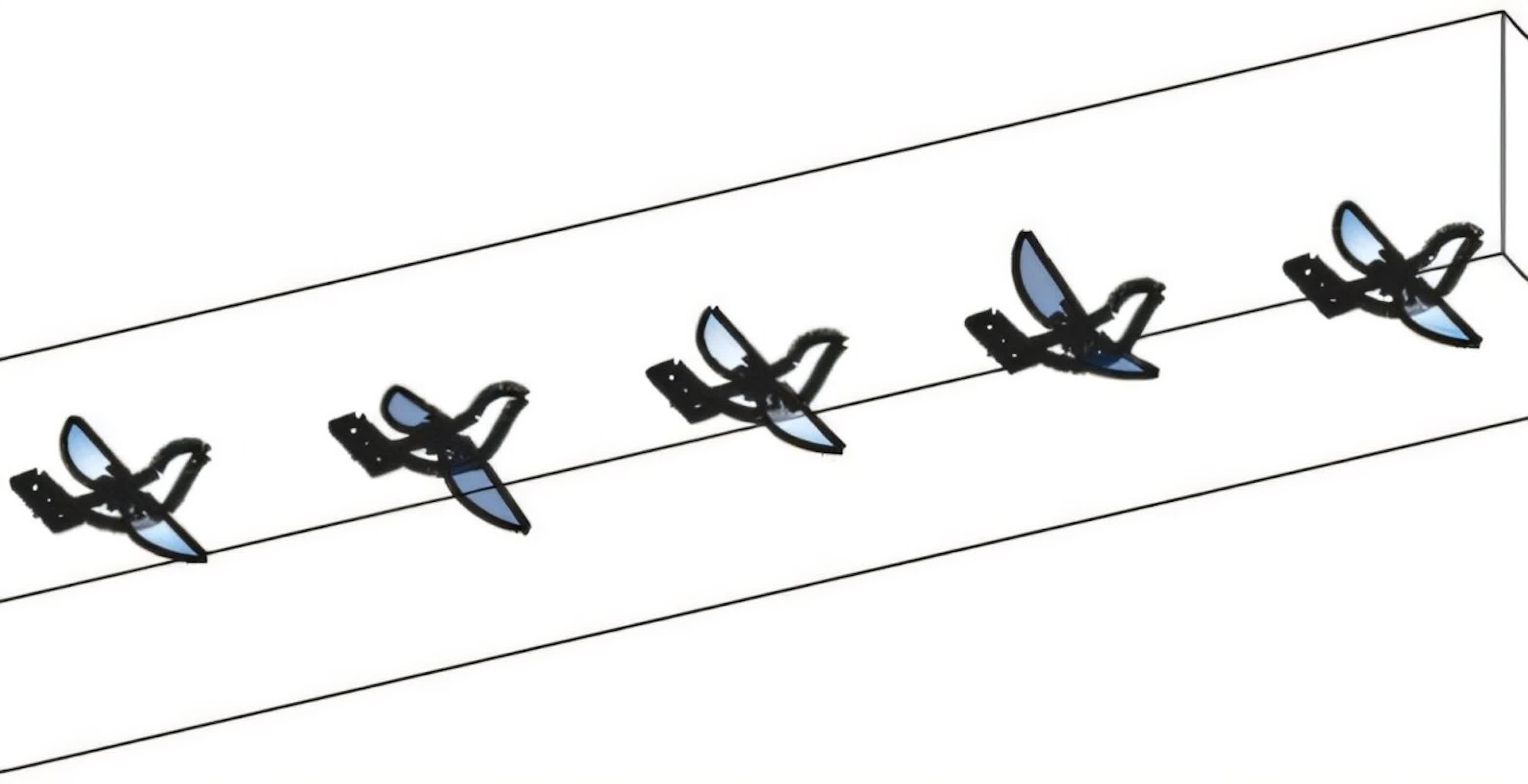
The team built a detailed computational model to replicate how these drones might behave, simulating everything from aerodynamics to electrical control. This allows them to test designs that cannot yet be physically built.
"We've scientifically demonstrated that this type of ornithopter can be possible when we make certain material assumptions," Bilgen said. "We can show the feasibility of designs that are not yet physically possible."
The limitation, for now, lies in materials. "Today's piezoelectric materials are not capable enough," Bilgen explained. "However, our mathematical model allows us to look into the future with reasonable assumptions."
Bilgen's fascination with flapping flight began nearly two decades ago, and his current work reflects a minimalist philosophy: achieve complexity through simplicity. "We want to achieve flapping flight without bone-like structures or muscle-like actuators, flapping in a much simpler way," he said.
While other teams have built robotic birds with motors and articulated skeletons, Bilgen's group takes a different approach by embedding Macro Fiber Composites directly onto flexible carbon-fiber wings. "The carbon fiber acts like feathers and bone, and the surface-mounted MFCs act like muscles and nerves," he said.
The result is an airframe that continuously changes shape, with no moving joints to wear out. Bilgen calls the design "mechanism-free," emphasizing that the flapping motion arises entirely from how the materials respond electrically rather than mechanically.
This research may eventually extend beyond flight. The same materials and principles could improve renewable energy systems by enabling real-time adjustments to turbine blades. "A turbine blade is basically a rotating wing," Bilgen said. "We've been looking at applying piezoelectric materials to turbine blades to see if there are aerodynamic benefits."
By tweaking blade shape on the fly, engineers might capture wind energy more efficiently – a goal that echoes nature's own approach to optimization. "Things that need to move fast must be lightweight," Bilgen noted. "That's why bird wings are delicate structures, and aircraft wings mimic bird wings."
For Bilgen, the aim isn't simply to copy biology but to push past it. "We don't want to just mimic nature," he said. "We want to exceed what nature does."