The big picture: NASA's long-delayed return to crewed lunar missions is no longer an abstract program of contracts and test stands, but a live flight now stretching away from Earth. With Artemis II, the agency is finally putting its next-generation transportation stack – the Space Launch System and Orion – through a full-scale crewed trial in deep space, a test that will shape how, and how soon, humans walk on the Moon again.
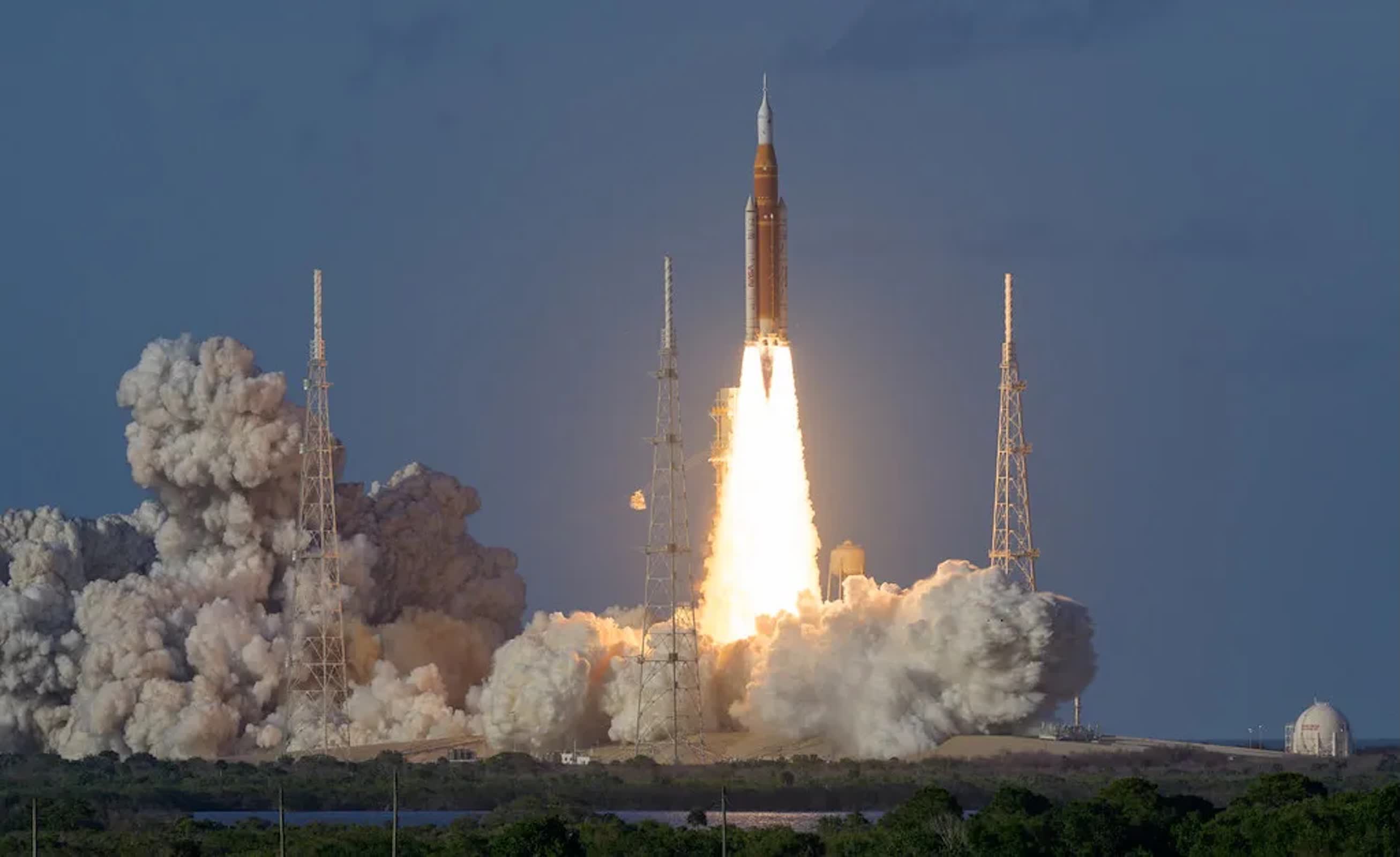
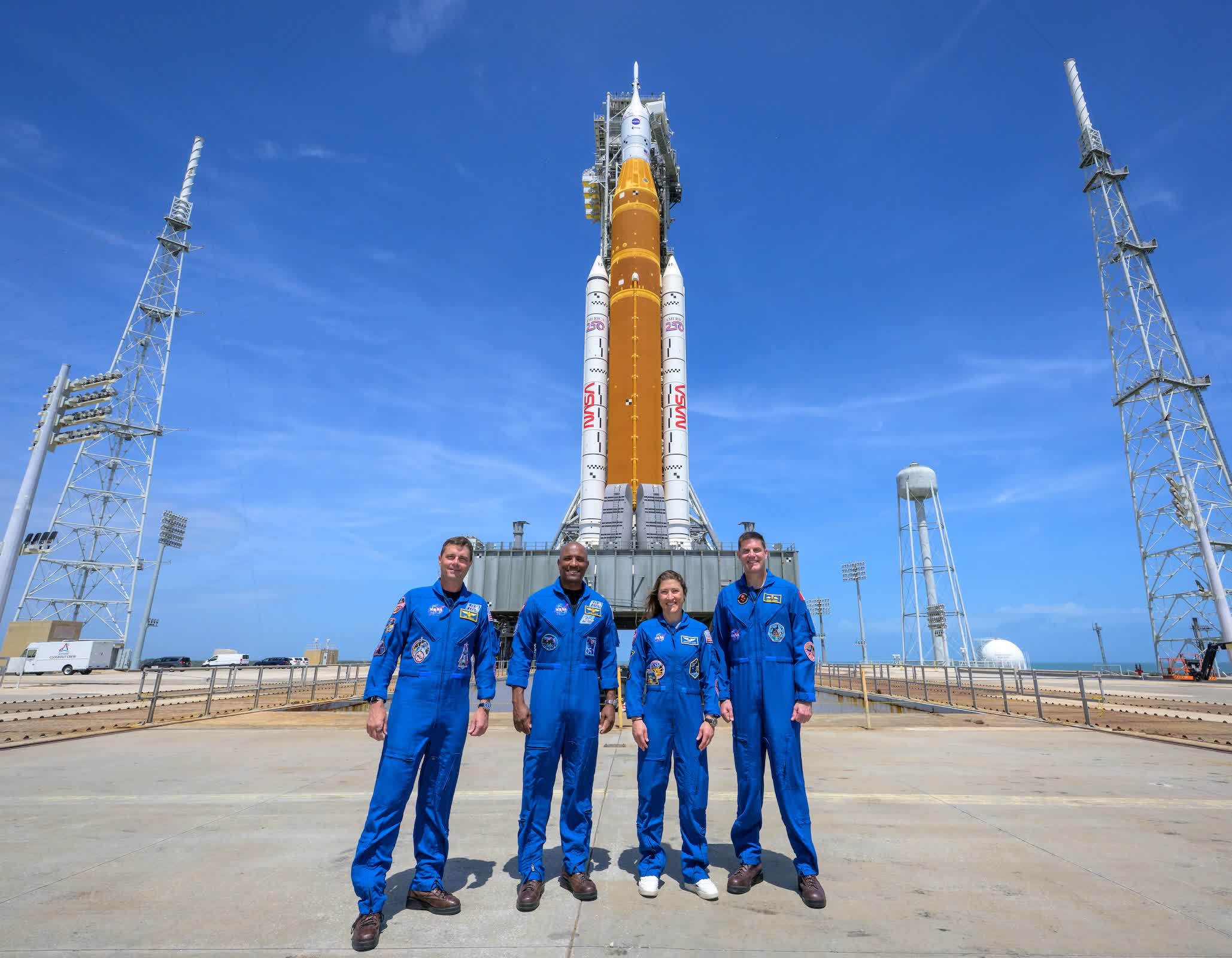
Four astronauts – Commander Reid Wiseman, pilot Victor Glover, mission specialist Christina Koch, and Canadian astronaut Jeremy Hansen – rode a 322-foot Space Launch System off Launch Complex 39B at 6:35 pm Eastern on Wednesday, beginning a roughly nine-day loop around the Moon.
The nearly 6-million-pound vehicle, powered by four hydrogen-fueled RS-25 engines and a pair of solid rocket boosters, produced about 8.8 million pounds of thrust, exceeding the legendary Saturn V in raw liftoff power. A few miles from the pad, the acoustic shock arrived as a wall of sound as the rocket punched through the lower atmosphere, trailing a long, bright plume.
From Orion's cockpit atop the stack, Wiseman – a 50-year-old Navy captain and former test pilot – radioed status calls as the SLS raced through its ascent profile. In just over two minutes, the solid boosters burned out at more than 150,000 feet and peeled away into the Atlantic, not to be recovered, as the four-engine core continued pushing the spacecraft toward orbit.
Protective hardware, including the launch abort system and aeroshell panels, was jettisoned on schedule before main engine cutoff and stage separation, roughly eight minutes after liftoff.
With the core stage gone, Orion extended its four solar arrays and coasted while the upper stage's RL10 engine established a parking orbit, then later fired again to place the capsule on a highly elliptical trajectory extending more than 40,000 miles from Earth – farther than any crewed vehicle has flown since Apollo.
From there, the mission pivots from the raw energy of launch to the measured work of validating a transportation architecture that NASA hopes will support a sustained lunar presence.
One of the most scrutinized tasks comes just a few hours into the flight. After Orion separates from the upper stage, Glover will take manual control to fly the capsule back toward the spent rocket for what NASA calls a rendezvous and proximity operations demonstration, or "prox ops."
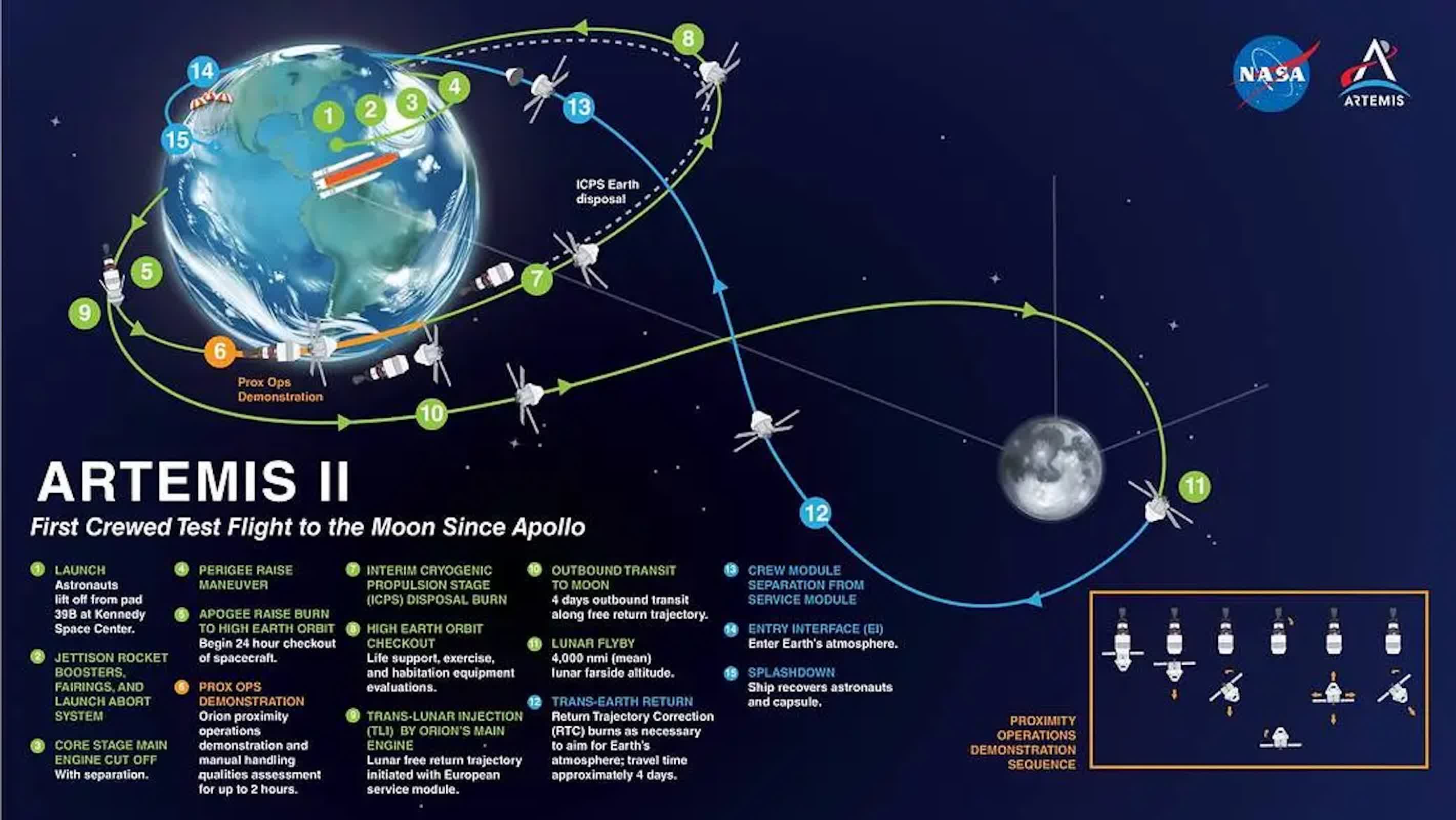
He will fire thrusters to bring Orion to within about 30 feet of the stage, then maneuver around it in all directions, including pitch, yaw, and roll. "We're not only going to fly the vehicle manually. We're going to execute all six degrees of freedom, so translating forward, backward, left, right, up, and down, and then pitch, yaw, and roll," Glover said before launch.
Glover's assessment carries extra weight because he has flown both Orion's more traditional cockpit and SpaceX's touchscreen-driven Crew Dragon. "There are physical rotational hand controllers and translational hand controllers, and this thing that we call a cursor control device, which is something you hold in your hand and hit buttons," he said of Orion.
"The SpaceX vehicle was built so that your kids could jump off their video games and jump in Dragon. A lot of it is intuitive, and that's a good thing. That's the paradigm that they are shooting for." By contrast, he said, "The crew (on Orion) has to be much more proficient to know where to go to see the right information."
Though Orion is designed to run on autopilot, the prox-ops session is about building confidence that crews can take over when needed, especially for future dockings with lunar landers in high lunar orbit.
Wiseman will back up Glover on the controls, while Koch tracks procedures and Hansen visually monitors range and closure, since this Orion flight does not carry a dedicated rangefinder. "We will be using subtended angles, how big the upper stage looks out the window or through a camera," Glover said. "So we are the primary hazard avoidance system, these eyes, in our assessment of how close we are." The sequence, lasting about 90 minutes, ends with a "breakout burn" to depart the upper stage for good.
Once clear, the tempo onboard slows as Houston and the crew turn to what NASA officials describe as the core purpose of Artemis II: validating life-support and other critical systems in the environment where they will actually have to operate.
Controllers will methodically bring Orion's life-support hardware and communications systems online as the spacecraft climbs toward the high point of its initial orbit. Near apogee, Orion will fire its thrusters to reshape that trajectory and set up for the trans-lunar injection burn later in the day – a roughly six-minute maneuver that commits the crew to the Moon.
NASA has made clear that the mission remains a test flight, with off-ramps if systems do not perform as expected. "On the life support system, the checkout that we get is a critical objective," said Amit Kshatriya, a senior NASA manager. "If it turns out that we don't get the performance we need after the acceleration and vibe (vibration of launch), we'll come home. We're not going to commit to the Moon if we don't have the performance."
If everything holds, Orion will swing thousands of miles beyond the Moon's far side, reaching roughly 252,799 miles from Earth – farther than any previous human flight – before returning along a free-return trajectory that uses the Moon's gravity to bend the path home.
Atmospheric reentry at about 25,000 miles per hour will culminate in a parachute-assisted splashdown in the Pacific Ocean off California – the final step in a mission designed to retire enough risk for NASA to begin focusing not just on lunar flybys, but on landings.