
In a nutshell: While it gained its own brand only after spinning off from Toshiba in 2018, the Kioxia team was a major driving force in the development of flash memory technology during the 1980s. Now, the Japanese memory manufacturer is looking to ease storage demand in the consumer space, as the AI frenzy turns nearly every piece of computer hardware into an unattainable luxury.
Kioxia has announced the EG7 series of solid-state drives, the company's first SSD line built around its quadruple-level cell (QLC) technology, branded as BiCS FLASH. Despite using QLC NAND, the new SSDs are said to deliver performance comparable to TLC-based drives – at least according to Kioxia. However, the EG7 series does not include any DRAM cache, which raises questions about how it achieves its advertised performance levels.
Kioxia claims its BiCS FLASH QLC memory can deliver sequential read speeds of up to 7,000 MB/s and sequential write speeds of up to 6,200 MB/s. The drives will be available in 512GB, 1TB, and 2TB capacities, and are rated for random read and write performance of up to 1,000 KIOPS.
The EG7 series will be offered in M.2 2230, 2242, and 2280 form factors, making them compatible with a wide range of PC configurations and space constraints. Additional specifications include support for the NVMe 2.0d protocol, PCIe 4.0 compliance, and always-on self-encryption via TCG Opal 2.0.
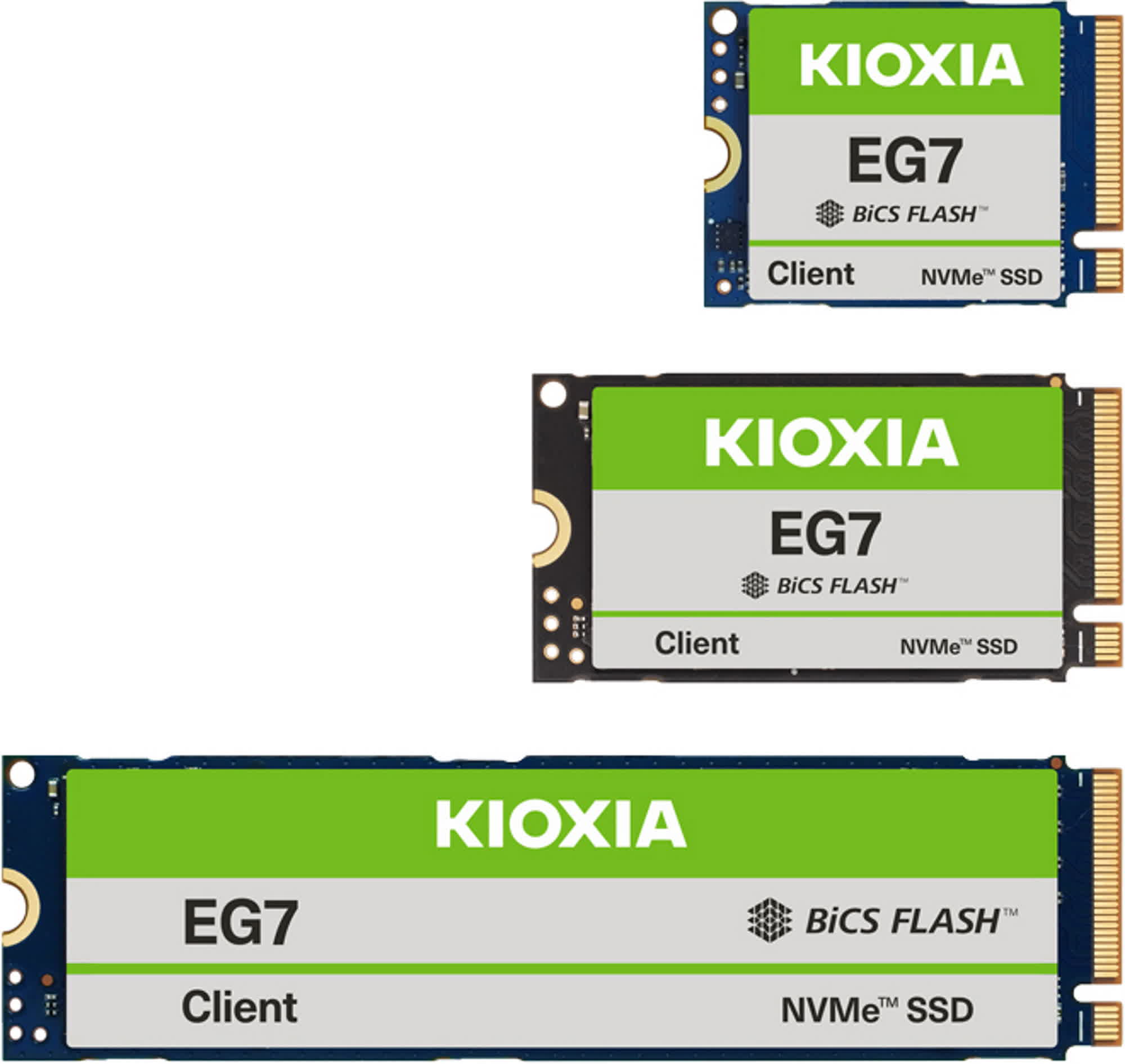
Kioxia's new SSDs are DRAM-less units designed to leverage Host Memory Buffer (HMB) technology to improve I/O performance. HMB allows the SSD to use a portion of the system's main DRAM via the PCIe bus for caching tasks. According to Kioxia's announcement, this "mature" technology is intended to improve cost efficiency, power consumption, and overall drive performance.
With the new EG7 series, Kioxia is specifically targeting value-oriented PC designs such as slim laptops, mainstream consumer notebooks, and entry-level desktop pre-built systems. The drives are already shipping to several unnamed OEMs, with the first systems expected to reach the market in the second quarter of the year.
Kioxia also emphasized the growing need for affordable storage components in the PC market, as major tech companies and hyperscalers continue to absorb large volumes of supply to support AI data center expansion. Earlier this year, Shunsuke Nakato, managing director of Kioxia's memory division, suggested that consumers may no longer see 1TB SSDs priced below $50 in the future.
According to Vice President Axel Stoermann, modern client storage customers must strike a careful balance between performance, efficiency, and cost. In practical terms, this likely means paying more for less capacity while adjusting expectations accordingly.
Image credit: Kyodo News