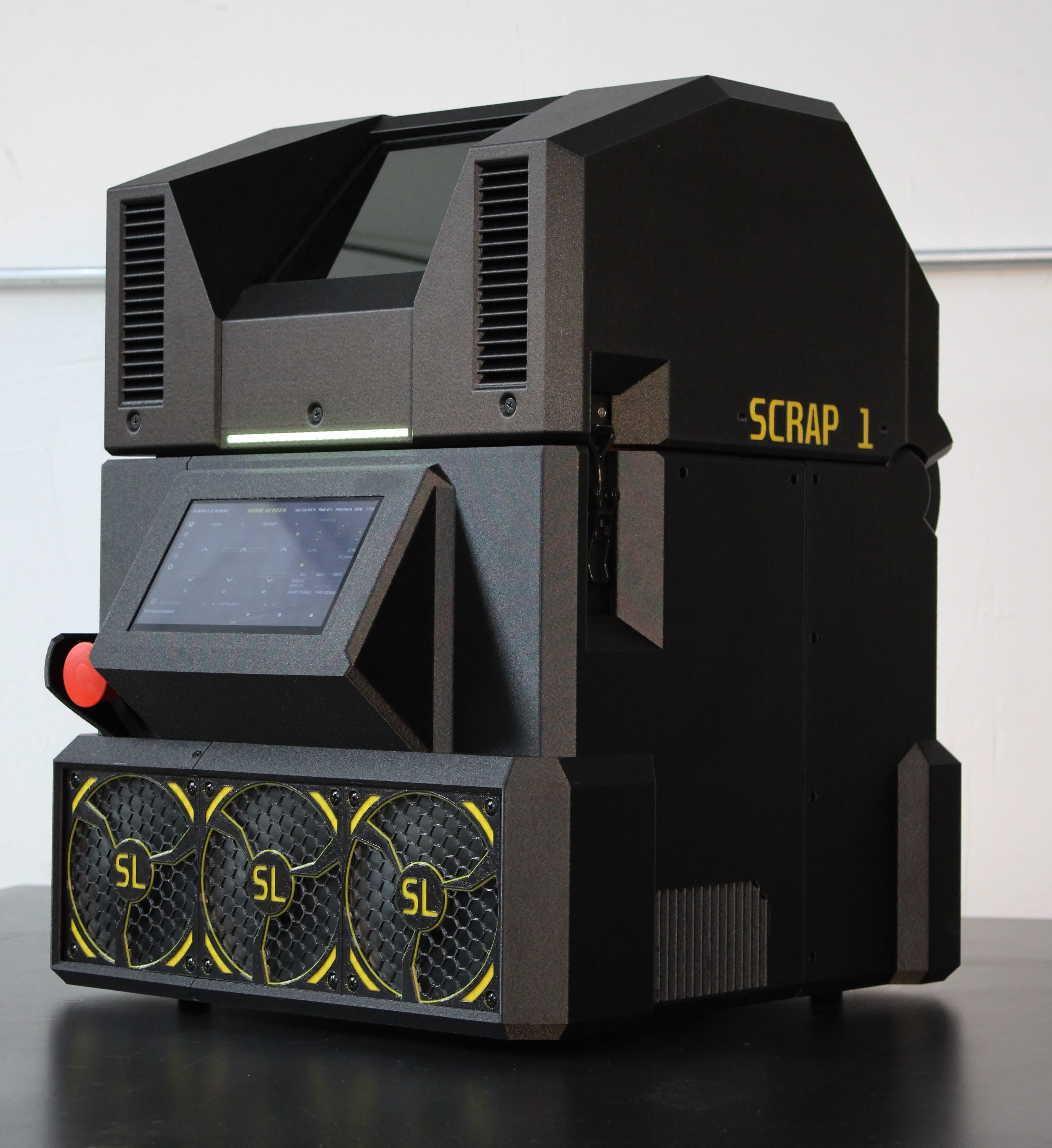
The takeaway: A compact metal printer debuting at a hobbyist festival in Colorado is testing whether one of manufacturing's most capital-intensive processes can be compressed into something closer to a benchtop tool. Scrap Labs, a Colorado-based startup, introduced its Scrap 1 system at the Rocky Mountain RepRap Festival in Loveland on April 18-19, positioning the machine as a lower-cost entry point into laser powder bed fusion.
The process – long dominated by industrial platforms – builds parts by spreading thin layers of metal powder and selectively melting them with a laser, repeating the cycle until a finished geometry emerges. The result can be dense, functional components with internal channels and lattice structures that are difficult or impossible to produce through conventional machining.
These capabilities have driven adoption across aerospace, automotive, and tooling, but cost and infrastructure demands have kept the technology largely out of reach for smaller operators.
Scrap Labs is targeting that gap. The company's first system brings laser powder bed fusion into a compact format intended for workbench deployment rather than a dedicated industrial cell. Traditional machines from established manufacturers can exceed $200,000 and typically require specialized electrical service, controlled environments, and extensive safety systems for handling fine metal powders. Even lower-cost offerings aimed at smaller buyers still run in the tens of thousands of dollars and assume a lab-like setup.
The Scrap 1 is designed to reduce those barriers without abandoning the underlying process. It integrates liquid and air cooling and uses HEPA filtration to manage particulates. The platform supports a range of metals, including stainless steel, tool steel, copper, nickel alloys, and cobalt chrome, targeting both prototyping and limited production use.
Connectivity options include Ethernet, Wi-Fi, and USB, along with a web-based control interface. The firmware is built on Klipper, and the system is compatible with established slicing tools such as PrusaSlicer and OrcaSlicer, as well as Scrap Labs' own ScrapSlicer workflow.
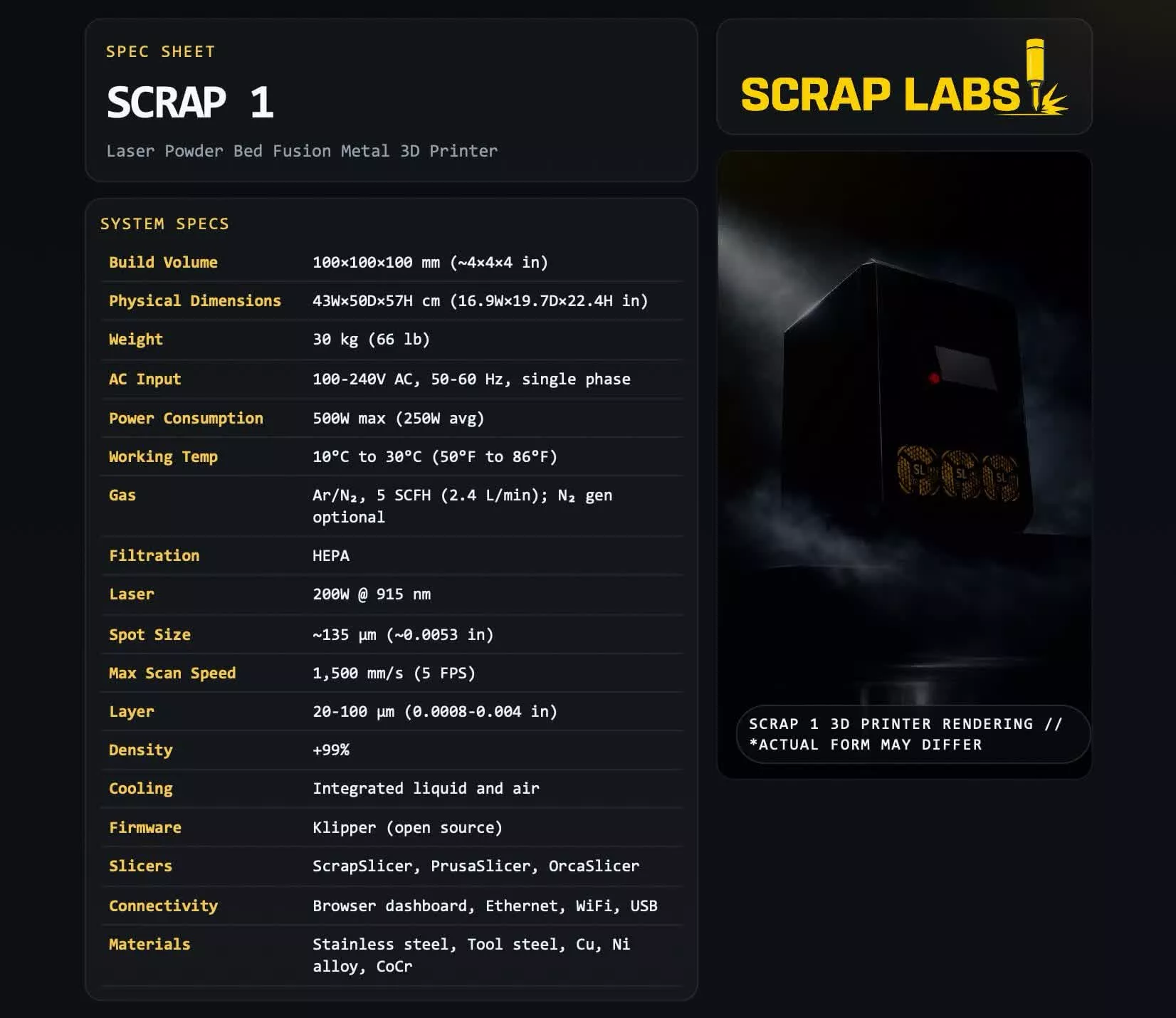
The focus on open tooling and familiar software is intended to avoid the closed ecosystems common in industrial additive systems. Rather than locking users into proprietary pipelines, Scrap Labs is aligning the machine with workflows already used in polymer printing and desktop fabrication, lowering the learning curve for those transitioning into metal.
Scrap Labs aims to serve users who have historically relied on outsourcing, including university labs, vocational programs, small manufacturers, motorsport shops, and design studios. For these groups, access to in-house metal printing could shorten iteration cycles, allowing parts to move from design to physical testing without the delays associated with machining or external service bureaus.
Scrap Labs has opened pre-orders, with kit versions starting at $9,600 under a limited-time offer, increasing to $14,200 after April 30, 2026. Fully assembled systems begin at $17,990. The company expects to begin shipments in early 2027, with options for refundable deposits or waitlist enrollment.
Scrap Labs reports completing a proof-of-concept phase in December 2025 and is now in an alpha testing stage with early partners. A broader beta phase is planned for late 2026, followed by a production ramp targeting mid-2027 for initial US deliveries.
Its ability to deliver consistent part quality, material performance, and operational safety at that price point remains unproven. However, by compressing laser powder bed fusion into a smaller, more accessible package and pairing it with open software workflows, Scrap Labs is pushing the technology toward a broader set of users.