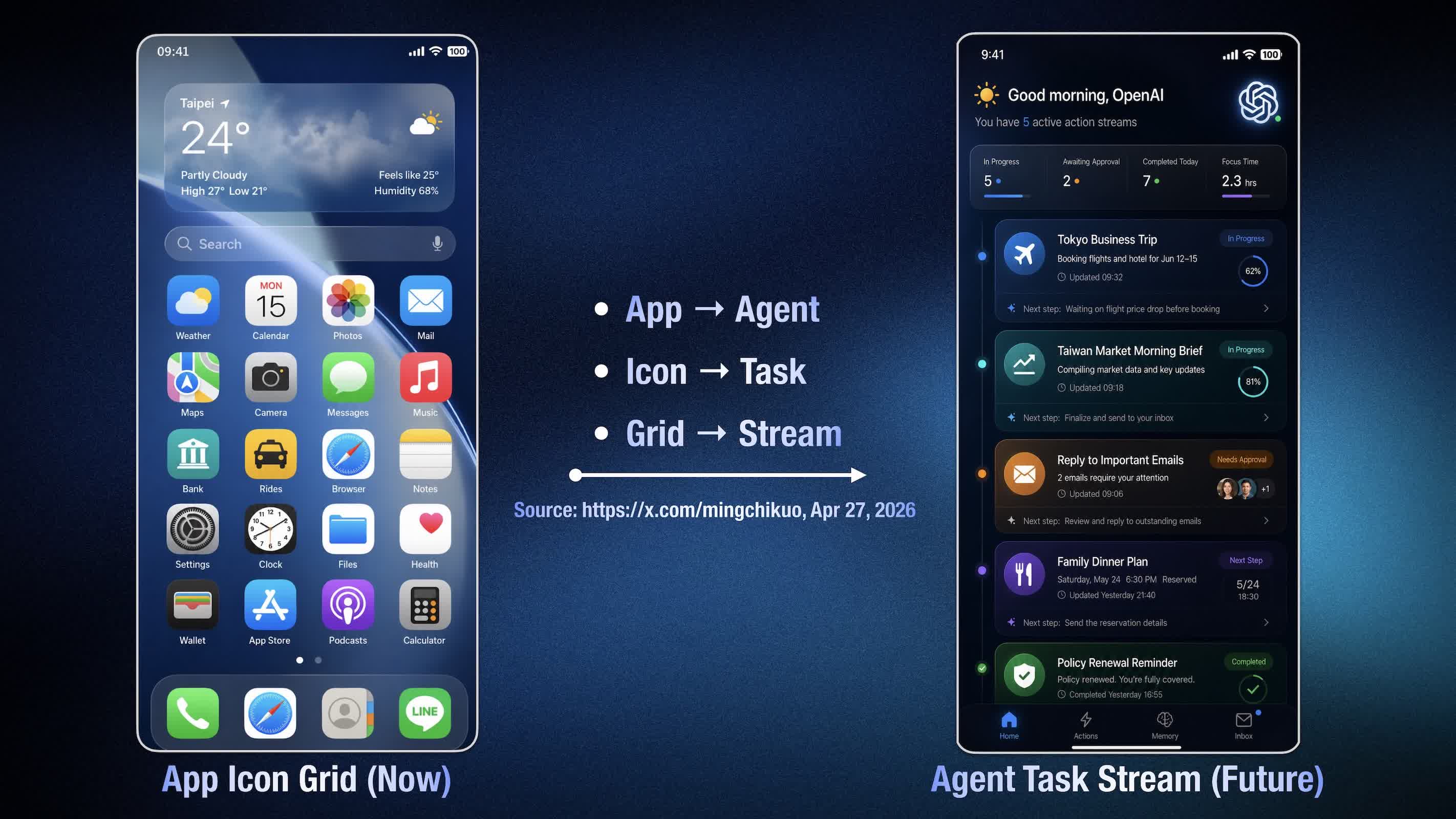
Rumor mill: OpenAI is reportedly working on a smartphone, but with a new approach: the project centers on AI agents as the primary interface, not apps. Apple analyst Ming-Chi Kuo said in a post that the company is developing a device designed to "deliver a comprehensive AI agent service." The project suggests a move away from the app-driven model toward one where AI handles tasks directly for the user.
The hardware side appears more conventional. Kuo says the device would use chips from either MediaTek or Qualcomm and be assembled by Luxshare, a manufacturer that also produces iPhones. That points to reliance on established partners rather than a new supply chain.
The more notable change is how the handset would work. Instead of a home screen filled with apps, the interface would revolve around a live panel of AI-driven activity. Kuo describes a system where users interact with ongoing tasks – like booking flights or pulling together market data – without jumping between apps.
A concept image shows a screen built around these active processes rather than icons. While that design isn't final, the idea is that AI agents handle multi-step tasks across services in the background.
That approach has been discussed across the industry, but mostly at the software layer. OpenAI appears to be exploring what happens when that model is built into the device itself. Owning the hardware could give the company more control over performance, data flow, and how its models are used day to day.
– 郭明錤|Ming-Chi Kuo (@mingchikuo) April 27, 2026
There are still open questions. Kuo doesn't say what operating system the device would run, though it would likely rely on an existing mobile platform. How deeply OpenAI would customize and integrate its models remains unclear.
The timeline also suggests this is an early-stage effort. Kuo says the device may not be finalized until late 2026 or early 2027, with mass production targeted for 2028. That gives OpenAI time to refine both the hardware and the user experience, which would need to feel meaningfully different from today's smartphones to gain traction.
The bigger challenge isn't building the device – it's changing user behavior. Replacing apps with AI agents might sound efficient in theory, but it depends on users trusting those systems to act on their behalf with minimal input.