What just happened? If the AI boom really is a bubble that will one day pop, it hasn't happened yet. Nvidia, the driving force behind the hardware powering most of the AI industry, once again surpassed Wall Street expectations in its quarterly results, hitting a record $81.6 billion in revenue.
Americans might rather live next to a nuclear power plant than a data center, but Nvidia CEO Jensen Huang hailed the pace at which these facilities are being built. "The buildout of AI factories – the largest infrastructure expansion in human history – is accelerating at extraordinary speed," he said.
Huang also mentioned another controversial element of AI, one which has contributed to layoffs at companies like Meta and Block. "Agentic AI has arrived, doing productive work, generating real value, and scaling rapidly across companies and industries."
Nvidia CFO Colette Kress summed up the situation this way: "Customers do not buy GPUs; they build AI factories & the right economic metric is not the purchase price of the GPU. It is the lifetime cost of an AI factory producing intelligence: tokens per watt, tokens per dollar, uptime, utilization, time to production, software durability & asset life. NVIDIA excels at all of them."
– The Transcript (@TheTranscript_) May 20, 2026
For Nvidia, this all means a very healthy bottom line. The chip giant said net income for the February-April quarter reached $58.32 billion, or $2.39 per share, compared with $18.78 billion, or 76 cents per share, a year earlier. On an adjusted basis, Nvidia earned $1.87 per share. Revenue, meanwhile, surged 85% year-over-year, climbing to $81.62 billion from $44.01 billion.
Those results exceeded analysts' expectations of $1.76 per share and revenue of $78.91 billion. For the current quarter, Nvidia forecast revenue of about $91 billion, ahead of analysts' expectations of $87.29 billion.
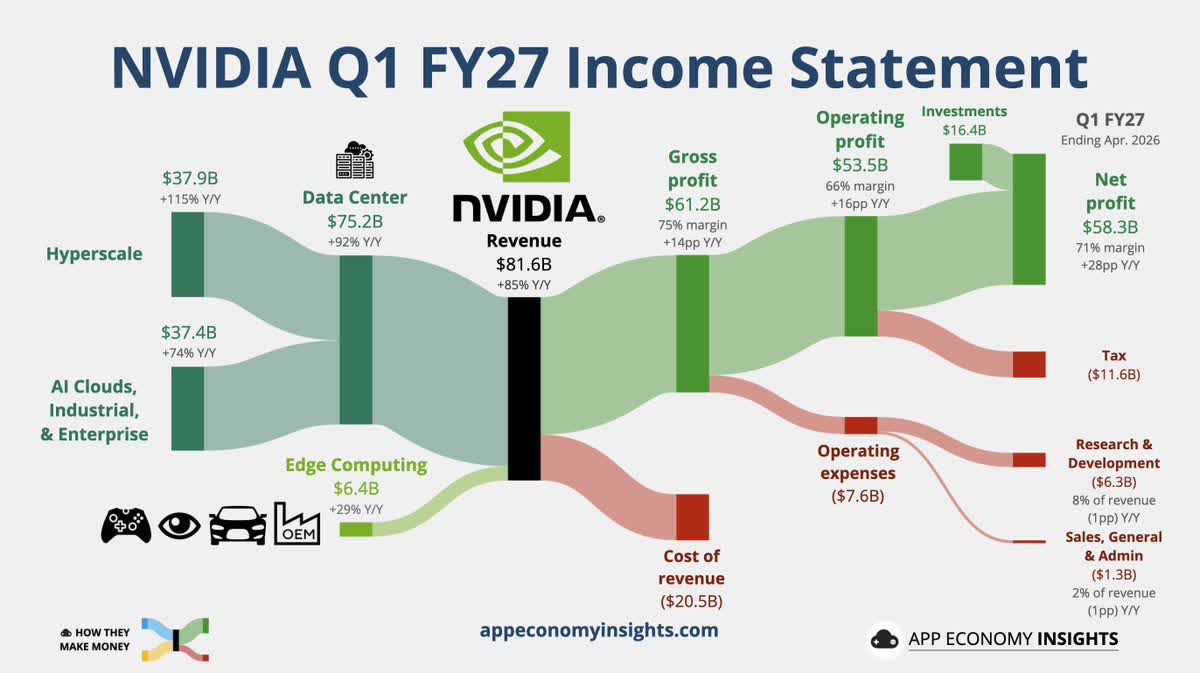
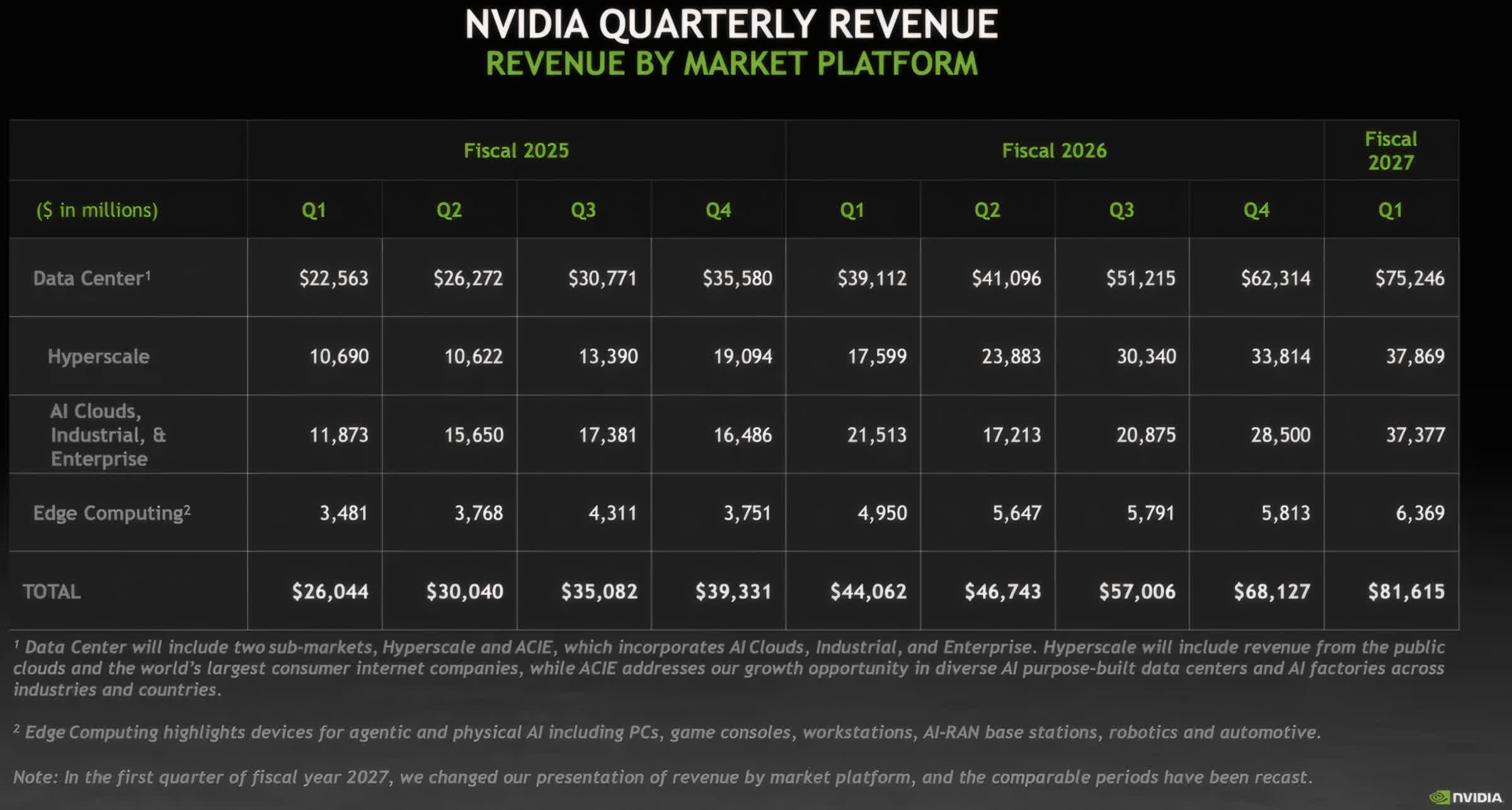
Unsurprisingly, most of the previous quarter's income came from Nvidia's data center division. It delivered another record quarter with revenue of $75.2 billion, a 92% year-over-year increase.
Another sign of how Nvidia has changed from gaming-first to AI-first is the way it now talks about its business. The company is moving to a new reporting framework built around two main market platforms: Data Center and Edge Computing. The latter is a broad category covering PCs, game consoles, workstations, AI-RAN base stations, robotics, and automotive, meaning sales of consumer and professional graphics cards will no longer be broken out as separate product categories in the same way.
That does not mean Nvidia's graphics business is disappearing, though. The company still listed Graphics as a reportable segment in its CFO commentary, where it generated $7.1 billion in revenue during the quarter, up 58% from a year earlier.
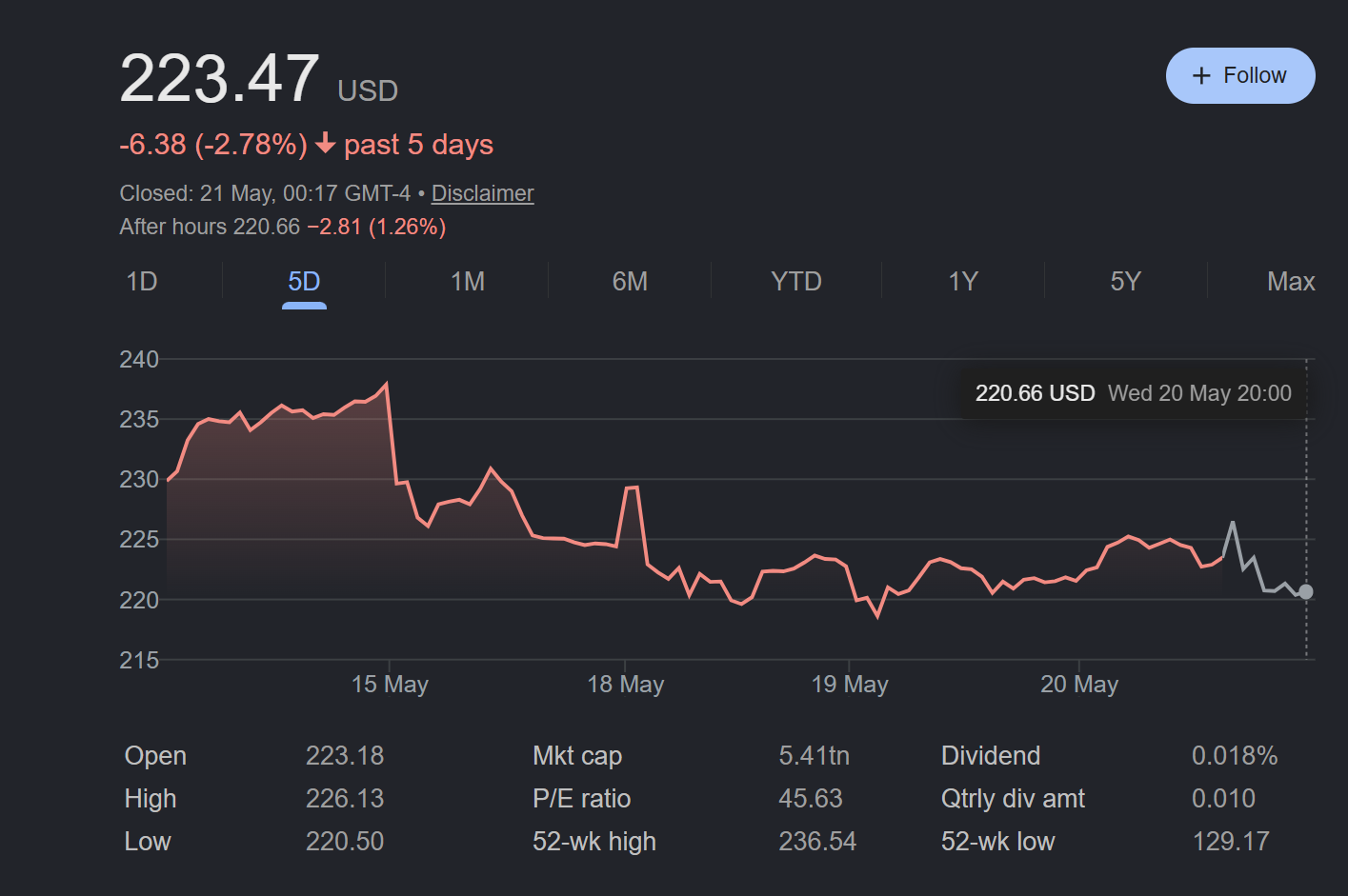
Despite another record-breaking quarter, Nvidia's share price dipped in after-hours trading from $223 to $220. It seems some investors remain worried that Team Green's AI-fueled winning streak can't last forever. Its market cap has climbed from about $365 billion at the end of 2022, before the AI boom truly took hold, to $5.47 trillion today – making Nvidia the most valuable company in the world. The fear is that a downturn will eventually arrive.
There are other concerns, too. Nvidia said its outlook assumes no data center compute revenue from China, while some of its biggest customers, including Amazon, Alphabet, and Microsoft, are spending heavily on their own AI chips. For now, though, the numbers suggest Nvidia remains the company everyone else is chasing.