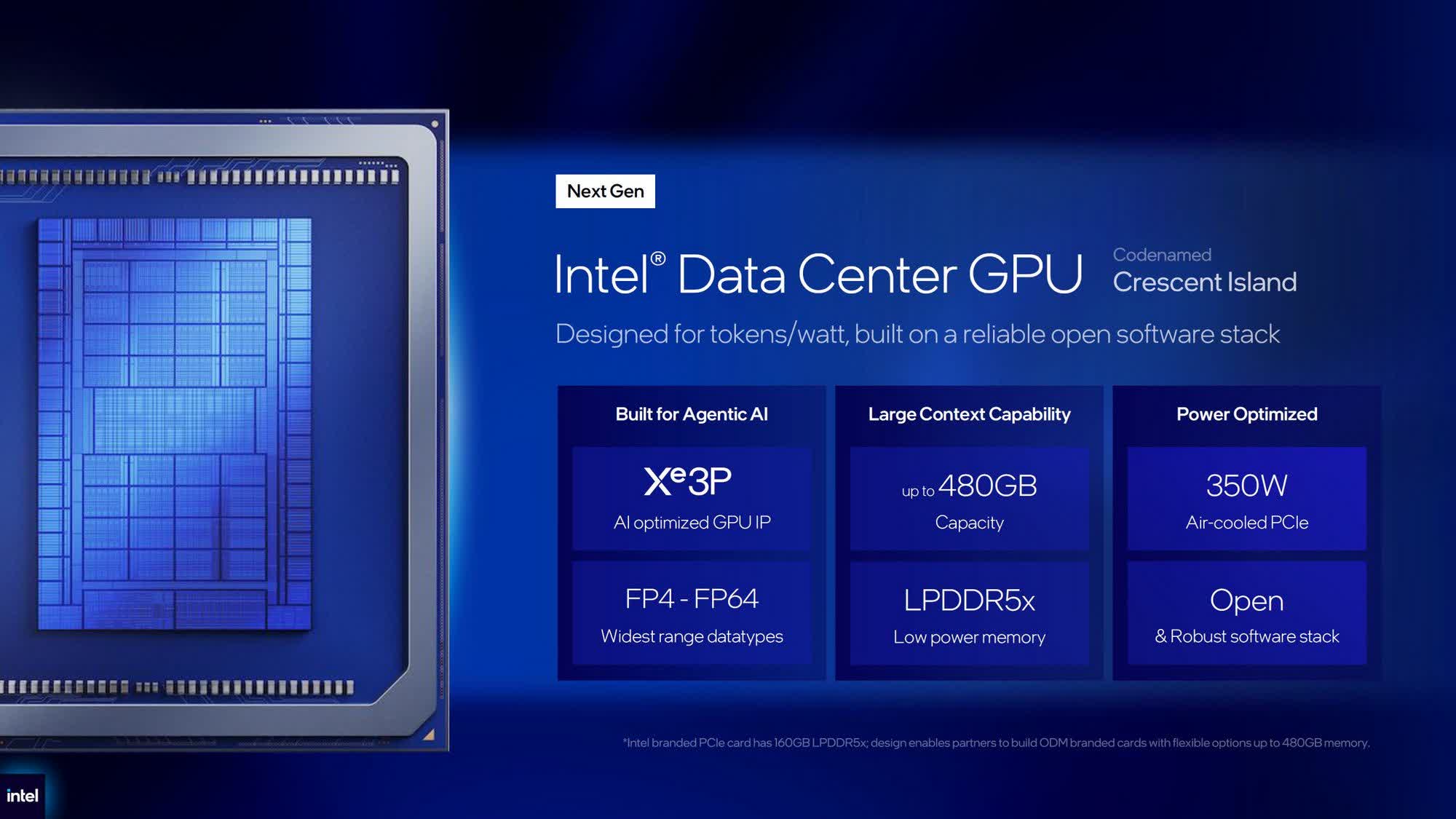
The big picture: Intel announced its Crescent Island data center GPU last year, confirming support for up to 160GB of LPDDR5X memory in the reference design. The company has now revealed that the chip will give board partners the flexibility to build accelerators with higher configurations, featuring up to 480GB of onboard memory.
At Computex 2026, Intel shared more details about its Crescent Island GPU architecture, noting that it is designed specifically for agentic AI workloads. While conventional AI accelerators from Nvidia and AMD rely on expensive high-bandwidth memory, Intel's new chip uses consumer-oriented LPDDR5X DRAM and is designed to run in air-cooled servers rather than liquid-cooled setups.

The new graphics chip supports a range of data types for inference workloads and cloud service providers, from FP4 to FP64. While FP4 is used for high-performance AI inference, FP64 is typically used for numerical simulations and scientific applications such as weather forecasting, climate modeling, fluid dynamics, and astrophysical calculations.
Intel claimed that Crescent Island has been optimized for performance per watt, delivering a 350W TDP in the air-cooled PCIe version. The power efficiency can also be attributed to the use of LPDDR5X memory, which employs a densely packed channel design, enabling significantly higher bandwidth without a corresponding increase in power consumption.

Recent leaks suggest that Crescent Island could use a 640-bit bus connecting 20 LPDDR5X modules of 24GB each to achieve its high memory capacity. With LPDDR5X offering 10.7 Gbps memory bandwidth, the total peak bandwidth is expected to reach 684 GB/s – far lower than the 5 TB/s delivered by Nvidia's older H200 GPUs.
Crescent Island is an inference-only graphics processor based on Intel's Xe3P graphics architecture, a performance-oriented variant of the standard Xe3 architecture used in Core Ultra 300-series "Panther Lake" chips for laptops and compact desktops. Xe3P is also expected to power Intel's Arc-C series GPUs for client devices.
Customer sampling for Crescent Island is planned for the second half of 2026, with availability expected in 2027. Intel has not yet shared full specifications or performance benchmarks, including end-to-end inference throughput, latency, or power efficiency figures. Most of those details are likely to be disclosed closer to the official launch next year.