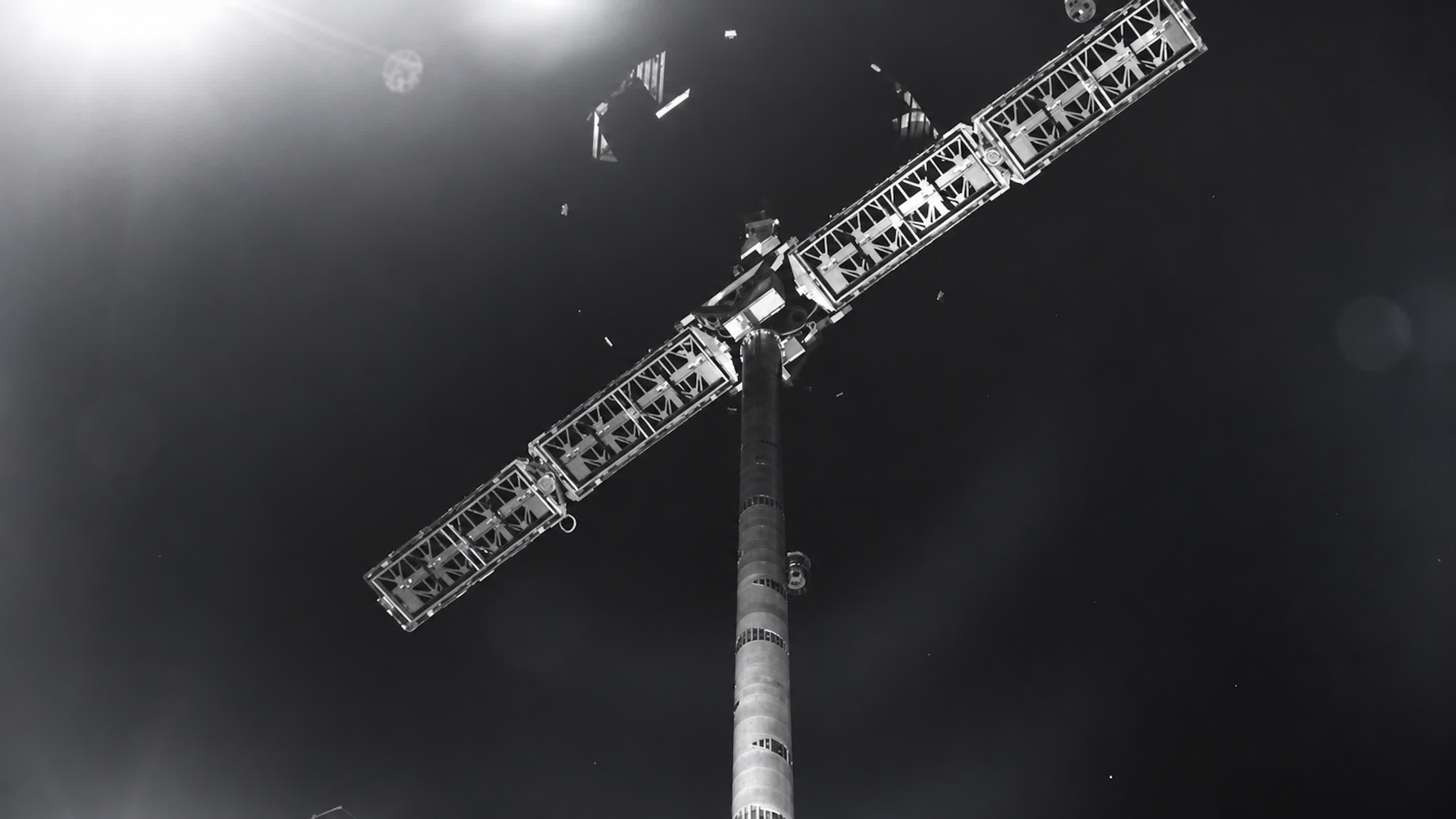
First look: Blue Origin is developing a solar power system designed for use on the Moon, where keeping equipment supplied with electricity will be one of the biggest practical challenges. The tower is still at an early stage of development, and Blue Origin has not said when it could fly to the Moon. But the system reflects the growing focus on the infrastructure needed for future surface operations. Launch vehicles and landers may get equipment to the surface. Systems such as the Power Tower would help keep it running once it arrives.
The company calls the system the Power Tower. It is a 20-meter-tall (65 foot) solar array that deploys vertically after landing and is designed to generate more than 10 kilowatts of electricity. Blue Origin said it is intended for Moon Base operations at the lunar south pole, the region NASA is targeting for its Artemis program.
The company released an animation showing the system landing on the lunar surface and extending from its base. A central mast rises first, followed by arms that unfold and lower the solar panels into place.
The design addresses a problem that will shape nearly every aspect of lunar operations: power is difficult to generate and distribute on the Moon. The lunar south pole is especially challenging. Parts of the region receive sunlight at low angles, while craters, ridges and other terrain can leave nearby areas in shadow. Conditions can change over short distances.
A vertical array can place solar panels above some of those surface-level obstacles. It could also reduce the amount of ground a power system occupies. That matters when a landing site must accommodate vehicles, science equipment, communications hardware and, eventually, habitats and rovers.
Blue Origin said the Power Tower's modular architecture will deliver power beyond the lander to the assets that need it most. That capability would be important for any permanent or semi-permanent lunar operation. Surface systems will need electricity for communications, thermal control, scientific instruments, computing equipment and mobility systems. A tower generating 10 kilowatts would not by itself run a large lunar settlement, but it could support smaller operations or serve as one part of a larger power network.
The Power Tower appears to be based on earlier work by Honeybee Robotics, a Blue Origin subsidiary. Honeybee developed the Lunar Array Mast and Power System, known as LAMPS, which was deployed during testing at NASA's Johnson Space Center in Houston in 2024.
– Blue Origin (@blueorigin) September 25, 2026
Honeybee Robotics has also worked with NASA through the agency's Vertical Solar Array Technology project. That effort has examined solar arrays that can operate effectively in the lunar environment, particularly in areas where conventional ground-mounted panels may be blocked by terrain or exposed to unfavorable sun angles.
Blue Origin's announcement also ties the tower to NASA's Moon Base plans, which run through 2029. Under the agency's present timeline, the base would be operating by 2032.