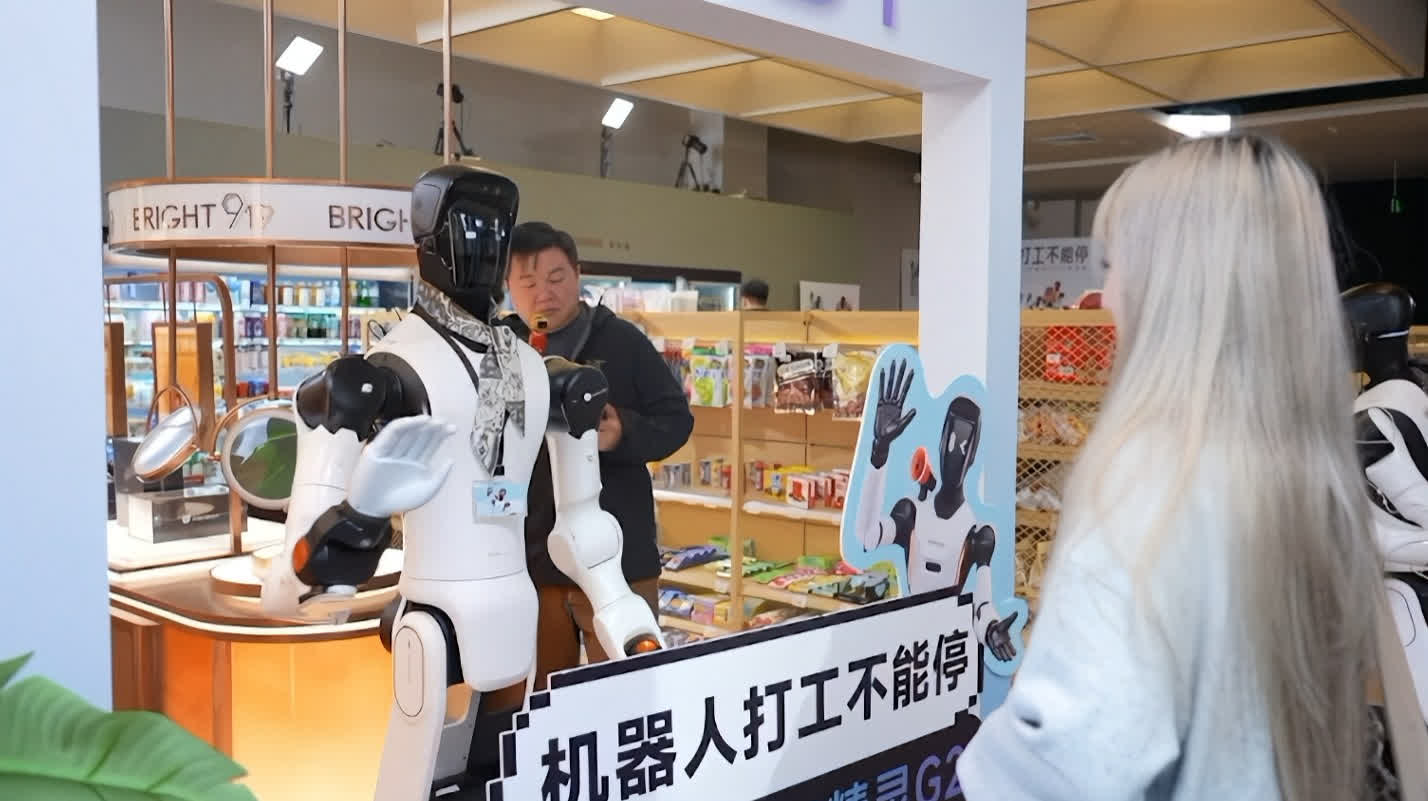
Through the looking glass: If you're wondering which job humanoid robots will take next, or "help the humans with," it could be in your local convenience store. A Chinese robot manufacturer recently launched a livestreamed challenge involving six of its humanoid machines working a 24-hour shift at a store, but not all of them passed their probation.
Agibot's G2 robots took over duties at an operating convenience store in Shanghai's Xuhui district between November 2 and 3. The company called the broadcast "Robots Never Clock Out," which perfectly captures why managers are introducing these robots.
The machines' assignments included stocking shelves, preparing coffee and hot food, greeting customers, and clearing rubbish. The challenge covered four periods: the lunchtime rush, evening crowds, overnight duty, and breakfast preparation. All of which meant there were plenty of opportunities for something to go wrong.
There were also some deliberately awkward tests. According to Machine Heart's report (via Sina), participants asked the robots to distinguish between sugary and sugar-free Coke, placed obstacles in their paths, and shook a container while a machine tried to pick up food. What better way to get robots used to working in a convenience store than to have them encounter difficult customers?
– AGIBOT (@AGIBOTofficial) November 2, 2026
By the end, the robots had completed 1,730 tasks. These included 683 customer greetings, 369 item retrievals and deliveries, and 147 coffees. However, only four machines passed the assessment. The cleaning robot and one assigned to patrol the shelves fell short. According to ITHome, the latter lacked initiative in inspecting and replenishing goods and failed to keep up with the store's turnover pace. Its on-duty enthusiasm needs to be improved in the future, apparently, which makes it sound even more human.
The cleaning bot encountered a full trash can while on night duty, causing it to deviate from the designated route, run outside the store, and stray from its post. Again, it's a scenario many people might relate to.
Before store owners start calculating how many salaries they could save, there are some fairly important caveats. Although the report describes 24 hours of continuous operation, it doesn't specify whether individual machines needed charging breaks, maintenance, or human assistance during that time.
We also don't know whether the robots matched human workers for speed and cost. A report from January found that humanoid robots were working about half as fast as their human counterparts, but factories were still buying them anyway.
The list of workplaces experimenting with humanoids keeps growing. AGCO plans to introduce Digit robots at its Kansas farm-equipment factory in 2027, complete with the usual assurances that they will help employees rather than replace them.
South Korea has also approved a trial allowing 20 humanoids to share factory workspaces with humans, under an exemption from existing safety-barrier requirements and with additional safeguards. At least making coffee is a more reassuring use for these machines than pummeling a YouTuber in a cage.