
This motherboard roundup has been in the works for the better part of a year, but we are finally done – or at least we have stopped waiting for more boards to arrive. We have capped the list at 47 unique AMD B850 motherboards. There is a lot to cover, so let's get started.
We have 47 motherboards in total, we already took a close look at 23 of them in part one, focusing on models priced under $200. This second part covers 24 more B850 boards, most of which are priced above $200, though some newer, more affordable models have since arrived, so we included those as well. Let's get into it.

The Big Spec Table
Here are the 24 motherboards included in this roundup, in order of appearance. Check out part one, for a similar table with specs of most of the remaining budget B850 motherboards.
| Mobo | Price | Vcore VRM | PCIe x16 | M.2 Gen 5.0 |
M.2 Gen 4.0 / 3.0 |
USB 3.x | USB 2.0 | WiFi | LAN |
|---|---|---|---|---|---|---|---|---|---|
| ASRock B850 Challenger WiFi |
TBD | 12, 50A | 2 | 1 | 1 | 11 | 4 | WiFi 7 | 2.5 GbE |
| ASRock B850 Steel Legend WiFi |
$210 | 14, 80A | 2 | 1 | 3 | 12 | 8 | WiFi 7 | 2.5 GbE |
| Asus B850 Max Gaming WiFi W |
$200 | Discrete MOSFETs |
4 | 1 | 2 | 8 | 9 | WiFi 6E | 2.5 GbE |
| Asus TUF Gaming B850M-Plus WiFi |
$220 | 14, 80A | 1 | 1 | 2 | 10 | 6 | WiFi 6E | 2.5 GbE |
| Asus TUF Gaming B850-Plus WiFi |
$240 | 14, 80A | 2 | 1 | 2 | 10 | 6 | WiFi 7 | 2.5 GbE |
| Asus ROG Strix B850-A Gaming WiFi |
$230 | 14, 80A | 2 | 1 | 3 | 10 | 4 | WiFi 7 | 2.5 GbE |
| Asus ROG Strix B850-F Gaming WiFi |
$270 | 16, 80A | 2 | 2 | 2 | 10 | 8 | WiFi 7 | 2.5 GbE |
| Asus ROG Strix B850-E Gaming WiFi |
$320 | 16, 90A | 2 | 3 | 2 | 10 | 6 | WiFi 7 | 5 GbE |
| Asus ROG Strix B850-I Gaming WiFi |
$350 | 10, 90A | 1 | 1 | 1 | 8 | 3 | WiFi 7 | 2.5 GbE |
| Gigabyte B850 Aorus Elite WiFi7 Ice |
$230 | 14, 60A | 3 | 1 | 2 | 11 | 8 | WiFi 7 | 2.5 GbE |
| Gigabyte B850I Aorus Pro | $310 | 8, 80A | 1 | 1 | 1 | 8 | 4 | WiFi 7 | 2.5 GbE |
| Gigabyte B850 AI Top | $320 | 16, 110A | 3 | 2 | 1 | 11 | 8 | WiFi 7 | Dual 10 GbE |
| MSI Pro B850-P WiFi | $200 | 6-phase discrete MOSFETs |
4 | 1 | 2 | 9 | 8 | WiFi 7 | 5 GbE |
| MSI B850M Gaming Plus WiFi |
TBD | 8, 60A | 2 | 1 | 1 | 11 | 4 | WiFi 7 | 5 GbE |
| MSI B850M Gaming Plus WiFi6E |
TBD | Discrete MOSFETs |
1 | 1 | 1 | 11 | 4 | WiFi 6E | 2.5 GbE |
| MSI B850 Tomahawk WiFi |
TBD | 14, 80A | 2 | 1 | 2 | 9 | 8 | WiFi 7 | 5 GbE |
| MSI B850 Tomahawk Max WiFi |
$280 | 14, 80A | 3 | 2 | 2 | 11 | 8 | WiFi 7 | 5 GbE |
| MSI B850M Mortar WiFi | $230 | 12, 60A | 1 | 2 | 1 | 12 | 4 | WiFi 7 | 5 GbE |
| MSI MPG B850 Edge Ti WiFi |
$200 | 14, 80A | 3 | 2 | 2 | 11 | 8 | WiFi 7 | 5 GbE |
| MSI MPG B850I Edge Ti WiFi |
$265 | 8, 90A | 1 | 1 | 1 | 9 | 2 | WiFi 7 | 5 GbE |
| MSI B850M Power | $260 | 12, 60A | 1 | 2 | 2 | 11 | 4 | WiFi 7 | 5 GbE |
| Sapphire Pulse B850M WiFi |
$140 | 7, 60A | 1 | 1 | 1 | 5 | 10 | WiFi 6 | 2.5 GbE |
| Sapphire Pure B850A WiFi7 |
$190 | 12, 55A | 3 | 1 | 2 | 7 | 6 | WiFi 7 | 2.5 GbE |
| NZXT N7 B850 | $200 | 16, 80A | 3 | 1 | 2 | 12 | 8 | WiFi 6E | 2.5 GbE |
The Motherboards
Asrock B850 Challenger WiFi
We will start with the Asrock boards. Most of the lineup was covered in part one of this series, as 11 boards were priced at $200 or less. Asrock has only one board priced above $200. The recently released B850 Challenger WiFi should cost well under $200, though availability is still very limited, so the exact price is unknown.

We did not have the Challenger previously, so we are including it now. This model is available in black or white, and the white version is fully white, similar to the Gigabyte ICE models.

In terms of features, it is an interesting board with just two M.2 slots, leaving a large empty section between the primary and secondary PCIe x16 slots. Asrock has included two PCIe x1 slots, allowing users to add M.2 expansion cards if needed, making it a bit more flexible than models like the Steel Legend or Pro RS.

It also includes WiFi 7 and 2.5 Gbit Ethernet, along with up to 11 USB 3.2 ports. The I/O panel features six USB 3.2 ports, four USB 2.0 ports, and a single Type-C port. Power delivery consists of twelve 50 A power stages for the vcore, which should be more than sufficient.
Asrock B850 Steel Legend WiFi
The Steel Legend WiFi is Asrock's flagship B850 motherboard, priced at $210, which seems very reasonable. For that price, it offers a 14-phase 80 A vcore VRM on an eight-layer PCB, two PCIe x16 slots, four M.2 slots, twelve USB 3.2 ports, eight USB 2.0 ports, WiFi 7, and 2.5 Gbit LAN.

Compared to the more affordable MicroATX version, the I/O layout is similar, although this model provides three more USB 3.2 ports, including one Type-C. Overall, the Steel Legend is a solid motherboard, though it is not dramatically different from cheaper ATX models like the LiveMixer.

Asus B850 Max Gaming WiFi W
Now for the Asus boards. In the previous test, we found only two Asus B850 models priced at $200 or below. The B850 Max Gaming WiFi W has since dropped to $180, though most of the lineup is still priced above $200.

The B850 Max Gaming WiFi W features a basic VRM using discrete MOSFETs, similar to the Prime B850-Plus WiFi. It shares many of the same features and uses a six-layer PCB. It offers four PCIe x16 slots, three M.2 slots, and a nearly identical USB configuration with eight USB 3.2 ports and nine USB 2.0 ports, along with WiFi 6E and 2.5 Gbit LAN.

Overall, it is a well-equipped board, though the power delivery is not particularly impressive at this price point. We are still interested to see how it performs in our testing.
Asus TUF Gaming B850M-Plus WiFi
At $120, we have the TUF Gaming B850M-Plus WiFi, which is the first truly good B850 motherboard from Asus in our opinion. For power delivery, it features fourteen 80 A power stages for the vcore on an eight-layer PCB. Oddly, it includes only a single PCIe x16 slot, along with one PCIe x1 slot.

Fortunately, Asus has squeezed three M.2 slots and four SATA ports. For connectivity, the board supports a total of ten USB 3.2 ports and six USB 2.0 ports, along with WiFi 6E and 2.5 Gbit LAN. The TUF Gaming B850M-Plus WiFi is very similar to Gigabyte's B850M Aorus Elite WiFi 6E Ice, though it costs $30 more. That is a bit of an Asus tax, but to be fair, Asus does offer a higher-spec VRM.

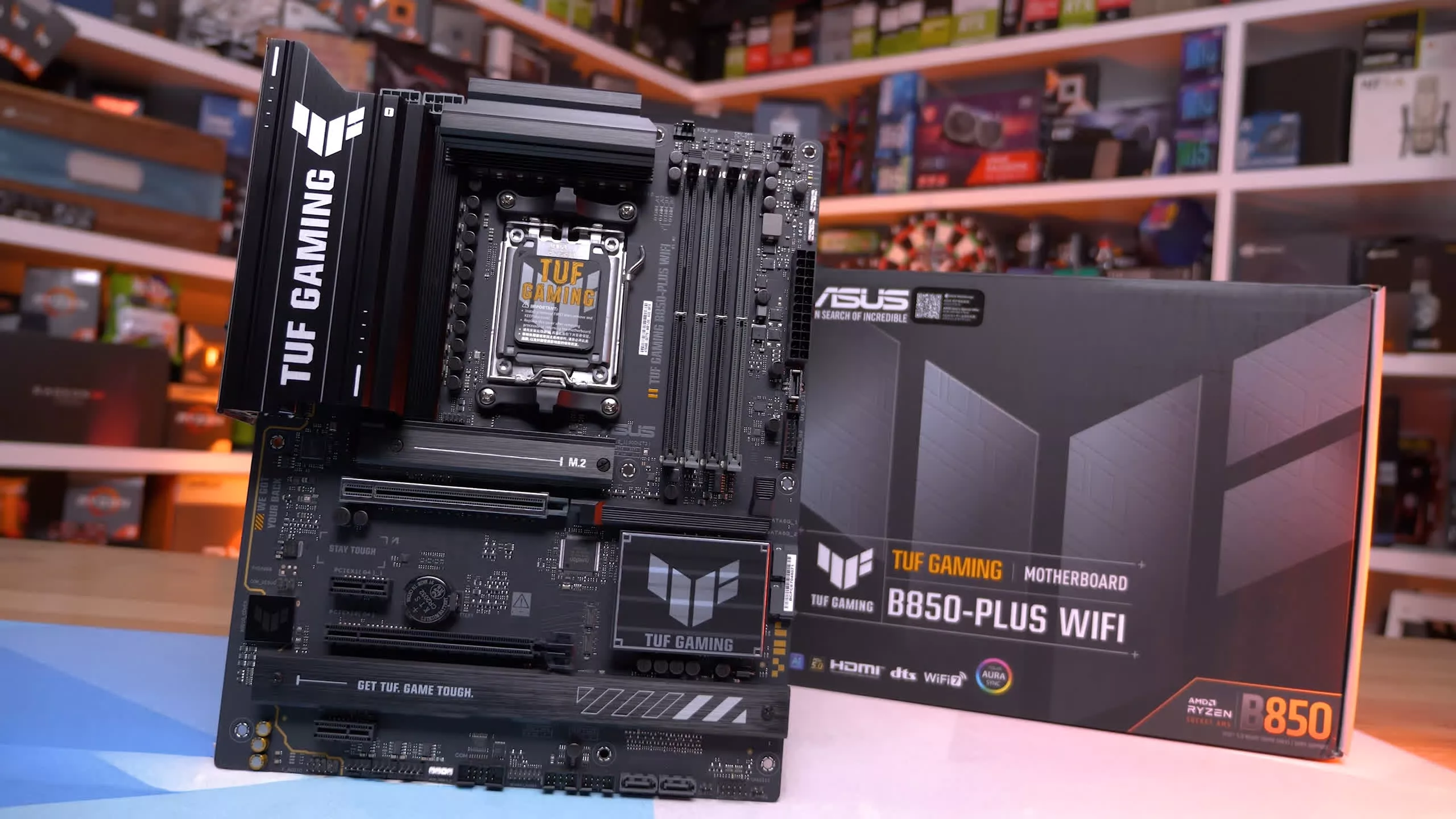
Asus TUF Gaming B850-Plus WiFi
For $10 more, Asus offers the ATX version of the TUF Gaming. It retains the same fourteen 80 A power stages for the vcore on an eight-layer PCB and adds a second PCIe x16 slot. Everything else remains mostly unchanged. This model is very similar to Asrock's Steel Legend, though it costs $10 more. It is a small premium, but given Asus's track record, especially with X3D processors, the extra investment is likely worthwhile.
Asus ROG Strix B850-A Gaming WiFi
Now the big guns from Asus start at $230, here we find the ROG Strix B850-A Gaming WiFi. It is a striking white motherboard, though not completely white, as many connectors are still black. It features the same fourteen 80 A power stages for the vcore on an 8-layer PCB as the TUF Gaming models.

Compared to the ATX TUF Gaming version, the ROG Strix B850-A Gaming WiFi is very similar in terms of features, and it costs only $10 more. You get an additional M.2 slot but lose two SATA ports, with most other features remaining the same.

The main upgrades involve the heatsinks, which are more numerous, generally larger, and the primary M.2 heatsink uses a tool-free design.

Asus ROG Strix B850-F Gaming WiFi
For around $15 to $20 more, we find the ROG Strix B850-F Gaming WiFi, a black motherboard with several notable upgrades. The VRM is upgraded to sixteen 80 A power stages for the vcore on an eight-layer PCB. It still includes four M.2 slots, but now two of them support PCIe 5.0. The I/O panel is nearly identical, with the only difference being two additional USB 2.0 ports. Overall, it is essentially a black version of the B850-A with some enhancements.


Asus ROG Strix B850-E Gaming WiFi
Next is the ROG Strix B850-E Gaming WiFi, which is a crazy overkill B850 board which doesn't make sense for this chipset. At this level, it would be wiser to consider an X870E motherboard.
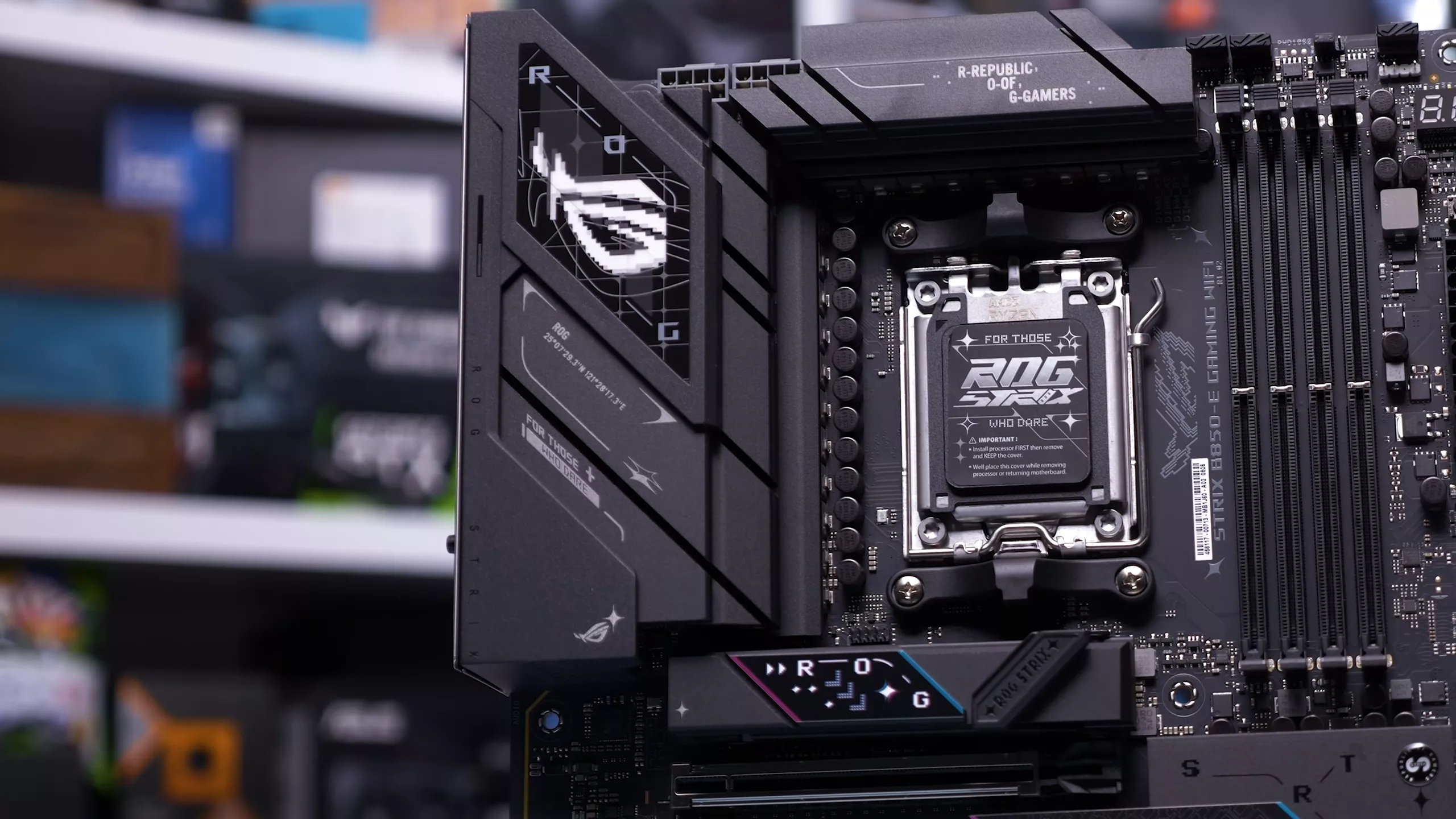
This model includes sixteen 90 A power stages for the vcore, five M.2 slots (two of which are PCIe 5.0), support for USB4 via one port, WiFi 7, and 5 Gbit LAN. It is a highly capable board, but the pricing is hard to justify.

Pricing at the time of this review was around $500, which is difficult to rationalize and likely due to limited availability. In Australia, pricing is more reasonable in terms of availability, but it still costs $600 AUD, making it the most expensive B850 motherboard in that market. That is around 20 percent more than the Strix Mini-ITX board, which places it at no less than $420, yikes!

Asus ROG Strix B850-I Gaming WiFi
Finally, we have the Strix Mini-ITX model, the ROG Strix B850-I Gaming WiFi, currently priced at $350. It is a very compact and very expensive B850 motherboard.

In terms of features, it is well equipped. The vcore VRM uses ten 90 A power stages on a ten-layer PCB. As expected for Mini-ITX, there is only one PCIe x16 slot, but it offers two M.2 slots, which is decent, though at this price we would have expected at least three. There are also two SATA ports, eight USB 3.2 ports, four USB 2.0 ports, WiFi 7, and 2.5 Gbit LAN.

On the I/O panel, there are only six USB 3.2 ports and two USB 2.0 ports. For the price, this Mini-ITX board feels somewhat underwhelming.
Gigabyte B850 Aorus Elite WiFi7 Ice
Most Gigabyte boards were covered in part one, as the majority of their lineup is priced at or below $200. One that did not make it into that section is the Gigabyte B850 Aorus Elite WiFi7 Ice, which is now available for $200 after discounts.

This is a great-looking board and very well equipped, featuring a fourteen-phase 60 A vcore VRM, three PCIe x16 slots, three M.2 slots, eleven USB 3.2 ports, eight USB 2.0 ports, WiFi 7, and 2.5 Gbit LAN. It is a solid offering for the price, and we are keen to see how it performs.

Gigabyte B850I Aorus Pro
Gigabyte also offers a Mini-ITX B850 board, though it is quite expensive at $310. For power delivery, it uses eight 80 A power stages on a ten-layer PCB, which should be more than adequate. It includes two M.2 slots, two SATA ports, eight USB 3.2 ports, four USB 2.0 ports, WiFi 7, and 2.5 Gbit LAN.

However, the I/O configuration is even more limited than the Asus Mini-ITX model, offering just five USB 3.2 ports and two USB 2.0 ports, which is disappointing given the price.

Gigabyte B850 AI Top
Pricing for the Asus ROG Strix B850-E Gaming WiFi was stupid. While the Gigabyte B850 AI Top is also a high-end B-series motherboard, it feels far more reasonable. It costs $320, which is surprisingly good considering the feature set.

The VRM is insane, with sixteen 110 A power stages for the vcore. It also includes dual 10 Gbit LAN ports, WiFi 7, eleven USB 3.2 ports, eight USB 2.0 ports, and a total of twelve USB ports on the rear I/O. There are three M.2 slots, two of which support PCIe 5.0. This is an excellent option for users wanting 10 Gbit LAN, though this can also be added to most boards via an expansion card at extra cost.

For example, Intel X540 cards can be found for as little as $55, though most models, such as the TP-Link TX401, start at around $80. Having 10 Gbit LAN integrated frees up PCIe slots for other uses.
MSI Pro B850-P WiFi
Previously, we had only a few MSI boards to test, and very few were available for $200 or less. We are now adding nine MSI boards, starting with the Pro B850-P WiFi, which is now available for $200. This model uses discrete Sino Power MOSFETs in a six-phase configuration, so power delivery is not the strongest at this price point.

In terms of features, it offers four PCIe x16 slots, three M.2 slots, four SATA ports, nine USB 3.2 ports, eight USB 2.0 ports, WiFi 7, and 5 Gbit LAN. Overall it is a weak offering from MSI. For less money, the Gigabyte B850M Aorus Elite WiFi 6E Ice is better equipped. It may be a MicroATX board, but it offers stronger I/O.

Where this MSI board offers just four USB 3.2 ports on the I/O, the Gigabyte alternative provides twice as many, with the same number of USB 2.0 ports.
MSI B850M Gaming Plus WiFi
Another MSI board we have tested is the B850M Gaming Plus WiFi, which stands out visually with an unusual design and green accents. It is difficult to judge its value without knowing the price, so here are the key features.

It includes two PCIe x16 slots, four DIMM slots, two M.2 slots, four SATA ports, eleven USB 3.2 ports, four USB 2.0 ports, WiFi 7, and 5 Gbit LAN. For power delivery, MSI uses eight 60 A power stages for the vcore on a six-layer PCB, making it a decent but basic design. The primary M.2 slot features a tool-free mechanism, but otherwise the setup is fairly standard.

MSI B850M Gaming Plus WiFi6E
Confusingly, MSI also offers a different motherboard called the B850M Gaming Plus WiFi 6E. We just looked at the B850M Gaming Plus WiFi, and now this version adds 6E to the name, but the changes go far beyond the wireless module.

This WiFi 6E version is a significantly downgraded product. The VRM has been heavily reduced, using low-cost discrete MOSFETs. There is only one PCIe x16 slot, WiFi is downgraded to 6E, wired LAN drops from 5 Gbit to 2.5 Gbit, the tool-free features are removed, and the second M.2 slot does not include a heatsink. This is a substantial downgrade and does not deserve to share the Gaming Plus name. MSI needs to improve this.

MSI B850 Tomahawk WiFi
Next, we have another yet-to-be-released and potentially confusing product, the B850 Tomahawk WiFi. The B850 Tomahawk Max WiFi is already available, but soon there will be a non-Max version. Apparently, that is necessary, though we do not yet have pricing information.

This non-Max version does not have an official product page yet, but we can outline its specifications. It uses the same fourteen 80 A power stages as the Max version, but instead of an eight-layer PCB, it uses a cheaper six-layer design. It drops from three PCIe x16 slots to two, removes one M.2 slot for a total of three, and reduces the number of USB 3.2 ports to nine. However, the I/O layout is unchanged. It still appears to be a solid board, though how good it is will ultimately depend on pricing.

MSI B850 Tomahawk Max WiFi
The B850 Tomahawk Max currently costs $210, which seems very competitive for a board of this caliber. It offers two PCIe 5.0 M.2 slots and two PCIe 4.0 M.2 slots, three PCIe x16 slots, eleven USB 3.2 ports, WiFi 7, and 5 Gbit LAN. Power delivery remains at fourteen 80 A power stages, this time on an eight-layer PCB. Overall, it competes closely with Gigabyte's B850 Aorus Elite WiFi7 Ice.


MSI B850M Mortar WiFi
The MSI B850M Mortar WiFi resembles a MicroATX version of the Tomahawk series, though it carries a different name, which we appreciate given MSI's recent naming confusion.

This is a fairly expensive MicroATX B850 board at $230. It features twelve 60 A power stages for the vcore on an eight-layer PCB. There is a single PCIe x16 slot, while the secondary x4 slot can accept full-length cards at reduced bandwidth. It includes three M.2 slots, four SATA ports, up to twelve USB 3.2 ports, and four USB 2.0 ports, along with WiFi 7 and 5 Gbit LAN.

It is better equipped than Gigabyte's B850M Aorus Elite WiFi 6E Ice, but it also costs $40 more, so you will need to consider the feature difference carefully.
MSI MPG B850 Edge Ti WiFi
MSI's flagship B850 motherboard is the Edge Ti WiFi, which costs a reasonable $220. This makes it much cheaper than the Gigabyte B850 AI Top and significantly more affordable than the Asus ROG Strix B850-E Gaming WiFi. However, it does not offer the same level of high-end features. It includes a single 5 Gbit LAN connection, four M.2 slots with a tool-free heatsink on the primary slot, three PCIe x16 slots, eleven USB 3.2 ports, eight USB 2.0 ports, and WiFi 7.

The I/O panel is not particularly impressive. There are three Type-C ports, but only six USB 3.2 ports in total and four USB 2.0 ports. It is a good-quality board overall and likely competitive at the price, though a bit lacking in I/O.

MSI MPG B850I Edge Ti WiFi
MSI also offers a Mini-ITX option, the B850I Edge Ti WiFi, which costs $290, making it more affordable than equivalent models from Asus and Gigabyte. It is well equipped, featuring eight 90 A power stages for the vcore on a ten-layer PCB. It includes two M.2 slots, two SATA ports, nine USB 3.2 ports, and two USB 2.0 ports, along with WiFi 7 and 5 Gbit LAN.

The I/O layout is similar to Gigabyte's Mini-ITX board, with six USB ports in total, all 3.2 spec, and a single Type-C. MSI appears to offer slightly stronger VRM performance on paper, faster wired networking, and a lower price, making it a strong contender for the best Mini-ITX B850 motherboard.

However, it does have a critical flaw. The primary PCIe 5.0 M.2 heatsink includes a fan, but it does not make full contact with the SSD. Despite its large actively cooled heatsink, the SSD controller receives no direct cooling due to the way MSI designed the fan mount. This is a significant oversight and difficult to understand.


MSI B850M Power
Finally, we have the MSI B850M Power, priced at $260. Unlike the other B850 motherboards, this model is geared exclusively towards the overclocking crowd. MSI advertises it as an extreme memory overclocking board with only two DIMM slots, suggesting it is aimed at enthusiasts.

It uses twelve 60 A power stages for the vcore on an eight-layer PCB. There is a single PCIe x16 slot, four M.2 slots (two of which support PCIe 5.0), two SATA ports, eleven USB 3.2 ports, four USB 2.0 ports, WiFi 7, and 5 Gbit LAN. It also includes debug LEDs and an external EZ Dashboard module with clear CMOS, reset, and power buttons. Overall, it is a unique board that should easily pass VRM thermal testing.

Sapphire Pulse B850M WiFi
Sapphire has released a line of B850 motherboards, and fortunately we were able to get our hands on a few of them. One of these is the Pulse B850M WiFi. Pricing is not yet confirmed as it has not gone on sale, but we expect it to be around $140, which makes sense given the very basic feature set.

It includes a single PCIe x16 slot, four DIMM slots, two M.2 slots, four SATA ports, only five USB 3.2 ports, and ten USB 2.0 ports, along with WiFi 6 and 2.5 Gbit LAN. As mentioned, it is a very simple motherboard. The I/O panel has only eight USB ports, and just two of those are USB 3.2, with the rest being USB 2.0.

For the VRM, it uses seven 60 A power stages for the vcore, which is reasonable, and they are covered by a large heatsink. However, there is no pre-installed I/O shield. If this board launches at $140, it should offer good value, similar to the Asrock B850M Pro RS and cheaper than Asrock's WiFi version.

Sapphire Pure B850A WiFi7
Sapphire also provided the Pure B850A WiFi7, which did not yet have a product page at the time of review. This board is expected to retail for around $190. It features twelve 55 A power stages for the vcore on a six-layer PCB, three PCIe x16 slots, four DIMM slots, three M.2 slots, four SATA ports, seven USB 3.2 ports, six USB 2.0 ports, WiFi 7, and 2.5 Gbit LAN. It is a decent offering, but if it does end up costing $190, it will face strong competition.


NZXT N7 B850
Finally, we have the NZXT N7 B850, a simple and clean name that we appreciate. This model is manufactured by Asrock, and although pricing has not been confirmed, it appears to be a well-equipped board. The VRM is very strong, with sixteen 80 A power stages on an eight-layer PCB. It offers three PCIe x16 slots, three M.2 slots, four SATA ports, up to twelve USB 3.2 ports, eight USB 2.0 ports, WiFi 6E, and 2.5 Gbit LAN. Based on its specifications, we expect it to cost around $200.

The main appeal of this board is its design. It has a unique appearance and is available in either an all-black version or a white and black version. A large shroud covers most of the motherboard, concealing the components underneath.

However, while it looks attractive, the shroud is made of plastic, which is not thermally conductive. Covering M.2 SSDs with plastic is not ideal and can negatively impact performance. We would only recommend installing lower power SSDs unless you remove the plastic shroud and use a proper heatsink, which undermines the point of the design.

Thankfully, the primary PCIe 5.0 M.2 slot includes a proper aluminum heatsink, so high-speed SSDs can be safely installed there. But caution is advised with the second and third M.2 slots. The VRM heatsinks are also mostly covered in plastic, which is another questionable design decision. The VRM itself is so overbuilt that it is unlikely to be a real issue, but the choice is still puzzling.
Benchmarks
Now it is time for some testing. The case used is the Antec Flux Pro. For temperature measurements, we use a digital thermometer with K-Type thermocouples and report the peak PCB temperature. We do not report Delta T over Ambient. Instead, we maintain a room temperature of 21 degrees, and to ensure consistency, a thermocouple is positioned next to the test system.

For the stress test, we use the AMD Ryzen 9 9950X, and the load is generated using Cinebench 2024, looped for one hour. We then record the maximum PCB temperature using K-Type thermocouples.
VRM Temperatures
Here is a look at VRM temperatures after the one-hour stress test using the 170 W 9950X. If a motherboard passes this test, it should be capable of handling any AM5 processor, including future models, unless AMD goes Intel-14th -gen-crazy with power.
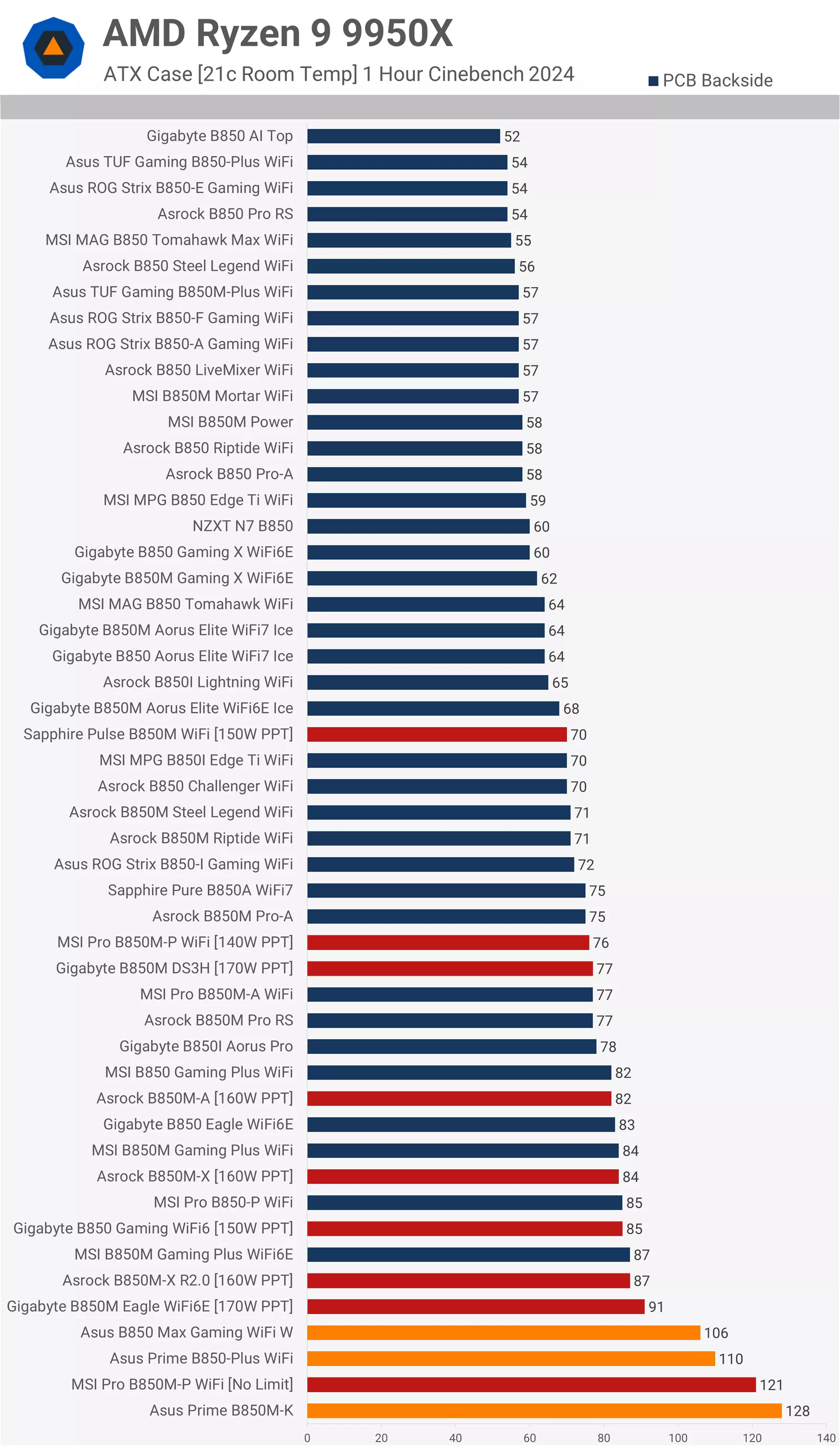
The good news is that of the 47 boards tested, the vast majority passed. Only a handful of boards, marked in red, failed due to power limits, and a few others in orange did not perform well and should be avoided, as there are better options at the same price.
At the top of the results is the Gigabyte B850 AI Top, peaking at 52 degrees, making it the best performer. However, this is largely just a formality, as all a board needs to do is pass without throttling the CPU while keeping VRM temperatures below 100 degrees, and most did exactly that.
More than 30 boards passed while staying below 80 degrees, and another five boards remained under 90 degrees. Because so many boards passed, we will focus on those that failed or did not meet our standards:
- Sapphire Pulse B850M WiFi
This board has a hard 150 W power limit that cannot be removed. Despite officially supporting 170 W processors, it cannot deliver full performance. At the 150 W limit, it peaked at only 70 degrees, so it is frustrating that Sapphire imposed this restriction. Sapphire claims the board supports Ryzen 9700X and 9800X3D, but the wording around broader support for Ryzen 7000, 8000, and 9000 series is unclear. We recommend avoiding this board, as alternatives like the Asrock B850 Pro-A handle the 9950X easily. - MSI Pro B850M-P WiFi
This board is significantly worse than the Sapphire Pulse. It has a 140 W limit that can be removed, but once removed, VRM temperatures exceed 120 degrees with the 9950X. The Sino Power discrete MOSFETs struggle heavily. At least Sapphire uses 60 A power stages. - Gigabyte B850M DS3H
This model has a 170 W hard limit. Gigabyte claims it delivers high performance for overclocking, which does not align with the enforced limit. - Asrock B850M-A and B850M-X
These entry-level models have a 160 W limit. They are acceptable for CPUs with 120 W or lower power draw, which includes most Ryzen models. However, for just $10 to $20 more, boards like the Asrock B850M Pro RS offer far better performance. - Gigabyte B850 Gaming WiFi6 and B850M Eagle WiFi6E
The Gaming WiFi6 is limited to 150 W, while the Eagle WiFi6E is limited to 170 W but still runs very hot. There are better alternatives for the price. - Asus B850 Max Gaming WiFi W, Prime B850-Plus WiFi, and Prime B850M-K
These boards are not power limited but still perform poorly, peaking above 100 degrees while many similarly priced boards run much cooler. This is due to Asus using low-cost discrete MOSFETs in their $150 to $180 B850 lineup.
For example, the Asrock B850 Challenger WiFi, priced at $180, peaked at just 70 degrees with no power limits and offers a better feature set.
Cinebench Score
Here is a quick look at performance results using a 10-minute Cinebench loop, immediately after the one-hour stress test. The orange bars represent boards that technically passed but ran very hot and are not ideal. The red bars indicate boards that failed by throttling the 9950X, resulting in lower scores.
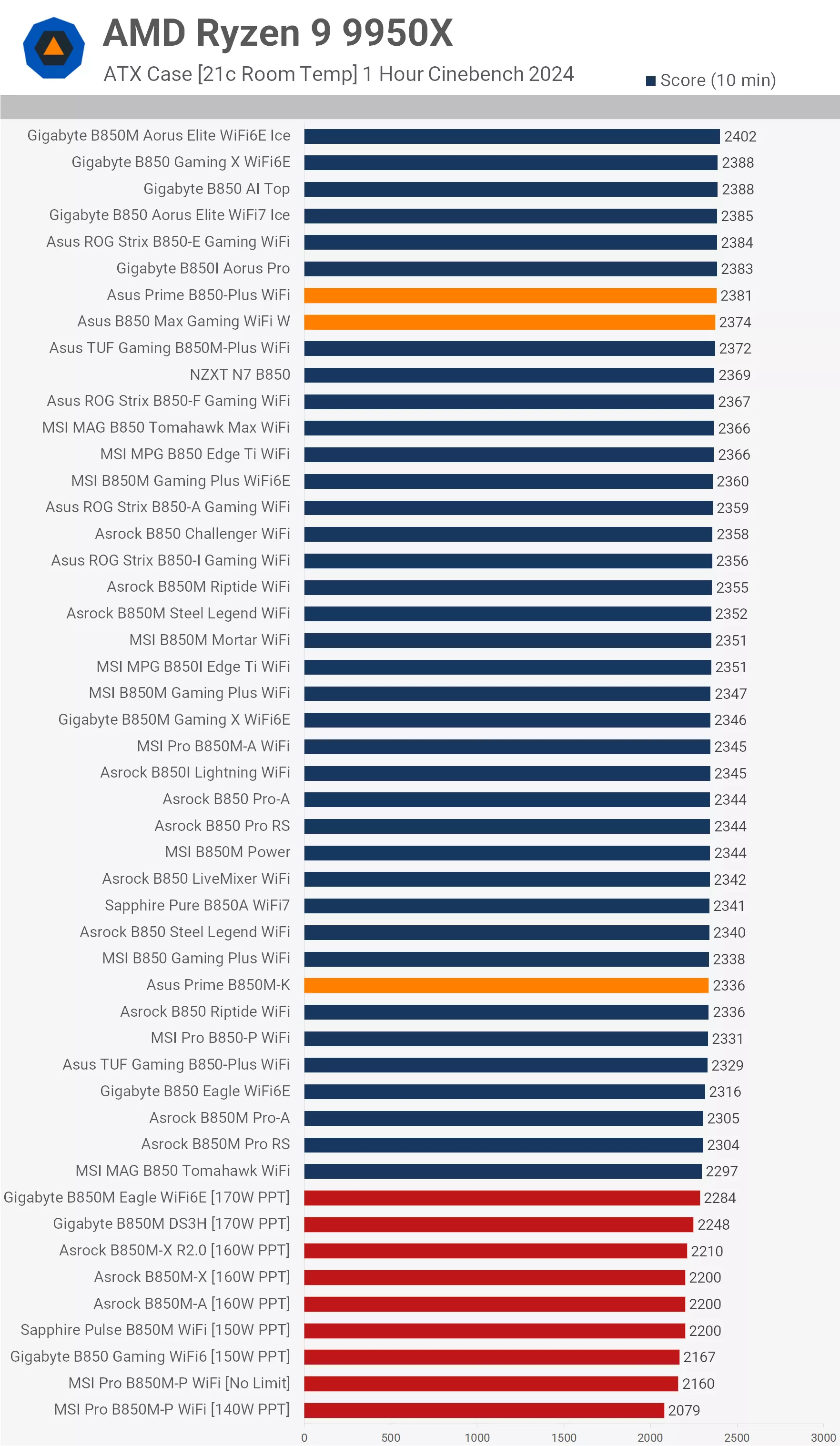
Among boards without orange or red bars, there is only about a 5% performance difference between the fastest and slowest results. Considering run-to-run variance is a few percent, performance across these boards is effectively the same.
It is also worth noting that with a 120 W or lower processor, all tested boards deliver the same performance, as the lowest power limit among them is the 140 W limit of the MSI Pro B850M-P WiFi.
Wrapping It Up: Our Picks
Budget B850
As we found in part one, which covered the more affordable B850 motherboards, there are plenty of good options to choose from. The only major concern right now is whether Asrock has fully resolved the issue affecting X3D CPUs. It is unclear how widespread the problem is, but because the situation is ongoing, we would only recommend Asrock AM5 motherboards if you are certain you will not be using an X3D processor anytime soon. Hopefully, there will be more clarity in the future.
This is unfortunate, as Asrock often delivers some of the best value boards, and that is true for their B850 range. For example, the B850M Pro RS currently sells for $130 and works perfectly with the 9950X. It also offers a solid feature set, so setting aside the X3D concern, it is the best-value B850 motherboard available right now.

The next best options would be the Gigabyte B850M Gaming X WiFi6E and the MSI Pro B850M-A WiFi. The Gigabyte board delivers excellent VRM performance with a decent feature set at $165. The MSI Pro B850M-A costs slightly more at $170 but upgrades wireless to WiFi 7, includes 5 Gbit LAN, and offers four additional USB 3.2 ports. Both boards are good, but at current pricing, MSI has the advantage.

Picks at $200
At around $200, choosing the best ATX motherboard becomes a bit harder. The MSI Pro B850-P WiFi did not particularly impress us, and for just $10 more, the Tomahawk Max WiFi is a far better product. It offers a stronger VRM on an eight-layer PCB rather than six, an additional M.2 slot, more USB 3.2 ports, and a better I/O layout.

The Tomahawk Max WiFi is slightly better equipped than the Asus TUF Gaming B850-Plus WiFi and is comparable to the Asrock B850 Steel Legend WiFi. All three are very good options, but we believe MSI offers the most at this price with the Tomahawk Max.
MicroATX
For MicroATX boards around the $200 mark, the main options are: Asrock B850M Steel Legend WiFi at $180 (currently discounted to $140), Gigabyte B850M Aorus Elite WiFi6E Ice at $190, Asus TUF Gaming B850M-Plus WiFi at $210, and the MSI B850M Mortar WiFi at $230.

The discounted Steel Legend is the clear standout, but even at its regular $180 price, it is arguably still the best deal. All four models are strong performers with excellent VRMs and features, so final choice will depend on pricing in your region. The MSI B850M Mortar WiFi does seem a little too expensive, although it is the only one to offer 5 Gbit LAN, two PCIe 5.0 M.2 slots, twelve USB 3.2 ports, and WiFi 7. The Gigabyte B850M Aorus Elite WiFi6E Ice is also a great option for white-themed builds.

Mini-ITX
For Mini-ITX B850 boards, the best choice depends on local pricing. Currently, based on retailers like Newegg, the Asrock B850I Lightning WiFi is unbeatable at $200 and delivered the best VRM thermal performance. All four Mini-ITX boards tested passed without issue.

The Asrock B850I Lightning WiFi, MSI MPG B850I Edge Ti WiFi, Gigabyte B850I Aorus Pro, and Asus ROG Strix B850-I Gaming WiFi all offer two M.2 slots, similar USB 3.2 counts (between seven and nine), and two SATA ports. The Asrock model is the only one with WiFi 6E, while the others all include WiFi 7. MSI is the only one with 5 Gbit LAN; the rest use 2.5 Gbit LAN.

If you need faster than 2.5 Gbit LAN, then the MSI model is the best option. At $290, it is cheaper than the Gigabyte model, has no significant compromises, and is far more affordable than the Asus board, which offers no real advantage. For us, the choice is between the Asrock Lightning and the MSI Edge, depending on the features and pricing in your region.
The Expensive Ones
As for the crazy expensive B850 boards that do not make much sense, once you approach $300, X870E motherboards become an option, often with features like USB4. That said, the Gigabyte B850 AI Top is the best of the extreme B850 boards and at least offers unique value with dual 10 Gbit LAN. To our knowledge, no X870 motherboard includes this.

Asrock's X870 Taichi Creator costs $320 and does include 10 Gbit LAN, but its second port is limited to 5 Gbit. It does provide one additional M.2 slot and two USB4 ports, which may be appealing to some. Even so, the B850 AI Top remains a unique high-end B850 motherboard that, in our view, justifies its asking price.