
AMD announced its latest RDNA 4-based budget GPU in late July, the Radeon RX 9050, with a suggested price of $280. Oddly, despite receiving an MSRP in dollars, it wasn't actually intended for retail sale in the US. But that's the least strange thing about this GPU. In this review we're testing the cut-down 4GB version hiding inside prebuilt PCs, and (spoiler) it's considerably worse than the RX 9050 most buyers will find when they research the card.
Getting one wasn't easy, either. It cost us about $1,700 Australian dollars to get our hands on this entry-level GPU because you can't buy it in Australia, and where the 4GB model is available, it isn't sold on its own. It's an OEM-only product, and as we'll see, a particularly dodgy one.
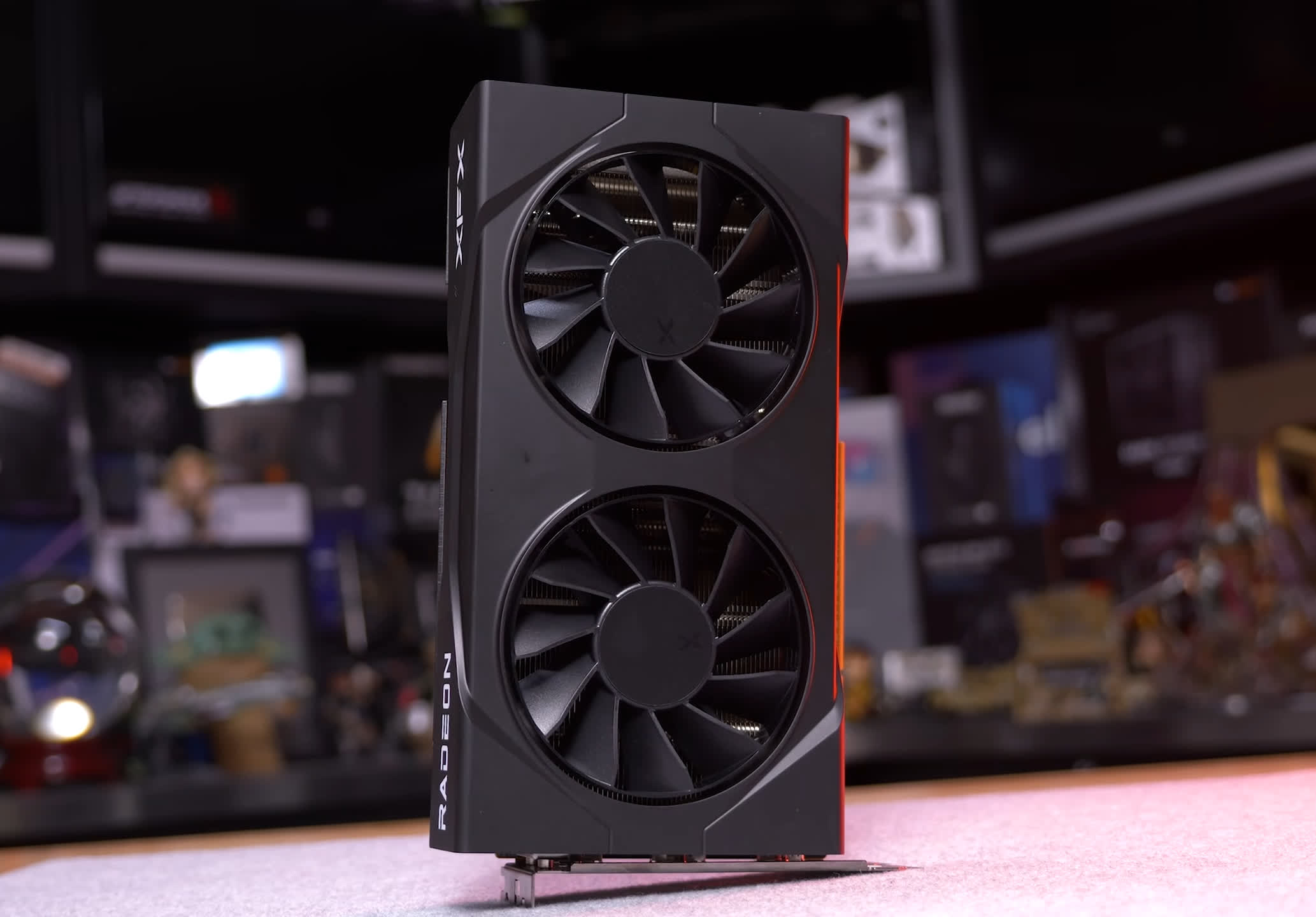
You can currently purchase the 8GB RX 9050 as a standalone retail product in several regions. In Japan, for example, it can be found for around 54,000 yen. A direct currency conversion puts that at roughly $345, while Intel's Arc B570 can be had for around 42,000 yen, or approximately $270.
The Real Problem: 4GB and Half the Bandwidth
But that's the retail 8GB RX 9050. Unfortunately, two very different GPUs share the exact same name, somewhat like the RX 9060 XT, which is available with either 8GB or 16GB of VRAM. As questionable as that naming scheme is, the RX 9050 situation is even worse.
That's because the particularly nasty 4GB version can only be sold as an OEM product under AMD's rules, meaning it can only be offered as part of a prebuilt computer. That's how we got ours. We purchased CyberPowerPC's "Gamer Master Gaming Desktop" from Best Buy for $750.
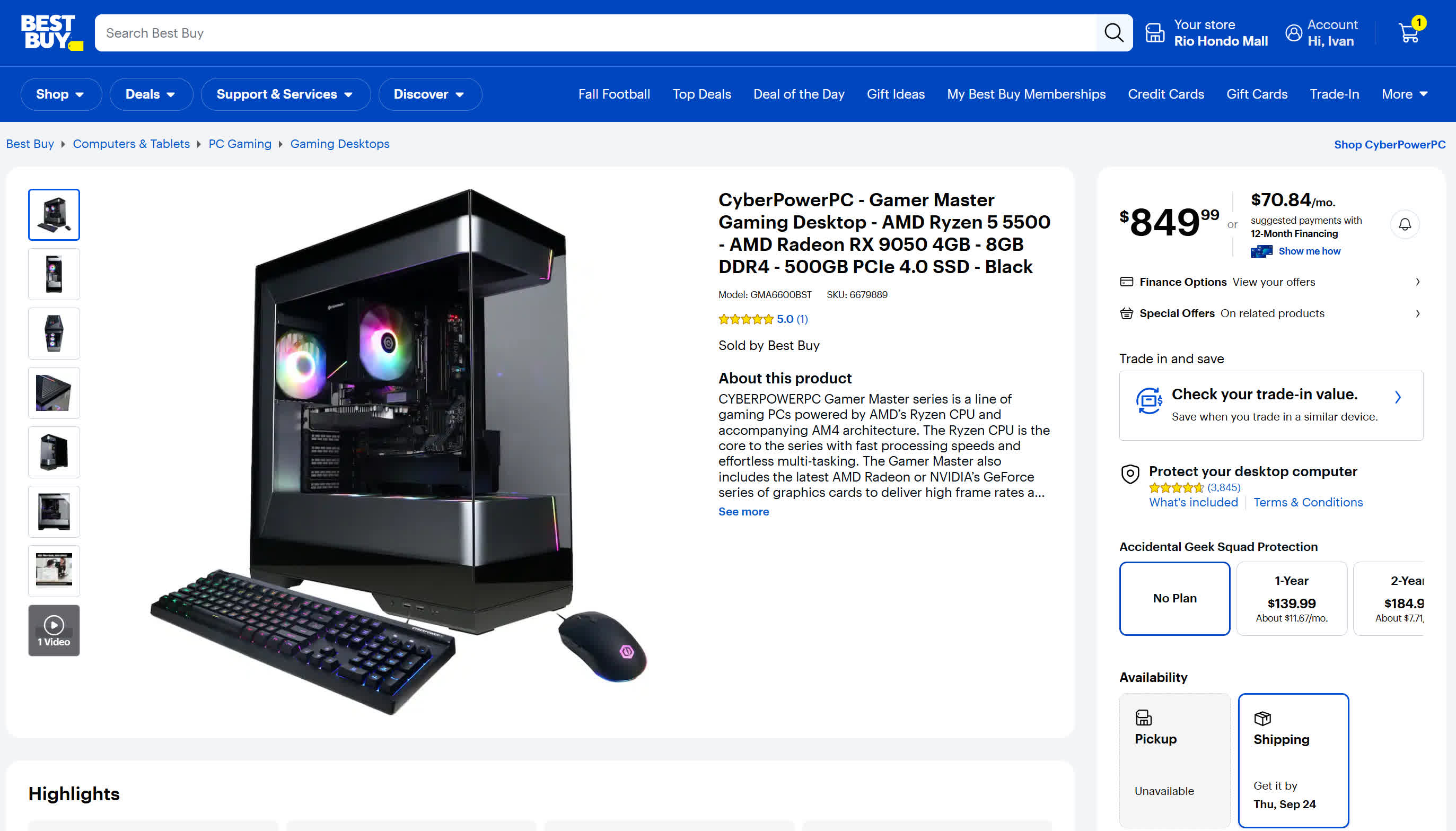
The PC is advertised as including "AMD Radeon RX 9050 graphics," but if you look closely at the specifications, you'll notice that it only has 4GB of GDDR6 dedicated video memory, assuming the person buying the system even knows what that means.
To state the obvious, this version has just 4GB of VRAM, while every retail RX 9050 we've seen comes with 8GB. That's a problem because anyone researching the Radeon RX 9050 is almost guaranteed to find information about the faster 8GB model. In fact, if you visit AMD's official product page, that's the one you'll find.
A buyer doing their due diligence might check whether the RX 9050 can handle the games they want to play. AMD's own performance data suggests around 60 fps in 007: First Light, almost 100 fps in Cyberpunk 2077 using medium settings, and 206 fps in Rainbow Six Siege. That all sounds pretty good for a budget graphics card. Unfortunately, if you buy a system equipped with the 4GB version, you'll be looking at significantly lower performance than those figures suggest.
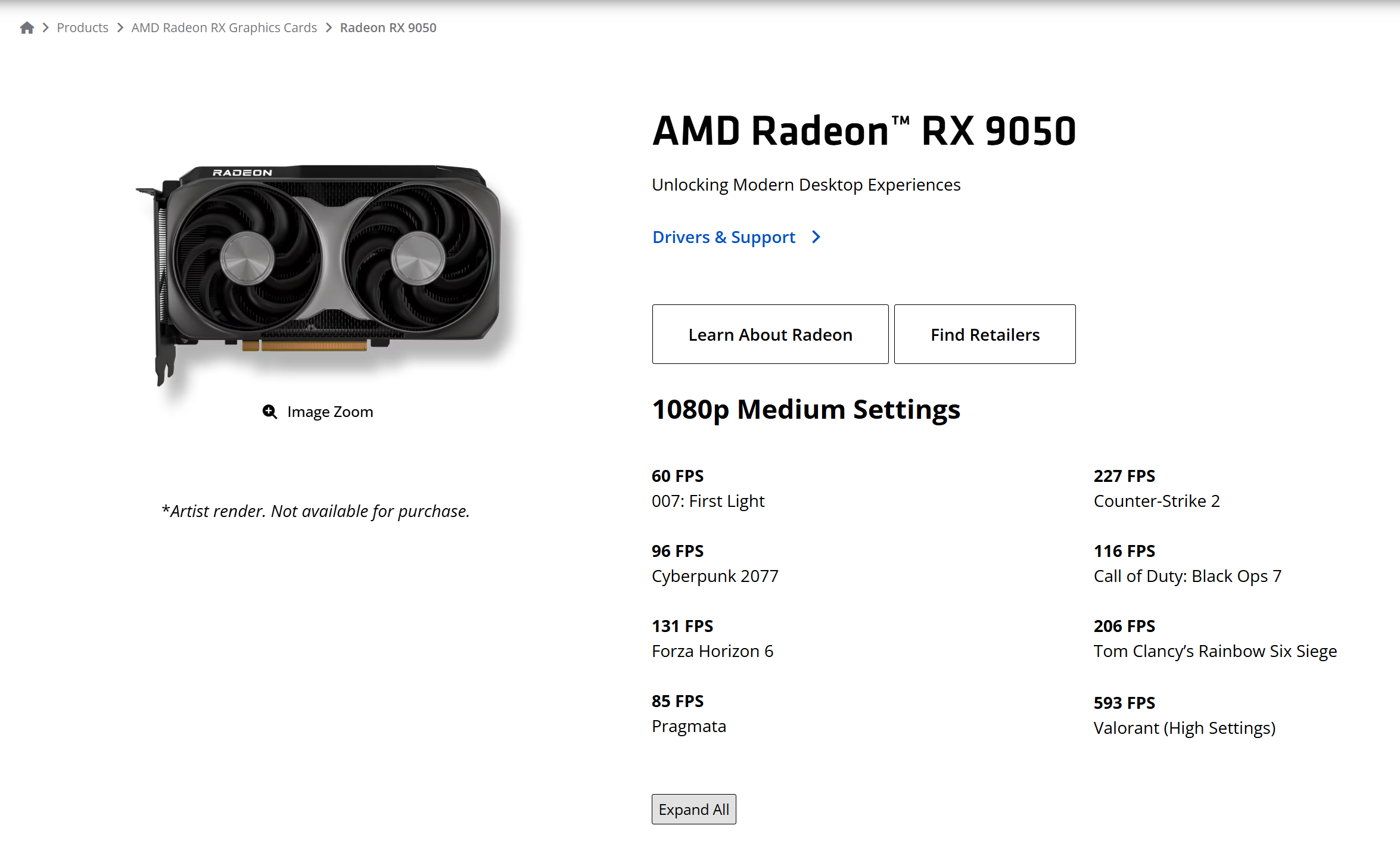
AMD's Radeon RX 9050 product page
And that's because the RX 9050 4GB doesn't simply have half the VRAM of the retail version. It also has half the memory bandwidth. The Navi 44 die used by the RX 9050 supports up to a 128-bit memory bus, achieved using four 2GB GDDR6 memory chips. Each chip connects through a 32-bit interface, so four chips provide the full 128-bit bus used by the 8GB model.
Using only two of those chips cuts the bus to 64-bit, halving memory bandwidth along with capacity. Whereas the 8GB RX 9050 offers 288 GB/s of memory bandwidth, the 4GB model is reduced to just 144 GB/s, the same bandwidth offered by the Radeon RX 6500 XT models.
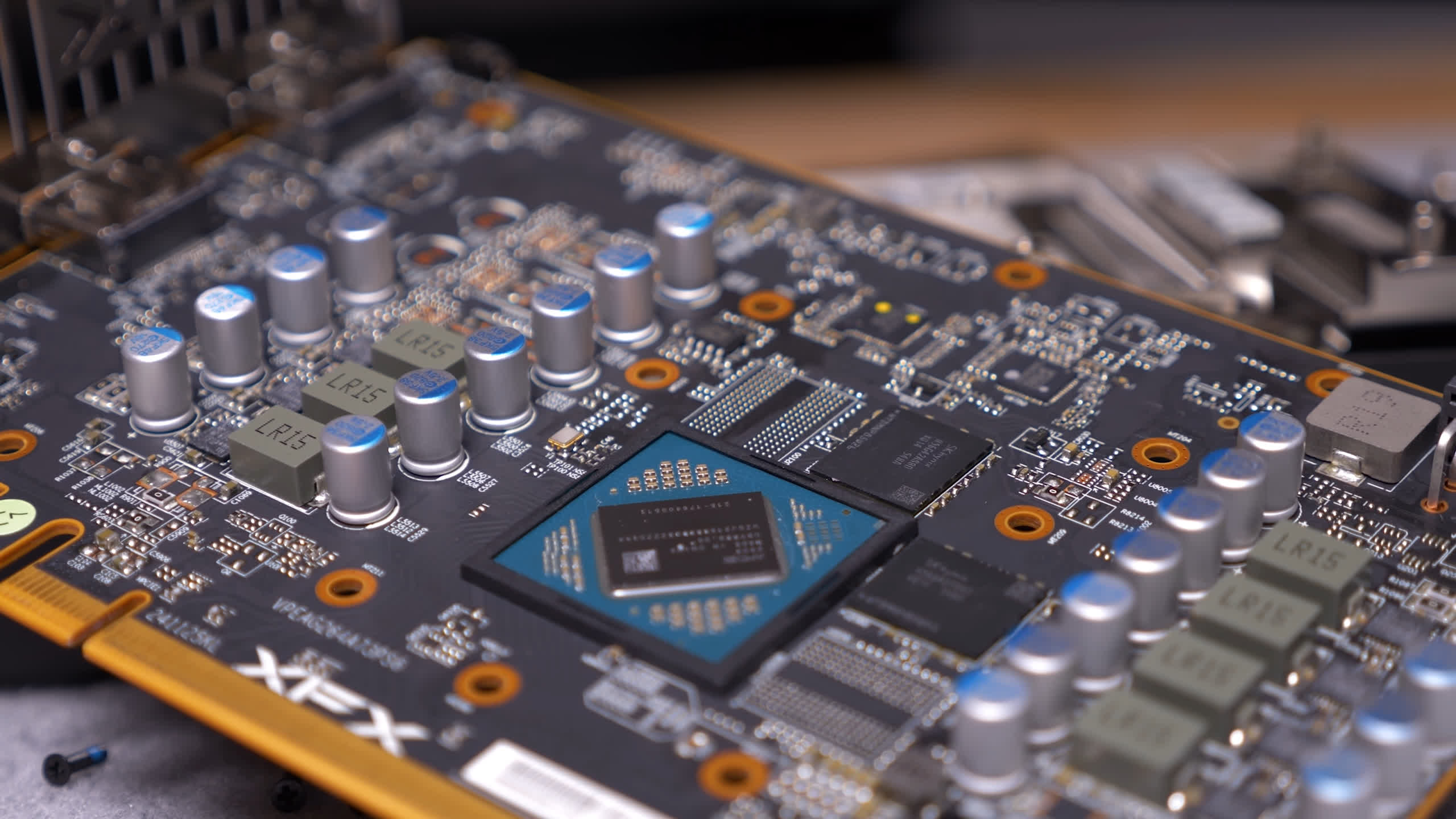
That combination is a serious handicap: half the bandwidth and just 4GB of VRAM for modern games.
To recap, the RX 9050 4GB shares the exact same name as the 8GB model despite offering half the VRAM and half the memory bandwidth. Worse, it's confined to prebuilts, where buyers may have no obvious indication that they're getting a substantially slower version of the GPU they researched.
| Radeon 9050 4GB | Radeon 9050 8GB | Radeon 9060 | Radeon 9060 XT | |
|---|---|---|---|---|
| Price (MSRP) | OEM | $280 | OEM | $300 |
| Release Date | July 28, 2026 | Aug 5, 2025 | Jun 5, 2025 | |
| Process | TSMC N4P | |||
| Transistors | 29.7 billion | |||
| Die Size (mm2) | 199 mm2 | |||
| Core Config | 1024 / 64 / 64 | 1792 / 112 / 64 | 2048 / 128 / 64 | |
| GPU Boost Clock | 2600 MHz | 2990 MHz | 3130 MHz | |
| Memory Capacity | 4 GB | 8 GB | ||
| Memory Speed | 18 Gbps | 20 Gbps | ||
| Memory Type | GDDR6 | |||
| Bus Type / Bandwidth | 64-bit : 144 GB/s | 128-bit : 288 GB/s | 128-bit : 288 GB/s | 128-bit : 320 GB/s |
| Total Board Power | 92W | 132W | 150W | |
The remaining question is simple: just how bad is the Radeon RX 9050 4GB?
To find out, we're comparing it directly with the 8GB version. We've also included Intel's Arc B570, along with both the 4GB and 8GB versions of the Radeon RX 6500 XT.
All testing was conducted using our standard GPU test system, which features the Ryzen 7 9800X3D. This represents an absolute best-case scenario for the RX 9050 4GB, as the system supports PCI Express 5.0 and high-speed DDR5 memory, both of which can help mitigate some of the performance penalties associated with running out of VRAM.
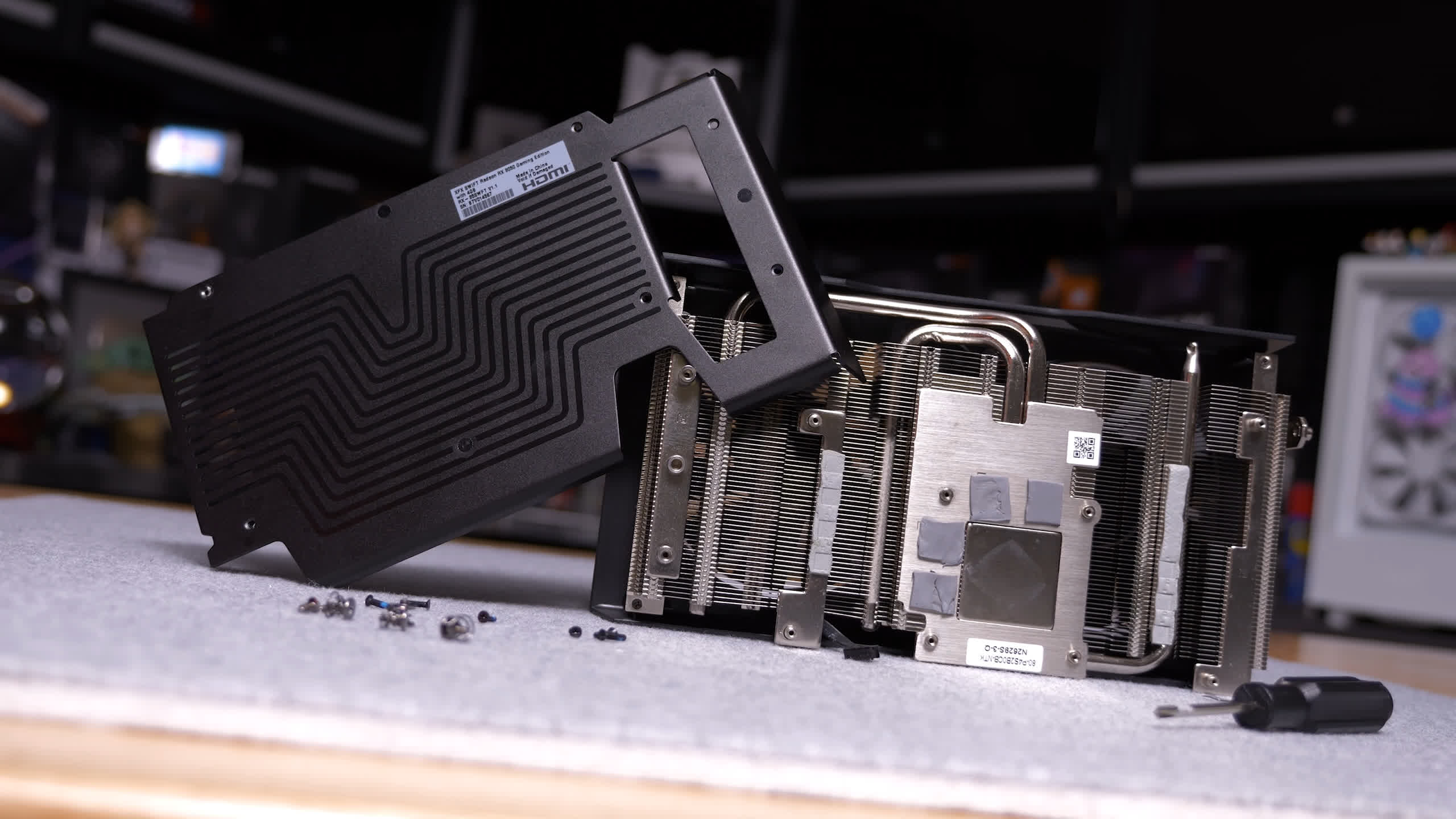
We'll also test the RX 9050 4GB on a much weaker platform in a follow-up, but for this review we're giving it the best possible chance. Every game was tested at 1080p using the lowest available quality preset. In other words, on a game-by-game basis, we're doing everything reasonably possible to extract the highest performance these graphics cards can deliver.
Test System Specs
| CPU | AMD Ryzen 7 9800X3D |
| Motherboard | MSI MPG X870E Carbon WiFi [BIOS 7E49v1AA7] |
| Memory | G.Skill Trident Z5 RGB DDR5-6000 CL30 [CL30-38-38-96] |
| Graphics Card | Radeon RX 6500 XT 4GB, Radeon RX 6500 XT 8GB Radeon RX 9050 4GB, Radeon RX 9050 8GB, Intel Arc B570 10GB |
| ATX Case | MSI Prospect 700R |
| Power Supply | Kolink Regulator Gold ATX 3.0 1200W |
| Storage | TeamGroup T-Force Cardea A440 M.2 PCIe Gen4 NVMe SSD 4TB |
| Operating System | Windows 11 25H2 |
| Display Driver | AMD Radeon Adrenalin 26.8.1 Intel Graphics Driver 32.0.101.8993 |
Benchmarks
Forza Horizon 6
Starting with Forza Horizon 6, we find some pretty dismal results for the 4GB version of the RX 9050. Using the Medium preset, the 8GB model was 47% faster, and that margin was still 40% using the Very Low preset.
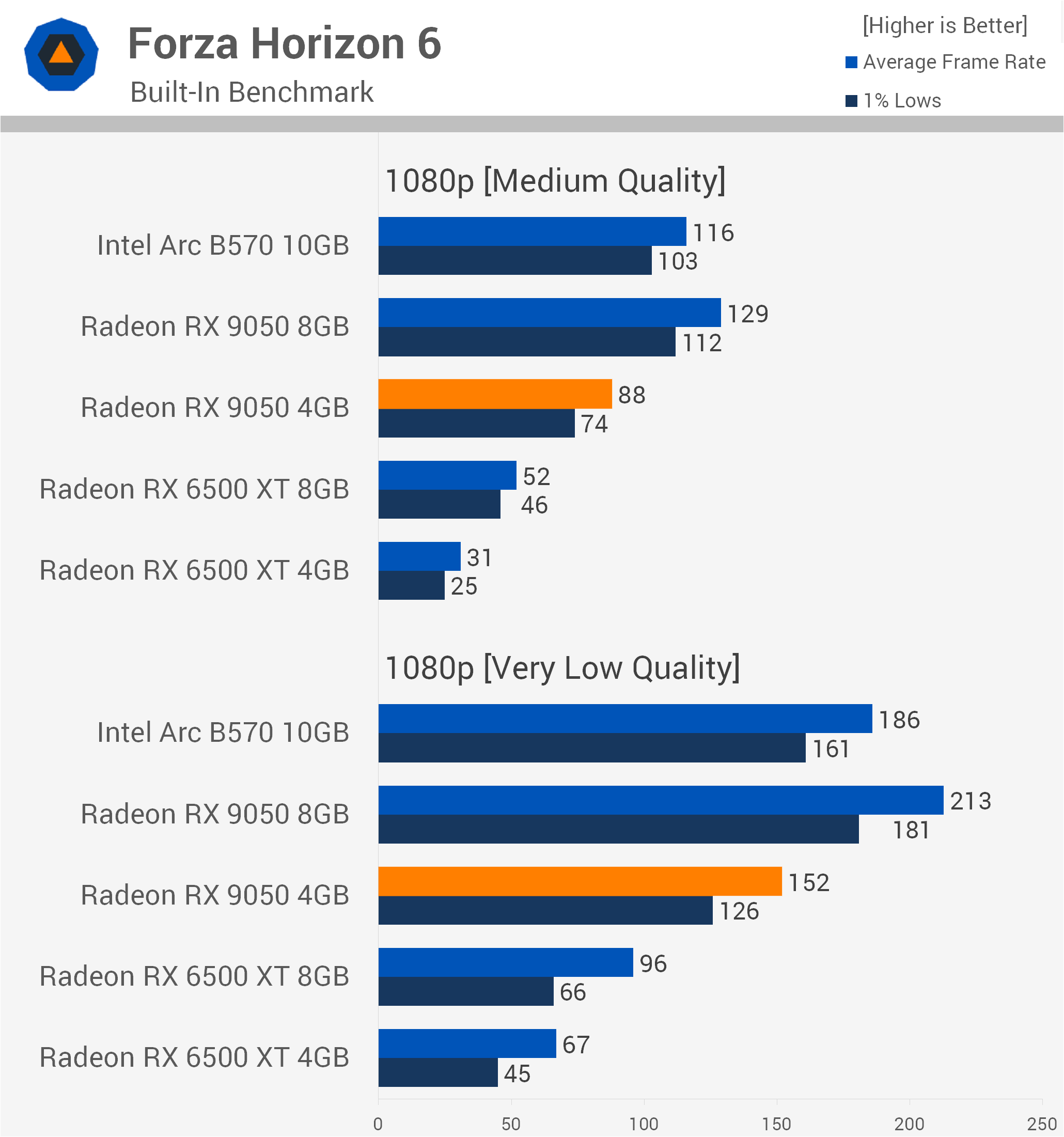
The Arc B570 was also 32% faster using Medium settings, and that margin would likely grow as visual quality is increased. Given that the B570 averaged 116 fps here, there's plenty of headroom to do exactly that.
Assassin's Creed Black Flag Resynced
Next we have Assassin's Creed Black Flag Resynced, and the results are again horrible for the RX 9050 4GB. The 8GB version was around 45% faster in both the Low and Ultra Low quality tests.
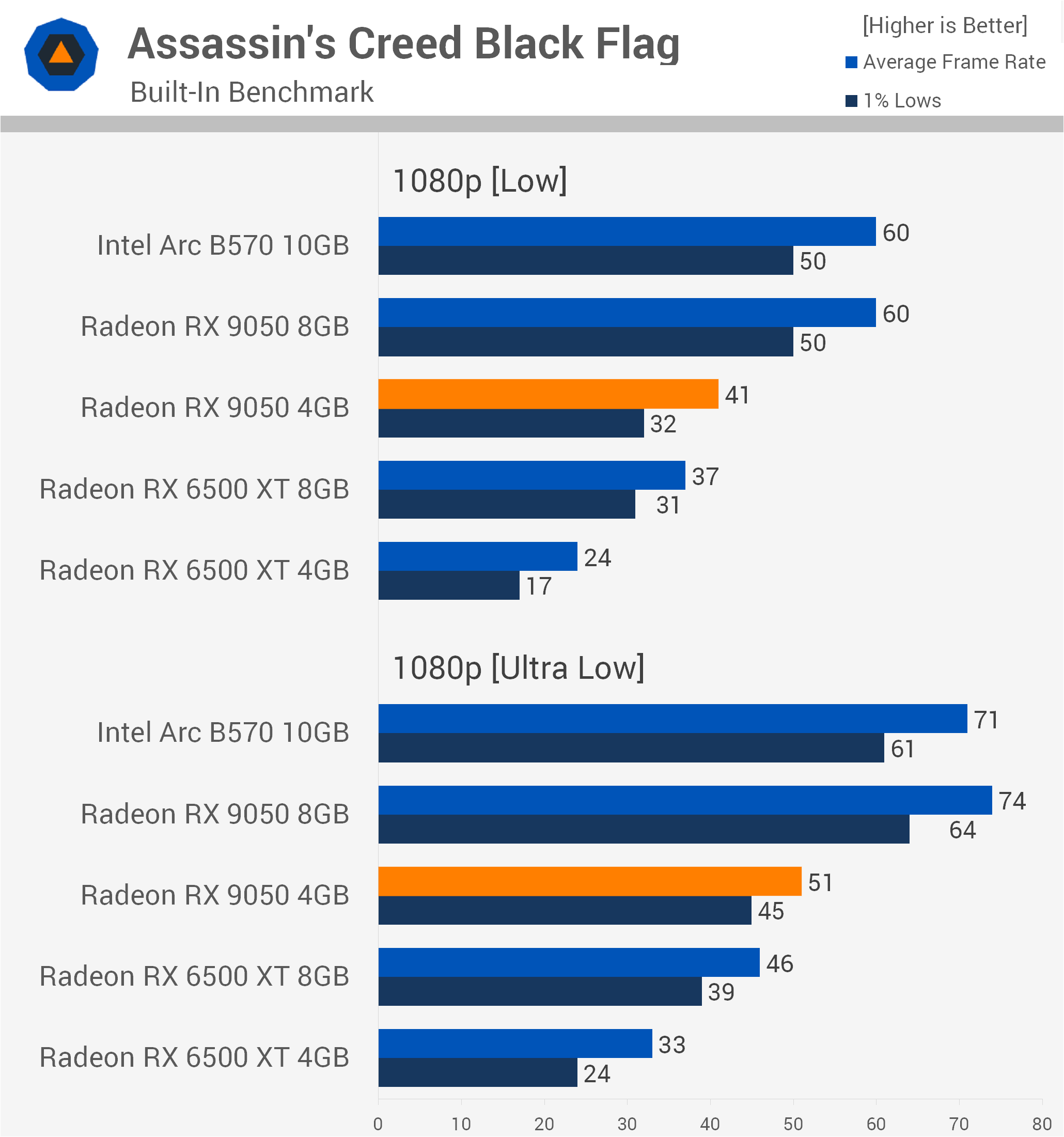
The Arc B570 was also much faster, offering 46% greater performance with the Low preset and, more importantly, averaging just over 60 fps.
The Last of Us Part II Remastered
Testing with The Last of Us Part II Remastered saw the RX 9050 8GB deliver 31% to 36% more performance than the OEM 4GB version.
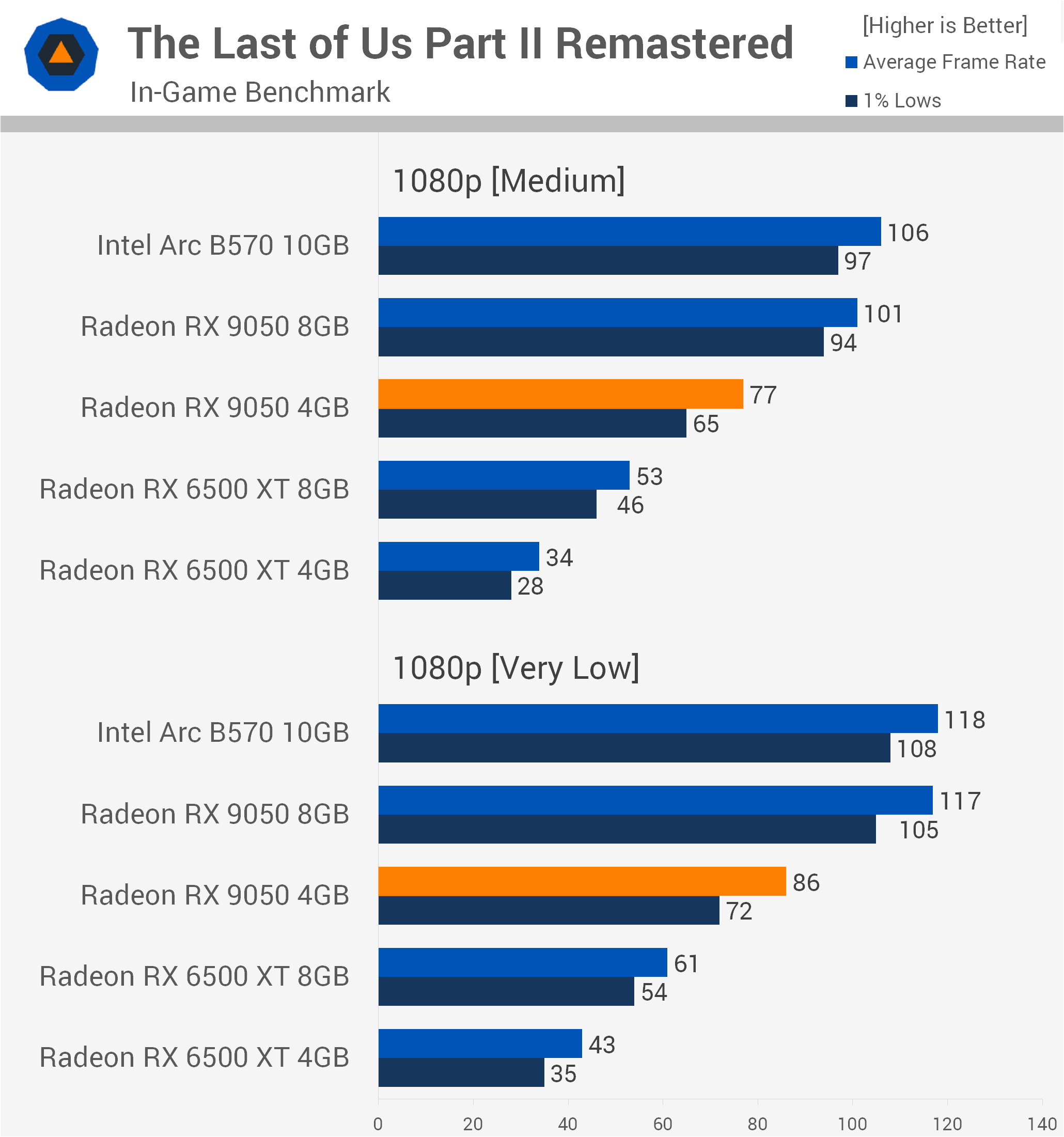
Even worse for AMD, Intel's Arc B570 was around 38% faster. The B570 also gives you considerably more flexibility to increase visual quality, including maxing out texture quality thanks to its 10GB of VRAM.
Crimson Desert
Moving on to Crimson Desert, we find some interesting results. First, note how the 4GB and 8GB versions of the old RX 6500 XT delivered similar frame rates, at least when using the Low and Minimum quality presets. That's because the game isn't using more than 4GB of VRAM here, so the 4GB 6500 XT isn't being penalized by its reduced capacity.
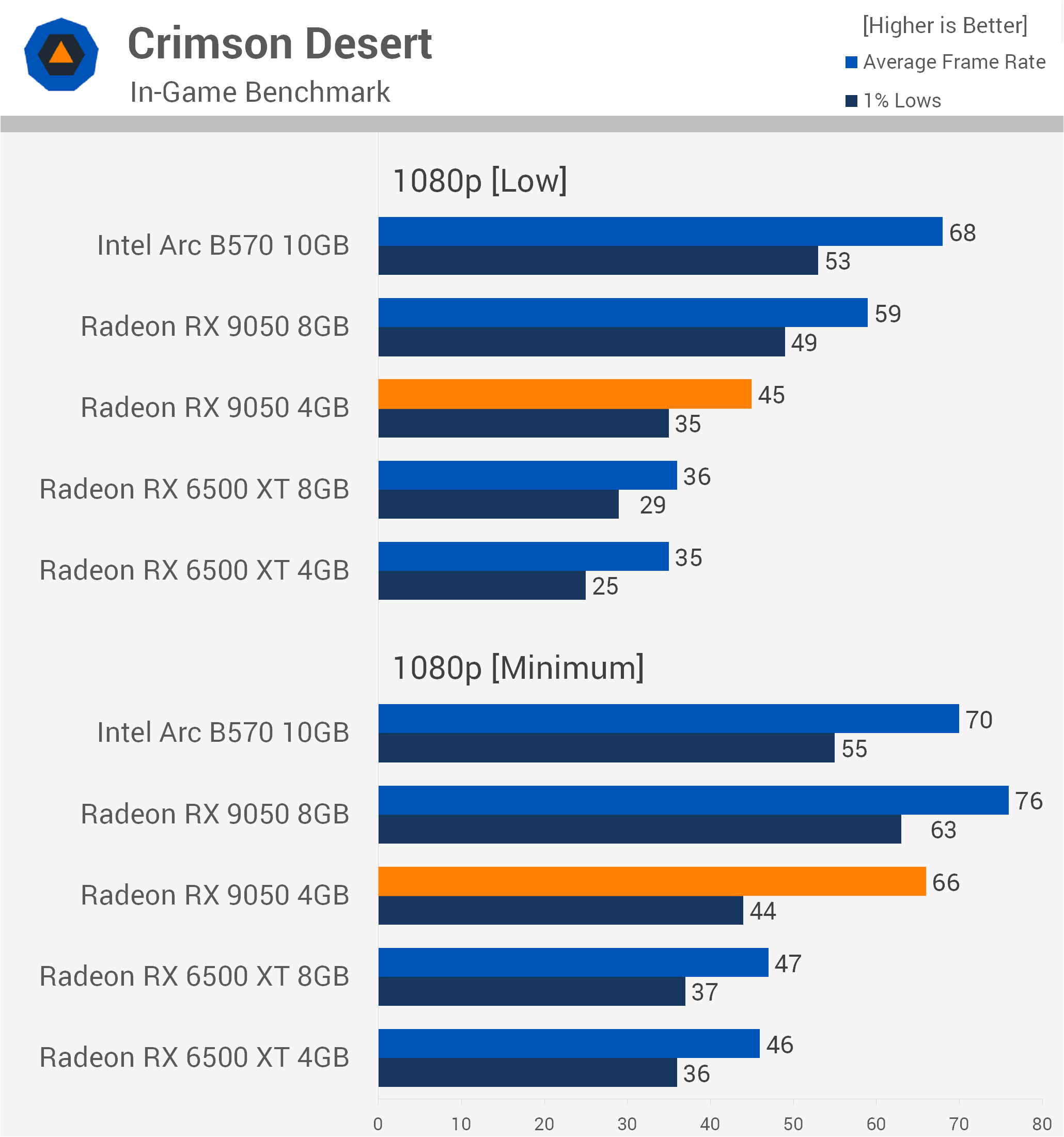
However, that's not the case for the RX 9050 4GB. The 8GB model was 31% faster using the Low preset and remained 15% faster even with the lowest possible quality settings.
That performance hit isn't being caused by VRAM capacity, but rather memory bandwidth. In other words, the 4GB RX 9050 can be slower than the 8GB model even when a game is using less than 4GB of VRAM.
Finally, with the Low preset enabled, the Arc B570 was a whopping 51% faster, rendering 68 fps on average.
Resident Evil Requiem
Resident Evil Requiem delivers what appears to be fairly typical performance for the RX 9050 4GB. The 8GB version was roughly 38% faster using both the Low and Lowest quality presets.
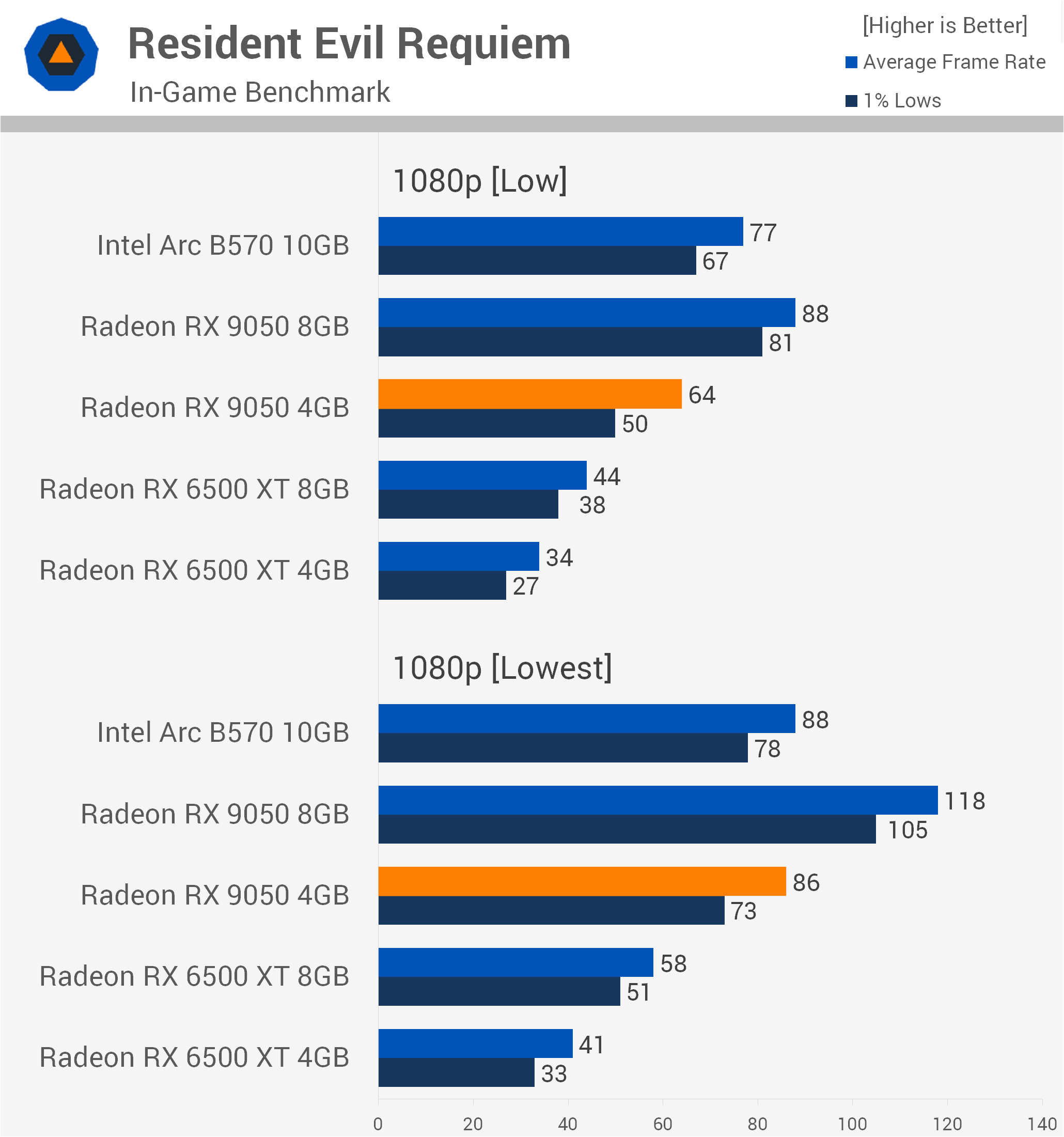
The Arc B570 doesn't perform particularly well in this game, matching the 4GB RX 9050 with the lowest settings. However, it was 20% faster using the Low preset, and we'd expect that margin to grow as visual quality is increased.
007 First Light
Next we have 007 First Light, and this is a particularly bad example for the RX 9050 4GB. It managed just 38 fps using the Low preset, which is already the lowest quality setting available in the game. So what we have here is a modern AAA title that can't run anywhere near 60 fps on the brand-new Radeon RX 9050 4GB at 1080p using the lowest possible quality settings.
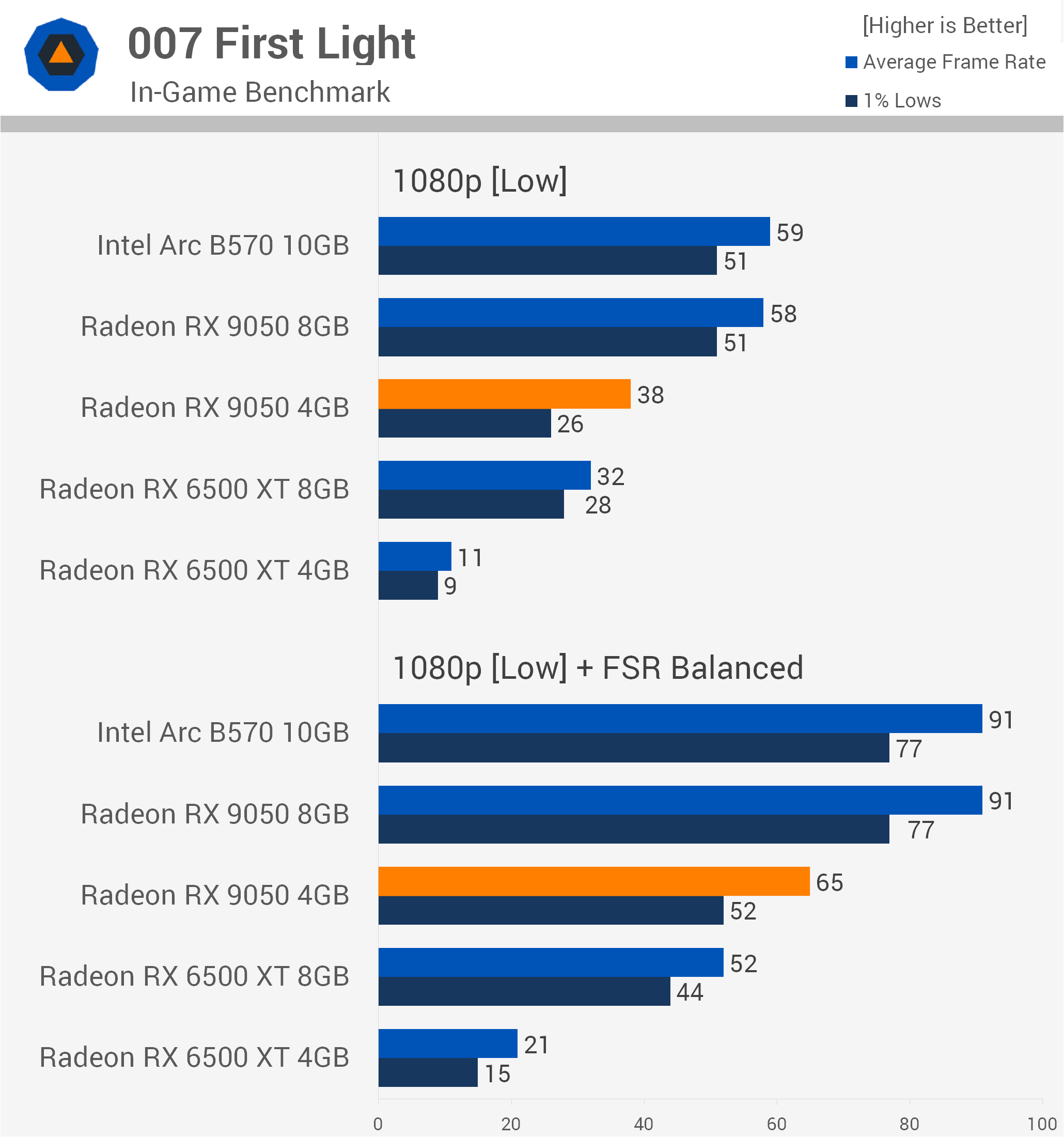
Next we have 007 First Light and this is a particularly bad example for the 4GB RX 9050 as it was only able to render just 38 fps using the low preset, which is the lowest quality settings you can use in the game.
The 8GB version was 53% faster, while the Arc B570 averaged 59 fps, making it 55% faster. More importantly, its 1% low performance was 96% higher, so needless to say, the experience was significantly better on the Intel GPU.
The only way we could get the RX 9050 4GB up to 60 fps was by enabling FSR Balanced upscaling. At 1080p, the resulting image quality looks horrid, but it did technically get us there. So that's where budget PC gaming is in 2026.
F1 25
Moving on to F1 25, this is a game that's easy to run on low-end hardware, even using the Medium quality preset. Despite that, the RX 9050 8GB was still 41% faster than the 4GB model, although the OEM version did at least deliver a highly playable 134 fps.
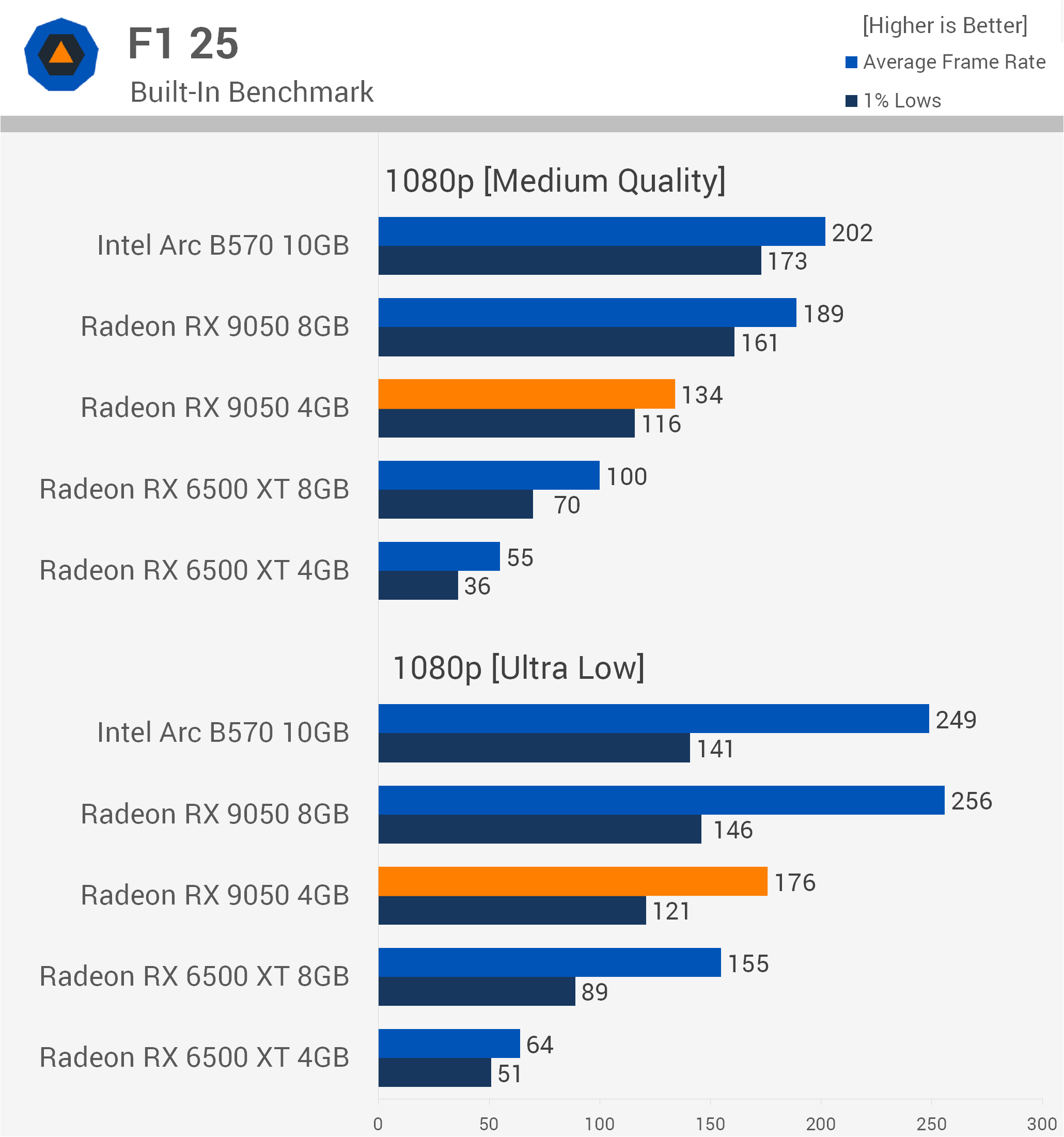
From a value perspective, that's less impressive when the Arc B570 was 51% faster, pushing 202 fps.
The Ultra Low preset increased the margin between the two RX 9050 models to 45%, while the Arc B570 was 40% faster than the 4GB model. That said, given the frame rates we're seeing here, you'd probably want to use higher-quality settings in F1 25 anyway.
Cities: Skylines II
Cities: Skylines II provides another good example of why halving the RX 9050's memory bandwidth is so detrimental to performance. Whereas the 4GB and 8GB versions of the RX 6500 XT delivered identical performance in this title, the RX 9050 8GB was 35% faster using Low settings and a massive 66% faster using Very Low.
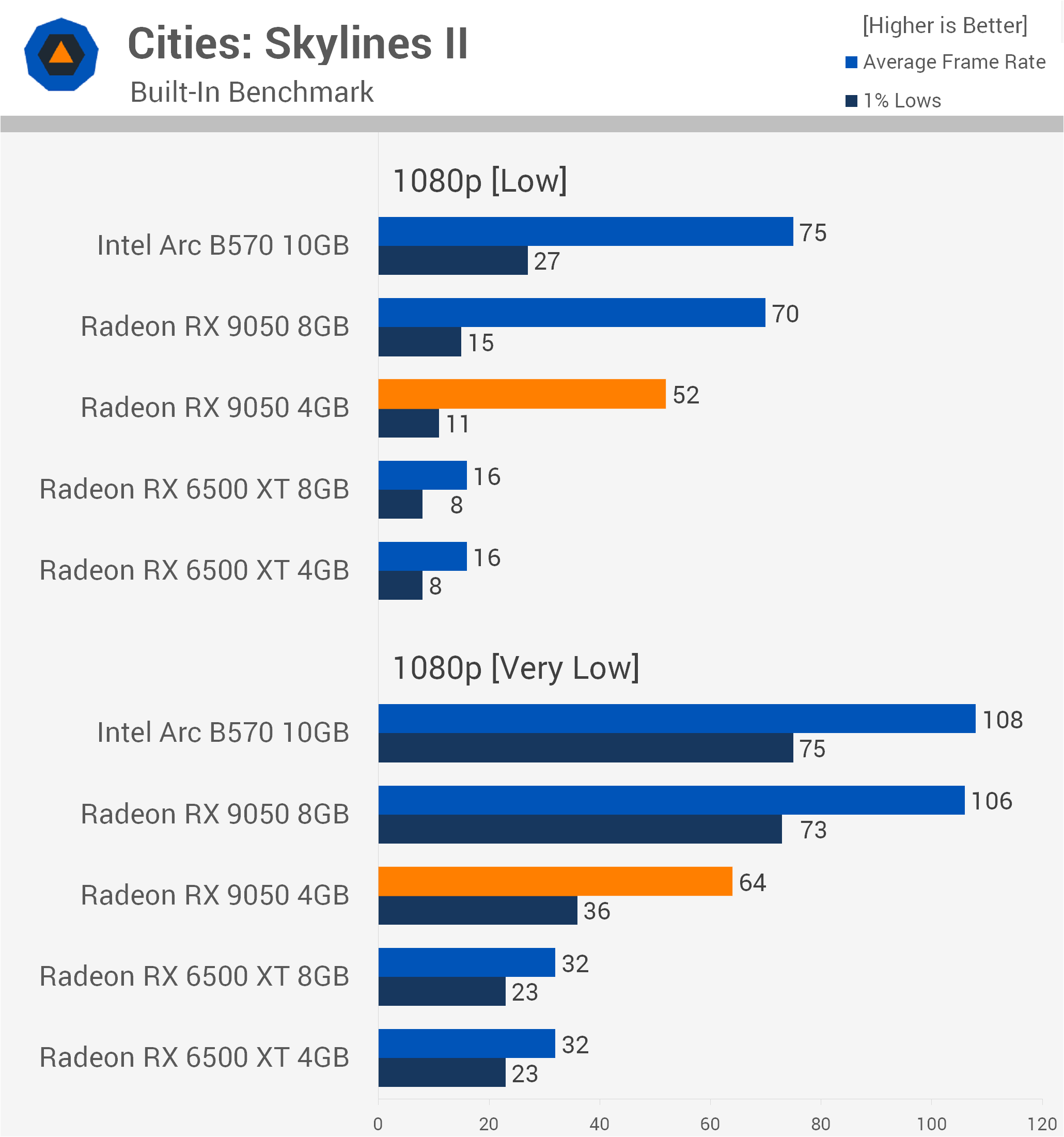
The Arc B570 was also significantly faster than the RX 9050 4GB, leading by anywhere from 44% to 69%.
Space Marine 2
Taking a look at Space Marine 2, we again see the severe performance penalty imposed on the RX 9050 4GB. Using Medium quality settings at 1080p, the 8GB version was roughly 46% faster, delivering 70 fps on average compared to just 48 fps.
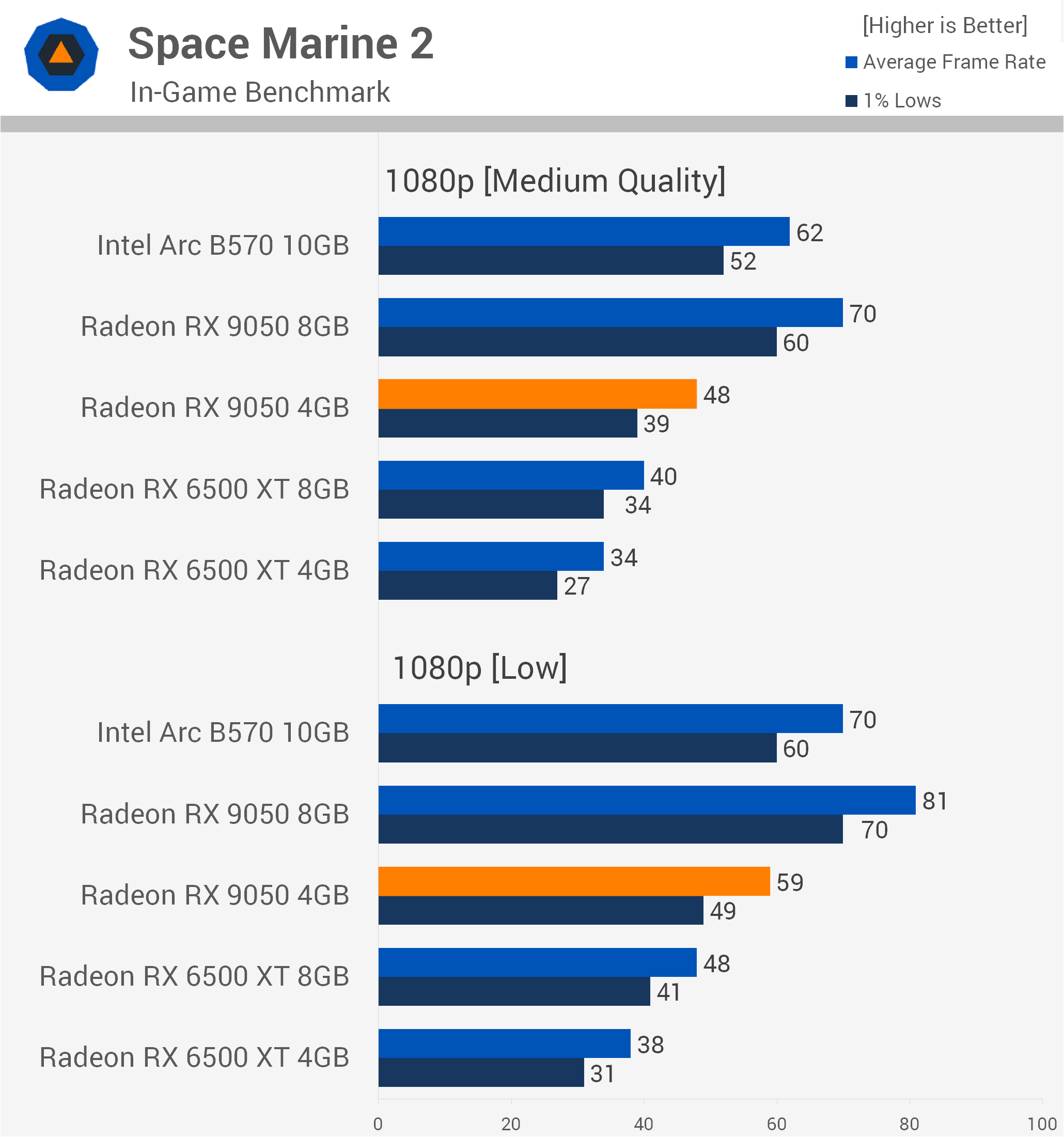
The Intel Arc B570 also comfortably outperformed the 4GB RX 9050, coming in 29% faster with a much more playable 62 fps. Dropping to the Low preset didn't completely save the 4GB model, either. The RX 9050 8GB maintained a commanding 37% lead, pushing 81 fps, while the Arc B570 was roughly 19% faster than the cut-down Radeon GPU at 70 fps.
Interestingly, we also saw a notable performance gap between the older RX 6500 XT models, with the 8GB version outpacing the 4GB card by 26% using these lower settings. In this case, the limited 4GB VRAM buffer was clearly hurting performance as well.
Fortnite
Fortnite presented some interesting scaling behavior depending on the rendering mode used. With DX12 and Low quality settings, the Arc B570 was roughly 17% faster than the RX 9050 8GB, hitting 362 fps. The 8GB Radeon, in turn, was around 20% faster than the 4GB model.
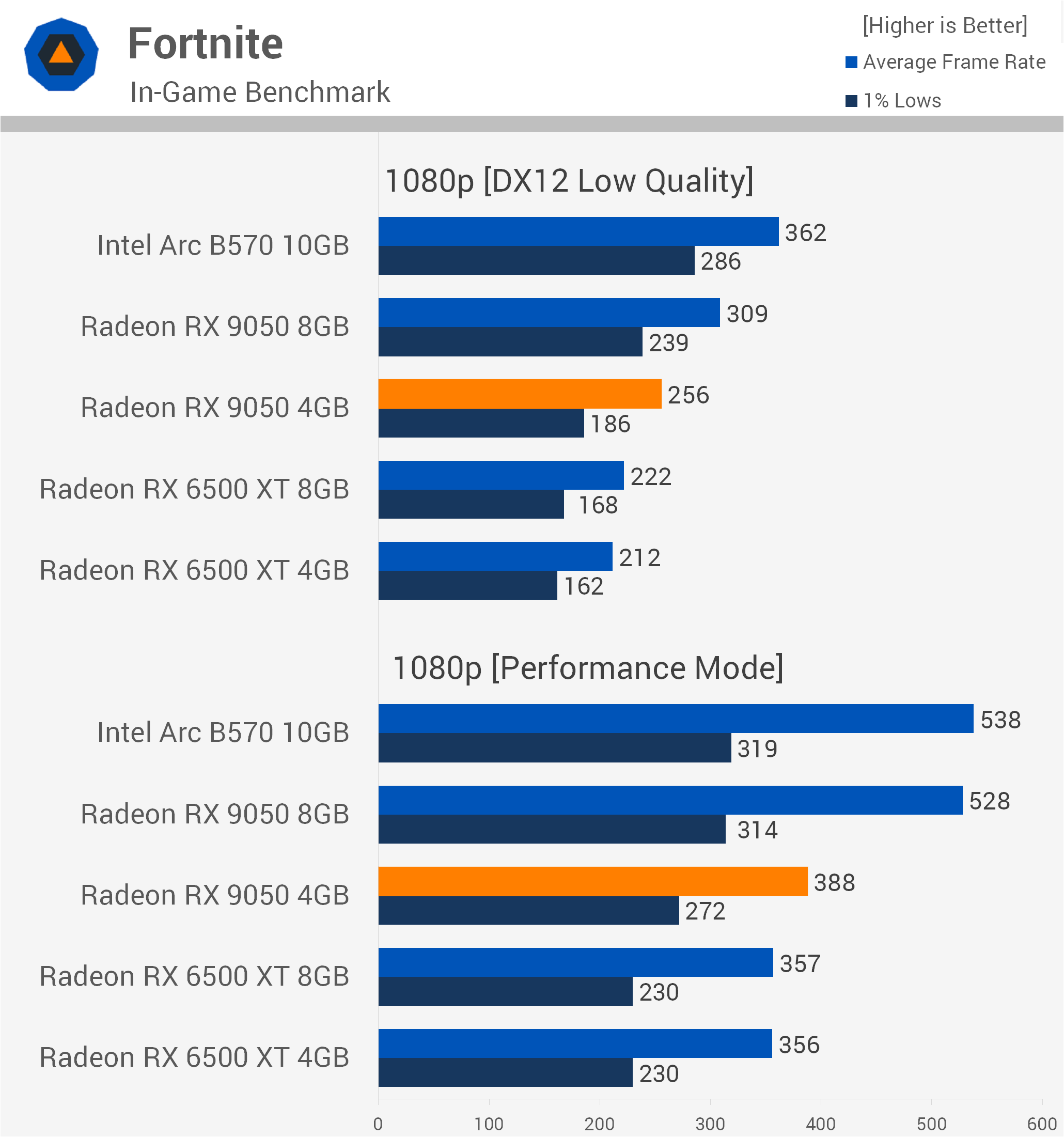
Switching to Performance Mode significantly changed the picture. The RX 9050 8GB essentially matched the Arc B570, with the two GPUs delivering 528 and 538 fps, respectively.
Unfortunately, the RX 9050 4GB couldn't keep pace. The 8GB model was 36% faster, once again highlighting how severely the cut-down memory configuration can hurt performance, even in a high-frame-rate competitive title.
Cyberpunk 2077: Phantom Liberty
Testing with Cyberpunk 2077: Phantom Liberty showed a much narrower gap between the two RX 9050 models. At 1080p Medium, the 8GB card was just 8% faster, delivering 80 fps compared to 74 fps for the 4GB version.
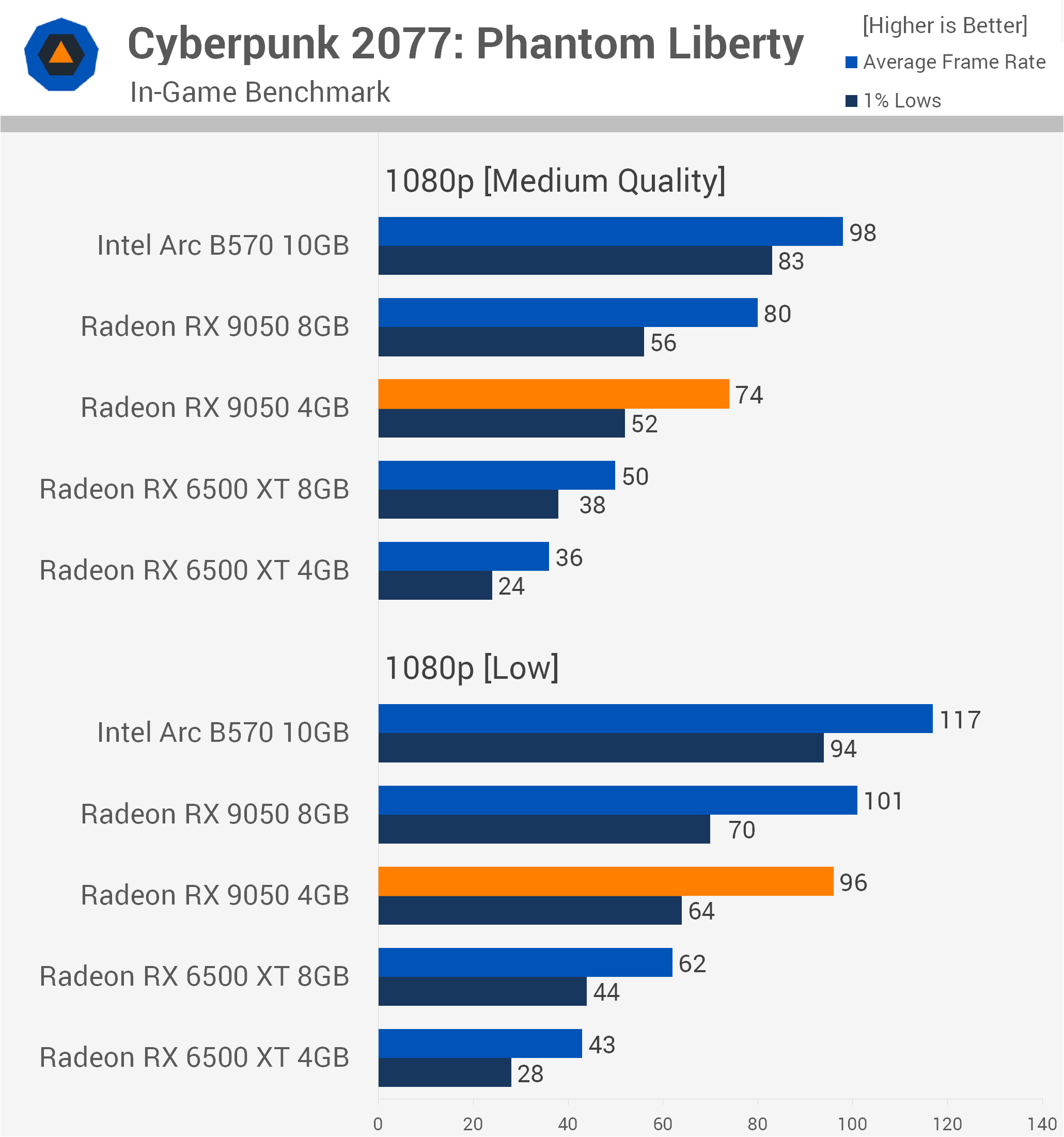
Intel's Arc B570 was considerably faster than both, however, averaging 98 fps and beating the RX 9050 8GB by 22%.
The RX 6500 XT 8GB also comfortably outperformed its 4GB counterpart by around 38%, showing that VRAM capacity still matters in this test.
Dropping visual quality to Low allowed all of the current-generation cards to comfortably clear 60 fps. The B570 continued to lead at 117 fps, while the RX 9050 4GB trailed its 8GB sibling by a relatively small margin.
Pragmata
Pragmata gave us a dead tie between the Arc B570 and RX 9050 8GB. Using the Balanced preset at 1080p, both GPUs averaged exactly 84 fps with identical 1% lows of 72 fps.
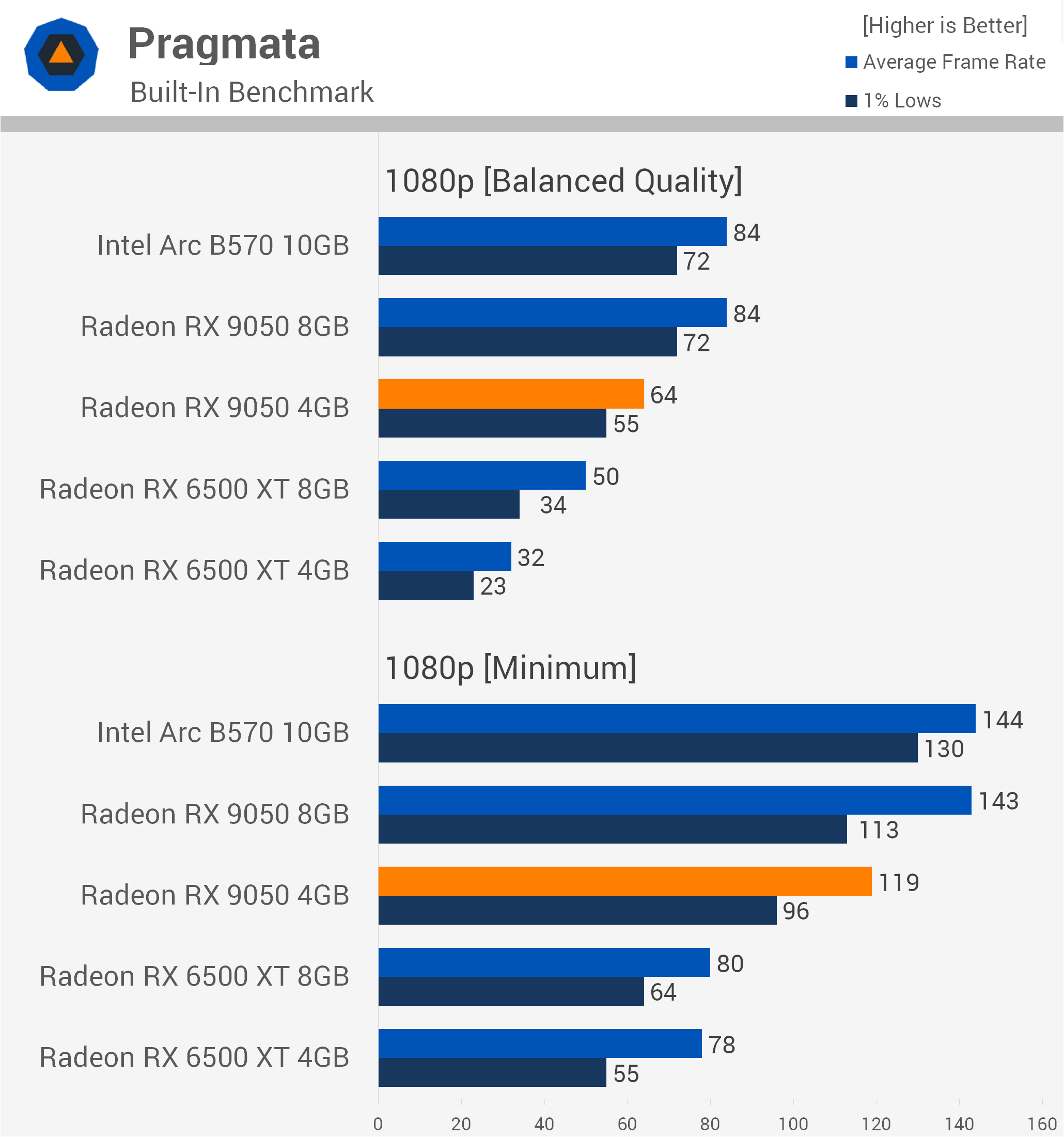
The RX 9050 4GB simply couldn't keep up, allowing the 8GB model to deliver 31% more performance. Even with the less demanding Minimum preset, the B570 and RX 9050 8GB remained neck and neck at the top of the graph. Meanwhile, the 4GB model again fell well behind, with the 8GB version coming in 20% faster.
Lego Batman: Legacy of the Dark Knight
Moving on to Lego Batman, the 1080p Medium preset favored the Arc B570 and RX 9050 8GB, which delivered 181 and 175 fps, respectively. The RX 9050 4GB, however, fell well behind, allowing the 8GB model to deliver 42% more performance. The impact of VRAM capacity was also glaringly obvious with the older RX 6500 XT, where the 8GB model was nearly twice as fast as the 4GB version, rendering 112 fps compared to just 59 fps.
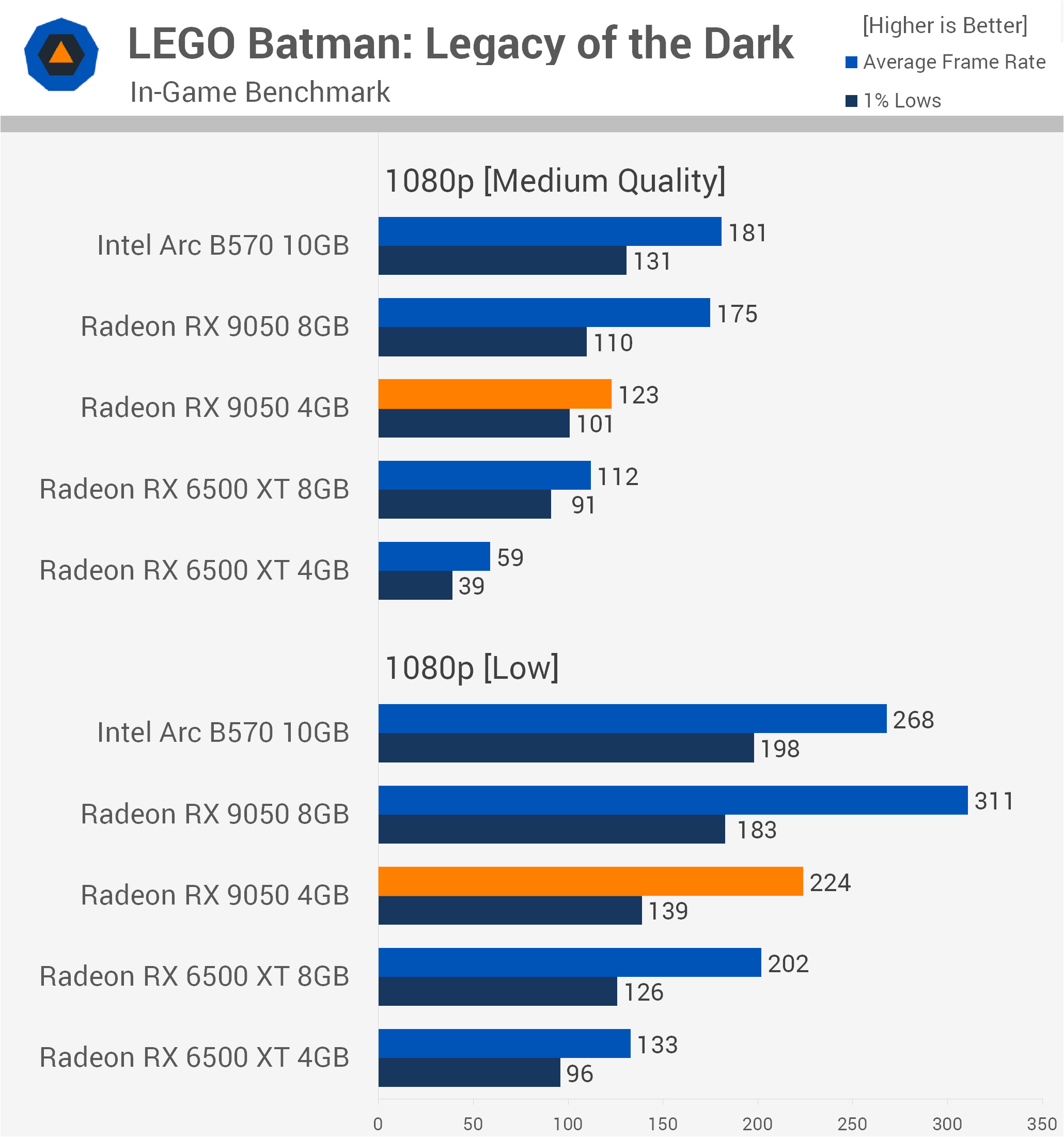
Dropping to the Low preset allowed the RX 9050 8GB to reach 311 fps, making it 39% faster than the 4GB version. Admittedly, the 4GB model still averaged a very high 224 fps, but LEGO Batman looks truly awful using this quality preset.
Counter-Strike 2
Counter-Strike 2 delivered extremely high frame rates across the board, but still clearly illustrated the differences between these GPUs. Using the Medium preset, the RX 9050 8GB held a 25% performance advantage over the 4GB model, pushing well beyond 300 fps.
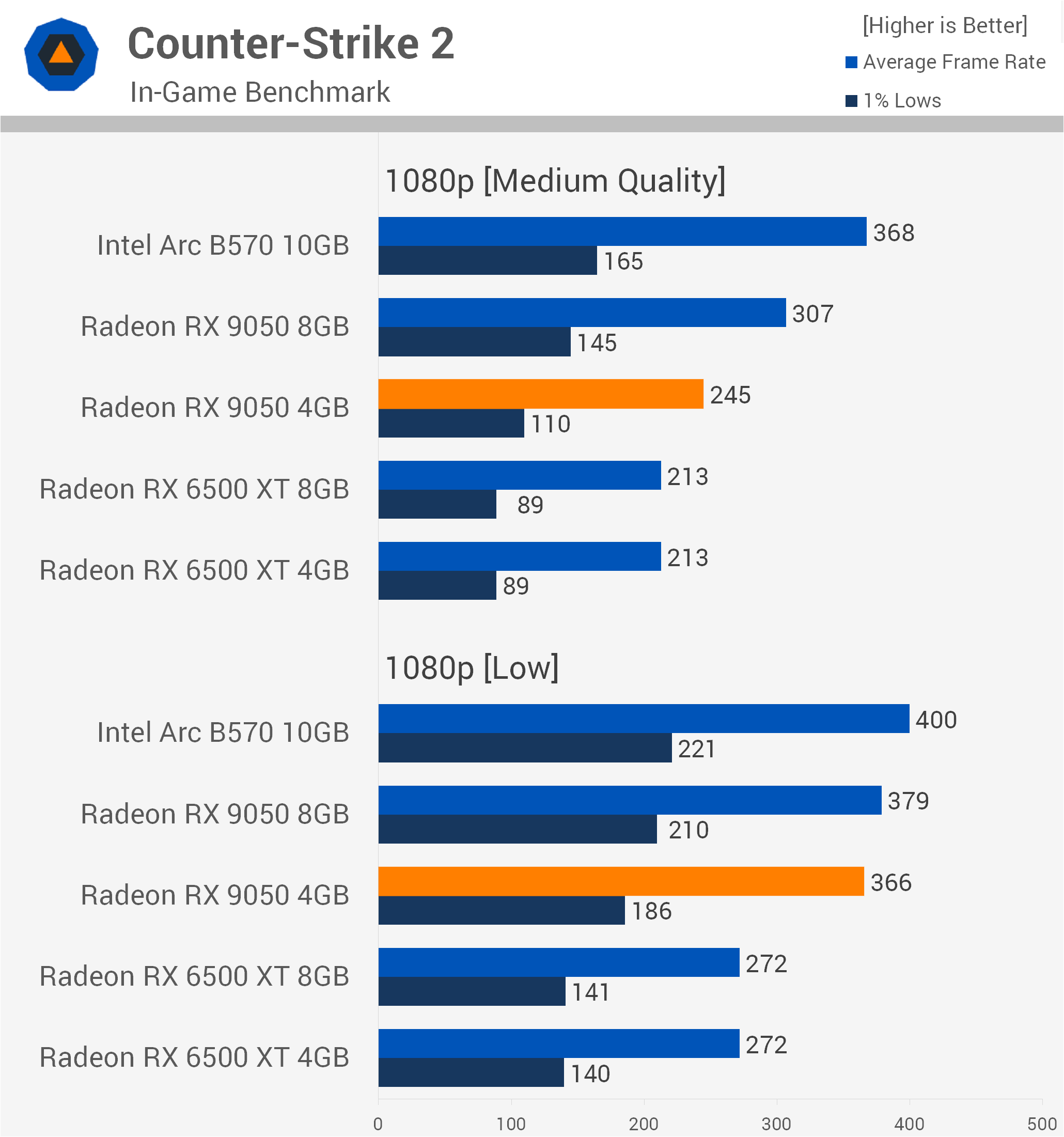
The Arc B570 was faster again, averaging 368 fps and comfortably leading the Radeon GPUs.
Interestingly, the 4GB and 8GB versions of the RX 6500 XT both averaged 213 fps. That suggests VRAM capacity wasn't the limiting factor here, once again pointing to the reduced memory bandwidth as the key weakness of the RX 9050 4GB.
Switching to the Low preset significantly reduced the gap between the two RX 9050 models, but the Arc B570 remained at the top of the chart with an impressive 400 fps average.
Tom Clancy's Rainbow Six Siege X
Moving on to Tom Clancy's Rainbow Six Siege X, the performance deficit of the RX 9050 4GB was glaringly obvious. Using the High preset at 1080p, the 8GB version delivered an impressive 180 fps on average, making it 62% faster than the 4GB model. The Intel Arc B570 was faster again, pushing 192 fps to lead the group.
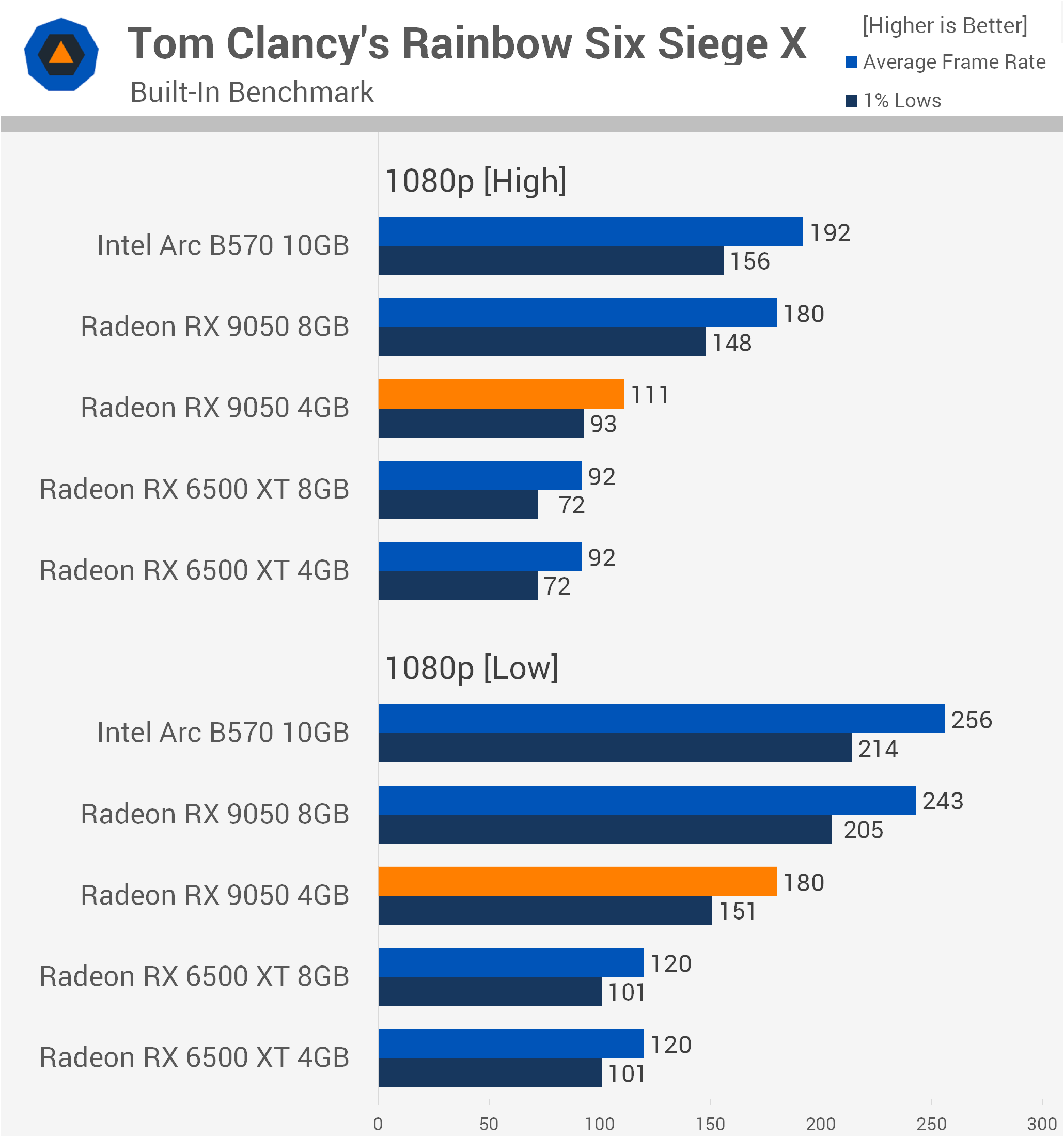
Interestingly, the 4GB and 8GB versions of the older RX 6500 XT delivered identical performance at 92 fps. This indicates that exceeding a 4GB VRAM buffer wasn't the issue in this test and again exposes the severe memory bandwidth limitation of the RX 9050 4GB.
Even dropping to the Low preset couldn't close the gap, as the 8GB model remained roughly 35% faster, delivering 243 fps compared to 180 fps.
Battlefield 6
Next up is Battlefield 6, where the results were quite punishing for 4GB graphics cards. Using Medium quality settings, the RX 9050 8GB was roughly 38% faster than its 4GB counterpart, delivering 98 fps compared to 71 fps.
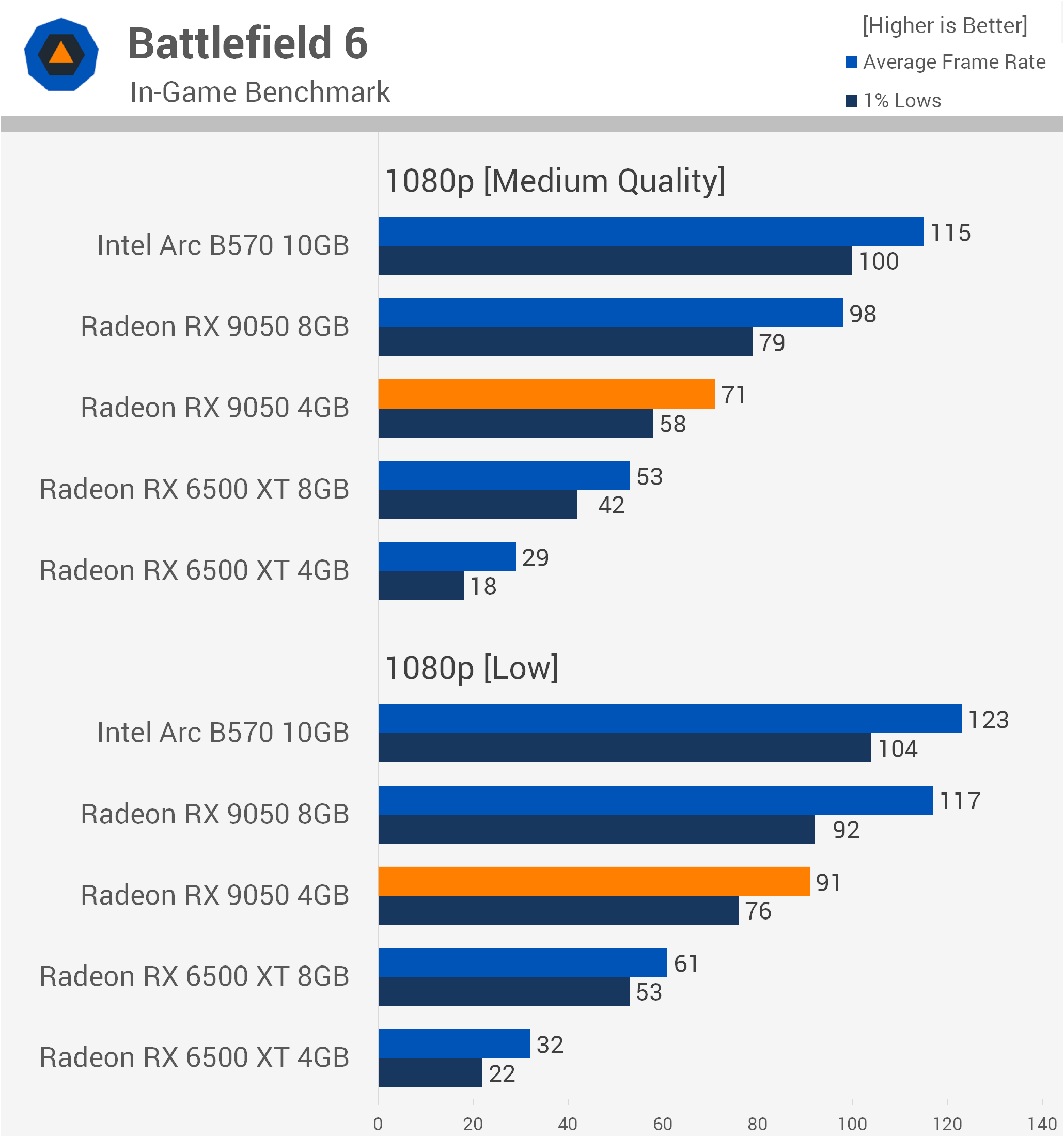
The Arc B570 also performed extremely well in this title, outpacing the 8GB RX 9050 by 17% to average 115 fps.
Switching to the Low preset tightened the race considerably, but the B570 still led at 123 fps. The RX 9050 8GB remained 29% faster than the 4GB model, while the B570 extended that margin to 35%.
Marvel Rivals
Finally, Marvel Rivals closely mirrored the results we saw in Pragmata. With Medium quality settings enabled, the Arc B570 and RX 9050 8GB were virtually indistinguishable, delivering 70 and 69 fps, respectively, with identical 1% lows of 56 fps. The RX 9050 4GB was significantly slower, allowing the 8GB model to deliver 43% more performance.
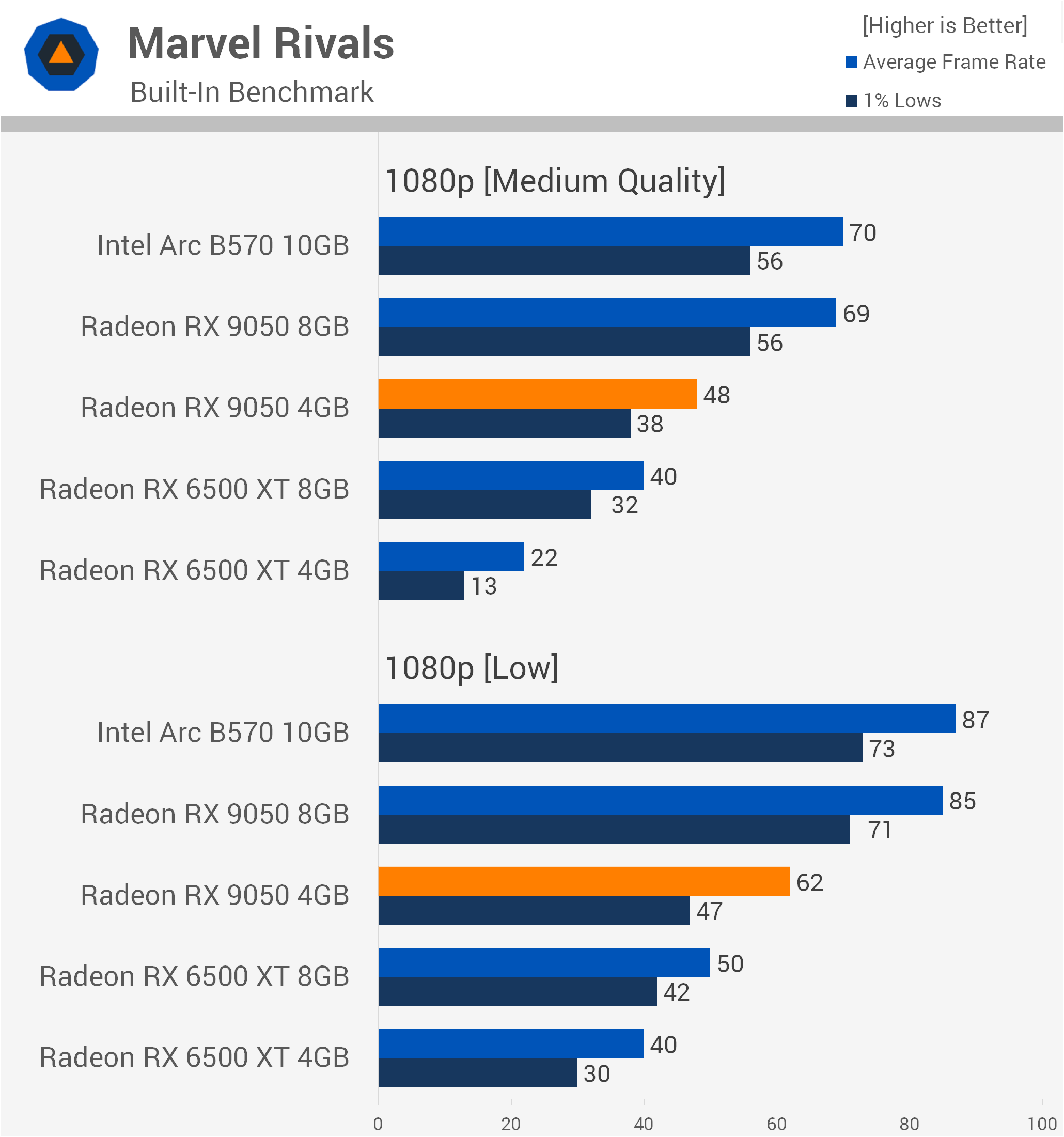
Switching to the Low preset naturally boosted frame rates across the board, but the overall trend remained unchanged. The B570 and RX 9050 8GB were closely matched at the top, while the 4GB model trailed significantly. Here, the Arc GPU delivered 40% more performance, providing yet another example of how damaging the RX 9050 4GB's cut-down memory configuration can be.
18 Game Average at 1080p
Wrapping things up with our 18-game average, we can clearly see the brutal reality of modern gaming on a 4GB graphics card. Looking first at the 1080p Low data, Intel's Arc B570 10GB took the overall lead, edging out the Radeon RX 9050 8GB by roughly 5% with a solid 112 fps average.
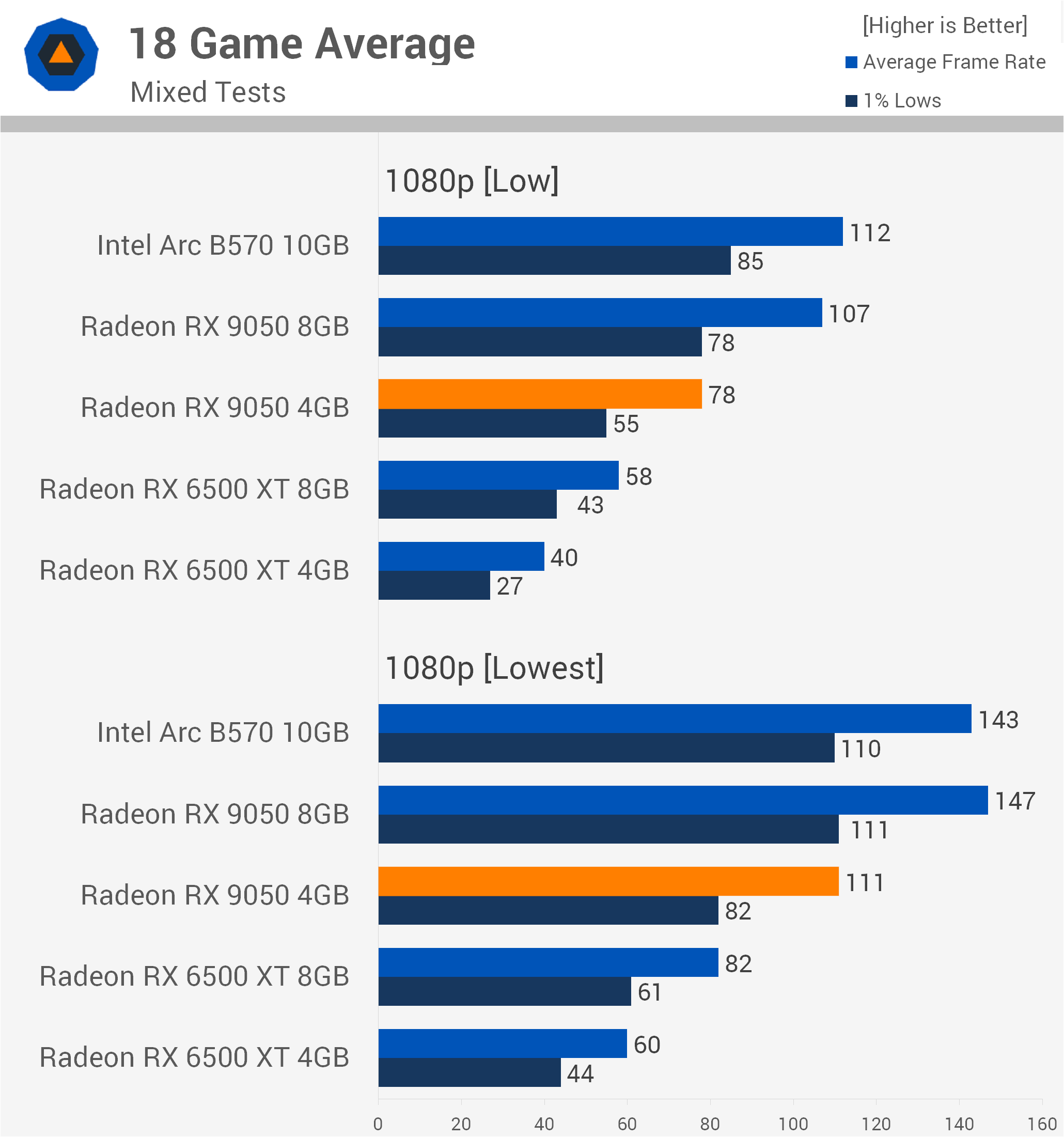
But the real story is the enormous gap between the two RX 9050 variants. The fully equipped 8GB model was a staggering 37% faster than the cut-down 4GB OEM version, highlighting just how damaging the reduced memory configuration can be.
And the situation is likely even worse than what we're showing here. All of this testing was conducted on our modern GPU test system, which supports PCI Express 5.0 and uses high-bandwidth DDR5 memory. Both can help mitigate some of the performance penalties associated with running out of VRAM.
Dropping to the Lowest quality preset tightened the race at the top. The RX 9050 8GB managed to edge past the Arc B570 by just 3%, averaging 147 fps. However, the 4GB model still couldn't catch a break, with the 8GB version remaining 32% faster.
Across a wide range of games, the conclusion is difficult to ignore: pairing a 4GB VRAM buffer with half the memory bandwidth of the retail RX 9050 results in a substantially slower GPU, even when testing at 1080p with heavily reduced quality settings.
This Should Have Been the RX 9040
So, is the Radeon RX 9050 4GB as bad as we expected? Yes. In some respects, it's even worse.
The most surprising result was Rainbow Six Siege X, where VRAM capacity clearly wasn't the primary limitation. The RX 9050 8GB averaged 180 fps, while the 4GB model managed just 111 fps, despite the game not coming close to exhausting a 4GB VRAM buffer. Meanwhile, the 4GB and 8GB versions of the RX 6500 XT delivered identical performance.
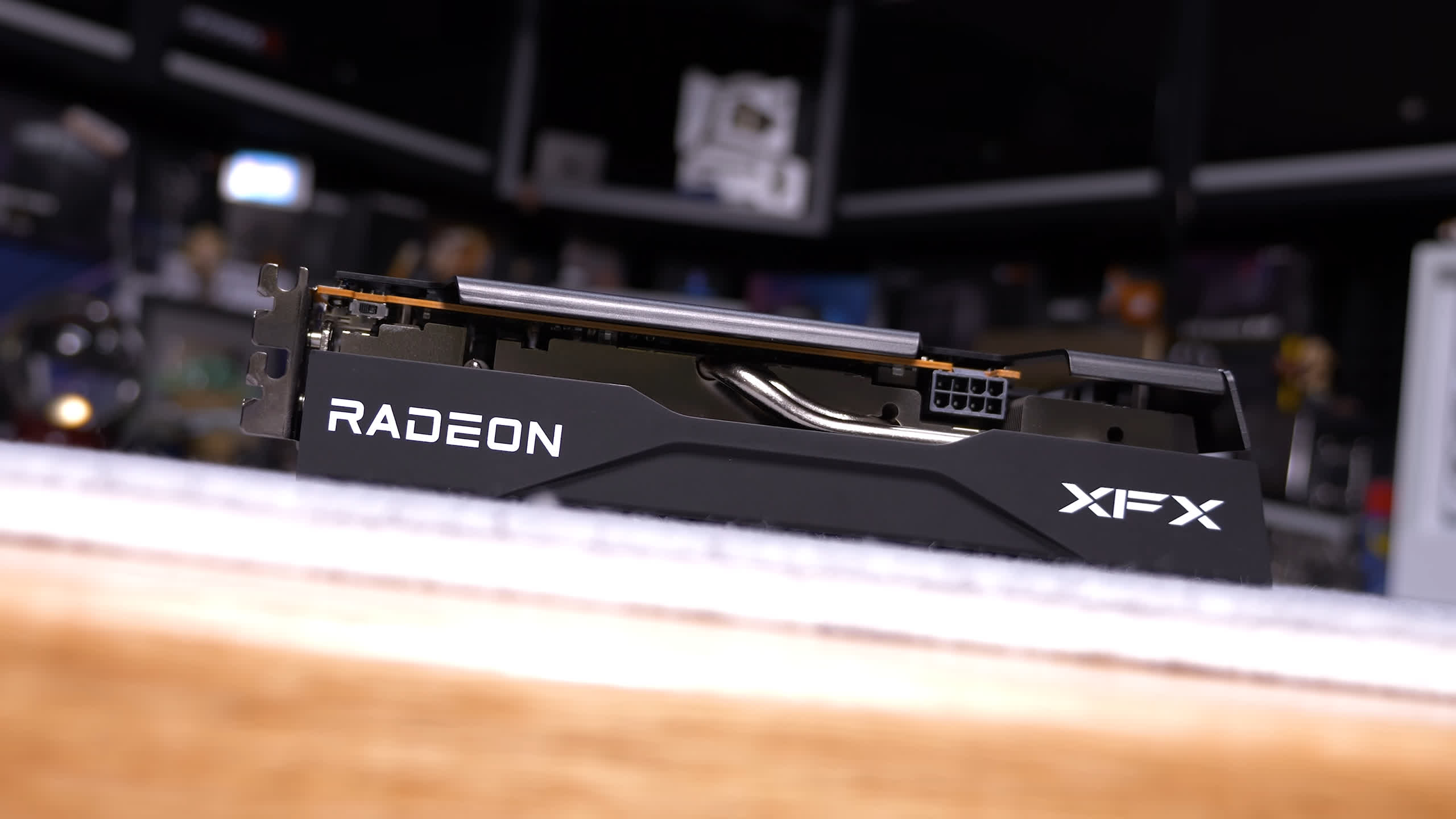
There's no two ways about it, the 4GB RX 9050 is a scam, plain and simple, AMD should be embarrassed by this, and the community backlash should be swift and brutal. There is no excuse for why this shouldn't be called the RX 9040, whether it's a retail product or not, it needed a different name.
Some will point out that the card technically works and that, for example, running Rainbow Six Siege X at 111 fps is still perfectly playable. That's true, but it misses the point. We have no issue with budget GPUs. In fact, affordable hardware is often far more interesting to test than something like an RTX 5090. The problem is value and transparency.
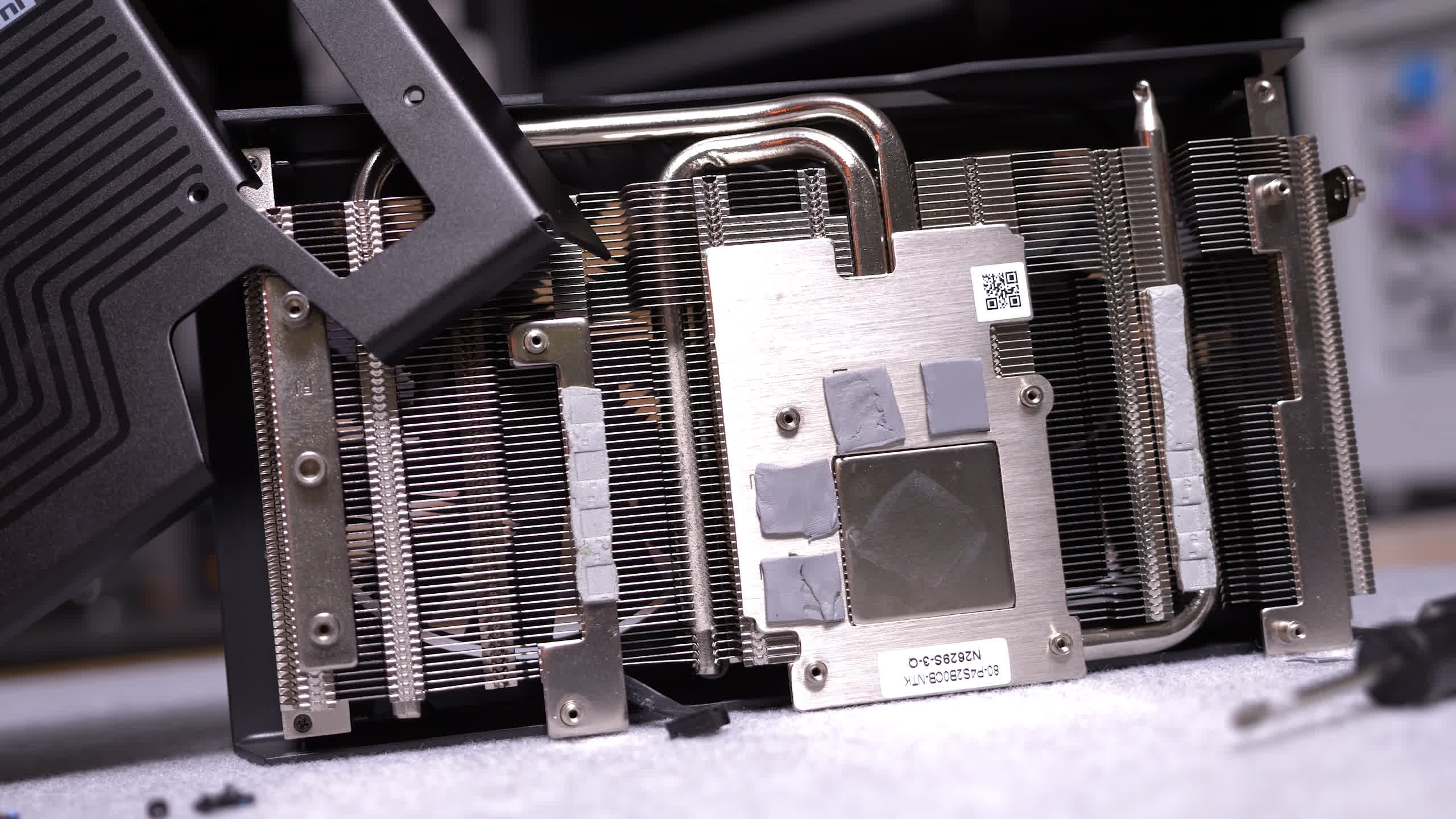
The RX 9050 4GB might deliver playable frame rates in some games, but it's substantially slower than the 8GB RX 9050 version that buyers are most likely to encounter when researching the product (and that's why we wanted to write this review, so you can find this key difference in specs).
As shown in today's testing, on average the Intel Arc B570 is 44% faster, and it can currently be found for around $260. We don't know the "standalone" price of the RX 9050 4GB because it's OEM-only, but we can make a rough estimate based on the CyberPowerPC system we purchased for $750.
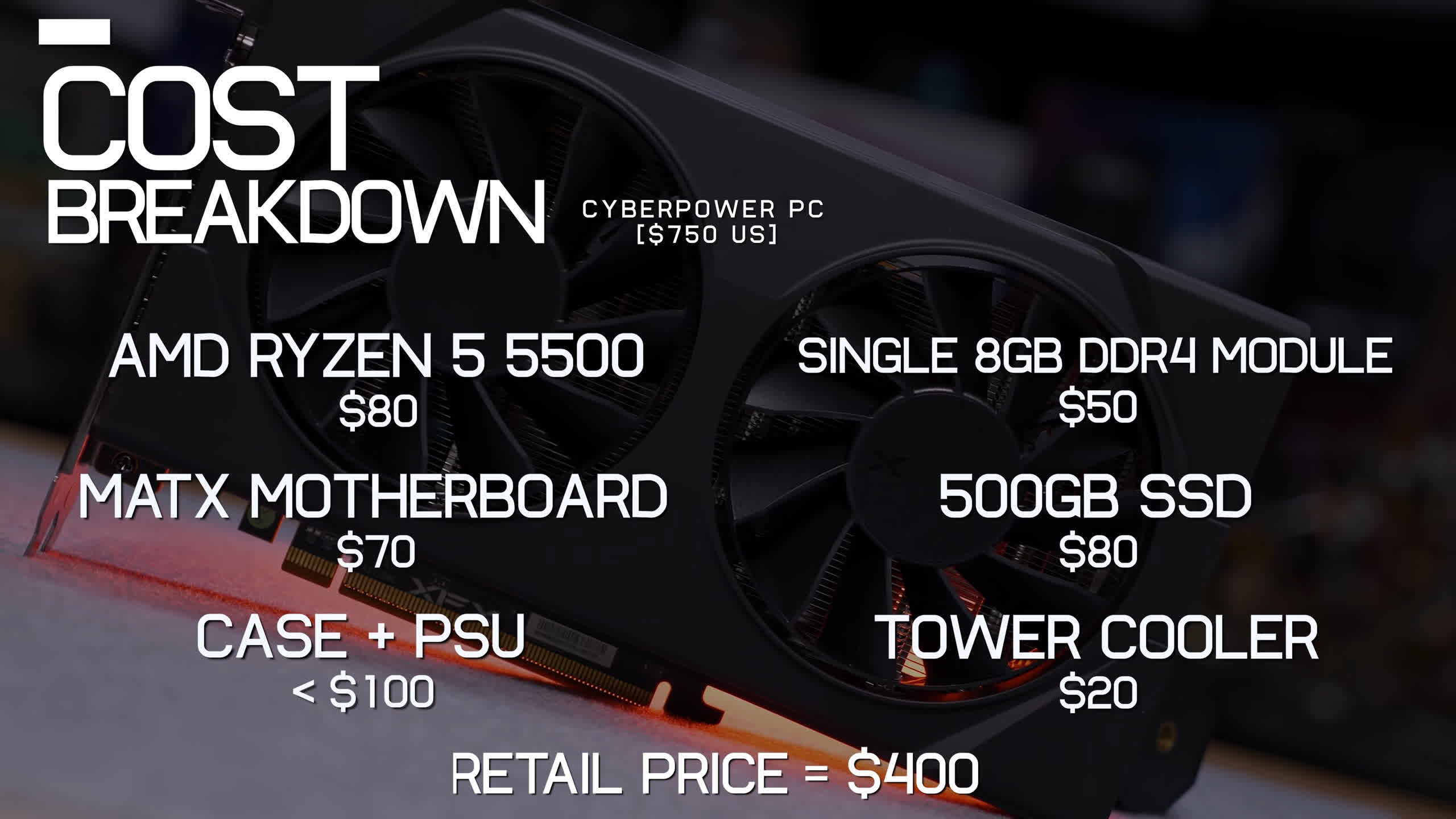
That system includes a Ryzen 5 5500, 8GB of DDR4 memory, an AM4 MicroATX motherboard, a 500GB SSD, and the Radeon RX 9050 4GB. The Ryzen 5 5500 can be found for around $80, while a basic 8GB DDR4 module costs roughly $50. An entry-level AM4 motherboard is around $70, a 500GB SSD about $80, and a comparable case and power supply can be had for under $100. Add roughly $20 for a basic tower cooler, and you're looking at around $400 worth of hardware at retail prices before accounting for the GPU, Windows license, assembly, and profit.
That leaves roughly $350 to cover all of those remaining costs. Based on that, we'd expect the RX 9050 4GB to represent a meaningful portion of the system's price, potentially putting it in roughly the same territory as the Arc B570. That's only an estimate, but the broader point remains: you could build a similarly priced system around a considerably faster GPU.
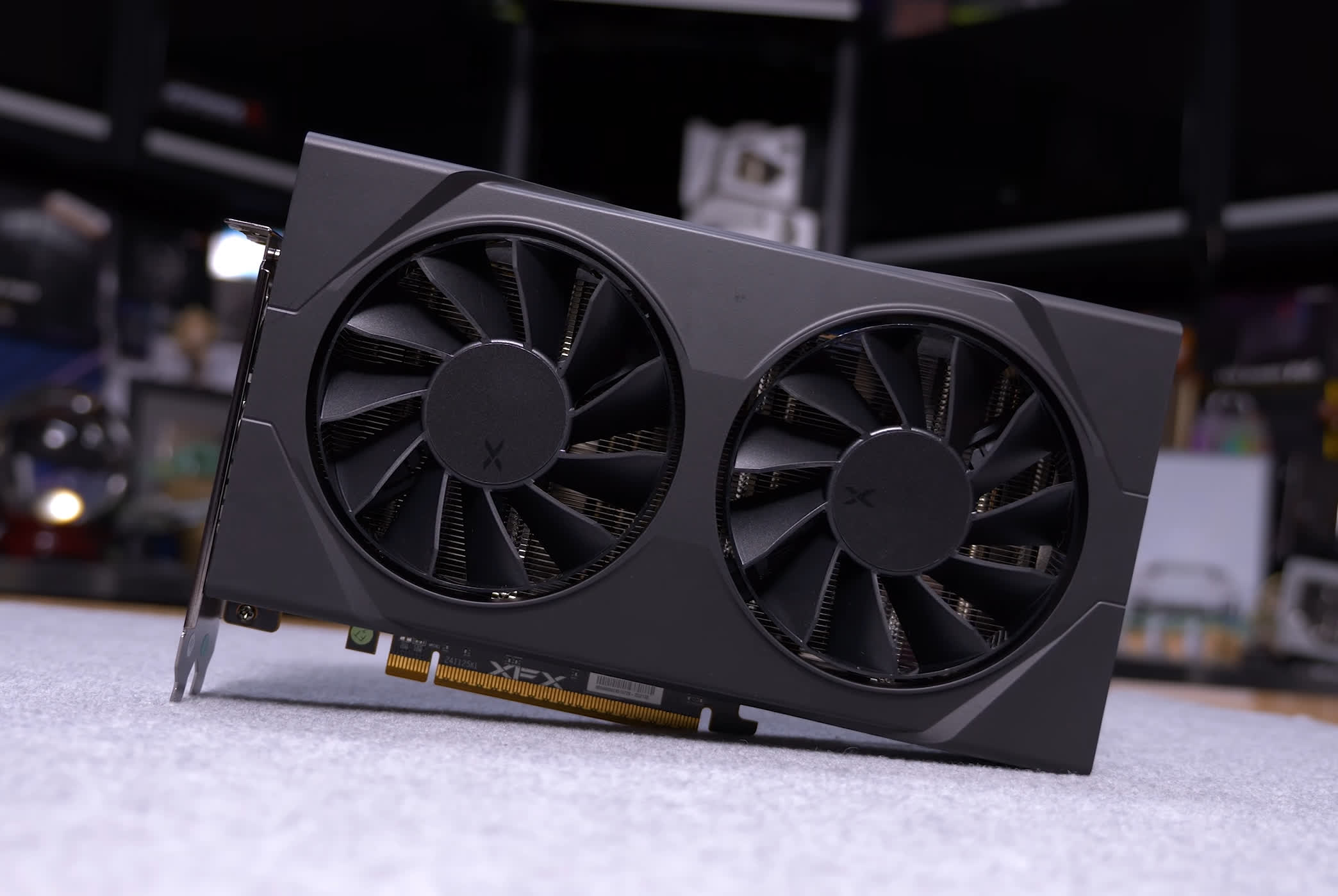
Something to explore soon will be testing the Radeon RX 9050 4GB inside the CyberPowerPC system itself in a follow-up benchmark review. That should be especially interesting because the Ryzen 5 5500 limits the GPU to PCI Express 3.0, while the system also includes just 8GB of single-channel DDR4 memory. When the graphics card runs out of VRAM and has to lean more heavily on system memory, those limitations could make an already bad situation considerably worse.
That should be fun to witness.
Ultimately, the Radeon RX 9050 4GB is a scam. It's designed to trick less experienced and it's deceptive. That's the real issue here. A budget GPU doesn't need to be fast, but buyers should be able to understand what they're actually getting. Calling both of these products the Radeon RX 9050 makes that unnecessarily difficult. Let us know what you think in the comments.