
Forza Horizon 6 is an exciting game to benchmark: not only does it play well, but the visuals are incredible. Turn 10 Studios is once again building on its ForzaTech engine, but this installment marks the first time the studio has targeted ninth-gen consoles. These systems, the PS5 and Xbox Series consoles, launched in late 2020 define the current era of video game hardware. Older platforms like the Xbox One have been left behind entirely, giving the developer considerably more headroom to work with.
On the PC version, the game features ray tracing-enabled global illumination for indirect lighting and ray traced reflections. Ray-traced global illumination computes real-time indirect lighting and ambient occlusion across cars and dynamic environments. There are also ray traced reflections for the full open-world environment, as well as car-on-car reflections, replacing the static cube maps that have long been a staple of the genre.

Turn 10 has also added Advanced Refraction Shaders, which model real-time rainbow refraction physics on plastic and polycarbonate materials such as headlights and taillights.
Forza Horizon 6 supports DLSS, FSR, and XeSS upscaling, as well as DLSS 4 Multi-Frame Generation up to 6X on RTX 50-series GPUs. AMD FSR 3 and FSR 4 are also supported, along with Intel XeSS 2.1 for both upscaling and frame interpolation on non-RTX graphics cards.
Earlier this week, we examined VRAM usage and performance in Forza Horizon 6, pitting the 8GB and 16GB variants of the GeForce RTX 5060 Ti against each other. The takeaway was clear: getting the most out of this game requires at least 12GB of VRAM. Today, we're going broader, testing 47 graphics cards from AMD, Nvidia, and Intel to build a more complete picture of where GPU performance stands.

Frame generation is not part of this test, though we do have upscaling data we'll get to shortly. The core results cover native 1080p, 1440p, and 4K across four of the nine available presets: Extreme+RT, High+RT, Extreme, and High, with some preset scaling data included as well.
For the benchmark itself, we're using the game's built-in tool, which is highly representative of actual gameplay. There are well over 1,100 data points ahead, so let's get into it.
Test System Specs

| CPU | AMD Ryzen 7 9800X3D |
| Motherboard | Gigabyte X670E Master [BIOS F42b] - Resizable BAR Enabled |
| Memory | G.Skill Trident Z5 RGB DDR5-6000 CL30 [CL30-38-38-96] |
| ATX Case | MSI Prospect 700R |
| Power Supply | Kolink Regulator Gold ATX 3.0 1200W |
| Storage | TeamGroup T-Force Cardea A440 M.2 PCIe Gen4 NVMe SSD 4TB |
| Operating System | Windows 11 25H2 |
| Display Driver | Nvidia GeForce Game Ready Driver 596.49 WHQL AMD Radeon Adrenalin 26.5.2 WHQL |
Benchmarks
Preset Scaling Performance
Let's start with preset scaling, as this clearly demonstrates some of the unusual behavior you're about to see when comparing GPUs not just across brands, but also across generations.
In this example, we're comparing the Radeon RX 9070 XT and GeForce RTX 5070 Ti, two GPUs that generally deliver similar levels of performance. Interestingly, if we look at the bottom of the graph using the maximum in-game preset, Extreme+RT, the GeForce GPU is just 4% faster, which is the kind of margin we'd typically expect to see.

However, as we lower the quality settings with the Ultra+RT preset, the GeForce GPU becomes 13% faster. That margin is slightly reduced to 8% with the High+RT preset before widening again to 13% with the Extreme preset, which disables ray tracing while maxing out everything else.
The Ultra preset tells a similar story, with the GeForce GPU delivering 14% higher performance. But then we see an unusual shift with the High preset. The average frame rate now favors the RTX 5070 Ti by a 17% margin, yet the 1% lows narrow significantly to just a 5% lead.
That margin is completely eliminated with the Medium preset, where both GPUs delivered virtually identical 1% lows at 160-161 fps. Despite that, the RTX 5070 Ti still maintained a 17% advantage in average frame rate.
The results become even more confusing with the Low preset. Here, the 9070 XT was actually 11% faster in terms of 1% lows, despite the fact that the 5070 Ti remained 13% faster when comparing average frame rate.
This trend continues with the Very Low preset, where the 9070 XT was 12% faster for 1% lows, while the 5070 Ti still held an 8% lead in average frame rate. We suspect this points to additional driver optimization work being needed on AMD's side, though it remains to be seen whether AMD will address it. We certainly don't sit around waiting for new Radeon drivers, as those fixes often never arrive.
Upscaling
As we just saw, at native 1440p using the Extreme+RT preset, the RTX 5070 Ti is 4% faster than the 9070 XT. However, once you enable upscaling using DLSS for the GeForce GPU and FSR for the Radeon GPU, that margin increases to anywhere between 8% and 14% in favor of the GeForce GPU.

1080p Extreme + RT Preset
Here are all 46 ray tracing-capable GPUs tested at native 1080p using the maxed-out Extreme+RT preset. As expected, the RTX 5090 sits at the top of the chart with an average of 157 fps, making it 38% faster than the RTX 4090 and 45% faster than the RTX 5080.

The RTX 5080 averaged 108 fps, making it 9% faster than the RTX 5070 Ti, which just edged out the RTX 4080 Super and RTX 4080. The 5070 Ti was also 9% faster than the RX 9070 XT, and while the Radeon GPU still delivered solid performance with 91 fps on average, it trailed the RTX 4080.
The standard RX 9070 managed to beat the RTX 5070 by a 9% margin and was also much faster than the RX 7900 XTX, delivering 16% greater performance. Meanwhile, the RX 7900 XT was competitive with the RTX 4070, though it remained 12% slower than the RTX 4070 Super.
Nvidia's GeForce RTX 5060 Ti 16GB averaged 63 fps, making it 40% faster than the 8GB version. That allowed it to deliver performance similar to the RTX 4070, RTX 3090, and RX 7900 GRE.
AMD's Radeon RX 9060 XT 16GB was 10% slower than the 16GB RTX 5060 Ti, rendering just 57 fps on average. That's not a particularly strong result, especially considering it was only slightly faster than the RX 7800 XT and RTX 4060 Ti.
The RTX 3080 managed 48 fps, making it 8% slower than the 16GB RTX 4060 Ti. We also find the Arc B580 in this range, along with the RX 7700 XT, RTX 5060 Ti 8GB, and RX 9060 XT 8GB. Beyond that, frame rates fall below 40 fps and the game becomes difficult to play, or at least it did for us. Skill issue, perhaps.
1440p Extreme + RT Preset
Increasing the resolution to 1440p reduced RTX 5090 performance by 24%, bringing the average frame rate down to 120 fps. That's still an excellent result given we're testing at the native resolution using the maximum in-game quality settings, including the highest level of ray tracing.

Aside from the expected drop in performance compared to the 1080p results, there are a few noteworthy changes. GPUs such as the RX 7900 XTX held up relatively well, experiencing only a 20% performance reduction, whereas the RX 9070 suffered a 30% decline. As a result, the 7900 XTX is now able to match the RX 9070 at around 60 fps on average.
Other than that, the standings remain very similar from top to bottom. The RTX 4070 Ti Super delivered 58 fps, followed by the RTX 5070 with 56 fps, the RTX 4070 Super with 54 fps, and the RX 7900 XT with 52 fps.
Below that, performance drops into the mid-40s, where you'll find GPUs such as the RX 7900 GRE, RTX 3090, RTX 4070, and 16GB RTX 5060 Ti.
From there, frame rates fall into the mid-30s with GPUs such as the RTX 4060 Ti 16GB, RTX 3080, RX 6950 XT, and Intel's Arc B580. Beyond that, you're looking at a 30 fps experience or worse, so it's probably time to dial down the quality settings. We'll do exactly that in a moment, but first let's take a quick look at the 4K data.
4K Extreme + RT Preset
Moving to 4K, the GeForce RTX 5090 delivered 78 fps on average, which is excellent performance for native 4K gaming. With a little help from upscaling, it could likely push beyond 100 fps. That also made it roughly 40% faster than the RTX 4090, which averaged 56 fps. While that's still respectable performance, smooth gameplay at these settings now really depends on upscaling.
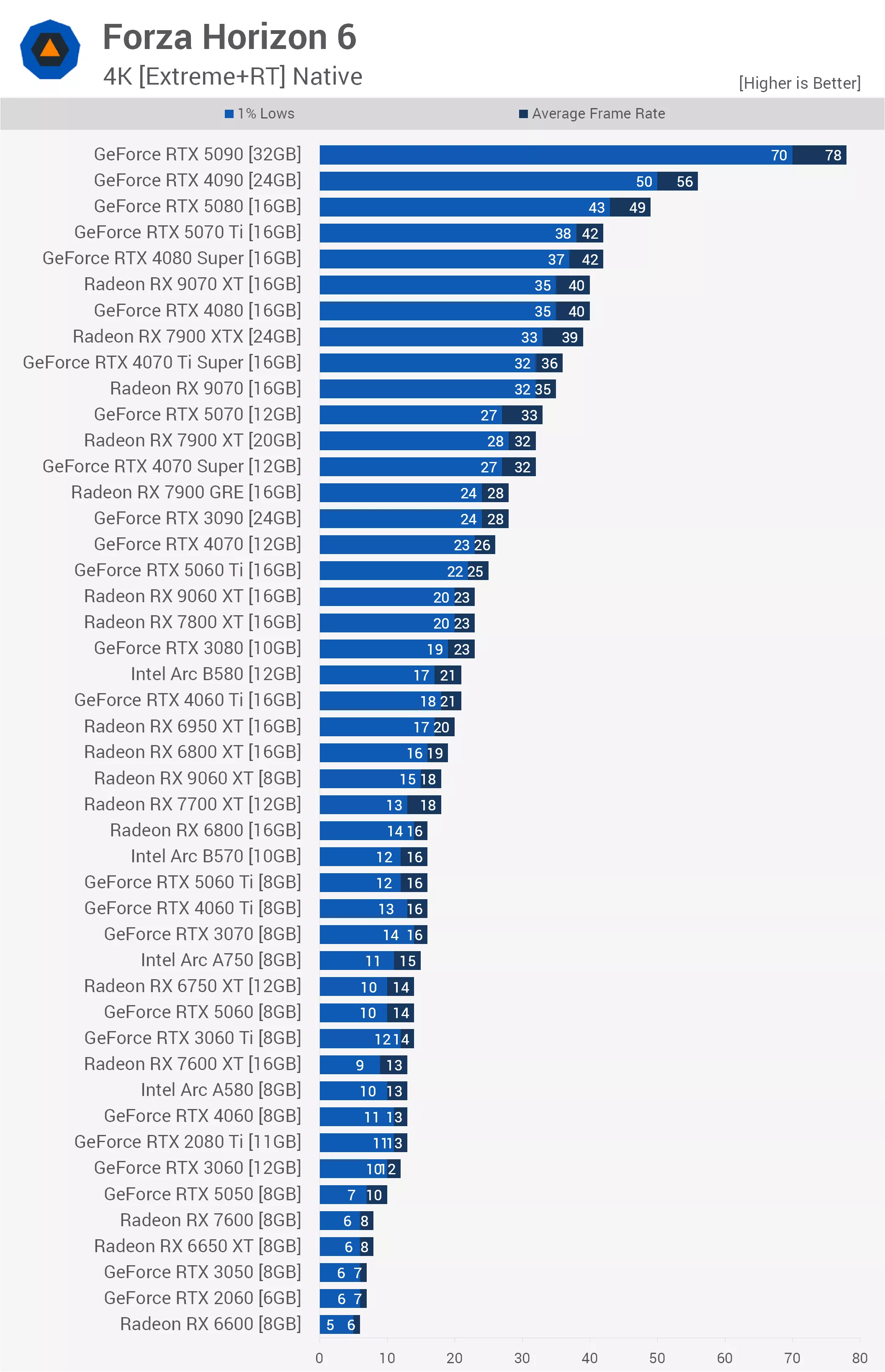
The RTX 5080 averaged just 49 fps, placing it well below the 60 fps mark. That said, with balanced upscaling, you could still achieve solid performance from GPUs such as the RTX 5070 Ti, RTX 4080 Super, and RX 9070 XT.
1080p High + RT Preset
Once again, here are all 46 GPUs we tested at native 1080p using the High+RT preset, and just like with the Extreme preset, the RTX 5090 sits at the top of the chart with an average of 215 fps, making it 30% faster than the RTX 4090 and 22% faster than the RTX 5080.

The RTX 5080 averaged 176 fps, making it 6% faster than the RTX 5070 Ti, which actually managed to tie the mighty RTX 4090 at 166 fps. The 5070 Ti was also 13% faster than the RX 9070 XT, though AMD's top Radeon GPU still delivered a strong 147 fps, placing it just ahead of both the RTX 4080 Super and standard RTX 4080.
The standard RX 9070 effectively tied the RTX 5070 and RTX 4080 with 141 fps, while also outperforming the RX 7900 XTX by an 11% margin. The RX 7900 XT averaged 117 fps, placing it neatly between the RTX 4070 and RTX 4070 Super.
Nvidia's GeForce RTX 5060 Ti 16GB averaged 114 fps, making it 21% faster than the 8GB version. That allowed it to slightly outperform the RTX 4070 while maintaining a comfortable lead over the RTX 3090 and RX 7900 GRE.
AMD's Radeon RX 9060 XT 16GB was roughly 8% slower than the 16GB RTX 5060 Ti, averaging 105 fps. That placed it just ahead of the RX 7900 GRE and RTX 3090, while also comfortably outperforming the RX 7800 XT.
The RTX 3080 managed 96 fps, making it 8% faster than the 16GB RTX 4060 Ti. We also find Intel's Arc B580 here at 91 fps, sitting just above the RX 7700 XT and RTX 4060 Ti 16GB. Because the High+RT preset is far less demanding than Extreme+RT, frame rates don't dip below 40 fps until the very bottom of the chart with the RTX 2060, meaning nearly every GPU tested here delivers a very playable experience.
1440p High + RT Preset
Moving up to 1440p using the High+RT preset, the RTX 5090 remains at the top of the chart with an average of 193 fps, making it 39% faster than the RTX 4090 and 40% faster than the RTX 5080.

The RTX 5080 averaged 138 fps, effectively tying the RTX 4090 while also making it 7% faster than the RTX 5070 Ti. The 5070 Ti, in turn, was 8% faster than the RX 9070 XT, though the Radeon GPU still delivered a strong 120 fps, placing it just ahead of the RTX 4080 Super.
The standard RX 9070 matched the RTX 4080 with 115 fps, making it 8% faster than both the RTX 5070 and RX 7900 XTX, which tied at 106 fps. The RX 7900 XT averaged 96 fps, putting it right alongside the RTX 4070 Super, which managed 95 fps.
Nvidia's GeForce RTX 5060 Ti 16GB averaged 83 fps, making it 14% faster than the 8GB version. This allowed it to match the RTX 4070 exactly, while sitting just one frame behind the RTX 3090.
AMD's Radeon RX 9060 XT 16GB was roughly 6% slower than the 16GB RTX 5060 Ti, averaging 78 fps. That placed it slightly behind the RX 7800 XT but still ahead of the RTX 3080.
Speaking of the RTX 3080, it managed 77 fps, making it 17% faster than the 16GB RTX 4060 Ti. Intel's Arc B580 also continues to perform well here with 69 fps, sitting comfortably ahead of the RTX 4060 Ti 16GB. Toward the bottom of the stack, you'll need something like an RX 6650 XT or better to remain above the 40 fps mark, while GPUs such as the Arc A580, RX 7600, and RTX 3050 fall just short of that threshold for a consistently smooth experience.
4K High + RT Preset
Moving up to 4K, the RTX 5090 once again sits comfortably at the top of the chart with an average of 142 fps, making it 29% faster than the RTX 4090 and 48% faster than the RTX 5080.

The RTX 5080 averaged 96 fps, making it 9% faster than the RTX 5070 Ti, which managed 88 fps. The 5070 Ti was, in turn, 5% faster than the RX 9070 XT. AMD's flagship Radeon GPU delivered 84 fps, placing it just behind the RTX 4080 and RTX 4080 Super.
The standard RX 9070 averaged 79 fps, sitting just behind the RX 7900 XTX at 81 fps. Even so, it remained 10% faster than the RTX 5070. The RX 7900 XT delivered 70 fps, placing it a few frames ahead of the RTX 4070 Super, which averaged 67 fps.
Nvidia's GeForce RTX 5060 Ti 16GB averaged 54 fps, making it 20% faster than the 8GB version. That wasn't quite enough to catch the RTX 4070 or RTX 3090, but it did remain ahead of the RX 6950 XT.
AMD's Radeon RX 9060 XT 16GB was around 6% slower than the 16GB RTX 5060 Ti, averaging 51 fps. That placed it right between the RX 6950 XT and RX 7700 XT.
The RTX 3080 averaged 55 fps, making it 22% faster than the 16GB RTX 4060 Ti. Intel's Arc B580 also continues to hold up surprisingly well with 47 fps, sitting just ahead of the RX 9060 XT 8GB and both RTX 4060 Ti models.
Toward the bottom of the stack, 4K resolution proves too demanding for older and entry-level GPUs. You'll need something like an Arc B570, RTX 5060, or RX 6800 to remain above the 40 fps mark, while cards such as the RTX 3070 and below struggle to deliver a consistently playable experience.
1080p Extreme Preset
Moving to the standard Extreme preset at 1080p, we see frame rates climb significantly across the board. The RTX 5090 continues its dominant run at the top of the chart with an average of 204 fps, making it 26% faster than the RTX 4090 and 19% faster than the RTX 5080.

The RTX 5080 averaged 172 fps, making it roughly 6% faster than the RTX 5070 Ti. Interestingly, the RTX 5070 Ti, with 163 fps, managed to narrowly edge out the RTX 4090, which isn't something we'd normally expect to see. This could be driver-related behavior or simply something unique to Forza Horizon 6.
Another interesting point is that the RTX 5070 Ti was also roughly 20% faster than the RX 9070 XT, which still delivered a solid 136 fps, placing it right between the RTX 4080 and standard RX 9070. Again, AMD may still have some driver optimization work to do here.
The standard RX 9070 averaged 132 fps, allowing it to outperform the RTX 4070 Ti Super while delivering a 12% lead over the RX 7900 XTX. The RX 7900 XT was competitive with the RTX 5060 Ti 16GB, with both GPUs hovering around the 108-109 fps mark.
Nvidia's GeForce RTX 5060 Ti 16GB delivered an average of 108 fps, making it a substantial 30% faster than the 8GB version. That level of performance placed it ahead of heavy hitters such as the RTX 3090 and RTX 4070. On the AMD side, the Radeon RX 9060 XT 16GB was roughly 12% slower than the 16GB RTX 5060 Ti, averaging 95 fps, just enough to stay ahead of the RTX 3080.
Looking further down the chart at some popular mid-range options, the RTX 3060 Ti managed a respectable 70 fps, while the RX 7600 XT followed with 64 fps. The RTX 3060 remained comfortably within playable territory at 62 fps, and even the entry-level RTX 5050 managed a clean 50 fps average.
Intel's Arc B580 also performed well with 83 fps, matching the RTX 5060 Ti 8GB. At 1080p Extreme, the game remains highly playable for almost the entire stack. It's only when we reach the very bottom with the RTX 3050 and RTX 2060 that averages dip to 39 fps, narrowly missing the 40 fps threshold for what we'd consider a smooth experience.
Speaking of the RTX 2060, it's interesting to note that we were finally able to include the Radeon RX 5700 XT in this data set now that ray tracing is disabled. While the performance isn't amazing at just 46 fps on average, it was still 18% faster than the RTX 2060 and much more likely to deliver a playable experience using upscaling, though the Radeon GPU is limited to the lower-quality FSR 3 implementation.
1440p Extreme Preset
Stepping up to 1440p, the RTX 5090 maintains its massive lead at the top of the chart with an average of 187 fps. That makes it 34% faster than the RTX 4090 and 32% faster than the RTX 5080.

The RTX 5080 averaged 142 fps, narrowly beating the RTX 4090 by just a few frames. It was also 8% faster than the RTX 5070 Ti, which still managed an impressive 132 fps. The RTX 5070 Ti, in turn, delivered roughly 13% greater performance than the RX 9070 XT, once again suggesting that AMD may still have some driver work ahead of it. The RX 9070 XT averaged 117 fps, placing it neck and neck with the standard RTX 4080 while sitting just one frame behind the RTX 4080 Super.
The standard RX 9070 averaged 112 fps, exactly tying the RTX 5070. This placed it comfortably ahead of the RX 7900 XTX, which delivered 103 fps. The RX 7900 XT managed 94 fps, slotting in just behind the RTX 4070 Super.
Nvidia's GeForce RTX 5060 Ti 16GB averaged 85 fps, making it an impressive 35% faster than the 8GB version, which managed just 63 fps. The 16GB model matched the RX 7900 GRE while narrowly edging out the RTX 4070, though it still fell short of the old RTX 3090 flagship.
AMD's Radeon RX 9060 XT 16GB was roughly 9% slower than the 16GB RTX 5060 Ti, averaging 77 fps. That placed it roughly on par with the RX 7800 XT and just slightly behind the RTX 3080, which managed 79 fps.
Looking at some of the other popular mid-range cards, Intel's Arc B580 continues to hold its own with 67 fps, just a single frame behind the RTX 4060 Ti 16GB. The RTX 3060 Ti still delivers a very playable 55 fps, while the RX 7600 XT manages 51 fps. The RTX 3060 drops to 48 fps, which is still perfectly viable for a relatively smooth experience.
However, stepping down to the entry-level RTX 5050, performance falls below the 40 fps threshold to an average of 39 fps. It joins GPUs such as the Arc A580, RX 7600, and RX 6600 near the bottom of the stack, where the 1440p Extreme experience starts to become quite challenging without aggressive upscaling.
4K Extreme Preset
Finally, for the Extreme preset testing, we have the native 4K results. Here, the RTX 5090 shows no signs of slowing down, easily taking the top spot with an average of 151 fps. That makes it 29% faster than the RTX 4090 and an enormous 40% faster than the RTX 5080.
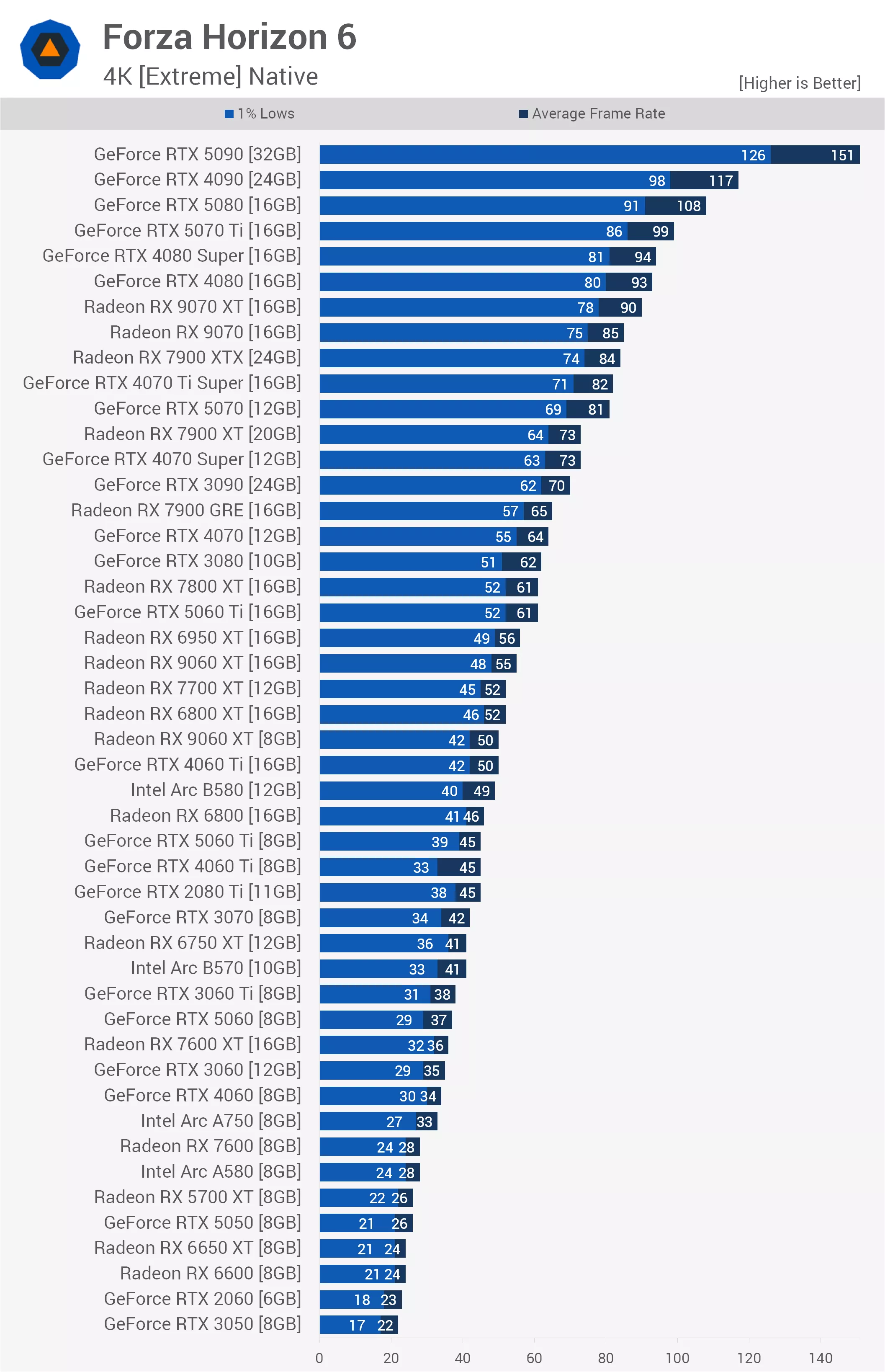
The RTX 5080 averaged 108 fps, giving it a 9% lead over the RTX 5070 Ti, which still delivered an impressive 99 fps. The RTX 5070 Ti, in turn, maintained a 10% advantage over the RX 9070 XT. AMD's flagship Radeon GPU reached 90 fps, placing it just behind the RTX 4080 and RTX 4080 Super.
Looking at the standard RX 9070, it averaged 85 fps, allowing it to narrowly edge out the RX 7900 XTX while also delivering a 5% lead over the RTX 5070. Further down the chart, the RX 7900 XT and RTX 4070 Super were dead even, both averaging 73 fps.
Nvidia's GeForce RTX 5060 Ti 16GB delivered an average of 61 fps, making it 35% faster than the cut-down 8GB version, which struggled with just 45 fps. The 16GB model matched the RX 7800 XT while sitting just one frame behind the RTX 3080 and a few frames short of the RTX 4070.
AMD's Radeon RX 9060 XT 16GB was roughly 10% slower than the 16GB RTX 5060 Ti, averaging 55 fps. That placed it just behind the RX 6950 XT.
Intel's Arc B580 also deserves a mention here, still holding up surprisingly well at 4K with a 49 fps average, putting it right alongside both the 8GB and 16GB RTX 4060 Ti models.
However, the demands of 4K Extreme are brutal for mainstream and older GPUs, with many popular options falling below the 40 fps playable threshold. The RTX 3060 Ti averaged just 38 fps, while the RX 7600 XT managed 36 fps and the RTX 3060 dropped to 35 fps.
If you're running an entry-level current-generation GPU like the RTX 5050, you'll be looking at a very choppy 26 fps experience. That places it alongside older GPUs such as the RX 5700 XT, meaning you'll definitely need to rely on upscaling or reduce visual settings to achieve a smooth 4K experience.
1080p High Preset
Finally, we have the High preset data, and as usual we'll start at 1080p. Relative to everything we've already seen, frame rates are flying. Of course, the RTX 5090 still sits at the top, but now we're looking at a blisteringly fast 244 fps, making it 13% faster than the RTX 4090, though only 4% faster than the RTX 5080 as we begin running into CPU bottlenecks at this resolution and preset.

The RTX 5080 averaged 235 fps, making it just 3% faster than the RTX 5070 Ti. Interestingly, the RTX 5070 Ti actually managed to outperform the mighty RTX 4090 here, delivering 228 fps. It was also 19% faster than the RX 9070 XT, which averaged 191 fps, placing AMD's flagship Radeon GPU comfortably between the RTX 4080 Super and standard RTX 4080.
The standard RX 9070 delivered an impressive 184 fps, allowing it to easily outperform the RTX 4070 Ti Super while delivering a 16% lead over the RX 7900 XTX. Meanwhile, the RX 7900 XT averaged 148 fps, placing it just a few frames behind the standard RTX 4070.
Nvidia's GeForce RTX 5060 Ti 16GB averaged 167 fps, making it an enormous 27% faster than the 8GB version. That result placed the 16GB model just ahead of the RTX 4070 Super and comfortably ahead of the RTX 3090.
AMD's Radeon RX 9060 XT 16GB, interestingly, tied the 8GB version at 143 fps, making it roughly 14% slower than the 16GB RTX 5060 Ti. Even so, it still managed to outperform both the RTX 3090 and RTX 3080.
Looking further down the chart at some of the more popular mid-range and entry-level options, the RTX 3060 Ti delivered a buttery-smooth 104 fps, while the RTX 3060 averaged 95 fps. The RX 7600 XT followed closely with 94 fps, and the entry-level RTX 5050 still managed a very comfortable 87 fps. Intel's Arc B580 also performed remarkably well, averaging 121 fps.
Because the High preset at 1080p is so forgiving, every single card in this 46-GPU lineup delivered a highly playable experience, with even bottom-tier GPUs such as the RTX 3050 and RTX 2060 remaining well above the 60 fps mark.
1440p High Preset
Stepping up to 1440p using the High preset, the RTX 5090 averaged 241 fps. That makes it 24% faster than the RTX 4090 and 18% faster than the RTX 5080 as the CPU bottleneck imposed by the Ryzen 7 9800X3D begins to ease.

The RTX 5080 averaged 205 fps, giving it just a 5% lead over the RTX 5070 Ti. Once again, the RTX 5070 Ti narrowly edged out the RTX 4090 by a single frame, which isn't typically something we'd expect to see. It was also 17% faster than the RX 9070 XT, which averaged 166 fps, placing the Radeon GPU just ahead of both the RTX 5070 and RTX 4080 Super.
The standard RX 9070 managed 159 fps, allowing it to comfortably surpass both the RX 7900 XTX and RTX 4070 Ti Super, which tied at 141 fps. Then we have the RX 7900 XT at 129 fps, slotting in right between the RTX 5060 Ti 16GB and RTX 4070.
Nvidia's GeForce RTX 5060 Ti 16GB averaged 135 fps, making it an impressive 25% faster than the 8GB version. This is somewhat unexpected, as the game doesn't appear to require more than 8GB of VRAM using these settings, so we can't fully explain why the 16GB model remains so much faster. It appears to be related to how the game allocates memory, where having more VRAM available improves asset streaming performance.
What's even more unusual is that AMD's Radeon RX 9060 XT 16GB tied its 8GB counterpart at 115 fps, making it around 15% slower than the 16GB RTX 5060 Ti. This could potentially be related to the Radeon GPU supporting a full x16 PCI Express interface, though that's only speculation for now and would require further investigation.
Looking further down the stack at our popular mid-range and entry-level options, the RTX 3060 Ti still provides a very smooth experience at 79 fps. The RX 7600 XT and standard RX 7600 follow closely at 76 fps, while the RTX 3060 remains comfortable at 73 fps. The entry-level RTX 5050 also holds up reasonably well with 71 fps.
Intel's Arc B580 also continues to perform strongly, averaging 98 fps. Because we're using the High preset, even at 1440p, the entire stack remains highly playable. Even the bottom-tier RTX 3050 stays well above 40 fps, averaging 52 fps.
4K High Preset
The last test in this big session is 4K using the High preset, the RTX 5090 remains at the top of the chart with an impressive average of 205 fps. With the CPU bottleneck completely removed at 4K, the RTX 5090 really flexes its muscles, making it 32% faster than the RTX 4090 and an enormous 43% faster than the RTX 5080.
Speaking of the RTX 4090, it actually reclaims its position ahead of the RTX 5080 at this resolution, averaging 155 fps compared to the RTX 5080's 143 fps. The RTX 5080 still maintained a 7% lead over the RTX 5070 Ti, which delivered 134 fps. The RTX 5070 Ti, in turn, was roughly 12% faster than the RX 9070 XT, which landed just behind the RTX 4080 and RTX 4080 Super with 120 fps.

The standard RX 9070 averaged 113 fps, allowing it to narrowly edge out both the RX 7900 XTX and RTX 4070 Ti Super, which tied at exactly 111 fps. Further down the chart, the RX 7900 XT and RTX 3090 also found themselves tied, both averaging 97 fps to sit just behind the RTX 4070 Super.
Nvidia's GeForce RTX 5060 Ti 16GB delivered a very solid 89 fps, making it 14% faster than its 8GB sibling, which averaged 78 fps. That result placed the 16GB model just one frame behind the RTX 4070 and slightly ahead of the RX 7900 GRE.
Once again, AMD's Radeon RX 9060 XT 16GB and 8GB models delivered identical performance, both averaging 75 fps. That made them roughly 16% slower than the 16GB RTX 5060 Ti, placing them right alongside the RX 6950 XT.

Looking further down the stack at more mainstream GPUs, Intel's Arc B580 holds up surprisingly well at 4K High, tying the RX 6800 at 64 fps. The RTX 3060 Ti still delivers a very playable 58 fps, interestingly matching the 16GB version of the RTX 4060 Ti. The RTX 3060 drops to 51 fps, while the RX 7600 XT manages 49 fps. The entry-level RTX 5050 hangs in there with 48 fps, matching the Arc A750 and standard RX 7600.
Overall, the High preset is forgiving enough that even at 4K, the vast majority of tested GPUs still deliver a playable experience. You only dip below the 40 fps threshold at the very bottom of the chart with older or entry-level cards such as the Arc A580, RTX 2060, RX 6600, and RTX 3050.
Forza Horizon 6 Pushes GPUs in All the Right Ways
Forza Horizon 6 is a visually stunning, highly demanding, yet impressively optimized game that really pushes the latest hardware, especially when you crank up the ray tracing and global illumination settings.
So what did we learn after digging through more than 1,100 benchmark data points?

As usual, ray tracing hammers frame rates. The RTX 5060 Ti 16GB, for example, was almost 100% faster using the standard Extreme preset compared to Extreme+RT. We also have to say that throughout most of our testing, it was difficult to spot the differences between the two modes. That's not to say there aren't visual improvements, but rather that they aren't always obvious during gameplay. Unfortunately, the performance hit is always obvious, and it's a big one.

Soon we'll also have an optimization guide (now live!) ready that will help improve the game's visuals without the massive performance penalty. As a brief teaser, Tim has confirmed that we're not crazy, and what we observed in the built-in benchmark is accurate: ray tracing doesn't add much here beyond crushing performance.

Because the benchmark sequence takes place during an overcast rainstorm, there isn't a huge amount of visual impact beyond reflections on city buildings. Those reflections do make a noticeable difference in dense urban areas filled with glass structures, but the effect is far less significant elsewhere. Car reflections and several other RT effects also make limited use of ray tracing.
The global illumination quality setting, on the other hand, can make a much larger difference, though its impact depends heavily on the time of day. Scenes with strong bounce lighting, such as sunsets, benefit significantly, while midday scenes show a much smaller improvement.

Tim also noted that the RT Low setting is largely pointless, as screen-space reflections deliver a very similar visual result with a much smaller performance penalty. That effectively makes the High+RT preset difficult to recommend, since it uses low GI quality and low-quality ray traced reflections. Instead, you're generally better off using the standard Extreme preset, as it offers similar performance to High+RT while providing significantly better world detail and texture quality.
Still, for a much deeper breakdown of how each setting impacts visuals and performance, it's best to check out Tim's optimization guide.

Moving on, we also can't ignore the VRAM situation. The 16GB GeForce RTX 5060 Ti absolutely dominated its 8GB counterpart, delivering 40% more performance at 1080p using the Extreme+RT preset. Even at 1440p High, where VRAM capacity seemingly shouldn't be a hard limitation, the 16GB model still maintained a massive 25% lead. That result highlights just how important memory allocation and asset streaming are in the ForzaTech engine.
Finally, we also need to give Intel's Arc B580 a well-deserved mention. It consistently delivered playable and competitive frame rates across the board, proving to be a surprisingly capable budget option, particularly at 1440p. And with that, we're wrapping up this massive benchmark session.
Shopping Shortcuts:
- Intel Arc B580 on Amazon
- Nvidia GeForce RTX 5060 Ti 16GB on Amazon
- Nvidia GeForce RTX 5070 on Amazon
- AMD Radeon RX 9070 on Amazon
- AMD Radeon RX 9060 XT 16GB on Amazon
- Nvidia GeForce RTX 5070 Ti on Amazon
- Nvidia GeForce RTX 5080 on Amazon
Image credit: Gameplay screenshots by ShiftTabAuto, Jan Kotarzewski, Andy