The latest generation of GPUs kicked off earlier this year, and while that brought a handful of genuinely interesting products, it also delivered some true abominations. Much of that depends on how you feel about AMD and Nvidia still pushing 8GB of VRAM on the masses in 2025. Actually, let's start there, as we've made it our mission over the past three years to end 8GB discrete GPUs – and we think we're finally starting to win.
But before we get into AMD and Nvidia, a quick disclaimer. We understand that not everyone can – or wants to – spend big on high-end hardware, even if they have the means. So when we call something like the RTX 5050 the biggest heap of garbage Nvidia has shipped this year, we're not mocking or shaming those who bought it.

The reality is that budget GPU hardware choices are painfully limited, and that lack of meaningful options is the real issue we're calling out.
To be clear, this isn't an attack on consumers. It's directed squarely at AMD and Nvidia, and at the margins they're protecting by pushing products that don't make sense. These cards miss the mark, and both companies can do better next time.

Of course, how much they care right now isn't up for debate, because they don't. They're making mad money selling GPUs to AI data centers and therefore mostly view gamers as annoying peasants. They'll come crawling back at some point – they always do – and when that happens, things will have to change. No more 8GB next-gen GPUs, we say.
With that in mind, let's check out the GPUs that shouldn't have existed in 2025.
Nvidia GeForce RTX 5060 Ti 8GB

Perhaps the worst product in the current-generation lineup is the GeForce RTX 5060 Ti – more specifically, the 8GB version, which unfortunately shares the exact same name as the 16GB model. Releasing two very different versions under the same name is obviously problematic, especially when one of those versions has a VRAM capacity that's quickly becoming inadequate.
Worst of all, Nvidia knew this was the case. It's not like the entire 8GB VRAM disaster caught them by surprise – they knew exactly what they were doing. In fact, they were so aware that they actively worked to mitigate the damage to themselves, not gamers. They did this by trying to hide all 8GB models in the GeForce 50 series – not just the 8GB version of the 5060 Ti, but also the 5060 and 5050.

Nvidia PR employees told us directly, in a private meeting, that they were not trying to hide the 8GB models and that samples would be made available to reviewers – not by Nvidia, mind you, but by their board partners. They said we were free to immediately contact board partners and request 8GB samples of the 5060 Ti, while Nvidia was exclusively sampling reviewers with the 16GB model.
So the second our meeting with Nvidia was over, we reached out to several board partners we've had long-standing relationships with. Every single one of them told us the same thing: they were under strict orders from Nvidia not to sample any 8GB versions of the 5060 Ti to the media under any circumstances.

In fact, some partners told us Nvidia was so worried about reviewers covering the 8GB version that retail samples were delayed by a week. That meant when the RTX 5060 Ti first went on sale, the vast majority of cards available were 16GB models. Reviewers who wanted to cover the 8GB version had to wait a week before they could even buy one.
Thankfully, through some great contacts, we were able to scoop one up on release day. That allowed us to promptly show just how broken an 8GB GPU with the compute power of an RTX 5060 Ti is in 2025. It was really bad – made even worse by the fact that Nvidia disabled half the PCI Express lanes, limiting the 5060 series to just eight lanes. That's a disastrous decision for anyone using PCI Express 3.0 systems.

Nvidia knew full well that pushing out an 8GB GPU with 4,608 CUDA cores at a cost of $380 was doing gamers dirty, but they did it anyway. Had the 8GB version been called the 5060, and not the 5060 Ti like the 16GB model, it would have been far less egregious. Instead, at $380, the 8GB model was a trap – and informed buyers made sure to spend the extra $50 on the 16GB version.

The good news is that gamers have clearly woken up to the 8GB VRAM nonsense. Sales data from several major online retailers shows that GPUs with both 8GB and 16GB variants sold anywhere from 15 to 30 times better in favor of the 16GB models.
We said Nvidia should never have released an 8GB version of the RTX 5060 Ti, and we were right. We approached this from the consumer's perspective, but even from Nvidia's standpoint, listening would have avoided unnecessary brand damage for no real gain. Gamers saw through the BS, and like us, told Nvidia to shove it by voting with their wallets. So, good work, gamers.
AMD Radeon RX 9060 XT 8GB

After watching all the drama unfold with the GeForce RTX 5060 Ti series – not just Nvidia releasing a nearly $400 graphics card in 2025 with only 8GB of VRAM, but also misleading gamers by selling two very different products under the same name – AMD, in typical AMD fashion, decided they too would screw up.
For context, the GeForce RTX 5060 Ti series was officially announced on April 15, 2025, roughly two months before AMD was set to release the Radeon RX 9060 XT series. That's not a lot of time, but it's still enough to watch, learn, and realistically reverse bad decisions to save face. The backlash Nvidia received over the 8GB 5060 Ti was more severe than even we expected. Gamers weren't happy, and Nvidia was working overtime on damage control.
Despite witnessing all of this, AMD went ahead and made all the same mistakes – every single one. Not only did they release an 8GB GPU for $300, but it shared the exact same name as the 16GB model, with both called the 9060 XT. On top of that, they didn't sample the 8GB cards. By default, all reviewers were sent the 16GB model, despite AMD claiming reviewers could receive the 8GB version upon request.

We, of course, requested an 8GB sample and did manage to get one via Asus. However, almost every other reviewer who requested an 8GB sample was told they would receive one, only for it to never arrive. Linus Tech Tips, for example, was sent a Radeon RX 7700 XT instead – whoops, honest mistake, we guess.
The only real positive for AMD's 8GB abomination was that, compared to Nvidia's, it was cheaper and did support all 16 PCI Express lanes. Still, this was yet another tone-deaf move from the red team.

Like the 8GB 5060 Ti, the 8GB 9060 XT should never have existed. If anything, AMD should have called it the 9060 – a non-XT model with half the VRAM – just as they did with the previous generation, where the RX 7600 was an 8GB card and the RX 7600 XT shipped with 16GB.

The good news is that, just as we saw with the 5060 Ti, gamers rejected the 8GB version of the 9060 XT. Large German online retailer Mindfactory, for example, reported selling over 900 Radeon RX 9060 XT GPUs by the start of July, one month after release. Of those 900 sales, just 30 were for the 8GB version.

To date, reviews and coverage of the 8GB model have been scarce, so you'd think this would have convinced AMD and Nvidia not to repeat the same mistake. Surely, right?
That said, they do love to screw over less savvy users by palming off these 8GB versions in pre-built systems, as they see that as a win-win, enjoying larger margins while providing customers with something they will have to upgrade sooner rather than later.
Nvidia GeForce RTX 5050

The most miserable GPU release this year would have to be the GeForce RTX 5050. Now, don't get us wrong – we very much want more affordable GPUs, and we're big fans of entry-level products, arguably more so than something like the RTX 5090. But they still have to make sense, and a $250 RTX 5050 never did.
For starters, Nvidia's own (and still very underwhelming) RTX 5060 was, on average, 33% faster while costing only 20% more. Both models also featured the same limited 8GB of VRAM. Speaking of VRAM, Nvidia effectively confirmed with the RTX 5050 that 8GB is the bare minimum, because if it weren't, the 5050 would have shipped with even less.
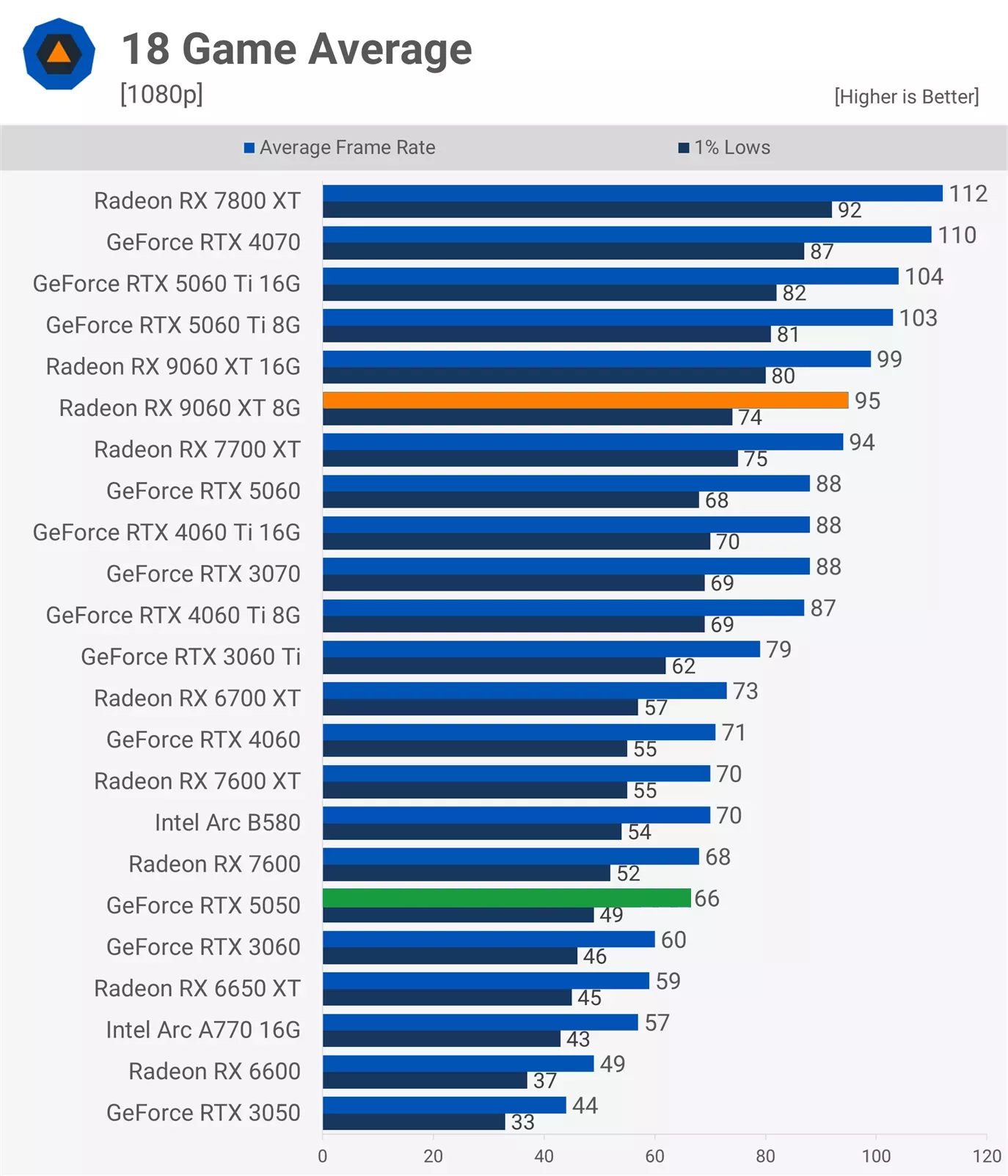
There was no point in buying the RTX 5050. Worse still, AMD's Radeon RX 9060 XT 8GB dipped down to $250 at one point and, for several months afterward, could be had for $270 – a mere 8% premium for around 45% more performance on average.

It's a shame, because we could almost give Nvidia a pass on the 8GB VRAM choice with this product. We still don't think any current-gen discrete GPU should ship with just 8GB of VRAM, but if any model were going to do it, it should have been the entry-level option. The RTX 5050 also had a unique product name – there wasn't a 16GB version selling under the same branding for a small premium.
| RTX 5050 | RTX 5060 | RTX 4060 | RTX 5060 Ti | |
|---|---|---|---|---|
| Price MSRP | $250 | $300 | $380 / $430 | |
| Release Date | July 1, 2025 | May 19, 2025 | June 29, 2023 | April 16, 2025 |
| Process | TSMC 4N | |||
| Die Size (mm²) | 149 mm² | 181 mm² | 158.7 mm² | 181 mm² |
| Core Config | 2560 : 80 : 32 | 3840 : 120 : 48 | 3072 : 96 : 48 | 4608 : 141 : 48 |
| L2 Cache (MB) | 32 MB | 24 MB | 32 MB | |
| GPU Boost Clock | 2572 MHz | 2497 MHz | 2460 MHz | 2572 MHz |
| Memory Capacity | 8GB | 8GB / 16GB | ||
| Memory Speed | 20 Gbps | 28 Gbps | 17 Gbps | 28 Gbps |
| Memory Type | GDDR6 | GDDR7 | GDDR6 | GDDR7 |
| Bus Type / Bandwidth | 128-bit , 320 GB/s | 128-bit , 448 GB/s | 128-bit , 272 GB/s | 128-bit , 448 GB/s |
| PCIe Bus Interface | PCIe 5.0 x8 | PCIe 4.0 x8 | PCIe 5.0 x8 | |
| Total Board Power | 130 W | 150 W | 115 W | 180 W |
At the end of the day, Nvidia simply cut the RTX 5050 down far too much. The tiny 149 mm² die featured just 2,560 CUDA cores – 33% fewer than the RTX 5060 – along with nearly a 30% reduction in memory bandwidth. As a result, it somehow managed to be slower than the previous-gen RTX 4060, as well as the Radeon RX 7600, a GPU that often sold for $250 over a year before the RTX 5050 launched.
Nvidia GeForce RTX 5080

Moving away from the entry level, we had a high-end GPU that was woefully under-equipped: the GeForce RTX 5080. The gap between the RTX 5080 and RTX 5090 was massive, and this was clearly by design. Nvidia had completed its product stack shuffle to justify its extreme flagship GPUs, and we'd argue they overcorrected.
The RTX 5080 packed half as many cores, nearly half the memory bandwidth, and – most shockingly – half the VRAM of the RTX 5090. Now, the 32GB strapped onto the RTX 5090 is overkill for gaming and likely won't be fully utilized during the realistic lifespan of that product, though we could be wrong. What we're not wrong about is the RTX 5080 lacking sufficient VRAM. Just 16GB on an 80-class GeForce GPU is criminal, especially with a $1,000 asking price.
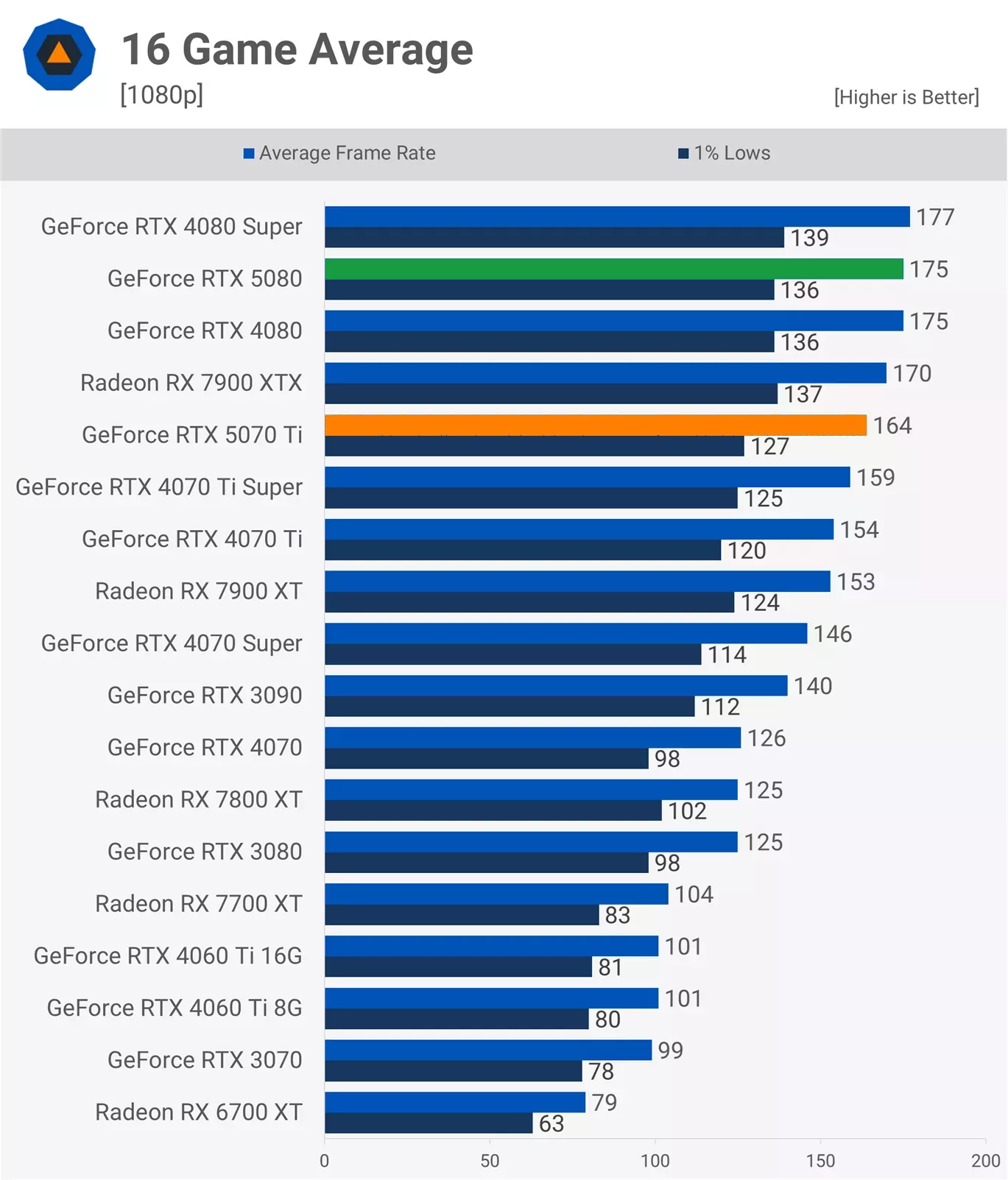
What really made the RTX 5080 look silly, though, was Nvidia's own GeForce RTX 5070 Ti. It launched at a 25% lower price while being just 13% slower on average in our testing, and both models featured the same 16GB VRAM capacity.

Had the RTX 5080 included at least 20GB of VRAM, it would have done a far better job justifying its price. As we see in 2025, 16GB of VRAM should really be the minimum configuration for a discrete GPU – and the reason for that will become very clear once the next-generation consoles arrive.
Making the RTX 5080 even harder to justify is its real-world retail pricing. The $1,000 MSRP already doesn't make sense for such an underwhelming product, yet most models have remained well above MSRP. That's largely because Nvidia faces no competition at this performance tier. The same applies to the RTX 5090, which has also spent most of its shelf life priced well above MSRP.

We're not saying there shouldn't be an RTX 5080. What we are saying is that what we should have gotten was an RTX 5080 that was at least 15% faster, with at least 20GB of VRAM, for the same $1,000. That would have given it a similar cost-per-frame to the RTX 5070 Ti and actually justified the extra spend.
But without competition, Nvidia clearly felt this wasn't necessary – and as a result, we ended up with the most underwhelming RTX 80-series product to date.
How Not to Launch a GPU
The worst releases of this generation were, without question, the 8GB versions of the RTX 5060 Ti and Radeon RX 9060 XT. These cards never should have existed. The RTX 5060 and RTX 5050 also landed as poor value propositions, but had Nvidia not attempted to block reviews, they likely would have been far better received by both the PC hardware community and gamers alike.

AMD copying Nvidia's mistakes with the 8GB RX 9060 XT really does beggar belief. This is, after all, the same company that decided to shift a still-shipping GPU architecture into maintenance mode and call it a reasonable strategy.
Overall, the latest generation of GPUs from AMD and Nvidia has been very mixed. There are some decent options buried among the garbage we just went over. As always, let us know what you think about this generation – we'll be reading all your comments.