72 sticks of server RAM were headed for the trash. They're now worth $20,000

Skye Jacobs

Posts: 1,917   +58
Staff
In context: A batch of server memory slated for disposal instead ended up in private hands, highlighting how enterprise hardware is often handled once it's written off. The situation began in 2024 during a server upgrade at an unnamed company. New systems arrived with higher-capacity memory already installed, leaving the existing modules – 72 sticks of registered DDR4 RAM – unused. They were set aside for disposal, but an employee retrieved them before they were scrapped and later gave them to a family member, who shared the story online.
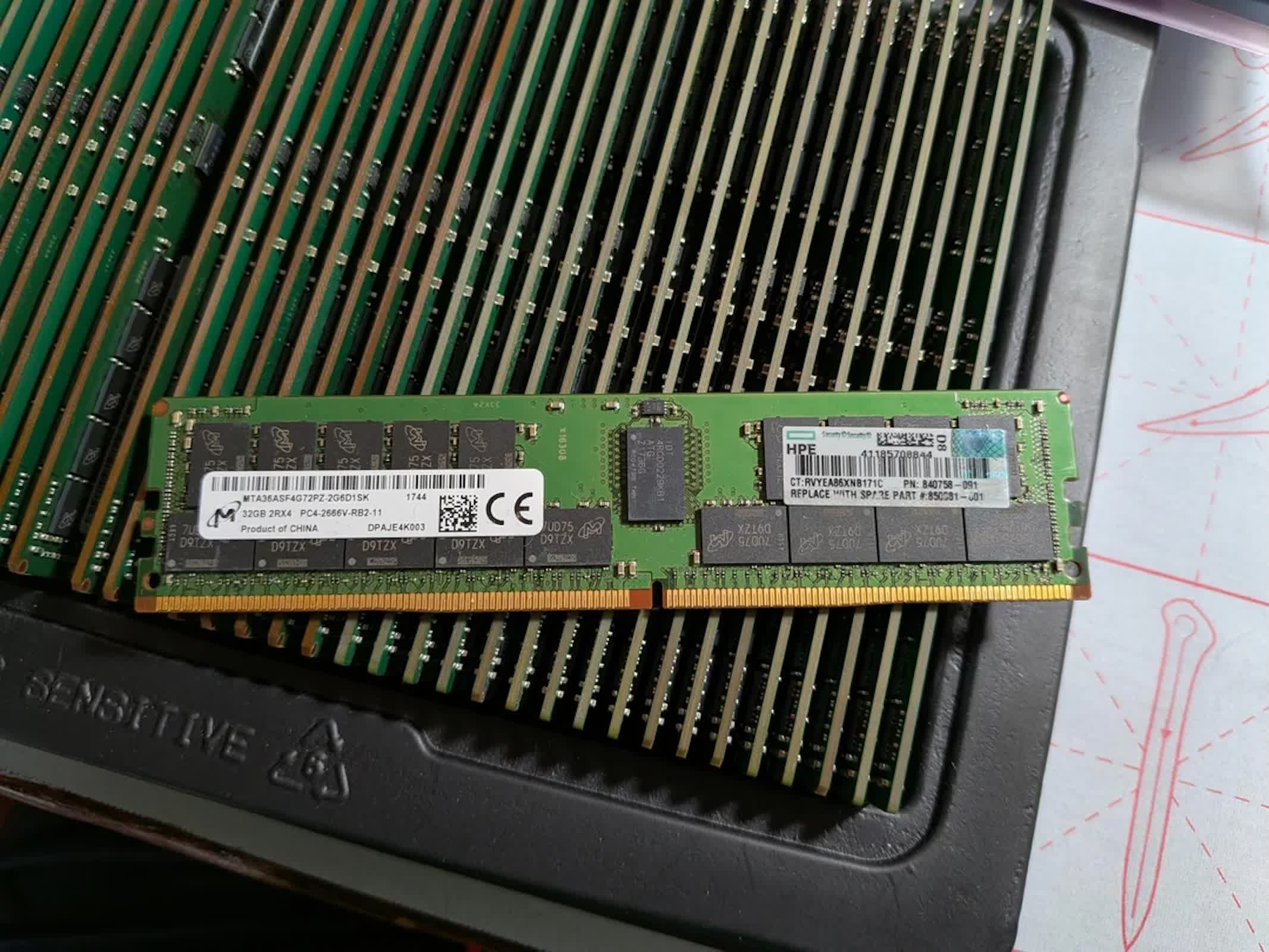
The story began in 2024, when an unnamed company completed a server upgrade. The incoming systems came with higher-capacity memory already installed, rendering the existing modules redundant. 72 sticks of registered DDR4 RAM were set aside for disposal. Before they were scrapped, an employee took them. They eventually passed to a family member, who posted about it online.

At current market prices, the haul looks significant. Comparable SK hynix registered DDR4 modules currently sell for about $287.95 each, putting the total value at more than $20,000. But that number tells only part of the story.

When the modules were pulled from service, they were worth far less. Price-tracking data shows they averaged around $35 in 2024, dropping further to roughly $29.02 by mid-2025. The sharp rise since then reflects a broader tightening of DRAM supply, driven largely by surging demand for AI infrastructure. Components that were once unremarkable line items in a server refresh budget have quietly become considerably more valuable.

That shift, however, rarely registers inside corporate IT departments. Once equipment is fully depreciated, accounting conventions render it essentially worthless on paper. The practical calculus reinforces that view: testing, storing, or finding uses for older hardware takes time and resources that often exceed what the parts are actually worth. Working components get discarded as a matter of routine.

Posts from the pcmasterrace
community on Reddit

A commenter on the original Reddit post offered a blunt description of how that thinking takes hold. "In many places where I worked, the sysadmins in charge of the servers were not hardware enthusiasts, had never built their own machines, and did not care what things cost as long as the infrastructure kept running," wrote ArcticCelt. "They constantly did things like that, throwing away perfectly good equipment instead of keeping it for test labs or anything useful. It was their budget to spend, and they simply did not give -- because no one above them understood how any of it worked."

The rescued memory, though, is of limited use to most people who might come across it. Registered DIMMs are purpose-built for server environments that demand stability across large memory pools. They depend on error correction and buffering features that consumer hardware does not support. Standard desktop motherboards will not recognize them. Making use of them requires a platform built around a server-class processor, an Intel Xeon or AMD Epyc.

That narrows the options considerably. A gaming rig or everyday workstation is out. The most practical path is resale, aimed at buyers running home labs, small data center setups, or operations still dependent on older enterprise equipment.

Even then, the price would land well below current retail. Used server memory carries the usual discounts: age, no certification, unknown service history. Still, the total return could approach what a high-end consumer PC costs new.

None of this is unusual. In enterprise environments, hardware lifecycles are governed by upgrade schedules, budget cycles, and depreciation tables – not by whether something still works. Fully functional components routinely become surplus. Many end up as e-waste.

Permalink to story:

 
So much for private sector efficency! Such wastefulness is unacceptable in ordinary times not just in high demand eras such as now.
 
The "IT" (I use that term lightly) guy at place I work he sometimes pulls the CPU, heatsink and RAM from old computers. Other times he's just too lazy to do so and dumps them.

His response to me one day when I asked if I could get some more RAM for my old computer, he said, "I don't understand RAM. I just threw in a bunch of extra sticks." and that is how I went from 4GB of RAM to 11GB of mis-matched RAM. Whatever, the system ran slightly better than it did before due to low RAM so I just accepted it and went on with my work.
 
Last edited:
So much for private sector efficency! Such wastefulness is unacceptable in ordinary times not just in high demand eras such as now.
Once hardware is out of support, any medium or large business is going to upgrade to newer supported hardware. "Run it till it dies" may save on some resources but is not confusing to good business or security practices.
 
Once hardware is out of support, any medium or large business is going to upgrade to newer supported hardware. "Run it till it dies" may save on some resources but is not confusing to good business or security practices.
The article was not talking about out of support hardware and neither was I.

No one is suggesting "run it until it dies"?, I certainly did not, many of us will have seen companies and organisation dispose of perfectly viable equipment into landfill as a tax right off or as part of an upgrade because of a budget underspend, that could be repurposed for use by others.

This is about still viable hardware being diverted from landfill/dumping of Ewaste in the global south. When there is no further utility then recycling of as much raw materials from decommissioned equipment should be undertaken.

Instead of dumping still useful hardware such as that described in the article into E waste, it could be donated / sold to the 3rd sector to be repurposed for public benefit.

Perhaps we need to modify the business tax system/accounting depreciation rules so that companies that enable repurposing of still useful hardware are rewarded, while those who just dump viable hardware as e waste are penalised.
 
The "IT" (I use that term lightly) guy ..... I asked if I could get some more RAM for my old computer, he said, "I don't understand RAM

At least you have an IT guy lol. We have no onsite IT, so its always corporate IT and remote.

Every IT issue I have always goes through IT's lowest rung guy first. I'm a firmware engineer and have been a PC enthusiast since I was like 7yo. Having to explain that I know exactly what the problem is and the solution, and yet still have to go through this guy's 30-40min stumbling through written procedures is so demoralizing. My laptop battery just died. If its installed in my laptop, its a dead brick. If its removed and running off external power only, it works. In my ticket I wrote out all the things I tried and observed. Still had to go through 30min his silly questions of things I've already checked that are completely obvious.

The guy has zero ability to creatively troubleshoot anything not something in his little manual. If its ever a software issue though, he's finally just accepted me telling him "Type in your admin password on the shared desktop and just let me drive it please" - So at least we're progressing there lol. He's been with us for over a decade, so I can only think he's still here because someone has be on the front line to handle all the inane little stuff.
 
The article was not talking about out of support hardware and neither was I.

No one is suggesting "run it until it dies"?, I certainly did not, many of us will have seen companies and organisation dispose of perfectly viable equipment into landfill as a tax right off or as part of an upgrade because of a budget underspend, that could be repurposed for use by others.

This is about still viable hardware being diverted from landfill/dumping of Ewaste in the global south. When there is no further utility then recycling of as much raw materials from decommissioned equipment should be undertaken.

Instead of dumping still useful hardware such as that described in the article into E waste, it could be donated / sold to the 3rd sector to be repurposed for public benefit.

Perhaps we need to modify the business tax system/accounting depreciation rules so that companies that enable repurposing of still useful hardware are rewarded, while those who just dump viable hardware as e waste are penalised.
DDR5 has been around for years. Longer in the server space then in the desktop space. This article is about DDR4 from servers.

You immediately assumed that is is "waste" when the servers they went into, at minimum, were 5 years old. Guess how long support contracts are for servers? You also assumed immediately that this process is inefficient, when it would be far less efficient for every corporation to have dedicated teams trying to resell hardware, as opposed to letting E waste recycling groups do it for them, which is what happens now.
 
DDR5 has been around for years. Longer in the server space then in the desktop space. This article is about DDR4 from servers.

You immediately assumed that is is "waste" when the servers they went into, at minimum, were 5 years old. Guess how long support contracts are for servers? You also assumed immediately that this process is inefficient, when it would be far less efficient for every corporation to have dedicated teams trying to resell hardware, as opposed to letting E waste recycling groups do it for them, which is what happens now.
I did not mentioned DDR 5.

The article says at the bottom

"In enterprise environments, hardware lifecycles are governed by upgrade schedules, budget cycles, and depreciation tables – not by whether something still works. Fully functional components routinely become surplus. Many end up as e-waste."

I suggested using the business tax system to encourage companies to find a way to avoid as much as possible creating e waste.

I was not suggesting that every company set up a resale operation for this purpose, a hallucination on your part?

Here in Cumbria we have a non profit that reconditions white goods, PCs (often donated by companies such as the Sellafield Nuclear site) for resale, e waste can be dropped off at local authority waste collections sites. Until the pandemic my landlord had furniture projects that resold furniture, office equipment, they did tenant house clearances and anything that could be repurposed, resold was available for cheap, last I heard similar projects have popped up post pandemic to replicate the service they provided.

When I moved into my home in 2009, I had very little, and was able to furnish the house for a lot less than if I had to pay for everything brand new.

Another example

One of my neighbours runs a repaint scheme, where excess paint stock from the previous years range is resold well below retail instead of being dumped into landfills, were it would pollute the local water table. Its been set up now as a non profit and has become part of the heart of our community. They are now expanding into clothes swap projects, futniture recycling, if big paint companies like Dulux which are involved in repaint schemes across the UK, why cant tech companies?

Why are you opposed to creating a circular economy that reuses and recycles finite resources where possible?
 
So much for private sector efficency! Such wastefulness is unacceptable in ordinary times not just in high demand eras
In ordinary times, no business would buy used ram for servers.

I suggested using the business tax system to encourage companies to find a way
Instead of attempting to force your own ideals on other people, why not stick with the free market system that's worked so well in the past? In general, when recycling makes sense, it's profitable to perform, and the market will do it anyway. Mandated recycling is good for virtue-signaling, but very often worse for the environment than simply buying new.
 
Humanity, mostly in the west, has been a "disposable" society for a LONG time. Explains why landfills fill up so fast.
I remember seeing a video from California, where a garbage truck is parked at one of those plastic, glass, paper recycle trash bins. What's he do? Dumps it ALL into the back of his trash truck (trash truck & bins had the same logo). People think they are saving the planet when they use those, but it's just virtual signaling.
 
I've worked in industry for 40 years. During that time I found this all to be very factual. We had no regard for completely depreciated equipment of any kind, it was considered trash once out of service.

I was able to scavenge a ton of stuff "intended for disposal" over the years and resell it. CPUs, memory, mobos, etc. all the way to a working electron microscope - which they told me to dismantle and put in the trash. The microscope had thousands in working parts! It took me awhile to sell that highly specialized stuff, but I did and made money from "company trash". FOOLS, I even told them what I was doing, they didn't care!
 
So much for private sector efficency! Such wastefulness is unacceptable in ordinary times not just in high demand eras such as now.

It's not that simple. There can be tax repercussions if the company were to sell that RAM, which could possibly cost more than it is worth.

First, the company has probably depreciated that RAM to zero. If they sell it, they will have to report the revenue as income. That's a nuisance.

But it can get far worse. If the company took any form of accelerated depreciation or investment tax credits when they bought it, and it has not yet reached the end of its STANDARD depreciation (not accelerated), which is five years on most computer equipment, they would have to do the calculations to recapture the excess depreciation that they wrote off in previous tax returns, forcing their tax returns for those years to be redone. If they sell the memory for more than its residual value in that calculation, they will still have to pay tax on that. And they might have to return some portion of any tax credits that were associated with the purchase.

The company is likely to come out better by donating it to a suitable nonprofit. It will also make a lot less work for their accountants. The nonprofit can then either use the RAM for its internal operations, or allow people to buy it in exchange for donations. In the latter case, the buyers will not get a tax deduction, as they are receiving something of value commensurate with the donation.

Of course, companies DO sell off old equipment, typically by handing an entire lot of five to seven year old computers off to a refurbishing company. And they presumably do pay taxes on whatever the refurbisher pays. But at least that's all one big transaction, not a bunch of little ones for RAM sticks. Or they may have leased rather than bought the computers, and then simply walk away from it when the lease expires.
 
Last edited:
Back