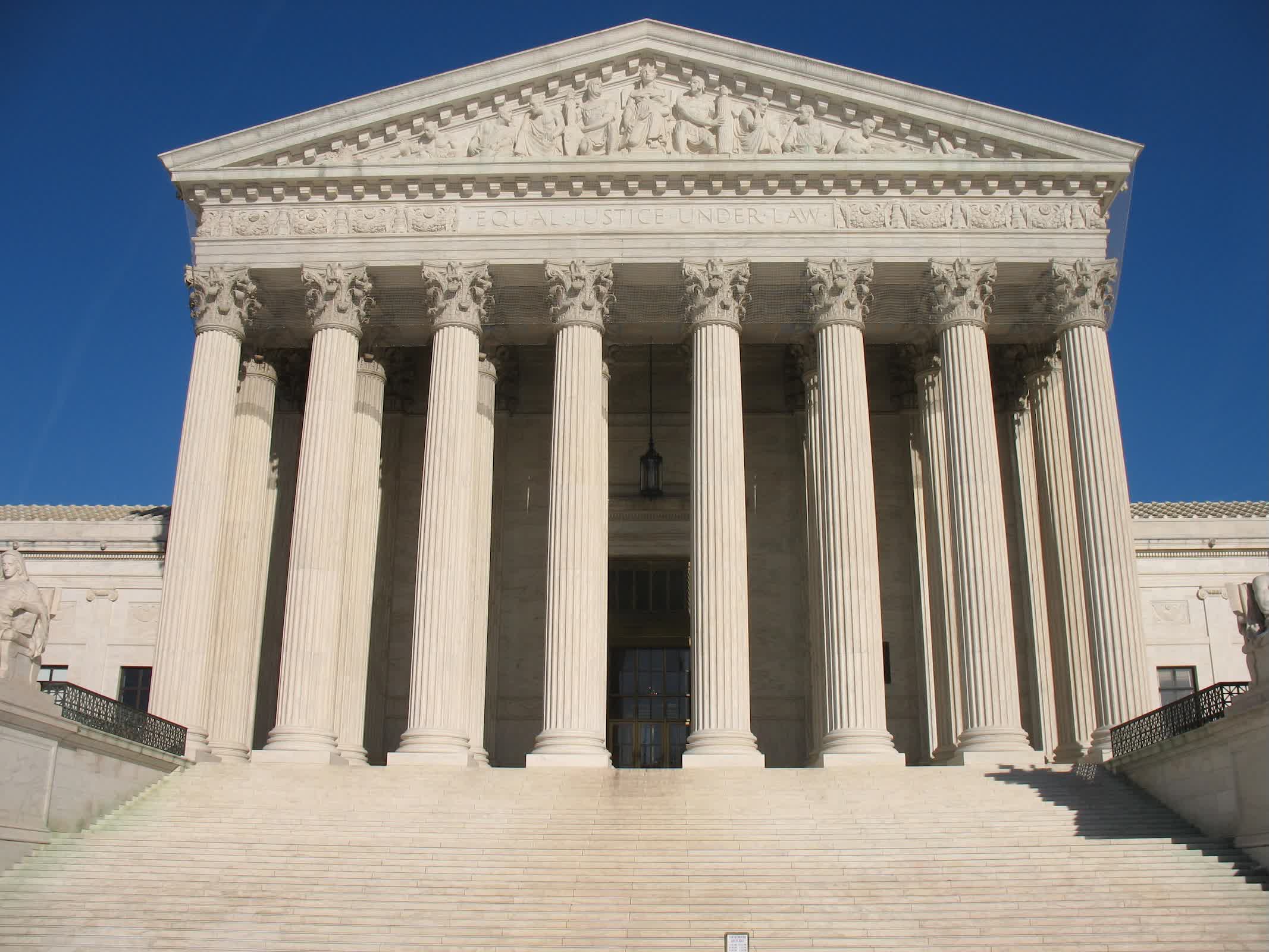
Why it matters: Geofence warrants, which let police run reverse searches on devices near a crime scene, are now before the Supreme Court in a case that could reshape how investigators tap the vast location data held by commercial tech platforms to track people. The justices must decide whether using Google "location history" as the basis is an unreasonable search under the Fourth Amendment and, if it is, what limits courts should place on these warrants.
The case stems from a 2019 armed robbery at Call Federal Credit Union near Richmond, Va., where a gunman took $195,000 from the vault before police arrived. When conventional investigative work stalled after reviewing security video and interviewing witnesses, a detective turned to a geofence warrant, asking Google to turn over location data for all devices that had been near the bank in roughly a one-hour window around the time of the crime. That data trail ultimately led investigators to Okello T. Chatrie, now 31, whose movements were reconstructed from his Google location history and later used to secure his conviction.
At issue in the Supreme Court argument is not whether police can ever use such data – the government did obtain a warrant in Chatrie's case – but whether the warrant's scope and structure met Fourth Amendment standards, given how much location data modern smartphones send to services like Google Maps.
In briefs and oral argument, Chatrie's lawyer, Adam G. Unikowsky, argued that geofence warrants resemble the general warrants the Fourth Amendment was meant to bar, saying they allow the government to "search first and develop suspicions later." He argued that a user's location history is private data kept in a password-protected account, and that sharing it with Google does not amount to consent to share it with police.
Inside the courtroom, questions from the bench cut across the court's usual ideological blocs. Justice Neil M. Gorsuch and Justice Sonia Sotomayor pressed the government's lawyer on why the theory used to justify access to location history would not also open the door to bulk access to emails, photos, or documents stored with a cloud provider.
Other justices, including Samuel A. Alito Jr. and Brett M. Kavanaugh, focused on how the ruling might affect police investigations. Justice Kavanaugh asked Chatrie's lawyer to explain how the detective's use of Google's tools in this investigation amounted to "bad police work," suggesting that the officer had followed steps that "should be applauded."

Image credit: Police Training Update
The Solicitor General's Office argued that Chatrie had voluntarily shared his data with Google – akin, in its view, to bank or phone records held by a business – and that he had chosen to keep his phone with him during the robbery, as surveillance video showed.
Chief Justice John G. Roberts Jr. sounded sympathetic to arguments from both sides. In an exchange with Chatrie's lawyer, he suggested that users can simply disable tracking – "If you don't want the government to have your location history, you just flip that off. What's the issue?" – but later pressed the government about mass identification of people at "a particular church, a particular political organization," and asked what would prevent that from becoming a problem.
Technically, the case sits on top of Google's "location history" architecture, which for years collected coordinates roughly every two minutes for users who opted in and stored that information in the cloud. That design made geofence warrants possible: police draw a virtual boundary around a crime scene and a time window; Google then queries its data, first producing anonymized device IDs and later, through a multi-step narrowing process, more specific information about selected devices.
Lower courts have been split on how to treat this kind of search. In Chatrie's case, a federal judge concluded that the geofence warrant violated the Fourth Amendment's probable cause and particularity requirements but allowed the evidence anyway, citing the officer's good-faith reliance on then-existing law.
A divided panel of the US Court of Appeals for the Fourth Circuit later upheld the search on different grounds, holding that Chatrie lacked a reasonable expectation of privacy in two hours of location history he shared with Google, and the full court deadlocked 7 – 7, leaving his conviction intact.
The Supreme Court last addressed cellphone location data in 2018, in Carpenter v. United States, ruling that police generally need a warrant to obtain historical cell-tower records and signaling that third-party ownership of data is not, by itself, enough to strip it of constitutional protection.

The court has also curbed warrantless GPS tracking and required warrants for searches of individual phones. In Monday's argument, several justices indicated that geofence access to location history likely belongs on the "warrant required" side of the Carpenter line and that courts should spell out rules to keep such warrants narrow.
The technical landscape around geofence data is shifting even as the court deliberates. Google says it stopped responding to geofence warrants last year because it changed its storage model, moving location history off centralized servers and onto individual user devices. The company now says it no longer holds the aggregate data that once allowed it to serve as a single point of collection for geofence requests.
Law enforcement agencies, meanwhile, have begun sending similar requests to other large tech providers, including Apple, Lyft, Snapchat, Uber, Microsoft, and Yahoo, and continue to lean on other data-driven tools such as automated license plate readers and AI-powered genealogy systems in major cases.
Any rule the court sets for geofence warrants will almost certainly extend beyond a single Google feature to other location-aware apps and cloud services that record where people go.


