AI may be ready for the mainstream, the economics aren't

Bob O'Donnell

Posts: 136   +2
Staff member

As 2026 gets underway, it's clear that AI's momentum hasn't stalled in the least. If anything, it's picking up speed, especially with the recent surge of interest in AI-powered agents, often referred to as agentic AI, that are beginning to reshape how the technology is used.

Bob O'Donnell is the founder and chief analyst of TECHnalysis Research, LLC a technology consulting firm that provides strategic consulting and market research services to the technology industry and professional financial community. You can follow him on Twitter

Capital spending on AI projects is surging, not just among the largest hyperscalers but across businesses of nearly every size and industry. For companies supplying the hardware and software that underpin AI systems, that investment wave has largely been good news. Yes, we've seen (and will undoubtedly continue to see) stock market bumps along the way, but there's no denying that the bigger picture trajectory continues to be incredibly positive.

At the same time, businesses and consumers are still working out how they actually want to use these tools. Enough compelling results have emerged to encourage experimentation, and there's real excitement about what might be possible next – even if that excitement is often tempered by a sense of unease about what widespread AI adoption could mean.

"Tokens" may be a convenient unit of measurement, but they remain an awkward stand-in for real customer value.

Despite all of this progress, one critical piece is still missing: business models that make economic sense and allow AI developers to sustain themselves long enough to deliver lasting impact. The tension is easy to describe, if difficult to resolve. The dilemma is straightforward, but not simple: customers want predictable spending and clear business value, while AI suppliers face variable – and in many cases rising – costs to deliver increasingly sophisticated capabilities. "Tokens" may be a convenient unit of measurement, but they remain an awkward stand-in for real customer value.

It's worth noting that the AI ecosystem is far from uniform. Some companies driving major advances are financially healthy. Many others, however, remain stuck in a cycle of heavy investment with little revenue to show for it. In some cases, their long-term viability appears to rest more on optimism than on durable financial fundamentals.

That imbalance has fueled growing fear of an AI bubble or crash because of the uncertainty around how these future plans translate into durable revenue. While some of the fallout has been visible for a while, those concerns now seem to be spreading across the broader tech industry (and even into the global economy) in ways that aren't always rational. Whether the fears are justified or not, their impact is real, and it's unlikely we've seen the last reaction driven by those doubts.

Because of all this, I remain convinced that 2026 is the year we need to start seeing more realistic types of business models coming to the AI side of tech industry. While the modern oracle of AI, Nvidia CEO Jensen Huang, loves to talk about how generating more tokens leads directly to generating more dollars, this argument feels less convincing than it used to. Building complete, easy-to-deploy AI solutions for enterprises while also figuring out how to monetize consumers who are happy to consume massive amounts of AI output for free is pushing early monetization strategies to their limits.

While the modern oracle of AI, Nvidia CEO Jensen Huang, loves to talk about how generating more tokens leads directly to generating more dollars, this argument feels less convincing than it used to.

Some experiments are underway, though their effectiveness remains uncertain. OpenAI's plan to introduce ads into ChatGPT has already faced skepticism, along with some pointed (and humorous, watch below) responses from competitors like Anthropic. Enterprise-focused offerings appear more straightforward, yet even there the shift toward outcomes-based pricing instead of model access raises difficult questions. Paying for results sounds appealing until issues of measurement, accountability, and risk enter the picture.

Plus, while there's been a lot of recognition around the largest, multi-purpose frontier models, some of the most dramatic success has been with smaller companies creating more targeted models that are optimized for specific industries and applications. In those cases, the value proposition is often clearer, and clarity matters when budgets come under scrutiny.

Per-seat pricing models, such as those used for Microsoft's Copilot, initially looked promising. Over time, however, concerns have emerged around uneven usage: heavy adoption by some employees and minimal engagement by others. Metered usage could help address that imbalance, but implementing it effectively is still an open question. Compounding the issue is the lack of meaningful training in many organizations, which significantly limits how these tools are used. There's also a quiet irony at play: companies deploying AI to reduce headcount may ultimately shrink the very pool of seats they're being asked to pay for.

Finally, one other issue that needs to be addressed is trust, but not necessarily in the way you may first think.

Trust in output quality, governance, safety, and security is essential, but so is trust in the longevity of the vendors themselves. Given how potentially impactful and far-reaching the influence of AI tools can be, if a company who wants to deploy a cool new AI technology can't be certain that the supplier of that technology is going to be around for a while, they simply won't do it. In that sense, financial stability becomes a prerequisite for trust.

There's little doubt that 2026 will serve as the backdrop for a fascinating period of discovery, as organizations and individuals start to discover more of the "art of the possible" when it comes to AI and agents. But for these developments to move beyond trendy hype and tech industry navel gazing and reach mainstream businesses and consumers, there's got to be more validity to the business propositions being put forward.

There are already enough technical, social, and even political battles to overcome when it comes to AI adoption. Building a solid base of business viability is going to be essential if the next step in AI industry evolution is going to occur.

Permalink to story:

 
Sure they are. It's new. It's hot. Somehow some corporate buddy will know how to make $ of off it and we won't like it. Remember when the internet was search yourself? and it took time and what was found was valuable. Now AI feeds you whatever and it may all be good but it ain't. The shake out is coming but no one knows when. I do know that the Trump administration is all in and the folk he has working on it are business people not academics
 
The $20 and $200/month plans are just to drive adoption.

The real money is in enterprise. Replace workers and split their compensation with the company. That’s the trillion dollar plan. So far it’s not ready to replace whole workers.
 
The $20 and $200/month plans are just to drive adoption.

The real money is in enterprise. Replace workers and split their compensation with the company. That’s the trillion dollar plan. So far it’s not ready to replace whole workers.
In order to replace workers AI would have to have at least the same cognitive and mechanical capabilities as humans, AND provide that at a lower cost than what employing humans costs. None of these is a given or does appear attainable in the long (but realistic, like less than decades or centuries) term.
 
Another day, another paid promotion.

If this tech is so amazing, where are the demonstrations of practical use cases? All we get are these writeups from CEO or investor types exploring everything else but the thing this tech can actually do.

This whole hype is driven by these execs and CEOs far removed from the actual work people below them do and they have no idea what the actual day to day struggles are. It’s like they invented the wheel, but can not imagine the cart because its not them working in the fields.
 
In order to replace workers AI would have to have at least the same cognitive and mechanical capabilities as humans, AND provide that at a lower cost than what employing humans costs. None of these is a given or does appear attainable in the long (but realistic, like less than decades or centuries) term.
Depends on the worker. For example, most customer service phone reps are replaceable simply because their job is to follow if then flows and read scripts to people as essentially an interactive FAQ for common customer issues. AI can do that today.

But yes, the average administrative staff or office worker or middle manager won't be eliminated. The odds are that AI will establish itself as good enough at specific things that companies can hire AI for that and need say 10% less corporate HQ employees. So HR still exists but now the "benefits person" is an AI bot that understands how to answer any employee questions about their insurance. And a company won't blink at paying $30K/year for that AI bot because it's still half the cost of a person.
 
And a company won't blink at paying $30K/year for that AI bot because it's still half the cost of a person.
That equation is not that evident, considering that in general companies have superior bargaining powers against human workforce (unions aside) when dealing with the latter, but the power structure changes when engaging with a trillion dollar AI companies. A single customer phone rep can not force his will and conditions onto a company, but a large AI company can do that with virtually all other companies.

So, the cost-benefit ratio (well, at least in the broader sense) between the two alternatives is not just a pure money thing.
 
That equation is not that evident, considering that in general companies have superior bargaining powers against human workforce (unions aside) when dealing with the latter, but the power structure changes when engaging with a trillion dollar AI companies. A single customer phone rep can not force his will and conditions onto a company, but a large AI company can do that with virtually all other companies.

So, the cost-benefit ratio (well, at least in the broader sense) between the two alternatives is not just a pure money thing.
Negotiating power is immaterial to my argument which is simple voluntary exchange.

AI companies want to offer replacement workers for enough of a savings that companies will buy them because that is worth tens of thousands of dollars / worker whereas a productivity/efficiency tool for your existing employees is worth hundreds of dollars / worker.

Negotiations may change the savings/profit split on the margins but it doesn't change the fundamental idea. And if AI companies changed the rates later the company simply cancels the contract and switched AI companies or rehires people.
 
Negotiating power is immaterial to my argument which is simple voluntary exchange.
Yeah, it's absolute not immaterial. Neither in the strictest, nor in the wider sense of this word.

The party that can force its will onto the other is the one that can profit off the agreement, and the other is merely surviving. That's why it's currently companies that make profit and why employees are merely surviving, mostly just so they can make even more profit for companies down the road.

However, if you replace human workers with AI, the relation changes, as explained above. It will now be the giant AI companies that will make all the profit, and the companies using their services (instead of employing human workers) will merely survive, at best, just so they can make even more profit for the AI companies down the road.

That's why it's not as simple as you might think. Then again, a lot of people and companies will be just as simple in their thinking as you do, and not realize they're being entrapped. We have seen that with social media, we've seen that with platforming, we've seen that with modern politics, which every company CEO and owner thought would benefit them, and it possibly did in the short term, but in long term and in the end they just handed control and power over themselves over to a few guys a lot richer than they were.

People are just generally dumb, and are easily taken advantage of. And AI is just the next iteration that enables grifting on them.
 
They have to cover costs that are much higher than those of search engines. Meanwhile, robots aren't consumers, so they'll also have to figure out what new jobs to give to displaced workers as the latter also turn out to be their customers.
 
Yeah, it's absolute not immaterial. Neither in the strictest, nor in the wider sense of this word.

The party that can force its will onto the other is the one that can profit off the agreement, and the other is merely surviving. That's why it's currently companies that make profit and why employees are merely surviving, mostly just so they can make even more profit for companies down the road.

However, if you replace human workers with AI, the relation changes, as explained above. It will now be the giant AI companies that will make all the profit, and the companies using their services (instead of employing human workers) will merely survive, at best, just so they can make even more profit for the AI companies down the road.

That's why it's not as simple as you might think. Then again, a lot of people and companies will be just as simple in their thinking as you do, and not realize they're being entrapped. We have seen that with social media, we've seen that with platforming, we've seen that with modern politics, which every company CEO and owner thought would benefit them, and it possibly did in the short term, but in long term and in the end they just handed control and power over themselves over to a few guys a lot richer than they were.

People are just generally dumb, and are easily taken advantage of. And AI is just the next iteration that enables grifting on them.
Yes, if you make up a scenario where one party has unlimited power over the other, than that party has unlimited power.

Luckily, most of the democratic world is not so dire.

The best way to "keep the profit" is to become an entrepreneur rather than an employee. But one has to take on additional risk to do that, which most people don't want to do. They want to come to work, make their widget, go home at 5, and get paid regardless of what happens with the product or company. But they will often complain about how unfair things are, despite it being easier to start a business than ever before.
 
Yes, if you make up a scenario where one party has unlimited power over the other, than that party has unlimited power.
I never used the word "unlimited" in any of my comments. And you don't need unlimited power to hhave the upper hand anyway.

But I understand at this point even you realized you can't argue with what I said, so now you're arguing with stuff you just made up. Aka the straw man fallacy.
 
If you think AI is going away, it's not. Here an example.

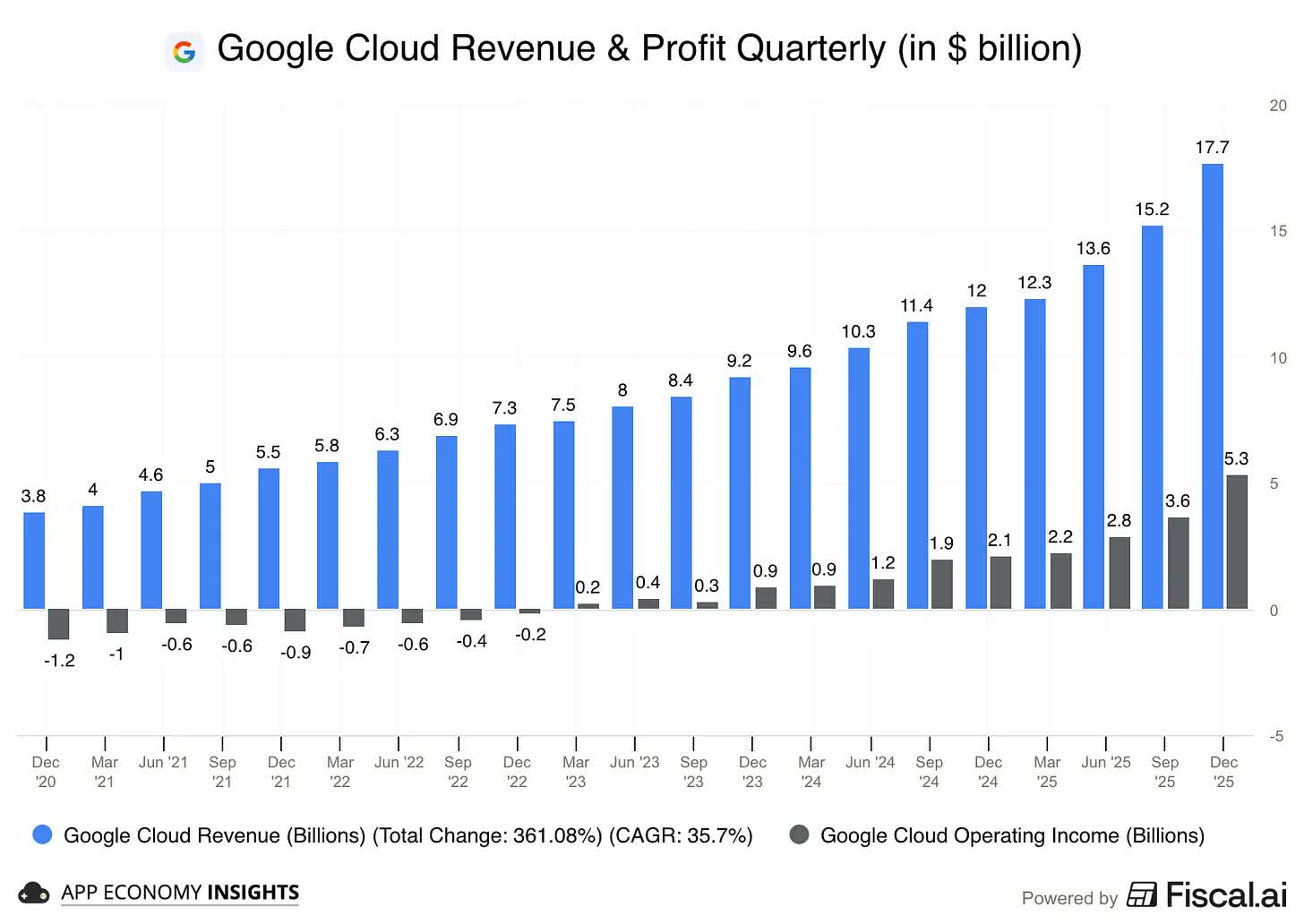
As Google doubles down on AI spending, Gemini delivers a breakout quarter. Alphabet's Gemini system has been a game-changer for the company, delivering tangible business results across search, cloud computing, and video streaming. The integration of Gemini into Google's core products has led to a 17% growth in Search revenue to $63 billion for the quarter. YouTube's revenue also increased by 9% to $11.4 billion, contributing to the service surpassing $60 billion in combined ad and subscription income annually. The Gemini App has crossed 750 million monthly active users, and the company plans to double its capital spending on AI infrastructure in 2026 to between $175 billion and $185 billion.

Plus, the Trump Administration is assisting with the growth.
 
For one, all the data you mentioned in themselves only indicate correlation, not causation. Google has been actually increasing their revenue like forever, even when there was no AI at all. So attributing Google's growth to AI is a logical fallacy begin with.

Also, as the dollar loses value (and it did lose >15% since Trump came into office again), all those apparent gains are non-existent at best, and losses at worst. Like that 9% increase in YouTube revenue expressed in USD... ?.That's actually a decrease of -6% in actual value/money made, because of how much less 1 dollar is worth now than it was a year ago.

And finally: with AI Google is killing its goose laying the golden eggs. Even if they'd actually make more money every quarter now with that (which they don't, see above!) they'd still lose a multiple of those gains in future years coming because of how AI affects the economy, especially the economy that Google operates in. With all their AI stuff they're killing the web that made them all that money, because they take all incentive from people to create and publish stuff, and the incentive from advertisers to spend money with them. Because AI creates an endless supply or advertising surface, and because AI as Google uses it just doesn't convert neither for advertisers, nor for publishers.

That's why AI will go away either way, even at Google. If not as a result of regulation and self-restraint, then because it kills the very host it feeds on. Hopefully it will be just the open web that falls prey to it, and not humanity as a whole. Which, unfortunately, is not a given at this point either.
 
I never used the word "unlimited" in any of my comments. And you don't need unlimited power to hhave the upper hand anyway.

But I understand at this point even you realized you can't argue with what I said, so now you're arguing with stuff you just made up. Aka the straw man fallacy.
It's funny that your response to my pointing out your straw man is claiming I'm using a straw man.
 
Back