AMD addresses AM5 socket burnout concerns after wave of Ryzen CPU failures

Skye Jacobs

Posts: 2,002   +58
Staff
Recap: AMD is addressing mounting concerns over socket burnouts tied to its AM5 platform after a spate of high-profile failures drew attention to certain third-party motherboards, particularly those made by Asrock. The company acknowledged that deviation from its recommended BIOS settings among some vendors has contributed to the problem, though the cause may be more complex than a single misstep in board tuning.
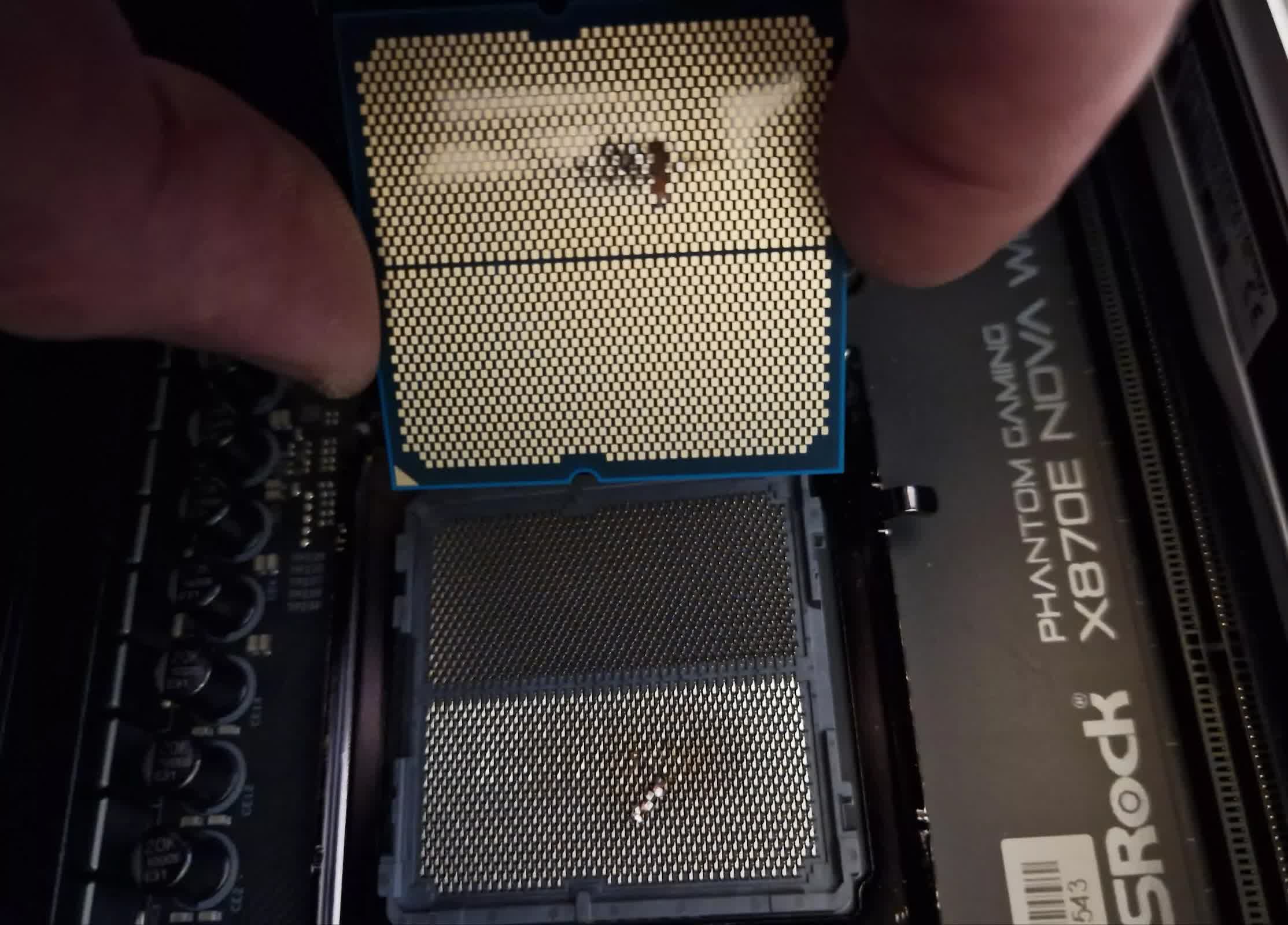
The controversy began earlier this year when users on Reddit began reporting failures of AMD's Ryzen 7 9800X3D processor. Many posts described catastrophic damage – sockets that had literally burned – with a disproportionate number of cases involving Asrock motherboards. The issue escalated to the point where Asrock's own forum moderators created a dedicated thread for tracking cases, noting a significant abnormality in the rate of incidents.

Asrock attempted fixes through successive BIOS updates, initially attributing the failures to memory compatibility. That explanation proved insufficient, and by late May the company released BIOS version 3.25, which included sweeping changes to Precision Boost Overdrive parameters. Those revisions adjusted values such as Electrical Design Current, Thermal Design Current, and "shadow voltages" to bring boards back within AMD's specifications. Reports of burnouts declined after the update, but some users have continued to voice concerns that the issue has not entirely disappeared.
In a recent exchange with QuasarZone, AMD executives David McAfee and Travis Kirsch outlined the company's position. "This issue arises because some ODM BIOSes do not adhere to AMD's recommended values," they said. "AMD's position is fundamentally to provide the highest quality products through thorough testing. We always recommend everyone update their motherboard BIOS to the latest version."

AMD's engineers emphasized that the company balances flexibility with reliability in its platform design. While many competing platforms restrict the number of motherboard and CPU combinations a user can choose, AMD supports broader options. That openness creates a wide range of potential configurations, which AMD described as introducing significant complexity for validation and troubleshooting. "While this is a complex issue, we are working closely with our partners to resolve issues and further develop the platform," the representatives told QuasarZone.

The latest guidance from AMD remains straightforward: users should update to the most recent BIOS whenever possible. While Asrock's May update appears to have mitigated most of the catastrophic failure conditions, the company and its partners continue to monitor reports that suggest a limited number of cases persist.

For now, AMD has not attributed the failures to its processors themselves but instead to how some third-party firmware settings exposed CPUs to voltages and power limits outside recommended specifications. It is still unclear whether further BIOS revisions or hardware-level changes will be necessary to fully eliminate the risk of socket burnout.

Permalink to story:

 
a46cmp.jpg
 
"AMD Clarifies AM5 Socket Burnout Concerns; Blames ODM BIOS Non-Compliance And Recommends Upgrading To Latest BIOS Versions"

https://wccftech.com/amd-clarifies-am5-socket-burnout-concerns/

I would have never guess that Asus, Gigabyte and Asrock, who are fighting for a performance crown by offering overkilled Overclocking features, would have made their BIOS non-compliant to gain more performances...
 
AM5 has been a huge mess and I sincerely wish I built on AM4 instead. It was a BIOS nightmare, and on top of that vendors pushed the envelope.

Curious if this gets as much press as the 4090 power connectors...
 
Well, this must be extremely rare. Amazon review stats are quite a good indicator of products failure rate. Many Ryzen 9000 have only 1% one and two stars combined which is extremely low, so low that it would be in the ultra reliable category. Compare it to 18 % of very unsatisfied users of the i9-14900KF3 and a lot of 8% for the intel 14th gen.
 
Well, this must be extremely rare. Amazon review stats are quite a good indicator of products failure rate. Many Ryzen 9000 have only 1% one and two stars combined which is extremely low, so low that it would be in the ultra reliable category. Compare it to 18 % of very unsatisfied users of the i9-14900KF3 and a lot of 8% for the intel 14th gen.
The Amazon stats definitely favor Ryzen, but they mostly reflect user satisfaction rather than true reliability, Intel’s higher negatives often come from heat and value complaints, not outright chip failures, so in terms of actual durability the gap isn’t nearly as big as it looks.
 
"AMD Clarifies AM5 Socket Burnout Concerns; Blames ODM BIOS Non-Compliance And Recommends Upgrading To Latest BIOS Versions"

https://wccftech.com/amd-clarifies-am5-socket-burnout-concerns/

I would have never guess that Asus, Gigabyte and Asrock, who are fighting for a performance crown by offering overkilled Overclocking features, would have made their BIOS non-compliant to gain more performances...

SHOCKING! ... see what I did there?
 
Mostly/all Ryzen 7 9800X3D cpus? Sounds about right to me.

AMD has stated that any X3D CPUs should not be overclocked due to the nature of the extra cach', they just get too hot if you do. So if a MB vendor pushes extra performance by ignoring a few specifications that don't affect non X3D CPUS that much, is it too surprising that a specialty design which the manufacture has stated needs a extra consideration is negatively affected?

So IMHO this squarely falls in the MB manufactures lap. There should be an opcode that backs off these "improvements" when a X3D CPU is installed. But that would make too much sense, or cost too much (all that extra coding). Got to keep those profits high ya know...
 
I read a quote of a statement by AsRock, who were working with AMD for a while on this issue.

They said, that in every motherboard that failed, damaged the CPU or the socket itself they found small amounts of "debris," under between socket and CPU contact points. There are even photos of it. (Only those that were returned and examined directly by AMD of course.)

My intiatial take was, hah... but quickly remembered the failure rate is very low. Below 1%.
Most cases were self built PCs.

Now, I have made a total of 11 desktop PCs over the years, and am always careful to airblast the socket and underside of the CPU before dropping it in ,very carefully.

It's quite possible that 1 out of 100 (less in fact) PC builders somehow got dust or even thermal grease between the CPU and socket.

There probably is more to it, as in the CPU is already been driven to it's max potential, and newer drivers have in large part mitigated the issue.

My guess is that due ot Mobo makers pushing an already "pushed," out the box CPU past what AMD recommends leaves no room for error. Something as small as a tiny spot of grease, a drop of sweat which would leave trace salts, dust etc is enough to render the very small redundancy that these chips and sockets use, overwhelmed. Causing arcing, over heating etc.
 
Mostly/all Ryzen 7 9800X3D cpus? Sounds about right to me.

AMD has stated that any X3D CPUs should not be overclocked due to the nature of the extra cach', they just get too hot if you do. So if a MB vendor pushes extra performance by ignoring a few specifications that don't affect non X3D CPUS that much, is it too surprising that a specialty design which the manufacture has stated needs a extra consideration is negatively affected?

So IMHO this squarely falls in the MB manufactures lap. There should be an opcode that backs off these "improvements" when a X3D CPU is installed. But that would make too much sense, or cost too much (all that extra coding). Got to keep those profits high ya know...
Fully agree. My above post mentions another factor which combined with Mobo manuf. or not, makes it even more likely.

But builder error has always occured. Just that these are already so close to maxed out, anything wrong will increase furrther the chance (or likely hood) of failure.

BTW: I use AsRock boards. So far Intel only. It's true they are the most agressive manuf. when it comes to overclocking. All cores at max multi, or running on all cores at turbo speed all the time is possible to do easily on my board. (Z390 Phantom gaming 9).
 
The Amazon stats definitely favor Ryzen, but they mostly reflect user satisfaction rather than true reliability, Intel’s higher negatives often come from heat and value complaints, not outright chip failures, so in terms of actual durability the gap isn’t nearly as big as it looks.
The 1 star reviews are mostly people who had a critical failure. Sorry for you, 1% for AMD, between 8 and 18% for Intel.
 
The 1 star reviews are mostly people who had a critical failure. Sorry for you, 1% for AMD, between 8 and 18% for Intel.
Overall Amazon stars are not a good indicator. If a popular catagory, by one maker has an average of 1 - 3 stars. Mmmm. Probably issues. Same for a popular catagory but a different maker/ manufacturer with an average of 4.5 stars. It's a vague indicator of it's potential.

For items with few sales I doubt it means much. I mean someone who had a bad experience, even if it was just late and messy shipping may well leave one star. On the other hand, some who gets their order quickly, perfect pacakaging and works out the box may give 5 stars.

Most reviews (granted not all so it's worth reading a few, especially those with pictures) are kind of first impression.

Having said that, as a prime member Japan, I very rarely update my review if initial impressions were found to be wrong after some usage. Doubt that's normal though.

Anyway, niether of you are wrong IMHO, but I favor Loadaxe take, a bit, with the caveat that the satisfaction is probably, initial satisfaction.

Finally, after re-reading my post, it's a bit much for an Amazon generalization of stars given, but I pressed reply all the same.
 
Last edited:
Not really related but lucky story about Amazon Japan.

Years ago, they sold the i9-9900ks mistakenly as the regular i9-9900k. I checked serial and asin to be sure, even the picture was the big plastic box that only the KS came in.

I thought I should tell them, but I also wanted to save a decent amount of cash. I did tell them.
As soon as my next day delivery arrived. They never got back to me but removed the KS entirely. Funny. Lucky for me.

Don't know for sure, but not sure how many KS were allocated to Japan region.

Over on the Overclock.net forums I told this story years ago. Several people replied and they all said that the overclocking ability, I.e. Silicon lottery dropped off terribly after the KS release.

Anything that could handle 5GHz all cores, all the time was "KSed." They were not amused but I got plenty of congrats on my lucky break!
 
The 1 star reviews are mostly people who had a critical failure. Sorry for you, 1% for AMD, between 8 and 18% for Intel.
Throwing out percentages without context is meaningless. A handful of one star reviews doesn’t magically turn into an 18% failure rate across Intel’s entire shipment volume, especially when they ship far more CPUs than AMD. Intel’s scale alone means even a tiny blip looks massive compared to AMD.

If Intel was really at an 18% catastrophic failure rate at scale, you’d be looking at recalls, lawsuits, and OEMs dropping them instantly. That’s not happening ... because the reality is nowhere near the “doom stats” people love to throw around.

But go on bashing Intel, claim they’re dead, tell everyone no one should buy them, etc. etc. etc. Without Intel in the fight, AMD would be charging you Nvidia rates for your CPUs and motherboards. Competition is the only reason you even have options ... and Intel’s presence is what keeps the whole market from going off the rails.

But I digress, some just can't see the forest for the tree's.
 
Throwing out percentages without context is meaningless. A handful of one star reviews doesn’t magically turn into an 18% failure rate across Intel’s entire shipment volume, especially when they ship far more CPUs than AMD. Intel’s scale alone means even a tiny blip looks massive compared to AMD.

If Intel was really at an 18% catastrophic failure rate at scale, you’d be looking at recalls, lawsuits, and OEMs dropping them instantly. That’s not happening ... because the reality is nowhere near the “doom stats” people love to throw around.

But go on bashing Intel, claim they’re dead, tell everyone no one should buy them, etc. etc. etc. Without Intel in the fight, AMD would be charging you Nvidia rates for your CPUs and motherboards. Competition is the only reason you even have options ... and Intel’s presence is what keeps the whole market from going off the rails.

But I digress, some just can't see the forest for the tree's.
I agree with you on your last point. Monopoly is bad for us. Intel gets what they deserved though, what they did to AMD (and Cyrix before) at the time of Athlon was absolutely disgusting. The future of computers will be dark, no matter what. Possibly (very probably), China will propose much better deals as soon as they are able to, but that will be just for a short while.
 
I agree with you on your last point. Monopoly is bad for us. Intel gets what they deserved though, what they did to AMD (and Cyrix before) at the time of Athlon was absolutely disgusting. The future of computers will be dark, no matter what. Possibly (very probably), China will propose much better deals as soon as they are able to, but that will be just for a short while.
Yeah, Intel definitely earned a lot of the backlash they’re getting now. The strong arming during the Athlon days, OEM shenanigans, and anti competitive behavior toward both AMD and Cyrix were pretty disgusting ... and they’re still paying for it in public perception.

That said, monopoly is always bad for us, no matter who’s holding the crown. If Intel truly collapsed, AMD wouldn’t stay “the good guy” for long. Without competition, they’d be charging Nvidia style premiums, and innovation would slow just the same. The only reason we got the Zen turnaround was because AMD was forced to fight for survival.

As for China, they may throw out cheap chips once they ramp up, but those will come with their own trade offs ... political, supply chain, and long term reliability concerns. A “better deal” on paper doesn’t always translate to a healthier market.

The truth is, as frustrating as both companies can be, we need them both slugging it out. The worst case scenario isn’t Intel limping ... it’s a world where one player dominates again, and we’re all stuck paying for it
 
Yeah, Intel definitely earned a lot of the backlash they’re getting now. The strong arming during the Athlon days, OEM shenanigans, and anti competitive behavior toward both AMD and Cyrix were pretty disgusting ... and they’re still paying for it in public perception.

That said, monopoly is always bad for us, no matter who’s holding the crown. If Intel truly collapsed, AMD wouldn’t stay “the good guy” for long. Without competition, they’d be charging Nvidia style premiums, and innovation would slow just the same. The only reason we got the Zen turnaround was because AMD was forced to fight for survival.

As for China, they may throw out cheap chips once they ramp up, but those will come with their own trade offs ... political, supply chain, and long term reliability concerns. A “better deal” on paper doesn’t always translate to a healthier market.

The truth is, as frustrating as both companies can be, we need them both slugging it out. The worst case scenario isn’t Intel limping ... it’s a world where one player dominates again, and we’re all stuck paying for it
Absolutely. Monopoly is the death of pushing R&D and advancements in everthing.
 
AM5 has been a huge mess and I sincerely wish I built on AM4 instead. It was a BIOS nightmare, and on top of that vendors pushed the envelope.

Curious if this gets as much press as the 4090 power connectors...
I am busy saving for a new pc as I am only using an I5 3340 as a web dev. Gave my brother my R5 2600 pc. I am still deciding AM4 5700x+ depends on price as that may cost more than the 8400F/7600. I want to go AM5 but first want to see how everything plays out. Won't go higher than those AM5 cpus as I play light weight games like Last Epoch/Diablo 2 etc.
 
Can't remember if AM4 had this problem been busy so didn't keep track at the moment. I had an AMD FX-4170 that I ran at 4.8GHZ stock volt 1.4125 I ran it at around 1.38v and it worked fine for years. Mother used pc and pc eventually died after around 9-10 years. I also had my Ryzen 5 2600 run at 4.2GHZ at 1.375v and had no issues. I had memory issues but it was the crap memory. All I can say is AMD should work with manufacturers to do test etc. What is the use of having a cpu when you can't oc? I oc'd a 386sx late 80s or early 90s with dip switches. That is almost 40 years ago lol. Can't tell me new tech can't take the punch.
 
Back